Cops Cuff The WRONG Black Vet — 30 Mins Later, The FBI STORMS The Station For THEIR Man
The glass wall of an interrogation room shatters as armed federal agents in tactical gear flood a police precinct. At the center of this chaos stands Marcus Daniels, a federal badge now clipped to his belt. The two police officers who arrested him just hours earlier now watch in shock as their mistake unfolds.
Before we get to this dramatic moment, let’s go back. Marcus, a 45-year-old retired Army veteran, is driving his Midnight Blue Mercedes S-Class through Oakidge, an exclusive Atlanta neighborhood. He’s just returned from the grocery store, lost and thought about dinner plans. This is his home, a dream he worked 20 years in the military to achieve.
Meanwhile, officers Brian Reynolds and Kevin Mitchell patrol the same streets. They’re responding to a vague call about a suspicious black male in dark clothing looking into windows. In this predominantly white community, that description is enough to make any black person a suspect. They spark Marcus’s Mercedes and without hesitation decide to follow him.
Marcus fills their patrol car behind him three blocks from his house. The familiar, unsettling feeling of being watched sets in. He drives carefully, checking his speed and keeping his hands visible on the steering wheel. Old habits from a lifetime of being black in America. As he pulls into his own driveway, the patrol car’s lights flash on, bathing his home in red and blue.
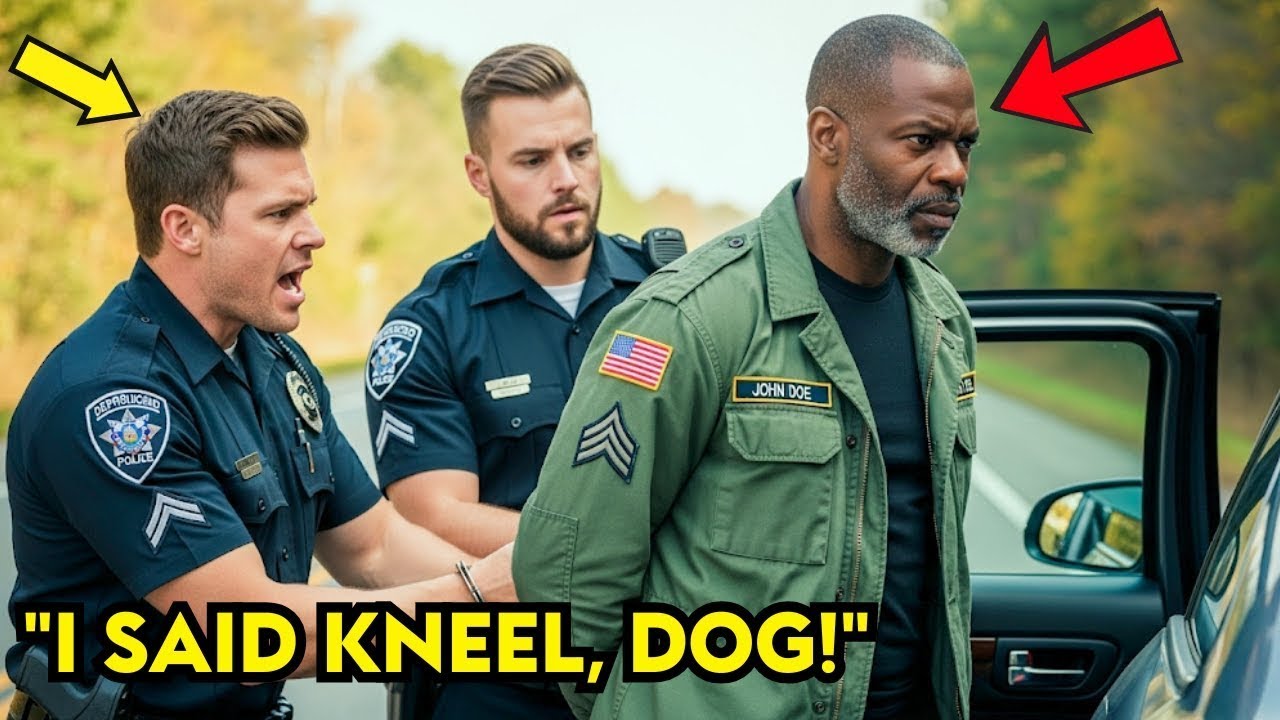
He turns off the engine and places his hands at 10 and two on the steering wheel. The officers approach, hands on their holstered weapons. Reynolds barks, “Where you coming from, buddy?” Marcus calmly replies, “I live here, officer. This is my home.” He offers his ID and proof of residence, but Mitchell scoffs, and Reynolds ignores the offered license.
“What business you got in Oakidge? This ain’t your neighborhood?” Reynolds says despite Marcus’s calm demeanor and his explanation that he is a retired Army veteran who owns the home, Reynolds dismisses his words. “Step out of the vehicle, sir. This is just routine,” he commands, claiming they are investigating a burglary. Marcus, knowing better than to argue, slowly and deliberately, steps out.
The officers immediately move in close, positioning themselves in an intimidating way. Before Marcus can speak, Reynolds spins him around and pushes him roughly against the car. The cold metal of handcuffs bites into his wrists as the officer secures them too tightly. Marcus winces, but remains silent.
His dignity the only defense he has. He asks why he is being detained. You’re matching the description of a burglary suspect, Mitchell replies, beginning to search his pockets without consent. Suspect is described as a black male in dark clothing. That could be anyone, Marcus points out. Reynolds smirks. Not in this neighborhood. The officers proceed to search his car without permission.
They find his prescription heart medication and immediately hold it up as if it’s illegal. What’s this? Drugs. more evidence of your character. Marcus feels rageb building but keeps his voice level. That’s prescription medication for a heart condition I developed during my military service. My name is on the bottle.
They also find a framed photo of him in his dress uniform decorated with metals. Mitchell scoffs and tosses it back inside. Nice prop. Very convincing. Despite Marcus’ repeated explanations and his offer to show them mail addressed to him at this house, the officers place him in the back of their patrol car. The entire arrest takes less than 15 minutes, but the public humiliation feels endless.
At the Atlanta Police Department precinct, Marcus is led through processing. His fingerprints and mugsh shot are taken and his personal items are cataloged. He remains silent, observing every detail of his surroundings with the sharp attention of an intelligence officer. He notes names on badges and the hierarchy of command.
He is placed in a stark interrogation room with a metal table bolted to the floor. For after 30 minutes, Detective Sandra Wilkins, a seasoned detective, enters. She carries a thin file. Mr. Daniels, she begins, do you understand why you’re here today? Marcus responds calmly. I’d like to understand that myself, detective. I’ve been arrested at my own home without cause.
Wilkins frowns, studying the arrest report. It claims Marcus was confrontational with officers, but Marcus calmly refutes this. I presented my ID showing I live at the address where I was detained. I remained calm despite being handcuffed in front of my neighbors. If requesting basic respect is considered confrontational, then we have different definitions.
Wilkins, comparing the vague suspect description to Marcus’s actual appearance, grows skeptical. The burglar was described as thin and 6t tall, while Marcus is 510 with a solid build. She agrees to let him make his phone tall. As she leaves the room, Marcus watches her speak with officers Reynolds and Mitchell, who are embellishing their report.
When Marcus is finally permitted his call, he surprises them by not calling a lawyer or family member. Instead, he dials a number from memory and speaks in coded language, just checking in. Situation Amber at location echo8 timestamp 417. He hangs up and appears more relaxed, almost amused. The clock I’ve been mentioning, it’s about to run out.
In the main hallway, Officer Reynolds and Mitchell huddle with Sergeant Cooper. They’re worried about Marcus’ behavior, calling him a sovereign citizen type who knows too much about police procedure. Cooper tells them to hurry up and process the arrest. Meanwhile, in the FBI field office across town, special agent Tamara Washington receives an urgent alert on her computer.
A fingerprint match has come in labeled Code Obsidian. This is a red alert status reserved for the highest priority federal assets. The fingerprints belong to Marcus Daniels and he has been detained by local police. Washington immediately assembles a tactical team. She briefs her agents on Marcus’ status. He’s a retired Army intelligence officer working as a special consultant for the FBI’s police reform task force.
His assignment is to gather evidence on departments with patterns of racial profiling. His detention was not planned, making this a rescue operation. Back at the precinct, Detective Wilkins doubts grow. She pulls the personnel files for Reynolds and Mitchell and finds multiple civilian complaints alleging racial bias, though all were dismissed.
Marcus, meanwhile, continues his psychological operation, dropping comments about body camera technology and federal oversight that make the officers increasingly uneasy. Reynolds and Mitchell get nervous, realizing this is no ordinary suspect. He’ll review the report, make sure everything lines up, Mitchell says to Reynolds.
Sergeant Cooper approaches Wilkins desk, telling her to stop second-guessing the arrest, but Wilkins has found a notation in Marcus’ file that is redacted by federal authorities. She realizes that the man they arrested is connected to federal law enforcement. She slips back into the interrogation room and tells Marcus, “I think there has been a misunderstanding.
” Marcus smiles. The clock I’ve been mentioning, it’s about to run out. Marcus requests a private meeting with the three officers involved, Reynolds, Mitchell, and Cooper, along with Detective Wilkins. When they arrive, he stands for the first time since his detention. His posture is transformed. His shoulders are squared and his eyes are sharp and commanding.
Gentlemen, lady, he begins. I think it’s time we clarify the situation. You have approximately 3 minutes before this conversation becomes much more complicated. Mitchell laughs nervously, but Marcus continues. You see, when you arrested me, you didn’t just detain an ordinary citizen.
You interfered with an ongoing federal investigation. Cooper steps forward aggressively, but Marcus cuts him off. He recites detailed information about Cooper’s service record, including civilian complaints and excessive force incidents. He then reveals that Reynolds has been the subject of eight racial profiling complaints, and that Mitchell has sent explicitly racist text messages to fellow officers.
The officers are stunned. The power dynamic in the room has completely shifted. Outside, a front desk officer notices four unmarked black SUVs pull up. “Special agent Tamara Washington, FBI, enters, her badge held high. “We’re here for Marcus Daniels,” she says, her voice leaving no room for argument. More tactical agents follow behind her.
“Back in the interrogation room, Marcus checks his watch. And now, gentlemen, our time is up.” Right on quue, the door opens and a uniform captain announces there’s FBI agents in the building demanding the release of the suspect. Cooper turns to Marcus, fury and realization waring on his face.
You son of a Marcus cuts him off with a cold smile. Careful, Sergeant. Everything in this room is being recorded. I’d consider my next words very carefully if I were you. The precinct erupts into controlled chaos as FBI agents swarm the building. Captain Richard Bennett, the station’s commanding officer, pushes his way into the interrogation room.
Who authorized federal agents to enter my precinct? He demands. Washington calmly introduces herself and explains that they are holding a federal asset who was detained while gathering evidence for an ongoing investigation. She hands Bennett a warrant authorizing them to retrieve Marcus and any related evidence.
Outside, more FBI vehicles arrive, including a mobile command center. Local news vans tipped off by the federal presence also begin to appear. An agent carefully removes Marcus’ handcuffs. Washington watches the officers who arrested him, her eyes cataloging every detail. Marcus rolls his shoulders, working out the stiffness from the restraints.
He then asks for a moment to speak to the officers. Washington nods, remaining close by. In a calm, authoritative voice, Marcus explains what happened. Officers Reynolds and Mitchell, approximately 5 hours ago, you detained me outside my residence based solely on a vague description of a black male in dark clothing.
Despite my providing identification showing I lived at that address, you proceeded to handcuff and arrest me, search my vehicle without consent, and bring me to the station where I was denied timely access to communication. Do you deny any of these facts? Mitchell tries to justify their actions, but Marcus points out that the description could have fit thousands of black men in Atlanta.
Your actions today will now become part of a federal case study on biased policing practices. Detective Wilkins, seeing the situation unfold, tells Washington that she had concerns about the arrest. Washington acknowledges her, stating that Wilkins’s actions will be noted in their report. In the captain’s office, Bennett faces Marcus and Washington, his initial bluster gone.
What exactly are you investigating? He asks. Marcus places a tablet on the desk revealing data on racial disparities in police stops and searches. For the past 18 months, the Department of Justice has been gathering data. Your precinct shows some of the most troubling statistics. Black drivers are six times more likely to be stopped than white drivers in your jurisdiction.
Washington explains what will happen next. Reynolds and Mitchell will likely face federal civil rights charges and Sergeant Cooper will be investigated for his role. The department will also face a federal consent decree operating under direct federal oversight for a minimum of 5 years.
Marcus requests another meeting, this time alone with Reynolds and Mitchell. He tells them he’s not there for an apology, but for them to understand the consequences of their actions. Reynolds, now humbled, admits he had no answer when asked if he would have stopped a white man in the same situation. Mitchell remains defiant, accusing Marcus of setting them up.
Marcus turns to Mitchell, his expression hardening. I wasn’t planning to be arrested today. I wasn’t planning to be handcuffed in front of my neighbors. You did that all on your own. He then reveals the evidence they’ve gathered. Mitchell’s racist text messages and the long history of civilian complaints against Reynolds that Sergeant Cooper had dismissed without investigation.
Reynolds stares at the stack of complaints. I never thought of it that way, he admits quietly. I just thought I was being thorough. Mitchell, however, remains defiant, accusing Marcus of being privileged. You have no idea what it’s like on these streets. Marcus’ expression doesn’t change as he refuts this, sharing his own story of growing up in a violent neighborhood.
The difference is, I don’t use that background to justify treating people as less than human based on their skin color. The next morning, at a press conference, Captain Bennett announces that the officers involved have been placed on administrative leave and that the department will be implementing immediate changes to its policies.
He confirms they are fully cooperating with the FBI to address both this incident and any underlying issues. He states that the department is committed to serving all citizens equally regardless of race. Inside headquarters, Officer Reynolds, watching the footage from the arrest, realizes he was part of the problem.
Detective Wilkins finds him and tells him that she had tried to warn them. Reynolds admits he should have listened. He will face disciplinary action, but unlike his partner, has a chance at redemption. Officer Mitchell meets with his union rep and is told the evidence against him is indefensible. His career in law enforcement is effectively over.
6 months later, Marcus stands before 30 police officers in the training room, giving a presentation on implicit bias. He explains that it’s not about being a bad person, but about acknowledging that everyone has biases that affect their judgments. Among the officers is Brian Reynolds, who has been assigned to a community outreach role.
The department has undergone a transformation with new body camera protocols, a civilian review board, and data tracking for every stop and arrest. Marcus later meets with Captain Bennett and Lieutenant Wilkins, who now heads the department’s new accountability and community trust division, and they review the progress.
Bennett notes a 40% reduction in discretionary stops of black drivers and a 60% increase in community engagement. Marcus stresses that reform has to become part of the department’s DNA. As Marcus drives through his neighborhood, he notices a change in the way his neighbors interact with him. They no longer watch him with suspicion.
Dr. Parker, who had watched his arrest without intervening, apologizes and asks him to lead the neighborhood’s new community relations committee. The story ends with Marcus accepting a role with the Justice Department to lead a police reform initiative in five other cities. He realizes that while his wrongful arrest was a painful experience, it served as a catalyst for meaningful change, proving that resistance is just transformation in its early stages.
The journey from a 17-year-old boy being treated like a criminal to a man leading a federal reform effort was long, but it ended with a small victory in a lifelong battle for equal justice.

