Cop Arrests Black Woman Watering Her Garden — She’s Retired Judge, Officer Gets 32 Years & $8.5M
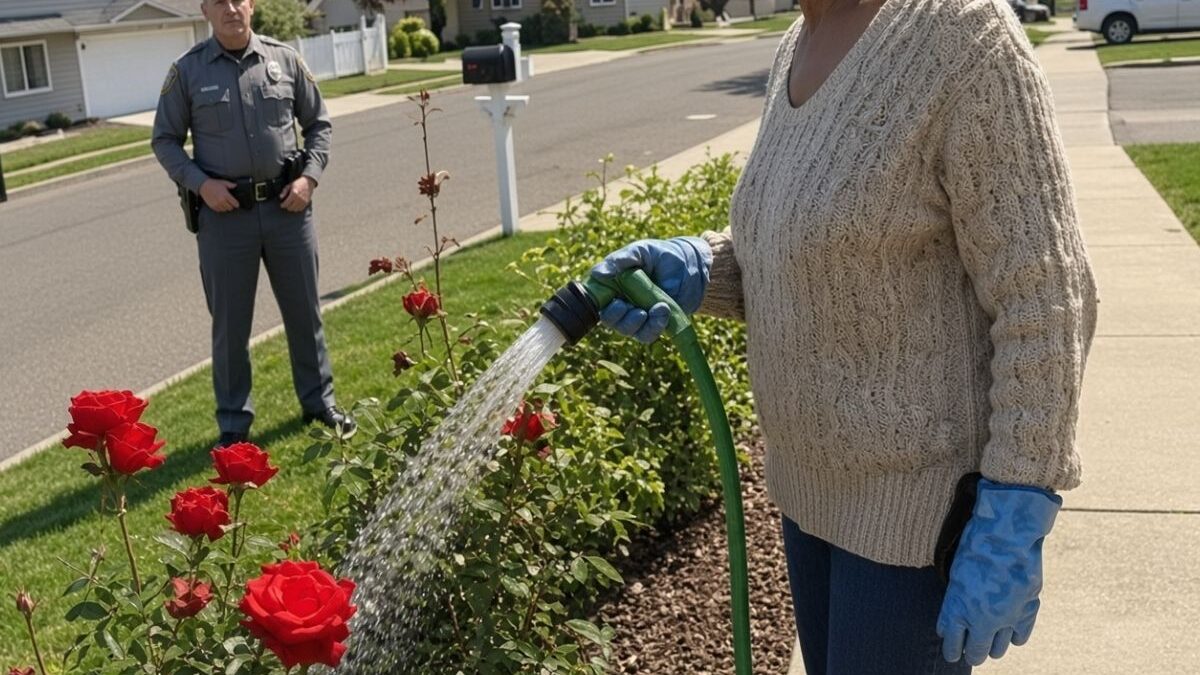
The sunlight slanted across the front lawn in soft, warm angles, warming the rich dark soil of the flowerbeds along the white picket fence. At sixty-seven years of age, Margaret Elizabeth Williams moved with the deliberate, patient cadence of someone who had earned every quiet moment of her retirement. She held a green watering can gently in both gloved hands, watching the fine spray nourish the prize-winning hybrid tea roses her late husband had planted more than two decades earlier.
The neighborhood of Arbor Hills in Northwest Portland was blanketed in the tranquil, peaceful hum of an ordinary Tuesday afternoon in mid-May. A lawnmower purred faintly three doors down, accompanied by the bright, distant laughter of children riding their bicycles along the sidewalk. Across the street, Mrs. Patricia Chen was busy trimming her hedges, humming a quiet tune while clipping away stray leafy branches in the mild air.
For twenty-five years, Margaret had called this stately corner property on Laurel Avenue her home, her sanctuary, and her grounding peace. Before stepping away from public service two years prior, she had devoted three grueling decades to the bench as an esteemed circuit court judge. She had spent thousands of mornings in heavy black robes, meticulously weighing facts, interpreting statutes, and insisting upon the constitutional boundaries of power.
She knew the delicate architecture of civil rights not merely as abstract theory, but as an essential safeguard forged through centuries of struggle. She had graduated from Yale Law School in 1982, defended indigent clients as a young public defender, and later prosecuted complex criminal conspiracies. Generations of trial attorneys, court clerks, and law enforcement officers throughout Multnomah County knew her simply as Judge No-Nonsense.
A gentle breeze rustled the leaves of the old oak trees that shaded the curb, carrying the fragrant sweetness of freshly clipped petals. Margaret bent down to pull a stubborn dandelion sprouting beside the cobblestone walkway, adjusting the wide brim of her woven straw sun hat. Everything about the quiet avenue felt safe, familiar, and predictable, exactly as it had remained for the past quarter of a century.
Around the bend of Laurel Avenue, a marked police cruiser cruised slowly along the curb, its tires crunching softly against stray gravel. Behind the steering wheel sat Officer Tyler Chen, an eight-year veteran of the department who possessed a severe, scrutinizing expression. He drove slowly past the manicured lawns and spacious driveways of the affluent enclave, scanning the sidewalks with aggressive, unyielding suspicion.
To casual observers and city dignitaries, Chen maintained the resume of a disciplined patrolman, having served honorably in the Marine Corps. Yet hidden beneath his pressed uniform and polished silver shield lay a toxic record of unwarranted stops and simmering civilian resentment. Within the past eighteen months alone, internal affairs had received eight complaints detailing his habit of interrogating Black citizens in affluent neighborhoods.
There was the downtown architect accused of casing his own firm, the night-shift nurse questioned in hospital scrubs, and the elderly homeowner walking his dog. Each incident had been quietly smoothed over by bureaucratic indifference, labeled as officer error or dismissed for insufficient evidence. His fellow patrol officers jokingly referred to him behind closed doors as Chen the Problem, well aware of his volatile pride.
When Chen’s cruiser crested the slight rise near the corner lot, his eyes locked onto Margaret standing among the vibrant rose bushes. He slowed his vehicle to a crawl, coming to an idle fifty feet away while his dashboard camera silently logged the coordinates and time. For four long minutes, he sat in silence behind tinted glass, watching an elderly woman in casual clothing water her blooming flowers.
There had been no radio dispatch, no emergency call to nine-one-one, and no report of suspicious activity anywhere in the sector. Yet Chen shifted his transmission into drive, pressed the accelerator, and turned abruptly into the private driveway of the corner residence. The cruiser bumped over the curb cut and rolled forward until its front bumper blocked Margaret’s sedan inside her own private garage approach.
Margaret blinked in mild surprise, releasing the handle of her watering can and letting it rest gently against the manicured turf. She stood upright, slipping off her soil-dusted gardening gloves and smoothing the fabric of her worn cotton shirt with calm dignity. She assumed the patrolman was lost, perhaps searching for an elusive address in the winding avenues, or seeking information about a neighbor.
Officer Chen pushed open the cruiser door, stepping out onto the asphalt with heavy, deliberate boots that conveyed immediate hostility. His tactical belt creaked under the weight of his sidearm, taser, and handcuffs as both of his hands rested rigidly near his waistline. There was no polite nod, no professional greeting, and no courtesy extended to the elderly woman standing quietly in her yard.
“What are you doing here?”
The question was barked with sharp arrogance, cutting through the pleasant afternoon air like the crack of dry timber snapping underfoot. Margaret stood her ground, observing the officer’s rigid jaw and narrowing eyes with the practiced evaluation of a veteran jurist. For an instant, the impulse crossed her mind to state her name and title, invoking the prestige that commanded respect in any courtroom.
Yet three decades on the bench had shown her the harsh reality endured by everyday citizens who possessed no judicial titles to shield them. She wanted to see precisely how this armed representative of the state would behave when he believed he was confronting someone powerless. She looked directly into his eyes, keeping her expression calm and her posture relaxed, refusing to yield to his manufactured tension.
“I am watering my garden. I live here, Officer. This is my home.”
Chen’s brow furrowed in disdain as he closed the distance between them, stepping onto the trimmed grass without permission or greeting. He looked past her toward the front porch, where an American flag hung beside the bay windows, before staring back with hostility. His posture remained combative, radiating the presumption that anyone of her demographic could only be an intruder on such manicured grounds.
“Can you prove that? Show me your identification and proof of residence right now.”
Margaret shook her head gently, her voice remaining level and polite despite the officer’s overbearing demeanor on her private property. She gestured toward the front steps, where the heavy wooden door stood securely shut against the mild afternoon breeze. She had spent her life upholding the law, and she had no desire to escalate a routine misunderstanding into an unnecessary confrontation.
“I don’t have my wallet on me. I’m just doing yard work. However, I will gladly step inside the house to retrieve it.”
As Margaret turned to walk toward her porch, Chen lunged forward two paces, planting himself directly across the stone walkway to cut her off. His hand hovered over his holster, his face darkening with a sudden rush of authority that bordered on physical intimidation. The peaceful tranquility of the garden evaporated, replaced by the suffocating weight of an armed officer asserting absolute dominance.
“Don’t move! Stay right where you are. You’re being awfully defensive for someone who claims to belong here.”
Margaret halted immediately, keeping her hands visible and empty at her sides, studying the young patrolman with profound disappointment. She recognized the textbook signs of an officer manufacturing suspicion where none existed, attempting to bait an ordinary citizen into agitation. She took a slow, measured breath, speaking with the clear enunciation of someone who had presided over thousands of evidentiary hearings.
“Officer, I am not being defensive. I am merely confused as to why you are aggressively questioning me on my own property.”
Chen did not listen, unhooking his shoulder microphone with a sharp, theatrical yank and pressing the broadcast button with his thumb. His eyes darted across the street, noticing neighbors glancing out their windows, which only seemed to fuel his stubborn determination. He spoke into the radio with deliberate volume, framing the encounter for the central dispatch log with completely fabricated suspicion.
“Unit two-fourteen, I’ve got a suspicious person at twenty-eight forty-seven Laurel Avenue refusing to provide identification. Requesting backup.”
Margaret watched the display in utter disbelief, looking down at the green plastic watering can sitting peacefully beside her blooming roses. Across the street, Mrs. Patricia Chen paused her hedge trimming, lowering her shears to peer across the pavement with growing alarm. The sheer absurdity of the accusation would have been laughable had the man with the badge not appeared so completely volatile.
“Suspicious? Officer, I am standing in broad daylight watering flowers in front of the house I have owned for twenty-five years.”
Chen lowered his microphone, stepping another foot closer until his shadow fell across the flowerbeds, his voice cold and menacing. He pointed a gloved finger directly at Margaret’s chest, leaning down to ensure his commanding presence felt overwhelming. He had established his narrative on the official radio channel, and he had no intention of retreating or admitting an error.
“Ma’am, if you continue to obstruct this active police investigation, you will be placed under immediate arrest.”
Margaret did not flinch, her gaze sharpening into the piercing, immovable stare that had silenced belligerent trial lawyers for decades. She recognized the hollow terminology of a manufactured stop designed to justify an unlawful detention through intimidation and fear. Her tone dropped lower, taking on the calm, absolute authority of a judge delivering an undeniable ruling from the bench.
“What investigation, Officer? What crime are you investigating at this residence on this afternoon?”
Chen’s jaw clenched tight, his nostrils flaring as he realized this elderly woman was neither trembling nor shrinking before his badge. He took refuge in the reflexive arrogance of someone who believed the uniform granted him immunity from accountability or explanation. He stepped into her personal space, his chest expanding as he sought to terminate any further questions with raw coercion.
“I don’t have to explain myself to you. Now, are you going to cooperate with my lawful orders or not?”
Margaret raised her chin, her words measured and exact, citing the legal standard that every sworn academy recruit was taught. She had lectured dozens of academy classes on the strict limitations of Terry stops and the sacred sanctity of private curtilage. Every syllable she uttered was chosen with surgical precision, creating an indelible record of unlawful police conduct under the law.
“Officer, you have no reasonable suspicion to detain me. I have no legal obligation to show identification on my private property. This violates the Constitution.”
Chen let out a short, dismissive laugh, shaking his head with bitter amusement as he stepped even closer to the garden fence. He had heard citizens quote rights before, and in his mind, anyone asserting legal boundaries was simply guilty of insubordination. He sneered down at the retired jurist, completely blind to the legal trap he was enthusiastically digging beneath his own boots.
“Oh, so now you’re a lawyer? You people always think you know the law better than the officers on the street.”
The phrase hung in the crisp afternoon air, heavy with prejudice, revealing the true motivation behind the unprovoked stop. Margaret noted the words instantly, filing them away with the cold precision of an experienced jurist recording judicial misconduct. Chen seemed to realize the slip of his tongue, but his fragile pride prevented him from correcting or softening the statement.
“Yeah, that’s right. You people who think you’re above the law, thinking you can just refuse commands.”
Across the street, Patricia Chen dropped her gardening shears into the grass and hurried across the asphalt, waving her hands anxiously. The seventy-one-year-old retired schoolteacher had lived in the neighborhood for three decades and knew every family on the block. Her voice was high and frantic as she approached the driveway, desperate to prevent a catastrophic mistake by the aggressive officer.
“Officer! Stop! That is Judge Williams! She has lived in that house for over twenty-five years!”
Chen spun around with a fierce snarl, resting his hand against his service weapon and shouting across the lawn with fury. He viewed any civilian intervention as a direct challenge to his absolute command, refusing to process the words being shouted. His face turned crimson under the collar of his uniform as he ordered the elderly neighbor to retreat from the scene.
“Ma’am, step back immediately! This is an active police investigation, and this matter does not concern you!”
Margaret stepped forward, her voice ringing out across the manicured lawn with the resounding clarity of a courtroom gavel striking oak. She knew the boundaries of police authority better than any patrolman, and she refused to let him intimidate her elderly neighbor. She spoke with unwavering resolve, addressing the officer directly while making her legal standing unmistakably clear to everyone present.
“Officer, you are unlawfully detaining me. I am the legal homeowner, and multiple neighbors can verify my identity right now.”
Chen turned back toward Margaret, his eyes flashing with vindictive anger, his professional composure completely swallowed by wounded pride. He refused to back down in front of witnesses, choosing instead to escalate his illegal stop into an outright constitutional catastrophe. He reached behind his utility belt, unsnapping the leather casing that held his steel peerless handcuffs with a deliberate click.
“You are under arrest for obstruction of justice and criminal trespassing!”
Patricia Chen gasped in horror, quickly retrieving her smartphone from her apron pocket and pointing the lens directly at the officer. Her hands shook, but she kept the camera steady, capturing every frame of the unlawful encounter unfolding across the bright green lawn. Down the street, the mail carrier, David Martinez, stopped his postal truck by the curb, stepping out with a bundle of letters.
“Hey! What in the world are you doing? That’s Judge Williams!”
From the opposite sidewalk, Robert and Susan Hayes paused their afternoon walk, their golden retriever sitting quietly beside their legs. The retired couple watched in stunned disbelief as the patrolman grabbed Margaret’s slender wrists with aggressive, unnecessary force. The entire neighborhood seemed to freeze, paralyzed by the shocking sight of an armed officer brutalizing an elderly pillar of their community.
“Officer, what is wrong with you? She lives there! She has lived there longer than anyone!”
Chen ignored every voice, twisting Margaret’s arms behind her back with enough force to cause her joints to groan under the strain. Margaret did not struggle, keeping her body rigid and balanced, refusing to give the officer any pretext to claim physical resistance. Her breath hitched slightly from the sudden pain shooting up her shoulders, but her voice remained firm, calm, and resolute.
“I am not resisting you. I am sixty-seven years old, and you are actively violating my Fourth Amendment rights under color of law.”
Chen forced the steel cuffs over her delicate wrists, ratcheting the metal teeth down until the mechanisms dug deep into her skin. The metal pinched into her flesh, cutting off circulation and bruising the delicate tissue surrounding her wrist bones within seconds. Margaret winced from the sharp bite of the steel, turning her head slightly to address the officer who stood breathing heavily behind her.
“These handcuffs are far too tight. You are causing physical injury, Officer.”
Chen offered no response, gripping the chain between the cuffs with one hand and Margaret’s upper arm with the other. He shoved her forward across the grass, marching her toward the back door of his idling cruiser parked haphazardly in her driveway. He popped the rear door open, forcing the retired jurist down into the hard plastic seat with callous, dismissive roughness.
“Sit down and keep your mouth shut.”
The heavy vehicle door slammed shut with a dull, hollow thud, locking Margaret behind the reinforced steel mesh and tinted safety glass. Inside the cruiser, the hum of the engine vibrated through the floorboards, while the officer’s dashboard camera silently recorded every movement. What Officer Chen failed to realize was that Margaret had spent decades training Portland police supervisors on the precise illegality of this stop.
At three twenty-four in the afternoon, the high-pitched wail of sirens signaled the arrival of two backup patrol cruisers on Laurel Avenue. Officers Ramirez and Jackson pulled their vehicles along the curb, tires skidding slightly against the asphalt as they exited in haste. Chen stood beside his squad car with his chest puffed out, resting his thumbs in his duty belt like a triumphant conqueror.
“What do you have, Tyler? Dispatch said you had an uncooperative trespasser refusing commands.”
Chen smirked, gesturing with a dismissive jerk of his thumb toward the back window of his cruiser, where Margaret sat upright. He spoke with casual confidence, completely unaware that his every word was being captured on his fellow officers’ body-worn audio equipment. He believed he had executed a textbook arrest, confident that the department would back his authority against any civilian complaint.
“Subject claims she lives here, but refused to provide ID, became belligerent, and obstructed. Booked her for trespassing and obstruction.”
From the rear seat of the cruiser, Margaret leaned toward the open partition window, her voice cutting through the officers’ conversation clearly. She did not scream, nor did she plead for leniency, speaking instead with the precise, measured vocabulary of an experienced legal scholar. Her calm demeanor stood in stark contrast to the frantic energy radiating from the young patrolman standing outside the driver’s side door.
“Officers, my name is Margaret Elizabeth Williams. I am a retired circuit court judge, and this is my lawful private residence.”
Officer Ramirez froze mid-stride, his eyes widening in sudden, paralyzing shock as the name registered in his memory with terrifying clarity. Every officer in Multnomah County knew the name Margaret Williams, the formidable jurist who had served thirty distinguished years on the bench. Ramirez looked from Margaret’s serene face to Chen’s arrogant smirk, feeling a cold dread settle into the pit of his stomach.
“Wait a minute… Tyler, did you say Judge Williams?”
Chen waved his hand dismissively, scoffing at his partner’s sudden hesitation and rolling his eyes with exasperated impatience. He was entirely convinced that the elderly woman was merely playing games, grasping at straws to avoid a trip to the county jail. He had no intention of admitting that he had spent twenty minutes interrogating an innocent homeowner over a plastic watering can.
“She’s claiming to be some judge to get out of an arrest. I haven’t verified anything because she refused to show paper ID.”
Margaret looked directly at Ramirez through the partition, her voice steady, authoritative, and entirely impossible to dismiss or ignore. She recited the details of her life with flawless accuracy, giving the officers the exact public records needed to dismantle Chen’s falsehoods. She had spent her life evaluating witness credibility, and she knew the administrative machinery of the city down to the smallest detail.
“Officer Ramirez, check your mobile terminal. Twenty-eight forty-seven Laurel Avenue. Margaret Elizabeth Williams. I have owned this home since 1999.”
Ramirez scrambled back to his cruiser, leaning through the open window to type the street address into his mobile computer terminal. Within seconds, the county tax assessor records, deed history, and driver’s license registration flashed brightly across the terminal screen. The primary homeowner photo appeared: Margaret Elizabeth Williams, former Presiding Judge of the Multnomah County Circuit Court.
“Oh, God… Tyler, look at this screen right now.”
Ramirez’s voice trembled, all the color draining from his face as he stared at the undeniable official records glowing before him. Meanwhile, the small crowd gathered on the sidewalk had grown bolder, their collective voices rising in righteous indignation against the arrest. Mrs. Patricia Chen stepped forward, holding her phone aloft to ensure every angle of the police interaction remained documented.
“I have lived across this street for thirty years! That is Judge Williams! She hosts our neighborhood watch meetings in that very living room!”
David Martinez, the postal worker, held up a thick stack of envelopes, pointing toward the polished brass mailbox mounted beside the porch. He had walked this route for over a decade and knew every resident, every pet, and every delivery address along Laurel Avenue. His voice cracked with anger as he confronted the officers standing beside their idling cruisers on the quiet residential street.
“I deliver her mail five days a week! Her name is on the magazines, the utility bills, and the legal journals! What is wrong with you?”
Robert Hayes stepped closer, his arm wrapped protectively around his wife Susan, his voice trembling with deep, personal fury. He had experienced Chen’s unwarranted hostility six months earlier when walking his dog, and the memory remained fresh and painful. He recognized the patrolman’s signature arrogance, realizing that Chen had finally targeted someone who possessed the power to shatter his career.
“She has been our beloved neighbor for twenty-five years! She is a distinguished judge, and you are treating her like a criminal in her own yard!”
A young college student jogging past slowed to a stop, pulling her phone from an armband and recording the entire scene without hesitation. She panned the lens from the cruiser to the elderly woman sitting calmly in the rear seat, narrating the unbelievable spectacle out loud. Within minutes, multiple video angles of the incident were already being compiled, ensuring that no police report could ever erase the truth.
“Look at this! An elderly Black woman being locked in a police car while watering her flowers! This is going all over the internet!”
By three thirty-one in the afternoon, Mrs. Chen had dialed the direct cell phone number of Margaret’s daughter, Lauren Williams. Lauren was a senior partner at a premier civil rights litigation firm downtown, known throughout the state for her brilliant legal mind. When Mrs. Chen explained that an officer had handcuffed her mother in her own front yard, Lauren felt a cold, focused fury take over.
“Mrs. Chen, keep your camera rolling and do not stop recording under any circumstances. I am making calls right now.”
At three thirty-four, Lauren dialed the direct line of Portland Police Chief Daniel Morrison, a veteran administrator who had known Margaret for decades. Morrison had served alongside Judge Williams on multiple statewide criminal justice reform task forces and held her in the highest regard. When Lauren described the scene unfolding on Laurel Avenue, Morrison stood up from his mahogany desk, his face turning pale with disbelief.
“Lauren, tell me you are joking. Please tell me this is a mistake.”
Two minutes later, at three thirty-six, Lauren placed a second urgent call to Multnomah County District Attorney Rebecca Torres. Torres had begun her career as a young prosecutor trying felony cases in Judge Williams’ courtroom, considering Margaret her primary mentor. Hearing that an officer had fabricated charges of trespassing against the retired judge on her own property filled Torres with outrage.
“Lauren, I will personally assign a senior prosecutor to handle this. If an officer has broken the law, he will face criminal charges.”
Back on Laurel Avenue, at three forty-two, a supervisory sergeant’s patrol unit pulled onto the curb with its emergency lights flashing. Sergeant Michael Foster stepped out of the vehicle, his expression tense as he surveyed the gathering crowd and the three police cruisers. Foster had attended advanced constitutional law training five years earlier, where Judge Williams had personally instructed him on lawful stops.
“Chen, report. What is going on out here?”
Chen puffed out his chest, stepping forward to offer his skewed summary, attempting to downplay the growing crowd of angry neighbors. He spoke with rapid, nervous energy, trying to maintain the illusion that he had exercised proper professional judgment during the encounter. He failed to notice the look of sheer terror on Officer Ramirez’s face as the sergeant approached the rear door of the patrol car.
“Sarge, I had an uncooperative female on private property refusing to show identification. She became aggressive, so I took her into custody.”
Foster walked past Chen, stepping up to the tinted rear window and peering through the glass to look at the detained suspect inside. The moment his eyes met Margaret’s calm, familiar gaze, the blood rushed from his face, and his breath caught in his throat. He stumbled backward a half-step, turning toward Chen with eyes wide with utter horror and disbelief at what had transpired.
“Chen… what in God’s name have you done?”
Chen blinked, taken aback by his supervisor’s visceral reaction, still clinging stubbornly to the fantasy that he held the upper hand. He pointed toward the cruiser, his voice rising in defensive pitch as he attempted to justify the unjustifiable arrest. He had no idea that the ground beneath his feet was already crumbling into an irreversible professional and personal abyss.
“Sarge, she refused to cooperate! She wouldn’t provide proof of residence, and she kept claiming she was some retired circuit court judge!”
Foster grabbed Chen by the tactical vest, his voice dropping to a harsh, furious whisper that cut straight through the patrolman’s arrogance. His hands trembled with rage as he realized the catastrophic civil liability and disgrace that had just been unleashed upon the entire department. Every officer on scene fell dead silent, realizing the magnitude of the disaster that Officer Tyler Chen had brought upon them all.
“That IS Judge Margaret Williams! The Margaret Williams who sat on the Circuit Court for thirty years! You just arrested an Oregon legend!”
Chen’s face drained of every drop of color, his knees suddenly feeling weak as the true identity of his prisoner finally struck home. The arrogant posture evaporated instantly, replaced by a hollow, nauseating terror that made his chest heave beneath his heavy tactical armor. The woman he had shoved into the plastic seat was not a powerless civilian he could intimidate; she was an icon of the judicial system.
Foster did not waste another second, turning abruptly away from Chen and rushing to open the rear passenger door of the squad car. He leaned inside, carefully supporting Margaret by the arm as he guided her out onto the asphalt with profound, desperate reverence. His voice shook with sincere remorse as he reached into his pocket to retrieve his personal handcuff key to unlock the steel restraints.
“Judge Williams, I am so profoundly sorry. You are being released immediately. Please allow me to take these off you right now.”
The cuffs clicked open, and Margaret slowly brought her hands forward, revealing deep, angry purple indentations circling her delicate skin. The metal had abraded the outer layer of tissue, leaving raw red marks and swelling that documented the excessive force used against her. She rubbed her wrists gently, her expression remaining composed, dignified, and terrifyingly analytical as she looked at the assembled officers.
“Sergeant Foster, make sure every frame of body camera and dashboard video is preserved immediately. Do not allow anything to be altered.”
Chen stepped forward, his voice cracking with desperate, stammering panic as he attempted to undo twenty minutes of constitutional violations. He held out his hands in a pleading gesture, looking pathetic and small beside the towering dignity of the woman he had brutalized. The authoritarian bravado that had fueled his actions was completely gone, replaced by the whining excuses of a cornered bully.
“Judge… Judge Williams, please. I didn’t know who you were! If you had just told me your title from the very beginning—”
Margaret turned her gaze upon him, and the sheer moral authority in her eyes froze the words in the back of his throat instantly. She did not raise her voice, but every word she spoke carried the devastating weight of thirty years of unimpeachable judicial wisdom. The neighbors watching from the sidewalk remained silent, listening to the retired judge dismantle the disgraced officer’s entire worldview.
“I told you repeatedly that I was the homeowner. I offered to get my identification from inside, but you deliberately blocked my path.”
She took a slow step toward him, her eyes locking onto his trembling face with an unyielding clarity that made Chen look down at the dirt. She laid out the facts of the encounter with surgical precision, leaving no room for excuses, rationalizations, or bureaucratic whitewashing. She spoke not merely for herself, but for every nameless citizen who had ever stood helpless before his unprovoked aggression.
“You detained me unlawfully. You ignored eight separate witnesses who verified my identity. And you looked at me and said, ‘you people.’”
Chen swallowed hard, his face burning with shame as Sergeant Foster glared at him with undisguised contempt and disgust. The gathered neighbors nodded in solemn agreement, their smartphone cameras recording every single syllable of Margaret’s masterclass in legal accountability. She paused, letting the silence settle over the driveway before delivering the final, crushing truth that would define the rest of Chen’s life.
“I should not have to be a judge for you to respect my constitutional rights, Officer Chen. Every human being deserves basic dignity.”
She pointed toward the marked cruiser, where the small green light of the dashboard camera continued to flicker silently on the windshield. Her voice was steady, calm, and filled with the absolute certainty of someone who knew the exact statutory consequences awaiting him. She had spent her career upholding the boundaries of state power, and she intended to see those boundaries enforced to their fullest extent.
“But since I am a judge, I know exactly what laws you violated today. And I know exactly what this department is liable for.”
Sergeant Foster ordered Chen to surrender his cruiser keys on the spot, assigning another officer to drive the patrol vehicle away. Foster personally escorted Margaret the short walk up her driveway and onto her front porch, apologizing repeatedly with deep humiliation. By three fifty in the afternoon, Margaret sat safely inside her home, surrounded by neighbors who rushed over with ice packs and support.
Downtown at police headquarters, the fallout began with the speed and intensity of an uncontainable five-alarm institutional fire. By four fifteen, Chief Daniel Morrison sat behind his desk in the executive suite, watching the raw dashboard footage with his head in his hands. Every second of Chen’s unprovoked aggression, dismissive arrogance, and blatant disregard for the law played out before him in horrific detail.
Across the street at the justice center, District Attorney Rebecca Torres convened an emergency meeting with her senior special investigations team. By five o’clock, a special prosecutor had been officially assigned to review Chen’s actions for criminal civil rights violations under state law. The legal machinery that Chen had so carelessly invoked against an innocent citizen was now turning its immense weight directly upon him.
Meanwhile, Mrs. Patricia Chen’s smartphone video had been uploaded to the Arbor Hills neighborhood social media group at six in the evening. Within an hour, the footage had escaped the quiet community board, spreading across the wider city like wildfire through dry pine needles. By seven fifteen, the video had garnered twelve thousand views; by nine thirty, civil rights organizations across the country had shared it widely.
At six forty-seven that same evening, Lieutenant Sarah Williams of the Internal Affairs Division arrived at Margaret’s front door. Accompanied by a written letter of personal apology from the Chief, the investigator began taking Margaret’s comprehensive official statement. By nine thirty that night, Patrol Division Commander James Rodriguez officially stripped Tyler Chen of his service weapon and suspended him without pay.
The following morning, Wednesday, May fifteenth, the viral video detonated across the national media landscape with unprecedented force. By seven in the morning, combined views on social platforms surpassed three hundred thousand, accompanied by millions of outraged comments. Local television stations led their morning broadcasts with the stunning headline: Retired Circuit Court Judge Arrested While Watering Her Own Garden.
By midday, major national news networks including CNN, MSNBC, and the Associated Press had picked up the astonishing story. Legal scholars from Harvard, Yale, and Stanford appeared on television panels, unanimously describing the encounter as a textbook Fourth Amendment violation. The hashtag demanding justice for Judge Williams trended number one across social media, accumulating over two million posts in forty-eight hours.
In the face of the public relations disaster, Chen hired a private defense attorney who issued a tone-deaf press release attempting damage control. The statement claimed the officer had merely made an honest error in judgment while exercising caution, denying any racial animus. The public rejected the excuse outright, flooding the defense attorney’s firm with thousands of scathing reviews and universal condemnation.
Three days later, Chen compounded his disastrous situation by agreeing to an ill-advised interview with a local television news outlet. Sitting before the cameras, he stammered through self-serving excuses, claiming he was being unfairly scapegoated for simply doing his job. His complete lack of remorse and inability to grasp the illegality of his actions only served to solidify public outrage against him.
Inside Internal Affairs, investigators conducted an exhaustive, frame-by-frame forensic analysis of all dashboard and body-worn camera recordings. They interviewed eight civilian witnesses on the official record, all of whom confirmed that Chen had ignored their repeated warnings. Margaret provided a four-hour, forty-seven-page formal deposition that laid out Chen’s statutory and constitutional violations in devastating detail.
When investigators questioned Chen under oath, his official statements contradicted the indisputable video evidence twelve separate times. He claimed Margaret had been peering suspiciously into neighbors’ windows, but the cruiser dashcam proved she had tended her garden for twenty uninterrupted minutes. He claimed she made sudden, threatening movements, but the clear audio proved she had remained calm, still, and completely non-threatening throughout.
Internal Affairs immediately reopened Chen’s entire personnel file, scrutinizing the eight previous complaints that supervisors had swept aside. Upon closer inspection, investigators discovered that six additional civilian complaints had been improperly filed away without formal logging. In total, fourteen separate incidents spanning three years revealed an undeniable, systemic pattern of Chen harassing minority residents without probable cause.
On May twenty-second, exactly one week after the incident, the internal affairs investigation concluded with a scathing, unequivocal report. Chen was found guilty of unlawful detention, false arrest, excessive force, failure to de-escalate, and filing false official statements. Chief Morrison announced Chen’s immediate termination from the Portland Police Bureau, referring the case to the FBI and District Attorney.
During his final exit interview, Chen alternated wildly between blind denial, bitter fury, and pathetic, tearful self-pity. He complained that his career was being destroyed, crying that he had a wife and two young children who depended on his salary. His final words to the investigators demonstrated the same callous ignorance that had led to his downfall from the very beginning.
“I never meant for this to happen. If I had only known she was a judge, none of this would have occurred.”
The statement underscored the very rot that Margaret Williams had dedicated her entire judicial career to exposing and eradicating. To Chen, constitutional protections were not universal human rights owed to all people, but special privileges reserved for the powerful. His firing was met with quiet relief among honorable patrol officers who had long despised his abusive, unaccountable behavior on the street.
On June third, 2024, Margaret took the next decisive step in her campaign for accountability, filing a massive federal civil rights lawsuit. Her daughter Lauren led a formidable team of experienced civil rights litigators in the United States District Court in Portland. The civil complaint named Tyler Chen individually, the Portland Police Bureau, and the City of Portland as institutional defendants.
The lawsuit alleged false imprisonment, excessive force, intentional infliction of emotional distress, and Monell liability for failing to discipline Chen. During the discovery phase, Lauren’s legal team obtained forty-seven body camera files, twenty-three dashcam recordings, and thirty-one depositions. The evidence painted an undeniable picture of an agency that had enabled a rogue officer until he targeted a former judge.
In March of 2025, the civil trial commenced inside a packed federal courtroom, drawing national press and live television coverage. Margaret took the witness stand for two full days, describing the lingering emotional trauma, sleeplessness, and humiliation she had endured. She spoke of the deep pain in her wrists that had required weeks of medical treatment, but focused primarily on the systemic failure.
“When an officer of the law can terrorize a citizen in her own front yard with impunity, the entire social contract collapses.”
Chen’s defense attorneys attempted to argue that their client had simply made an honest mistake while operating in high-crime conditions. However, Lauren Williams methodically dismantled their arguments on cross-examination, playing Chen’s dismissive words, ‘you people,’ repeatedly for the jury. The jurors watched Chen shove a sixty-seven-year-old grandmother against his cruiser while ignoring eight citizens who pleaded with him to stop.
The federal jury deliberated for less than three hours before returning a unanimous verdict in Margaret Williams’ favor on every single count. The courtroom fell dead silent as the clerk read the staggering damages awarded to the retired jurist for the egregious violations. The jury ordered the City of Portland and Tyler Chen to pay eight point five million dollars in total compensatory and punitive damages.
Two point five million dollars was awarded for emotional distress, three million for constitutional violations, and three million in punitive damages. The massive financial award sent shockwaves through municipalities across the country, serving as an unmistakable warning against ignoring officer misconduct. Yet for Margaret and her legal team, the civil judgment was merely the opening chapter in a much larger pursuit of justice.
In August of 2025, Tyler Chen entered the state criminal courthouse not as an armed officer of the law, but as a criminal defendant. The Multnomah County District Attorney had charged him with felony false imprisonment, official misconduct, and criminal deprivation of civil rights. The federal Department of Justice simultaneously prosecuted him under Title 18, Section 242, for willfully depriving a citizen of constitutional rights.
The criminal trial was swift and devastating, featuring the exact same indisputable video footage that had captivated millions of online viewers. Chen took the stand in his own defense, but crumbled under rigorous cross-examination, unable to explain why he had fabricated his reports. The criminal jury deliberated for only four hours before finding Chen guilty on every single felony and misdemeanor count charged.
Sentencing took place on a cold morning in October of 2025 before Federal District Court Judge Eleanor Vance. Judge Vance looked down from the bench with cold, unyielding severity, addressing the disgraced former patrolman standing before her in prison attire. Her words cut through the packed courtroom like an icy wind, articulating the profound betrayal Chen had inflicted upon the community.
“You wore a badge that symbolized the public trust, and you chose to wield it as an instrument of petty tyranny and racial prejudice.”
She noted Chen’s utter failure to express genuine remorse, highlighting his persistent belief that his only mistake was misidentifying his victim. She sentenced Tyler Chen to a staggering thirty-two years in federal prison, ordering the sentences to run consecutively rather than concurrently. Fifteen years for deprivation of rights under color of law, twelve years for false imprisonment, and five years for official misconduct.
Chen’s face went gray as the marshals stepped forward to clasp heavy steel chains around his waist, ankles, and wrists. His life had completely disintegrated: he was banned forever from law enforcement, stripped of his pension, and abandoned by his spouse. In addition to his lengthy prison sentence, the court ordered him to pay fifty thousand dollars in direct restitution to Margaret Williams.
Following the sentencing, Margaret walked down the grand stone steps of the federal courthouse, accompanied by her daughter and supporters. Dozens of camera crews and print journalists crowded around the microphones, eager to hear the legendary jurist’s final thoughts on the ordeal. Margaret stood tall before the press, her voice ringing out across the plaza with calm, unmistakable clarity and enduring moral power.
“For thirty years, I sat on the bench believing that the law was a shield designed to protect the innocent from tyranny.”
She took a slow, deep breath, looking out over the faces of the journalists, community activists, and ordinary citizens gathered before her. She spoke not with bitterness or personal vengeance, but with the profound, clear-eyed wisdom of someone who had survived institutional injustice. Her words resonated far beyond the courthouse steps, reaching millions of people watching the live broadcast across the nation.
“On May fourteenth, 2024, I learned firsthand what happens when an armed agent of the state decides the law does not apply to him.”
She raised her wrists, where faint, pale scars remained visible in the bright morning light as an enduring testament to the excessive force. She reminded the listening world that her victory was an exception born of privilege, resources, and decades of legal expertise. She spoke passionately for the countless unnamed citizens who had suffered similar abuses without the means or connections to fight back.
“I was arrested in my own yard for watering flowers, for existing while Black in a neighborhood where an officer decided I did not belong.”
She paused, allowing the gravity of her message to sink in before addressing the working-class citizens who face daily abuse from authority. She emphasized that human dignity is an inherent right that belongs to every worker, every neighbor, and every resident across the land. Her voice was steady and resolute as she called upon everyday people to stand firm, document abuses, and demand equal accountability.
“Respect is the baseline of our society. It is not something you grant only to those who look like you or live where you approve.”
She turned her gaze directly toward the television cameras, delivering a stern, uncompromising message to anyone who abused public authority. She reminded every sworn official that the uniform does not place anyone above the sacred principles of the United States Constitution. Her words served as an indelible standard for ethical public service, demanding institutional reforms that protect the vulnerable.
“If you cannot treat every human being with basic dignity and respect, you have no business wearing a badge in this country.”
In the months that followed the historic verdict, the City of Portland enacted sweeping, mandatory police reforms inspired by Margaret’s case. Every patrol stop requiring an identification check was mandated to include immediate electronic supervisor notification and continuous video verification. An independent civilian review board with full subpoena power was established to ensure that civilian complaints could never be buried again.
Across the nation, law enforcement academies integrated the footage of Margaret Williams’ arrest into their core constitutional curriculum. Recruits were taught to analyze every mistake Chen had made, studying the catastrophic consequences of arrogance, profiling, and unchecked pride. His name became a cautionary case study of how a single officer’s prejudice could destroy his own life and cost taxpayers millions.
Back on Laurel Avenue, the tranquil beauty of the neighborhood returned as the vibrant colors of spring blossomed once again. Margaret Williams walked slowly through her front yard on a mild Tuesday afternoon, holding her familiar green watering can in hand. The sweet fragrance of blooming hybrid roses drifted on the gentle breeze, filling the air with the timeless promise of renewal.
Across the street, Mrs. Patricia Chen waved warmly from her porch, watching her dear friend and neighbor tend to her beloved garden in peace. David Martinez waved from his postal truck as he dropped the afternoon mail into the brass mailbox that bore Margaret’s proud name. Margaret smiled, pouring a fresh stream of clear water onto the roots of the flowers her late husband had planted so long ago.
She had endured humiliation, physical injury, and the terrifying abuse of state power right upon the soil she had nurtured for decades. Yet she had faced down the injustice with unwavering poise, transforming her painful ordeal into an enduring monument to constitutional law. As the cool water soaked into the rich earth, Margaret Elizabeth Williams stood tall in the afternoon sun, sovereign, secure, and free.

