CEO Slapped a Black Nurse in Front of 20 Patients — Then Her Husband Walked In Wearing 4 Stars
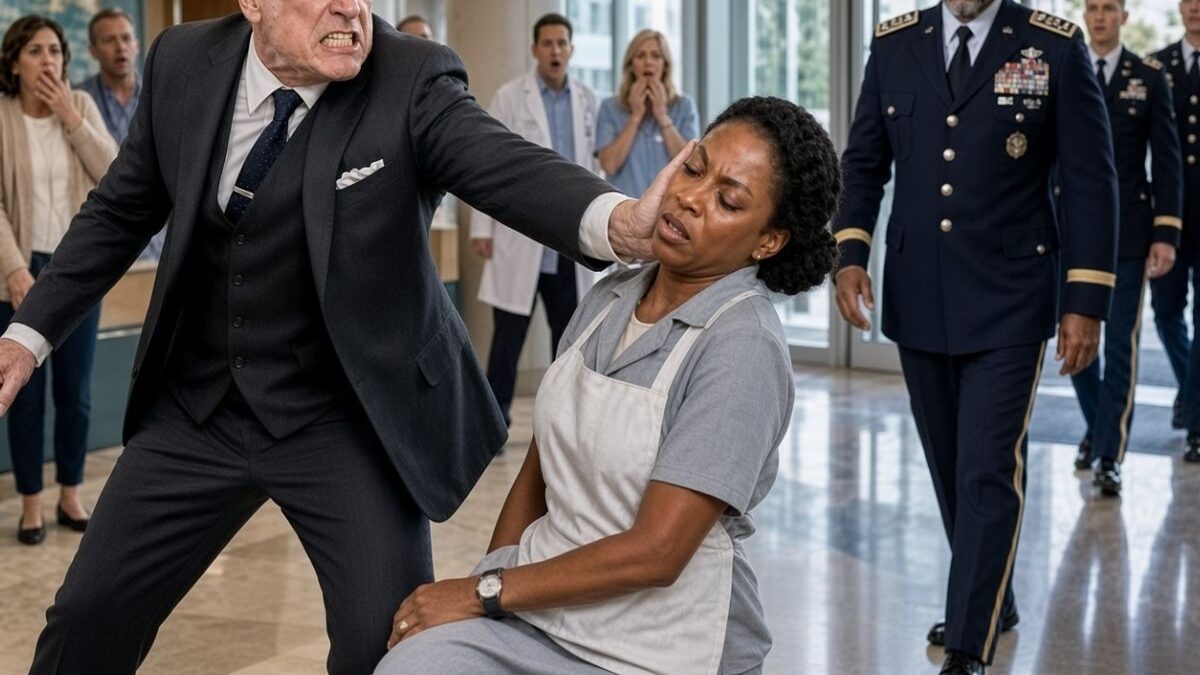
Get your filthy hands off my patient. >> Who gave you permission to touch a patient without my say so? Step away now. >> Sir, he’s in critical condition. >> Then let him die. That’s not your job. >> Sir, my conscience won’t allow that. >> Someone like you dare say that word to my face. Hold her down.
I’m teaching this one a lesson. Nobody moved. Ivy stood still, cheek on fire, eyes steady. Preston had just made the worst mistake of his life because the sound of that slap had just reached someone who could end his career with a single phone call. Have you ever watched someone powerful crumble in real time and felt that wave of justice hit your chest because you are about to drop a comment and hit like if you believe karma is real and let me take you back to where it all began.
But before that satisfying moment, before the stars, the SUVs, and the look on Preston Harrove’s face, you need to understand how it all started. How a man like him ended up standing in an emergency room slapping a woman who saved a life. Rewind. 4 months. Ridgemont Memorial Hospital had survived 62 years without a CEO like Preston Harrove.
It had weathered recessions, budget cuts, and a global pandemic. The nurses held it together with overtime and stubbornness. The doctors stayed because the patients needed them. It wasn’t glamorous. It was honest. Then the board of directors decided they needed fresh leadership. Preston Hargrove arrived on a Tuesday in March.
Black town car, Italian shoes that clicked on the lobby marble like a metronome. Three-piece gray suit, gold cuff links, a Rolex Submariner catching every fluorescent light in the building. He smelled like sandalwood and entitlement. He was 53 years old, son of the Harrove family real estate empire spanning 11 states net worth north of 400 million.
MBA [music] from Wharton, graduated middle of his class, but nobody remembers that part when your father golfs with the chairman of the hospital board. Preston Hargrove had never worked a single day in healthcare. Never held a stethoscope. Never watched a patient code at 3:00 in the morning. never smelled the mixture of bleach and fear that lives in every emergency room hallway. He didn’t need to.
He had a corner office now. His first week, he toured the facility with a clipboard and a frown. Second week, he issued a memo. Subject line: Operational efficiency restructuring phase 1. The bullet points were clean. The damage was surgical. Cut nursing staff by 15%. Reduce patient consultation time from 20 minutes to 12.
outsourced janitorial and maintenance to a contractor owned by coincidentally his college roommate. Freeze all raises for the next fiscal year. The hallways got quieter after that memo. Not peaceful quiet, scared quiet, the kind of silence that settles over a place when people start wondering if they’ll still have a job next Friday. Nobody pushed back.
Nobody filed a complaint. Nobody raised a hand in the all staff meeting and said what everyone was thinking. Nobody except Ivy Osborne. It happened during a department briefing. Preston stood at the front of the conference room, clicking through a slide deck titled Leaner, Faster, Stronger. 63 employees sat in rows of folding chairs.
Most of them stared at their laps. Ivy sat in the fourth row, scrubs still wrinkled from her shift. She raised her hand. Preston paused mid-sentence. He looked at her the way people look at a fly that landed on their food. “Yes, 12 minutes isn’t enough to properly assess an emergency patient,” Iivey’s voice was steady.
“Not loud, not aggressive, just factual. If we cut consult time to 12 minutes, someone will die. It’s not a matter of if, it’s when.” The room held its breath. Preston smiled. Not the kind of smile that reaches the eyes. And your name is Ivy Osborne. Emergency department. Nine years. He wrote something on his clipboard.
Slow, deliberate, making sure she watched him do it. Thank you for your input, Ms. Osborne. I’ll take it under advisement. He never did. But he remembered her name. He remembered her face. And from that moment forward, Ivy Osborne had a target on her back that she couldn’t see, but everyone else could. After the meeting, a few nurses whispered in the breakroom.
She shouldn’t have said anything. Someone had to. Yeah, but why her? Nobody answered that. They already knew why. Because Ivy was the only one in that room who still believed that doing the right thing mattered more than keeping your head down. That night, Ivy sat on the edge of her bed in the small apartment she kept near the hospital.
Colton was stationed at Fort Sam Houston, 700 miles away. She called him on FaceTime. His face filled the screen, still in his ACU fatigues. Cap off the kind of tire that comes from commanding people all day. “How was work?” he asked. “The new CEO is going to get someone killed.” Colton was quiet for a moment.
The kind of quiet that most people mistake for calm. What’s his name? Preston Hargrove. What did he do? Cut our consult time almost in half. I spoke up. He wrote my name down like I was a problem to solve. 5 seconds of silence. Colton’s jaw tightened. Barely visible on the screen. But Ivy had been married to this man for 14 years. She knew what that jaw meant.
“I want his full name,” Colton said softly. Ivy shook her head, smiled a tired smile. “Baby, I can handle it.” “I know you can. That’s not what I asked, Colton.” He exhaled. “Let it go for now. Just promise me you’ll be careful. I’m always careful.” “No, you’re not. You’re brave. That’s different.” Ivy laughed.
The kind of laugh that holds back tears. On her nightstand, the framed photo caught the lamplight. Her and Colton on their wedding day. Him in dress blues, her in white. Both of them 20 years younger and completely unaware of what the next decade would demand from them. She hung up, set the alarm for 4:30 a.m., closed her eyes.
Tomorrow, Preston Harrove would make his next move. Three weeks after Ivy spoke up in that meeting, Preston made his first real move. It started with an email, all staff, subject line, mandatory professional development assessment. The body was corporate language polished to a shine. Phrases like elevating institutional standards and aligning credentials with our tier 1 designation.
Underneath the polish, the message was simple. We’re looking at who deserves to be here and who doesn’t. Attached was a list, 27 names, nurses, technicians, support staff, all flagged for credential review. Most of them had bachelor’s degrees from state universities. A few had masters. One name on the list had a two-year associate degree from a community college. Ivy Osborne.
The meeting was held in the main conference hall. The same room as before, but this time it felt smaller, tighter. Preston had arranged the seating in a semicircle, everyone facing the projector screen. 64 employees packed in shouldertosh shoulder, standing room only along the back wall. Preston stood at the podium in a navy suit.
Fresh haircut, the Rolex catching light every time he gestured. He clicked to the first slide. Ridgemont Memorial is a top 20 hospital. Our patients expect excellence. Our board expects excellence and excellence begins with credentials. He clicked again. A spreadsheet appeared on the screen. Names, degrees, institutions, GPA, everything laid bare under fluorescent light for 64 pairs of eyes to read.
Now most of you have nothing to worry about. He smiled, paused. Let the word most do its work. He clicked through names, casually nodding at each one. Georgetown, solid. John’s Hopkins, impressive. Duke, very nice. His tone was light, almost friendly. The setup before the knife. Then he stopped. Ivy Osborne.
The room shifted. Chairs creaked. Someone coughed. Tuskegee Community College, two-year associate degree in nursing. He read it slowly, tasting every syllable. He looked up from the screen, found Ivy in the third row, locked eyes. Maybe that’s enough in Alabama. Silence. But this is Ridgemont Memorial, and I have a responsibility to this institution to ensure that every member of this staff meets the standard that our patients deserve.
Ivy felt the heat climb from her chest to her ears, 64 people staring, some with pity. some with relief that it wasn’t them. None with the courage to speak. Her hands were under the table. She pressed her fingernails into her palms hard enough to leave marks. She didn’t cry. She didn’t look away. She sat straight back in that plastic chair and held his gaze until he was the one who blinked.
Preston moved on to the next slide. The moment passed, but the damage was already done. It wasn’t just the words. It was the 64 witnesses who heard them and the zero who challenged them. After the meeting, the hallway buzzed with whispers. That was so messed up. He basically called her unqualified in front of everyone. Poor Ivy.
Someone should report it. You reported. I’m not losing my job. Nobody reported anything. The whispers dissolved into shift changes and patient charts and the daily machinery of a hospital that keeps moving no matter who’s bleeding inside it. Ivy went back to her station, checked vitals on three patients, changed an IV drip, helped an elderly woman to the bathroom.
Her hands didn’t shake, her voice didn’t crack. She was a professional and professionals finished their shift. But in the break room at 11:40 p.m., alone, she sat in the corner chair with a cup of coffee she didn’t drink. The vending machine hummed, the clock ticked, and Ivy Osborne stared at the wall and let herself feel it.
Not the humiliation. She could survive humiliation. She’d survived worse. Growing up black in rural Alabama had taught her that some people will look at you and see less, no matter what you do. She knew that lesson before she could spell it. What hurt was the silence. 64 people in that room. Nine years of working alongside them, covering their shifts, training their new hires, holding their hands on bad days, and not one of them said a single word.
That was the cut that went deep. She pulled out her phone. 11:52 p.m. Colton would be awake. He never slept before midnight. She dialed. He picked up on the first ring. Hey. Hey. 5 seconds of nothing. He knew. He always knew from the sound of the first word. What happened? She told him. All of it. The spreadsheet. The names.
Maybe that’s enough in Alabama. The 64 faces, the silence. Colton listened without interrupting. When she finished, the line was quiet for a long time. Give me his full name. Colton. His full name. Ivy. I’m not going to let you do anything. I just want to know the full name of the man who humiliated my wife in front of her colleagues.
His voice was soft. That was the dangerous part. Colton Osborne didn’t raise his voice. Generals didn’t need to. Preston Hargrove, Ivy said quietly. Preston Hargrove. He repeated it like he was filing it somewhere permanent. Okay, Colton, please. I can handle this. I just needed to hear your voice. Another pause.
She heard him exhale through his nose. Controlled military. You’re the strongest person I know, Ivy. Stronger than anyone I’ve ever commanded. But strong people still deserve someone standing next to them. You’re 700 m away. Not for long. She didn’t ask what he meant. She was too tired. She said good night.
Set her alarm. 4:30 a.m. Another shift. Another day in the building where she gave everything. And the man at the top gave her nothing but contempt. She didn’t know it yet, but the next time Preston Hargrove looked her in the eye, he would take something from her she couldn’t get back. And that would change everything.
Two weeks later, Preston struck again. And this time, he didn’t bother with slides. It was 8:00 in the morning. The emergency department lobby was full. 12 patients in the waiting area. Three more checking in at the front desk. Family members pacing. A child crying in her mother’s lap.
The usual controlled chaos of a hospital that never stops. Ivy was at the nurses station reviewing a chart for a 68-year-old cardiac patient she’d been monitoring all week. Mrs. Alderman, sweet woman, terrified of needles. Ivy had spent 20 minutes the night before just sitting with her, holding her hand, talking about Mrs.
his alderman’s garden until the fear passed and the IV went in without a flinch. That was the kind of nurse Ivy was. The kind who understood that healing isn’t just medicine. It’s presence. The elevator doors opened. Preston stepped out. Gray suit, blue silk tie, gold tie clip. The cologne arrived before he did. Beside him walked Ruth Keading, head of human resources, a thin woman with glasses and a clipboard who looked like she’d rather be anywhere else.
Preston walked straight to the nurse’s station. He didn’t slow down. He didn’t lower his voice. He wanted everyone to hear. Ivy Osborne. Ivy looked up from the chart. Yes, sir. Preston reached across the counter. He unpinned her name badge from her scrubs. Slowly, deliberately, the way someone removes a medal they’ve decided you no longer deserve.
He set it on the counter with a click. Effective immediately, you are reassigned from the emergency department. Iivey’s lips parted. Reassigned where? Sanitation. The word landed like a stone in still water. Ripples spread through the lobby. A nurse behind the counter stopped typing. A resident near the supply closet turned around.
You’ll report to facilities management. Mopping, disinfecting, waste disposal. Your new uniform will be provided. Sir, I’m a registered nurse with 9 years of were. Preston smiled, the kind of smile that isn’t meant to comfort. You were a registered nurse in this department. As of now, you’re reassigned to a role that better matches your qualifications.
He paused. Let the silence sharpen. Cleaning suits you better. 15 people heard it. Patients, families, staff, every one of them frozen in that particular kind of stillness that happens when someone witnesses cruelty and doesn’t know what to do with it. An elderly woman in a wheelchair, Mrs. Alderman, the same patient Ivy had comforted all week, reached out and grabbed Ivy’s hand.
Sweetheart, why are they doing this to you? Ivy squeezed the old woman’s fingers gently. She didn’t answer. She couldn’t. Not because she didn’t know, but because saying it out loud would make it too real. She unpinned her nursing ID from memory. It was already on the counter. Preston had done that part for her.
She straightened her scrubs, looked at Ruth Keading, who wouldn’t meet her eyes, and walked away from the nurse’s station. The hallway stretched long and fluorescent. Her shoes squeaked on the tile. The same sound as always, but it felt different now. Heavier, like the floor was pulling her down. She made it to the corridor behind radiology before she stopped, leaned against the wall, pressed both palms flat against the cold surface.
Her hands were shaking. Not her professional hands, the ones that didn’t flinch during codes and traumas. Her real hands, the ones underneath. Three deep breaths. In through the nose, out through the mouth, a trick her grandmother taught her when the world got too loud. She looked at her wedding ring, thin gold band, 14 years of a marriage built on distance phone calls, and the unshakable belief that they were both fighting for something bigger than themselves.
Colton fighting for the country, Ivy fighting for the patients. Now they’d taken the patients away. The next morning, Ivy showed up at 6:00 a.m. wearing the gray sanitation uniform. It was too big in the shoulders and too tight at the wrists. No name badge, no nursing ID, just a cart with a mop, a bucket, and a spray bottle of industrial disinfectant.
Her first assignment, clean the emergency department. She pushed the cart down the same hallway she used to run through in scrubs, barking orders during codes, saving lives with her hands. Now those hands held a mop handle. The fluorescent lights hummed the same hum. The tile was the same tile. But everything was different.
Dana, her closest colleague, saw her from the nurses station. Their eyes met. Dana opened her mouth, then closed it, looked away, kept typing. Dr. Emerson, a young resident who’d once told Ivy she was the best nurse he’d ever worked with, passed her in the hallway. He slowed. “This is wrong,” he whispered.
Then he kept walking. Nobody stopped. Nobody filed a grievance. Nobody marched into Preston’s office and said what every person on that floor was thinking. They were afraid. And fear is a silence that sounds exactly like agreement. Iivevy mopped. She disinfected. She emptied trash cans in rooms where she used to check vitals.
She cleaned the bathroom in bay 7, the same bay where she’d coated a patient back to life just 3 weeks ago. On the third day, she was mopping outside the break room when she heard two nurses talking through the cracked door. Did you hear three patients complained yesterday? Said their care got worse since Ivy left the floor. Of course, it got worse.
She was the best we had. Then why doesn’t someone say something? Silence. The coffee machine gurgled. The question hung in the air like smoke. Ivy kept mopping. She didn’t stop to listen. She didn’t need to. She already knew the answer. Nobody would say anything because Preston Hargrove had turned this hospital into a place where silence was safer than truth, where keeping your badge mattered more than keeping your integrity.
On the fifth day, old Mr. Peton, the patient who always asked if she’d be back tomorrow, saw her pushing the janitor’s cart past his room. He pressed the call button. When a different nurse came, he pointed at the hallway. That woman out there with the mop. She’s your best nurse, and you people are letting that man destroy her.
The nurse nodded, said nothing, closed the door. Ivy didn’t complain. She didn’t cry. She showed up every day at 6, pushed the cart, did the work, and went home. But something was building. Not an Ivy. She was steady as granite. Something was building in Preston. He’d expected her to quit. That was the plan. Humiliate her until she resigned, then replace her with someone who wouldn’t talk back. Someone who knew their place.
But Ivy didn’t quit. She mopped his floors and looked him in the eye every time he passed. And that that quiet, unbreakable dignity drove Preston Harrove absolutely insane. He needed to break her. And 10 days later, in front of 20 patients, he would try. 10 days of mopping, 10 days of silence, 10 days of Ivy Osborne pushing a janitor’s cart through the department she used to run and Preston Harrove waiting for her to crack.
She didn’t crack, and that’s what made the next part inevitable. Tuesday, 2:17 in the afternoon, the emergency waiting room held 20 people. A construction worker with a wrapped hand. A mother bouncing a feverish toddler. An elderly couple sitting close. The wife holding her husband’s arm like he might disappear. Three teenagers from a fender bender holding ice packs and scrolling their phones.
The rest scattered across plastic chairs in various states of patience and pain. Ivy was in the far corner ringing out a mop. Gray uniform, no badge, hair pulled back, wedding ring catching the overhead lights as her hands worked. The mop handle was starting to blister her right palm. She’d stopped noticing. Then the sound. A wet choking gasp.
The kind of sound a body makes when the airway starts to close. Iivey’s head snapped up. 30 ft away. A man in his 60s. Harold Tate, 63, retired postal worker sitting in the fourth row, had slumped forward in his chair. His face was swelling. His lips were turning blue. His hands clawed at his own throat. Anaphylactic shock.
Ivy knew it before her brain finished the word. Nine years of emergency nursing had wired the recognition into her nervous system. Swelling, strider, cyanosis. He had minutes, maybe less. The nurse at the triage desk, a 26-year-old named Becky, saw it, too. She froze. Her hand hovered over the phone. I need I should call Dr. Ror is in surgery.
Iivevy was already moving. She dropped the mop. It clattered against the tile. She sprinted across the waiting room 30 ft in 4 seconds and dropped to her knees beside Harold Tate. His eyes were wide. Bloodshot, terrified. His tongue was swelling shut. I need an EpiPen now. Iivey’s voice cut through the panic like a blade. Not a request, a command.
Becky ran to the crash cart, hands shaking. She fumbled the drawer, dropped a package of gauze, found the epi pen, and threw it to Ivy. Ivy caught it one-handed. Cap off. She drove the needle into Harold Tate’s outer thigh, held it, counted. 1 2 3 4 5 pulled it out. 10 seconds passed. Harold’s breathing hitched, then caught, then steadied. The blue faded from his lips.
His swollen face began to ease. His eyes found Ivy’s face. this woman in a janitor’s uniform kneeling beside him on a hospital floor and tears rolled down his cheeks. “Thank you,” he whispered. “Thank you.” The waiting room exhaled. Someone clapped, then another. 20 people applauding a woman in a cleaning uniform who had just saved a man’s life with her bare hands and nine years of training that no demotion could erase.
The applause lasted 4 seconds. Then the elevator doors opened. Preston Hargrove stepped out. 2:21 p.m. He’d been in a budget meeting on the fourth floor. Someone had texted him, “Incident in the ER lobby. The janitor just performed a medical procedure.” The janitor? That’s what they called her now. Preston’s face was already red when he crossed the lobby.
By the time he reached Ivy, still kneeling beside Harold, Tate’s EpiPen casing on the floor, the man’s hand gripping hers, his face was the color of raw steak. What the hell do you think you’re doing? Ivy looked up, calm, steady, the same eyes that had held his gaze in the conference room weeks ago. He was in anaphylactic shock, sir.
He would have died. “Who gave you permission?” Preston’s voice rose. Every head in the waiting room turned. “Who authorized you to touch a patient? You are not a nurse in this hospital. You are sanitation. You clean floors.” Sir, he was dying. I don’t care if he was on fire. Preston grabbed her wrist and yanked her to her feet.
The EpiPen casing skittered across the tile. You have no medical authority in this building. None. What you just did is assault. I will have you arrested. Harold Tate, still gasping, still clutching the armrest of his chair, looked up at Preston with confusion that slowly turned to horror. She saved my life, he said barely a whisper.
Preston didn’t look at him, didn’t acknowledge him, didn’t care. He leaned into Iivey’s face, close enough that she could see the capillaries in his eyes. “Someone like you,” he said. “Low, venomous, each word a separate weapon. With your 2-year degree from nowhere, your little Alabama background, you think you belong here?” Ivy didn’t flinch. She looked straight at him.
“Sir, my conscience won’t allow me to watch a man die.” The slap came fast, open palm, full force. The crack echoed off the tile floor, the glass partition, the ceiling panels. It bounced through 20 sets of ears and settled into 20 memories that would never let it go. Ivy stumbled, caught herself on the armrest of a chair.
Her left hand went to her cheek. The skin was already burning. The outline of four fingers was rising in red across her dark skin. The waiting room went silent. Not scared, silent. shocked silent. The kind of silence that comes right before something irreversible. You’re finished. Preston hissed. He pointed at two security guards near the entrance. Get her out. Call the police.
I’m pressing charges for practicing without a license. The guards walked over. One of them, a young guy named Torres, took Iivey’s arm gently, like he was sorry, like he knew this was wrong, but didn’t know how to stop it. 20 phones were up, 20 cameras rolling, 20 witnesses to the moment a CEO slapped a woman for saving a life.
Ivy stood in the grip of a security guard, cheek burning, eyes wet but unbroken, she didn’t beg. She didn’t shout. She held herself the way her grandmother would have, straightbacked, chin up, dignity intact, even when the world was trying to tear it away. And then through the glass doors of the emergency entrance, she saw them.
Two black Chevrolet Suburbans, tinted windows pulling to a stop. The doors opened. Not the regular sliding doors that patients walk through with insurance cards and worried faces. The emergency entrance, the wide one, the one that ambulances use. Two black Chevrolet Suburbans sat in the loading zone, engines still running.
Tinted windows, government plates. The kind of vehicles that don’t get parking tickets because nobody is brave enough to write one. Four soldiers stepped out first. Military police pressed uniforms, sidearms holstered. They didn’t rush. They moved with the deliberate measured stride of people who have been trained to enter rooms and control them without raising their voices.
They flanked the entrance, two on each side, feet shoulderwidth apart, hands clasped behind their backs. Then the rear door of the second Suburban opened. Colton Osborne stepped onto the curb. 6’4, 220 lbs of career military discipline, wrapped in the Army Service uniform, deep navy blue pressed to razor edges. The jacket sat square on his broad shoulders.
The left breast was covered in ribbons and metals. Bronze Star with Valor, Legion of Merit, Distinguished Service Medal. Three campaign stars from two wars. The kind of chess display that tells you a man has spent decades in places most people can’t find on a map. And on each shoulder, four silver stars gleaming under the afternoon sun.
Four stars that meant this man answered to exactly three people in the United States military. And one of them was the president. Colton adjusted his cap, white gloves in his left hand. He walked through the emergency entrance the way he walked into every room, unhurried, aware of everything, afraid of nothing.
He was here to take his wife to lunch. That’s all. Every Tuesday when he was stateside, he drove to Ridgemont Memorial at 2:30, waited in the lobby, and walked Ivy to the sandwich shop two blocks east. They’d been doing it for years, a small ritual in a life that didn’t allow for many. Today, he was 4 minutes early.
The waiting room saw him before Preston did. 20 people who had just watched a CEO slap a nurse looked up and saw a four-star general walking toward them with four military police officers at his back. The clapping had stopped. The phones were still recording. Colton scanned the room the way he’d been trained to scan rooms since he was a 22-year-old second lieutenant.
Entry, points, threats, civilians, and the person he was looking for. He found her. Ivy standing near the triage desk, a security guard’s hand on her arm, her left cheek red and swelling, the outline of fingers visible against her dark skin. Colton stopped walking. The entire room felt the temperature drop. Not literally, something worse.
The kind of cold that comes off a man who has spent 30 years commanding soldiers in combat zones and has just seen the one person in the world he would die for. Standing in a hospital lobby with a handprint on her face. His jaw set. One micro movement. The muscles in his neck tightened. His eyes dark brown the same shade as Iivey’s moved from her cheek to the security guard’s hand. Take your hand off my wife.
Four words spoken at a conversational volume. The security guard, Torres, released Iivey’s arm like he touched a live wire. He stepped back two feet and didn’t stop until his shoulder blades hit the wall. Colton closed the distance. He stood in front of Ivy. His gloved hand rose gently, slowly the way you touch something precious, and tilted her chin.
He examined the mark. His thumb brushed the edge of the swelling. His expression didn’t change. But Ivy knew. 14 years of marriage. She knew what that stillness meant. It meant someone was about to have the worst day of their life. Who did this? Ivy’s eyes flicked to the left, just once, just barely.
Colton turned. Preston Harrove was standing 12 ft away. He hadn’t moved since the soldiers walked in. His face had gone from red to white in the span of 6 seconds. His mouth was open, no sound. The Rolex on his wrist suddenly looked very small. Colton walked toward him slow. Each step measured. The metals on his chest didn’t jingle.
They were pinned too tight. The only sound was the click of his dress shoes on the tile. He stopped 3 ft from Preston, close enough to read the man’s pores. Preston Hargrove. Colton read the name badge. His voice was flat. Steel wrapped in silk. CEO. Preston’s mouth moved. I She There was a She violated protocol.
You hit my wife. Not a question. A statement filed like a bullet into a chamber. I didn’t know. It was She’s not even a nurse here anymore. She’s, “You hit my wife.” Three words this time. Each one separated by a silence that felt like a door closing. Preston’s eyes darted to the soldiers by the door, to the phones still recording, to Ruth Keading from HR, who had materialized from somewhere and was now standing against the far wall, clutching her clipboard like a life raft.
Do you know who I am? Preston tried, the last card in a hand that had already been folded. Colton didn’t blink. I know exactly who you are. The question is whether you know who I am. He turned to his aid, Colonel Hayes, standing two steps behind, already holding a phone. Colonel, contact Brigadier General Collins at the Pentagon, inform him that the medcom contract with Ridgemont Memorial Hospital, $340 million annually, is under immediate formal review, pending an investigation into executive misconduct and patient safety
violations. Colonel Hayes nodded once, stepped aside, dialed. Preston’s knees buckled. Not all the way, just enough. A micro stumble. The kind the body does when the brain finally processes that everything is over. Wait, what contract? What do you This hospital receives $340 million a year from the United States Army Medical Command to provide care for active duty personnel and veterans.
I am Lieutenant General Colton Osborne, Deputy Commanding General of MedCom. The contract renewal crosses my desk. He paused. It crossed my desk, past tense, the most devastating tense in the English language. The waiting room was silent, but not the scared silence from before. This was a different silence, the kind that settles over a crowd when justice walks into a room and everyone can feel it.
Harold Tate, still in his chair, still breathing because of the woman who’d just been slapped, looked at Colton Osborne with tears streaming down his face. He didn’t say anything. He didn’t need to. Colton turned back to Ivy. He took off his cap, held it against his chest, and he said the only thing that mattered.
I’m sorry I wasn’t here sooner. Ivy’s chin trembled. For the first time all day, all month, she led it. You’re here now. The first video hit the internet at 2:43 p.m., 7 minutes after Colton Osborne walked through those doors. It was filmed by a 19-year-old college student named Kayla Morrison, who’d been in the waiting room for a sprained ankle.
She uploaded it to Twitter with four words: CEO slaps nurse. Watch. By 3 p.m., it had a 100,000 views. By 5:00 p.m., it had a million. By midnight, 14 million people had watched Preston Hargrove slap Ivy Osborne across the face. 14 million people watched him scream at a woman in a janitor’s uniform for saving a dying man. And 14 million people watched a four-star general walk in, make one phone call, and dismantle the man’s entire career in under 90 seconds. The hashtag wrote itself.
Justice for Ivy trending number one by 9 p.m. The comment section became a war zone. Nurses from across the country shared their own stories. the shifts no one thanked them for. The patients who grabbed their hands and whispered, “Don’t leave.” The administrators who treated them like line items on a budget spreadsheet.
Iivey’s slap became everyone’s slap. Her silence became everyone’s silence and the sound of Colton’s voice. Calm, measured, lethal, became the sound of every reckoning that never came but should have. The hospital’s phone lines melted. The board of directors personal emails somehow leaked, filled with thousands of messages.
The PR department released a statement at 6 p.m. that said nothing. By 8:00 p.m., they released a second one that said even less. By 10 p.m., they stopped trying. The emergency board meeting was called for 7:00 a.m. the next morning. Preston arrived in the same gray suit, no tie this time. He hadn’t slept.
The bags under his eyes were purple. The Rolex was still on his wrist, but his hand trembled when he reached for the conference room door. Eight board members sat around the mahogany table. No one looked at him when he walked in. The chairman, Richard Whitmore, 71, the same man who’d golfed with Preston’s father, sat at the head of the table with his glasses off and his hands folded.
Sit down, Preston. Preston sat. The hospital’s legal council, a woman named Margaret Saunders, stood and pressed play on a laptop. The video filled the screen mounted on the wall. Every angle, every word, the slap, the scream, the soldiers, the stars. When it ended, the room was quiet.
Do you have anything to say? Whitmore asked. She violated medical protocol. She had no authority to She saved a man’s life. Preston, that’s not the point. That is exactly the point. Whitmore removed his glasses, rubbed the bridge of his nose. He looked old, tired, like a man who had just realized that the favor he did for a friend’s son had cost him everything.
The point is that you assaulted an employee on camera in front of 20 witnesses after demoting her from a clinical role to janitorial work for no documented performance reason. Margaret Saunders opened a folder. We’ve reviewed the demotion paperwork. There is no formal complaint, no disciplinary record, no performance review triggering reassignment.
Miss Osborne’s personnel file contains nine years of exemplary evaluations, three commendations, and a patient satisfaction score in the 98th percentile. Preston’s mouth opened. Closed. The board has voted. Whitmore’s voice was flat. Final. Effective immediately. Your employment with Ridgemont Memorial Hospital is terminated.
Your access credentials have been revoked. Security will escort you from the building. Preston stood, his chair scraped the floor. My father, your father called me at midnight. Whitmore met his eyes for the first time. He told me to do whatever was necessary. Those were his exact words. Preston’s face collapsed. Not dramatically, not like the movies.
It just fell. The muscles gave up. The jaw went slack. The eyes went flat. the face of a man realizing that the last safety net, the one that had caught him his entire life, had just been cut. Security arrived. Two guards, not Torres this time. They walked Preston through the lobby, past the nurse’s station, down the corridor.
The same corridor where Ivy had pushed her mop cart for 10 days, the same hallway where she’d been stripped of her badge, the same tiles that had heard, “Cleaning suits, you better.” Now Preston’s Italian shoes clicked against them one last time. Every nurse on the floor watched him go. Nobody said a word. 24 hours later, the county prosecutor’s office announced charges.
Assault in the third degree, a class A misdemeanor, maximum penalty, one year in county jail, and a $10,000 fine. 48 hours later, the Pentagon released a formal statement. The MedCom contract with Ridgemont Memorial was suspended pending a full institutional review of leadership practices, staff safety protocols, and organizational culture. $340 million frozen.
72 hours later, Harold Tate sat in a CNN studio, gray cardigan, reading glasses folded in his shirt pocket. The anchor asked him what happened in that waiting room. Harold looked straight into the camera, not at the anchor, at the lens, at the millions of people on the other side, and said, “I was dying.
I could feel my throat closing. I couldn’t breathe. And a woman in a janitor’s uniform dropped everything, ran to me, and saved my life.” His voice cracked. Tears rolled down his weathered face. Then a man in a fancy suit walked over and slapped her for it. Right in front of me. Right in front of everyone.
She saved my life and he hit her. The clip went viral within the hour. Another 12 million views. The comments were unanimous. Not divided, not debated. Unanimous in a way that the internet almost never is. The hospital scrambled. An interim CEO was appointed. Dr. Lorraine Bishop, a 20-year physician who had spent her career in the same emergency room where Ivy worked.
Her first official act, Call Ivy Osborne. Come back, Dr. Bishop said. Not to your old position. Ivy braced herself. To a new one. Head nurse emergency department. The job should have been yours years ago. Ivy sat in her kitchen, phone pressed to her ear, Colton across the table, still in uniform, coffee in hand.
He didn’t ask what the call was about. He just watched her face. I’ll be there Monday, Ivy said. She hung up, looked at Colton. Head nurse. He smiled. Not the big kind, the quiet kind. The kind that says I always knew. You earned that, he said. We earned that. He shook his head. No, I made a phone call. You survived 9 years, a demotion, a public humiliation, and a man’s hand across your face, and you never once stopped being who you are.
He reached across the table and held her hand. The one with the thin gold ring. That’s all you, Ivy. She squeezed his fingers the same way she’d squeezed her grandmother’s hand 23 years ago on a porch in Mon County. But this time, the grip held. 6 months later, the auditorium at Ridgemont Memorial had never been this full. 300 seats, everyone taken.
staff, community leaders, local press, a CNN camera crew, and in the front row, 12 young women in white coats sitting with their backs straight and their eyes wide. The banner behind the stage read the Dela May Osborne Nursing Scholarship Inaugural Class. Ivy stood at the podium. Navy blue dress, no jewelry except the gold wedding band.
Her natural curls framed her face. She’d worn them down today. For the first time in years, she wasn’t in scrubs, but her hands were the same hands. Steady, sure. The hands that had held a dying grandmother, saved a choking stranger, and taken a slap without falling. She didn’t talk about Preston Hargrove, didn’t mention the slap, didn’t reference the video that 47 million people had watched.
Not a single word about the man who tried to break her. She talked about Delmare. My grandmother raised me in a house with three rooms and one working faucet in Mon County, Alabama. She grew tomatoes in the backyard and read me scripture every Sunday. She died of a heart attack because the nearest hospital was too far and the ambulance took too long.
The auditorium was silent. I became a nurse because of those 41 minutes because I decided that no one should ever hold someone they love and wait for help that comes too late. She looked at the 12 young women. 12 faces from small towns and rural counties. Girls who worked night shifts and studied in their cars.
Girls who’d been told that where they came from was all they’d ever be. This scholarship isn’t about what happened to me. It’s about what happens next. It’s about making sure that the next girl from a dirt road who wants to save lives doesn’t have to do it alone. A girl in the front row was crying. 19 years old. Brianna Wells.
She’d driven four hours from Mon County, the same county where Delmare died on a dirt road 23 years ago. Her mother was a housekeeper who worked three jobs. Her high school guidance counselor told her to be realistic. She applied to the scholarship on the last day at 11:58 p.m. on a borrowed laptop in a McDonald’s parking lot because that was the only place with free Wi-Fi.
After the ceremony, Brianna found Ivy backstage. Her white coat was still crisp. Her eyes were still red. I’m from Mon County, too. My mama is a housekeeper. Everyone said nursing school was too expensive. That girls like us don’t make it. Ivy held her hands. Both of them looked her straight in the eye.
Girls like us are the only ones who do. Colton sat in the second row, full dress uniform, four stars, every metal pressed against his chest. He was the most decorated person in the room, also the quietest. He’d commanded 200,000 soldiers, led operations in three theaters of war, briefed the president in the situation room. He’d made decisions that moved battalions, and shaped borders.
He’d stood in rooms where a single word carried the weight of nations. But watching Ivy turn the worst moment of her life into a doorway for 12 strangers watching her stand at that podium without anger, without bitterness, without a single word about the man who tried to destroy her. That was the bravest thing he’d ever seen. Braver than any battlefield, braver than any command. He didn’t clap the loudest.
He didn’t need to. He just sat there, four stars on his shoulders, and watched his wife change the world the way she always had, one person at a time, quietly, stubbornly, without asking for permission. Harold Tate was there, too. Third row. He brought sunflowers. Didn’t know why. They just felt right.
When Ivy walked past him after the ceremony, he stood up slowly, carefully, the way a 63-year-old man does when his body reminds him it almost stopped working 6 months ago, and handed her the flowers. “These are for Delmare,” he said. Ivy took them, held them against her chest, and for just a moment, she was 11 years old again, standing on a porch in Alabama, holding her grandmother’s hand.
Monday morning, Ivy walked back into the emergency department. New badge, Osborne 1, head nurse emergency department. Same white shoes, same gold ring. Same hallway she’d mopped for 10 days in a gray uniform. She passed the spot where Preston had slapped her. Didn’t stop, didn’t flinch. Her pager buzzed.
Bay for incoming trauma. Ivy Osborne broke into a run.

