A Sheriff Arrested a Half-Bigfoot Man Near Willow Creek in 1974 — The Case Was Never Filed
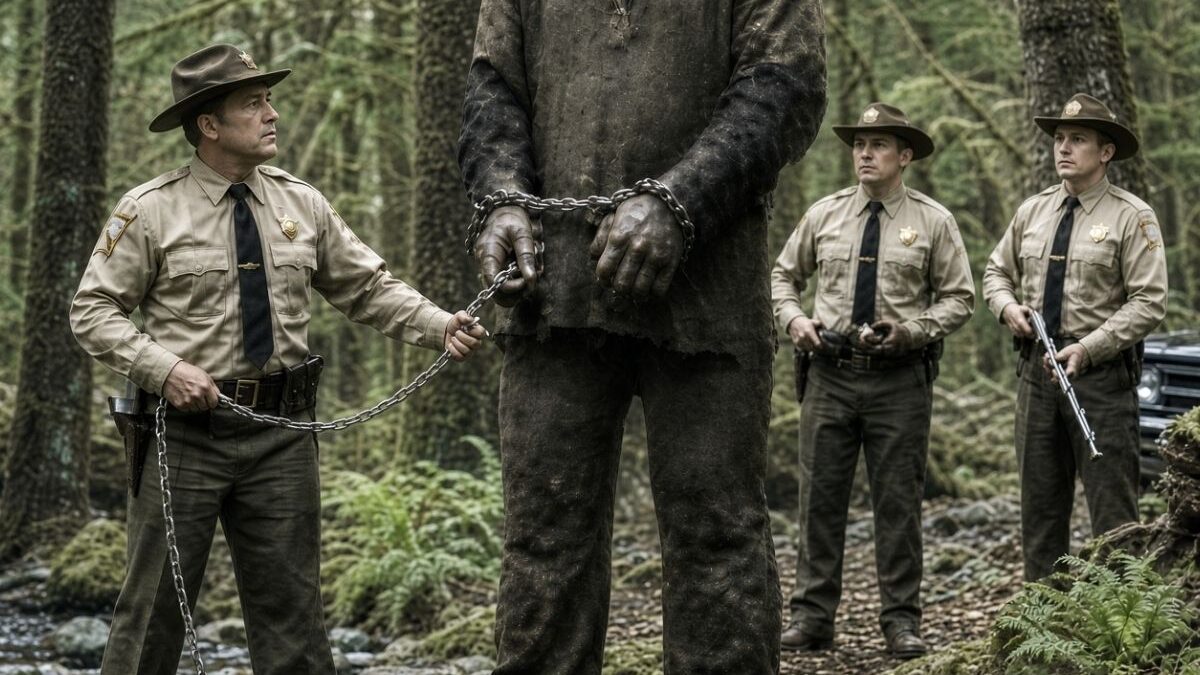
In April 1958 in Harland County, Kentucky, Sheriff Henry Lawson received a strange report from Hunter Samuel Reed near the edge of the Cumberland Forest. An unusually tall man had been appearing near a creek. He carried no identification, could barely speak English, and looked enough, like the creatures in old Appalachin Bigfoot stories that Reed had finally decided to tell the sheriff.
Lawson had dealt with every kind of person during his years in law enforcement. But this case was different. The stranger had massive shoulders, long arms, oversized hands, and a way of watching people that made anyone near him uneasy. Lawson brought him to the station to determine who he was. 4 days later, no charge had been filed and no official case had been opened.
What remained were several drawings, a brown covered journal, and a name Lawson had written on a sheet of paper. Kale. Hello everyone, Victor here, and welcome back to Bigfoot Sasquatch Story. Today’s account takes us to the mountains of eastern Kentucky, where a sheriff was to have kept a mysterious man in a jail cell for several days before quietly releasing him back into the forest.
Our team compiled the story from accounts passed down over the years. We cannot verify whether every part is true or whether it became an Appalachian legend shaped by generations of retelling. Listen with an open mind. If you believe deep forests still hide things we cannot explain, comment believe below.
Now let us return to Kentucky. An April morning in 1958 began at the Harlland County Sheriff’s Office with such ordinary work that Henry Lawson expected the day to pass like many before it. He sat behind a dark wooden desk reviewing a complaint about a cold truck blocking a warehouse entrance while Deputy Frank Miller typed at the desk behind him.
Outside, Harlon was slowly waking to traffic and the distant sounds of the mines. So when Samuel Reed pushed through the door, Lawson first looked up only out of habit. Reed was a hunter in his 50s who lived near the woods east of Harland, and almost never sought police help. That morning his coat was muddy, his hat twisted between both hands, and he stood in front of Lawson’s desk longer than usual before speaking.
At first light, while checking a trail near Cumberland Forest, Reed said he had seen a man beside the creek. The stranger was taller than anyone Reed had ever met in the region, with broad shoulders, a heavy upper body, long arms, and abnormally large hands. His clothing consisted of rough cloth mixed with pieces of hide, crudely but strongly assembled, as if made by someone who had lived outdoors for years.
Lawson asked whether the man carried a weapon or acted threateningly. Reed shook his head, then said something that made Frank stop typing. The stranger had only watched him. Reed had called out, asked his name, asked if he needed help, but the only answers were a few low horse sounds, as if the man had gone so long without normal speech that words no longer came naturally.
What disturbed Reed most were the stranger’s eyes. He had watched Reed with the concentration of someone trying to understand what had appeared inside familiar territory. Reed admitted that in that moment he had felt like the intruder. Frank asked whether he might have mistaken a bear standing upright for a man.
Reed replied that he had hunted bears for more than 30 years and had been close enough to see the stranger’s face. Lawson asked how Reed had left. Reed said he backed toward a tree where he had placed his rifle, turned away for only a few seconds to pick it up, then looked again. The stranger, who had been nearly 40 yards away, was suddenly less than 20 yard from him.
Dry leaves covered the entire ground between them. Yet Reed had heard no footsteps. The room became silent. Law sent the file in front of him, put on his coat, took the patrol car keys, and looked at Frank. He still believed the stranger might simply be a hermit or someone in need of help. But Reed’s report was serious enough to investigate. Frank rose.
Reed put his hat back on, and the three men left the office. Lawson still expected to find a lost man somewhere in unfamiliar mountains. within a few hours. That would be the first assumption he was forced to abandon. Samuel Reed sat in the front passenger seat and directed Lawson east out of Harlem along a narrow road where houses became sparse and wooded slopes took over.
April Rain had softened the road, forcing them to leave the car before a muddy section and continue on foot with Frank. Reed led them down a low slope through wet brush to a small creek. Several deep impressions remained in the soft ground near the water and continued toward the trees. Lawson crouched to study them. They did not resemble normal bootprints.
The bottoms were broad and uneven along the edges, almost as if bare feet had been wrapped in hide or layers of rough cloth soaked with mud. Reed confirmed this was where he had seen the stranger. Frank walked along the bank and remarked that if the man was still nearby, he had probably heard them long ago.
As Lawson stood, he noticed a branch broken above head height. The exposed wood was bright, meaning the break was fresh. A few seconds later, a small stone rolled down the slope. Reed turned first. Between two trees about 30 yards away, a man stood motionless, watching them. Lawson immediately understood why Reed had come to the sheriff.
The stranger was much taller than ordinary men in the county. His shoulders were wide, his torso thick, and his arms hung low along his thighs. He wore a coat assembled from coarse cloth and earthcoled hide, something that appeared handmade for surviving many seasons in the forest. Long black hair reached his neck. A heavy beard covered much of his jaw, and his hands were strikingly large.
Lawson stepped forward only enough to be seen clearly, kept his own hands visible, introduced himself, and pointed at the badge on his chest. He asked whether the man was hurt or needed help. The stranger watched Lawson’s mouth while he spoke, then looked at the badge. Frank asked his name and where he lived. The only reply was a short, rough sound from deep in the man’s throat.
Lawson noticed that he reacted to every word, but seemed unable to use language the same way they did. Lawson extended one open hand as a peaceful gesture. The stranger stared at it for a long time. Then a hunting rifle cracked from a distant ridge. The man instantly turned toward the sound, head lowered slightly, his entire body alert.
Frank instinctively put a hand on the pistol at his hip, and the stranger’s gaze dropped immediately to the weapon. Lawson understood that one nervous movement could transform the encounter. He told Frank to lower his hand and deliberately pushed his own revolver deeper into its holster. The stranger watched that motion and gradually relaxed his shoulders.
Lawson continued in a calm voice, pointed toward the patrol car, and asked if the man would come into town for food and rest. The stranger turned to look back into the woods. His eyes stayed on the trees for a long moment before he looked at Lawson again. Finally, he crossed the creek and followed them. Frank suggested handcuffs, but Lawson refused because the man had committed no crime.
On the walk back, the stranger repeatedly looked toward the forest. He had many opportunities to run and did not take them. At the patrol car, he had to bend very low to fit into the back seat. Lawson started the engine, and looked in the rear view mirror. The stranger kept his face, turned toward Cumberland until the woods disappeared behind a curve.
That was when Lawson first wondered whether they were not taking a lost man to safety at all, but taking someone away from the only place he had ever considered home. When the patrol car stopped in front of the Harland County Sheriff’s Office, a few people across the street immediately noticed the stranger.
Lawson opened the rear door and motioned for him to follow inside while Frank stayed a few steps behind. Under the office lights, the details that had been striking in the woods became even clearer. The man stood nearly a full head taller than Frank, with thick shoulders, long arms, enormous, collle hands, and old scars across his skin.
His clothing was made from faded fabric and hardened hide, stitched unevenly but strongly, the work of someone who understood how to make garments last through bad weather. Lawson offered him a chair and began the standard questions he had asked drifters, intoxicated travelers, and missing people countless times. Name, birthplace, address, family.
Why had he been near Cumberland? Every question produced intense observation, but almost no usable answer. The man watched Lawson’s face, sometimes tilting his head when the tone changed, while the sounds from his throat remained fragmented and unfamiliar. Frank wrote a few simple words on paper, and placed them in front of him.
The stranger studied the marks, then looked at Frank’s hand, apparently more interested in the act of writing than the meaning of the letters. They carefully checked what he carried. There were short cords braided from something like tree bark, a smoothed stone with a worked edge, and a cloth pouch filled with dried seeds.
There was no wallet, identification key, watch, money, or object that could establish who he was. Frank said they should contact state police that day. Lawson understood. An adult with no identity appearing from deep forest was clearly unusual enough to report. Yet there was still no charge to place against him.
Lawson took a map of Kentucky from the wall, spread it over the desk, and pointed to Harland, neighboring towns, and major roads. The man showed little reaction until Lawson’s finger moved toward the eastern part of the county, near the forest, where they had found him. His eyes stopped. Lawson moved his finger farther into Cumberland.
The stranger followed it carefully. That small reaction convinced Lawson the man knew exactly where he was and was connected to those mountains. By late afternoon, Lawson decided to keep him overnight in the temporary cell while they tried to identify him and determine whether anyone was looking for him. He explained as calmly as he could, gesturing toward the room in back.
The man stood and followed without resisting. Inside the cell, he spent several minutes examining every wall, the frame of the door, the small high window, and the spaces between the bars. Lawson recognized the behavior of someone accustomed to studying his surroundings before allowing himself to rest. At dinner, Frank brought meat, cornbread, and water.
The man lifted each item to his nose before eating. He finished the cornbread and drank in small sips, but left the meat untouched. Near the end of the shift, Lawson gathered his paperwork and prepared to go home. As he turned away from the hallway, the man suddenly stood and faced the north wall. Lawson paused, thinking he had heard something.
For several seconds, the building remained quiet. Only afterward did the heavy engine of a truck begin to reach them faintly from a distant road. Lawson looked toward the window, then back at the prisoner. The road was far enough away that Lawson had only just heard the truck. While the stranger had reacted before the sound was audible to him.
That night, when Lawson locked the office, he carried home a question he was not yet ready to say aloud. If this man had lived in the forest for years, how much had his senses changed? Lawson went home that night, but could think of little except the stranger. The way he had inspected the cell, smelled each piece of food, and reacted to a distant truck before Lawson himself heard it kept returning to him.
Near midnight, he put his coat back on and drove to the office, telling himself he only wanted to check on things. The hallway light burned dimly. When he entered, the stranger was sitting against the wall near a corner, head lowered slightly, but eyes open. The blanket on the iron bed had barely been touched. Lawson did not know when the man slept, or whether he slept as deeply as other people.
He brought a cup of water, set it near the bars, and sat in a wooden chair outside. He started talking, mostly as the silence felt heavier than speech. Lawson explained that in the morning he would continue trying to identify him, ask people near the woods whether a family was searching for someone and try to return him home if a place could be found.
At the word home, the stranger looked away from Lawson toward the small window at the end of the hall. That window faced the eastern mountains. Lawson noticed and repeated the word slowly. The man kept watching the same direction. Lawson fetched a topographic map used in mountain searches, spread it on a table near the cell, and pointed to the town of Harland.
He then pointed to the room they occupied and back to the map, trying to establish that the symbol represented where they were. The stranger moved closer to the bars. His eyes traveled across contour lines, streams, and the fine markings on the paper. Lawson moved his finger east toward the bus where Samuel Reed had found him.
This time the reaction was stronger. The man extended an arm through the bars, placed one fingertip on a forested area far from town, held it there, then traced south through a ravine, changed direction at a creek, and curved around another ridge. Lawson bent closer. The route did not follow any marked road. It crossed country. Most people around Harlland knew only from hunting and logging.
Lawson asked if he lived there. The stranger looked at him, then touched the same spot again. Lawson marked it lightly with pencil. When he tried moving his finger elsewhere, the stranger redirected it and repeated the original route with remarkable accuracy, stopping at a narrow creek, Lawson remembered crossing during a hunting trip years before, then continuing toward an unnamed ridge.
Lawson sat back and studied the pencil marks. Until then, he could explain almost everything by assuming the man was an isolated drifter who had lost contact with society, but lost people generally searched for populated places. The stranger had demonstrated the opposite. He knew exactly where he was, new routes through mountains the official map barely represented, and appeared to consider the deep forest his fixed point.
The mystery changed that night. The question was no longer where he had become lost. It was how long he had lived in those forests, and what else might exist in the place he had just shown Lawson. The next morning, Lawson arrived early with blank paper and several pencils from home. After the previous night, he knew ordinary questions would take them no further.
The stranger could hear, watch, and understand far more than he could express, but spoken language remained a locked door between them. Lawson sat before the bars, drew a simple human figure on the paper, wrote Henry beside it, touched the name, and pointed to his own chest. The man watched closely. Lawson repeated the demonstration, then passed the paper and pencil through the bars.
The stranger turned the pencil between his huge fingers, testing its weight, then began drawing. His first lines were heavy, but soon his movements became controlled. He drew a long curve like a mountain ridge, a lower line running parallel, and a narrow gap between them. Then came a creek winding along the base, three connected slopes, and a small path across low ground.
Lawson retrieved the topographic map and placed it beside the drawing. Frank arrived while he was comparing them and stopped when he saw both sheets. A water course on the official map matched the creek in the drawing almost exactly. The eastern ridges stood in the same relative position.
More remarkable was a tiny tributary represented on the map by only a fine line, one Lawson remembered crossing years earlier. The stranger had marked it accurately without seeing the map before beginning. Frank said he might simply have memorized the map the previous night. Lawson admitted it was possible, but the man continued adding his own symbols, groups of three short strokes like trees, arcs around slopes, narrow lines through rock gaps.
It increasingly resembled the field map of someone who had traveled the country many times. When Lawson pointed to a different area, as if asking for a route, the stranger immediately corrected him and guided his finger back to a smaller creek and around a ridge. Frank became more serious. A man with such deep knowledge of the wilderness, he argued, was exactly the kind of unexplained person they should report to state police.
Lawson saw another possibility. If the stranger had lived there long enough to know every creek and ravine, his appearance near Harlem might not have been a new event at all. He could have existed in those mountains for years without the town knowing. Lawson pointed toward a deeper region on the map.
The man suddenly caught his wrist. The grip was strong enough to stop him immediately, but was completely controlled. his eyes fixed on the area beneath Lawson’s finger. After several seconds, he released him and used the pencil to draw a dark boundary around that section. For the first time since they had met, Lawson felt the man was communicating an unmistakable warning.
Whatever lay inside that circle, he wanted Lawson to stay away from it. Rumors spread through Harlon faster than Lawson expected. Samuel Reed had told his wife, and the story passed through kitchens, stores, and conversations along the street. By midday, several people stood across from the sheriff’s office, simply watching.
Every retelling added something new. Some claimed Lawson had captured a murderer hiding in the mountains. Others said the prisoner was an insane hermit. One version insisted he ate raw meat and chased hunters, though neither claim was true. Frank pulled the front curtains when more young men gathered outside and told Lawson the situation was no longer an ordinary identity check.
The longer they delayed contacting state police, he said, the harder it would become to explain. Lawson glanced toward the back hall. The stranger sat quietly with paper and pencil. apparently unaware that the town was already turning him into a legend. Lawson asked for one more day. The man had injured no one, possessed no stolen goods, and had committed no obvious offense.
What they knew was simply that he had lived in the eastern forest long enough to know its hidden routes. Frank answered that this was precisely why higher authorities should be involved. Before the argument ended, an older man named Earl Sutton entered. Sutton had worked in the Harland coal mines for years before poor healthforced retirement.
He had heard the story in a nearby diner and wanted to know whether it was true. Lawson refused to let him see the prisoner, but Sutton asked about the stranger’s height, clothing, and the area where Reed had found him. As Lawson gave a brief description, Sutton’s expression changed. More than 20 years earlier, he said while still young, he and two other men had been checking an old logging route near Black Mountain.
At dusk, they saw a very tall figure standing on a slope above them. It was too large to look like an ordinary hunter, but the distance prevented them from seeing its face. The figure watched them and then disappeared among the trees. All three had eventually decided it must have been a bear. Sutton had nearly forgotten the incident until hearing the new description.
Lawson asked why he never reported it. Sutton shrugged. In Harlem, there had been more practical things to worry about, and people who claimed to see strange things in the woods were usually laughed at. He rose to leave, then stopped as another memory came back. Around the same period, a young woman from the area had disappeared after going toward the forest.
The disappearance had brought search parties into the mountains. Frank asked for her name. Sutton could remember only that the family name was Hail or Hall. Lawson remained outwardly calm, but the statement pulled his thoughts back to the stranger’s drawings and the heavily marked section of forest. After Sutton left, Frank again urged Lawson to call state police.
Lawson looked through the drawn curtain at towns people, waiting for a more exciting story than the truth. He knew time was running out, yet Sutton’s memory opened a possibility. He was not ready to surrender. If a woman had vanished near the same woods more than two decades earlier, the man in the cell might know what had happened to her.
For the first time, Lawson wondered whether the case before him had not begun the previous morning, but long before he became sheriff. At lunch on the second day, Lawson changed one small detail. The stranger had eaten cornbread and drunk water, but left the meat untouched, so Lawson ordered fried fish, more cornbread, and boiled vegetables from the nearby diner.
He pushed the tray through the bars. The man smelled the fish carefully, then ate without the long hesitation he had shown toward meat. Lawson leaned against the wall and watched. To anyone else it was just lunch, but to him it felt like the first small thing he had understood correctly about the stranger.
He brought paper and pencil again. Before Lawson could begin, the man reached out for the pencil himself. That mattered. Until then, Lawson had initiated every exchange. Now the stranger seemed to understand that drawing could serve as a language between them. He drew a person much smaller than himself with long hair and a slender body.
Behind her he added low rooftops and a road. Trees thickened to the right, and the woman stood at the boundary between settlement and forest. Lawson thought of Sutton’s missing woman, but said nothing. On the next sheet, the woman moved deeper between the trees. Opposite her appeared another figure, unlike the people in earlier drawings.
huge upper body, high shoulders, long arms, almost twice her size. The stranger shaded the head, neck, and arms heavily, suggesting thick hair or fur. Lawson glanced through the bars at the man drawing it. He too had long arms, heavy shoulders, hair, and a beard thicker than most local men, but Lawson refused to let imagination outrun evidence.
Another page showed a small cabin among trees with smoke rising from the roof. The woman stood beside it. The large figure stood nearby, but they were no longer facing one another like strangers. Snow covered the next scene around the cabin. Then the pencil stopped. The man stared at the paper for a long time before drawing a third figure between the woman and the large creature, a child.
The head and torso were childlike, but the shoulders were broader, and the arms extended lower than normal. Frank had appeared behind Lawson without either of them noticing. Both watched silently. The stranger added a few marks to the child, set the pencil down, and waited. Lawson pointed to the woman, then the large creature, trying to ask what connection they had.
Instead of answering, the man pointed to the child, held his finger there, then slowly placed his hand against the center of his own chest. Lawson looked at him for a long time. The drawings might have been memories, stories, or images he had heard elsewhere. The gesture made that explanation far harder to maintain.
He seemed to be saying that the child in the cabin was himself. If Lawson understood correctly the story no longer concerned only a woman who had entered Cumberland decades earlier. It described the origin of the man sitting in his jail. The stranger continued. He drew the child older standing beside the woman outside the cabin while the huge creature watched from the forest edge.
On another page the woman sat inside while the child stood near the door looking outward. Lawson noticed that the large figure was almost never drawn inside the cabin. It appeared at the edge of the woods or nearby, more like a guardian than a person sharing the same interior life. Another winter followed. Snow lines grew deeper.
The woman was now lying on a simple bed. The child stood beside her. The stranger’s pencil paused for a long time, his massive hand tightened until the wood rubbed audibly against his fingers. Then he drew a horizontal line through the woman. The next picture contained only the child and the large creature.
The woman was gone. Frank stepped closer and asked whether Lawson believed she had died. Lawson answered that they could not know. She might have left become ill, or the drawings might mean something entirely different, but the stranger’s expression whenever he touched the place where she had been made loss, seemed more likely than any other interpretation.
Lawson took another sheet, drew several rooftops representing Harlon, and pointed to the woman. Then he drew a path from the town to the forest, asking where she had come from. The stranger touched the rooftops and slowly moved his finger toward the woods. That was enough. Lawson asked Frank whether old missing person files were still stored downstairs.
Frank said records from before the war had been moved into a basement archive few people used. They left the stranger with his drawings and searched through boxes smelling of dust, damp wood, and old paper. Many labels had faded. They found cases of people who had run away, a logging accident, and several missing residents, later confirmed to have moved out of state.
Nearly an hour passed before Frank pulled a vial from a box marked 1935. A black and white photograph slid from the folder and landed on the floor. Lawson picked it up. The photograph showed a young woman with long hair, a narrow face, and a steady gaze. The first page identified her as Margaret Hail, age 22.
She had left home one October afternoon to gather firewood and never returned. Her woven basket was found beside a trail east of Harland. Search parties entered the woods for days, but found no body and no convincing trail. Eventually, the file was closed. Frank stood beside Lawson while he read the location where Margaret was last seen.
It lay near the very region the stranger had drawn repeatedly. Lawson did not claim this was proof. A file and several drawings were not enough. Yet the pattern was becoming difficult to dismiss as coincidence. If the woman in those drawings was Margaret Hail, then the stranger in the cell was not a mysterious outsider who had suddenly appeared in Harlem.
He might be the surviving part of a story that began in 1935 and that the town had once searched for before giving up. Lawson closed the file, took the photograph, and went upstairs. Across the yellowing cover, the typed words remained clear. Margaret Hat al missing. October 1935. Lawson spent almost an hour reading every page in Margaret Hail’s file.
The records showed she had lived with her parents east of Harlem, regularly gathered firewood and medicinal plants, and sometimes carried food to a relative near the foothills. On the afternoon she vanished, she left with a woven basket and said she would return before dark. When she failed to come home, her father and neighbors searched through the night.
Next morning, the basket was discovered along a trail into the forest. Firewood and several medicinal plants remained inside. There was no clear sign of a struggle. Search teams checked ravines, creeks, and abandoned cabins for days without finding her. Some people suggested she had run away with a man, but her family rejected the idea because her clothing, savings, and belongings were untouched at home.
Near the end of the file, Lawson found a handwritten note. 3 weeks before disappearing, Margaret had told a neighbor that while gathering wood, she saw a per, or perhaps a creature of extraordinary height standing between trees. The officer taking the statement had written beside it that poor evening light and distance might have caused her to mistake a bear for something else.
Lawson read the note twice. It matched the sequence in the drawings almost too well. A woman near town, a giant shape in the woods, then her disappearance. Frank reminded him that similarity was still not evidence. Lawson agreed. A sheriff could lose his judgment if every fact supporting a theory became proof in his own mind, but time, location, drawings, and the forgotten statement formed a chain he could no longer ignore.
He took Margaret’s photograph to the cell. The stranger was sitting near the iron bed with his papers beside him. Lawson gave no explanation. He simply placed the picture on the floor outside the bars and pushed it close enough to see. At first there was little reaction. The man looked down as he had looked at many unfamiliar objects.
Then his posture changed. His relaxed shoulders became completely still and his eyes fixed on Margaret’s face. Slowly, he crouched and picked up the photograph with both hands. Lawson looked at Frank. The stranger made no sound. He brought the picture closer, ran his thumb along its edge, then touched Margaret’s face with two fingertips, so gently that the gesture carried a familiarity.
Lawson found impossible to dismiss as curiosity. Lawson drew a woman on another sheet and pointed from it to the photograph, asking whether they were the same. The stranger ignored the new drawing. He continued staring at Margaret. When Lawson finally reached for the picture to protect the old evidence, the man held it a moment longer before returning it.
Before letting go, he touched Margaret’s face one last time. From that moment, Lawson could no longer comfortably treat Margaret’s disappearance and the stranger as separate stories. What remained was finding some way for the man to tell them who Margaret had been to him. Lawson tried once more to ask the simplest question.
He wrote Henry in block letters and pointed to himself. Then he wrote Frank and pointed toward the deputy. Finally, he left a blank space, looked at the stranger, and said only one word, “Name.” The man looked at Lawson and then at the paper. The silence lasted so long that Frank did not interrupt it.
At last, a low sound came from the stranger’s throat, something close to call or kale. The pronunciation was unlike the local dialect, and Lawson could not be certain he had heard correctly. He wrote Cal in the empty space, turned the paper around, pointed to the letters, then to the man. The stranger studied the four letters.
He touched the paper and traced each shape with one finger as though memorizing it. Lawson repeated the sound slowly. Kale. The man raised his eyes and nodded once. It explained nothing about his origins or Margaret. But from that moment, he stopped being an anonymous problem in Lawson’s mind. He had a name, even if Lawson did not know whether it was a birth name, a sound he had chosen for himself, or simply the nearest bridge between two different ways of speaking.
Lawson wrote Kale again on another sheet and left it inside the cell. Kale looked at it before placing it carefully beside his drawings. Then he took another page and began to draw. A familiar ridge appeared, followed by three tall trees growing close together. Beneath them he drew a small figure lying horizontally and covered it with short strokes like soil and stones. Lawson leaned closer.
Kale added the woman beside it using the same marks that had represented Margaret. Then he crossed the woman out, leaving only the earth beneath the trees. Lawson pointed toward Margaret’s photograph, then to the buried figure. Kale looked at the photograph, returned his eyes to the drawing, and gave a very slight nod.
Frank stepped forward immediately. If they were understanding correctly, Kale was not only recognizing Margaret, he might be showing them where she had died or been buried. In only a few hours, the nameless man had become Kale, and the missing woman from 1935 might finally have a resting place no one in Harlem had ever found.
Lawson spread the topographic map over the table, while Frank kept Margaret’s old file open beside him. Kale’s drawing of three trees, and the buried figure lay near the bars. Lawson touched Margaret’s photograph, pointed to the grave in the drawing, then to the map, reducing the question to a sequence of gestures.
Kale watched and marked a remote part of Cumberland. It lay close to the region he had circled heavily from the beginning, the same place that had made him stop Lawson’s hand. Frank traced the contour lines and said that if a grave truly existed there, they had a duty to organize a search and notify state authorities.
Margaret Hail was still officially missing. Human remains would turn everything into a formal investigation. Lawson understood, and he knew any surviving relative deserved to learn what had happened. But when Frank mentioned taking a group into the woods, Kale stood abruptly. He approached the bars, tapped the marked place hard with one finger, then drew thick trees around it, and placed a massive figure among them.
Lawson recognized the same broad shoulders and long arms from the earlier drawings. The creature associated with Margaret was now shown near the burial place. Kale struck the pencil twice against that figure and looked directly at Lawson. The earlier warning became more specific. The region was not merely connected to Margaret.
According to Kale, the large being still mattered there. Lawson could not tell whether Kale wanted to protect the grave, protect the creature, or protect both from the town. Frank insisted they could not allow a drawing to decide whether a missing person case was investigated. if the creature existed and was connected to Margaret’s death.
He argued that was even more reason to know the truth. Lawson answered that nothing in the drawings showed the creature harming her. The sequence suggested she had lived in the forest for years, raised a child, and later disappeared from the scenes. Frank looked at Kale and asked whether the large creature was still alive. Kale did not answer with a sound.
He placed a hand over the drawn figure and pointed toward the eastern window. Frank then said he would call state police in the morning. He had allowed Lawson enough time. The matter now involved a missing woman, possible remains, and a man with no legal identity. Kale may not have understood every word, but he understood the change in Frank’s voice and had heard the word police repeatedly over the previous days.
He rose, walked to the bars, and wrapped both hands around two iron rods. Lawson saw the muscles in his forearms tighten. A sharp metallic sound rang through the hallway. Frank stepped back. The bars did not break, but one bent visibly out of line. Kale looked at Frank and then Lawson. The warning in his eyes was unmistakable. Yet what struck Lawson even more was the control.
Kale could have applied more force. He had chosen to stop. Lawson slowly stood, motioned Frank away, and called Kale by name. Kale<unk>’s attention moved to him. Lawson held both hands open, spoke evenly, and pointed toward the chair inside. After a moment, Kale released the bars, and stepped back.
The metal trembled faintly before becoming still. Frank stared at the bent iron with a hard expression. Lawson stared, too, but reached a different conclusion. During every day in custody, Kale had eaten what they gave him, communicated however he could, and hurt no one. The bent bar proved something unavoidable.
If Kale truly wanted to escape, he had probably possessed the strength to try long before now. The more important fact was that he had chosen not to. After Frank left the hallway to inspect the damaged bar, Lawson remained in front of the cell. He touched the bent iron and knew a normal man would have needed tools to create that deformationation.
Kale had done it with his hands in seconds and stopped voluntarily. Lawson reviewed the entire encounter from the creek onward. Kale had been far enough away to vanish when they first saw him. He understood that Frank’s gun was dangerous and still walked with the officers. He had bent himself into the patrol car, entered the cell without force, studied every exit, and remained through several nights without attacking anyone or testing the lock.
Lawson had assumed the calmness meant Kale did not fully understand he was being detained. The bent bar made that explanation increasingly unlikely. Kale understood the door was locked. He understood the weapons. He understood that he was not free to walk out. More importantly, he had power to resist and had declined to use it.
Lawson began to see the past four days differently. Perhaps they had never truly captured Kale. Perhaps Kale had permitted himself to be brought into Harlem. Why remained uncertain. He might have been curious about the town where the woman in his drawings had once lived. Margaret might have told him stories about houses, roads, and people outside Cumberland, or he might simply have wanted to understand the uniformed men who entered the edge of his world.
Whatever the reason, the encounter now looked like something in which Kale had participated by choice, not a simple arrest. Lawson sat down with a fresh sheet of paper. On the left, he drew a few houses, a road, and a small building meant to represent Harlon. On the right, he drew ridges, a creek, and dense trees using Kale’s own symbols.
Between them, he drew a tall human figure. He pointed to the town, and then to Kale. Then he pointed to the forest and again to Kale. Frank had returned, but remained silent. Kale took the paper and studied it for a long time. His eyes moved from the houses to the trees and stopped on the figure between them. Lawson waited. Kale touched the town first, surprising him, but his finger remained there only briefly. Then he moved to the forest.
This time his hand lingered. He followed the creek, touched the trees, and stopped over the deep eastern mountains. Finally, he looked at Lawson and tapped the forest once. Both law men understood. The questions about Margaret, the grave, and the great creature remained unanswered, but for the first time they had a clear answer about what Kale wanted for himself.
He wanted to return to Cumberland. That night, Lawson stayed in the office longer than on any previous shift. Kale’s drawings were scattered beside Margaret Hail’s file, and the topographic map marked by several days of pencil lines. He faced a situation for which ordinary rules gave no satisfying answer. Kale had assaulted no one, stolen nothing, threatened no complainant, and resisted no officer.
In terms Lawson could prove he was keeping a man in a cell because the man had no documents, no address, and no way to explain himself in a language the government recognized. That troubled Lawson more than the bent steel. He opened an operations notebook and imagined what would happen if state police arrived.
Kale might be classified as a missing person, a mentally incompetent vagrant, a witness connected to Margaret Hail, or an unusual medical case. Each label would start a different procedure. Yet none captured the man sitting at the end of the hall. Institutions needed categories. A person had to belong somewhere on paper before the system knew which desk, agency, hospital, or officer should take responsibility.
Kale seemed to exist outside all of those boxes. Lawson also imagined what would happen if the story spread beyond Harlon. State officials could send Kale to a hospital. Doctors would want to study his unusual proportions, extraordinary strength, hearing, and apparent adaptations to wilderness life. If the drawings were interpreted as evidence of an unknown creature in Cumberland, researchers, reporters, and investigators might arrive.
Town’s people already gathered outside merely to glimpse him. Lawson did not know that all those people would intend harm. That uncertainty itself was the danger. Even people trying to help could turn Kale into a subject to measure, observe, explain, and control before asking what he wanted. Lawson removed his badge and set it on the desk.
For years he had believed his authority existed to protect order and people unable to protect themselves. Now he saw that authority could also injure someone simply by deciding for him while claiming to act for his benefit. Kale had pointed to the forest. The choice was clear. Lawson still had obligations to Margaret and to Frank, whose argument was reasonable.
A sheriff should not bury a serious matter by himself. Yet opening a new file would start a process. Lawson might never be able to stop. The telephone rang. A county employee asked whether rumors about a wild man being held at the sheriff’s office were true and whether someone should alert a higher office. Lawson said he was handling an unidentified person and had no official information to release.
Afterward, he stared at the closed curtains. The rumor had traveled beyond his control, and his time to decide was narrowing. He picked up his badge and held it in his palm, looking toward the hall. For the first time in years, he was not asking what the law allowed him to do. He was asking where the authority given to him by law ought to end.
Frank returned after dark, carrying two cups of coffee, and the tired expression of a man who knew the disagreement was unfinished. He put one cup before Lawson and looked over the maps, drawings, and Margaret’s file. Frank said he had thought carefully on the drive home and still believed they should contact state police the next morning.
Lawson did not argue immediately. Frank was not trying to hurt Kale or treat him as an animal. That was what made the issue difficult. His concerns were reasonable. If Kale had an illness or injury they could not recognize, keeping him in a small county jail might itself be wrong. If Margaret truly was the woman in the drawings, her family had a right to know where she had lived and died.
If the large creature still occupied the eastern mountains, no one knew whether it might threaten hunters or children, and the bent bar proved Kale had enough strength to make even a small misunderstanding dangerous if he ever lost control. Lawson listened and then said what troubled him was that they were using things that had not happened to decide the future of a man who had harmed no one.
Frank asked how Lawson would feel if someone were injured months later and Kale turned out to be involved. Lawson answered with the opposite question. How would Frank feel if they called higher authorities? Kale was taken away for examination and he was never allowed to return to the place he had chosen. They sat in silence.
It was no longer a simple dispute between right and wrong. Frank leaned back and told Lawson something more uncomfortable. Lawson was acting as though he knew what was best for Kale after knowing him only a few days. Delaying the state police was also Lawson’s decision. If he truly believed Kale had a right to choose, why was Kale still behind locked bars? Lawson looked up.
Frank continued more quietly. Keeping Kale for one more day to understand him better could serve Lawson’s curiosity as much as Kale’s safety. Lawson wanted to know whether Margaret was his mother. He wanted to know what the huge creature was. He wanted to know where the grave lay. Those desires could all be called investigation.
But for Kale, they meant another night in a locked room. Frank asked the question Lawson could not answer at once. Henry, are you protecting him or are you deciding for him? Lawson carried the paper, showing town and forest back to the cell. Kale was sitting near the wall but looked toward him before his footsteps had fully reached the hallway.
Lawson stood outside the bars longer than usual. For the first time, the contradiction in his own role was obvious. A jail cell was supposed to hold dangerous people to protect those outside. This one might be holding a man simply because the people outside did not know what to call him. Lawson sat and redrrew the two choices more carefully.
Harlon on the left, Cumberland on the right, Kale between them. He pointed to the town, touched Kale<unk>’s chest, and said, “Home.” Then he pointed to the forest and repeated the word. Kale watched, but did not respond immediately. Lawson indicated both again and put a hand against his own chest as if asking, “Where do you belong?” Kale touched the drawing of Harland first.
Lawson was surprised. Kale held his finger over the rooftops, then took the pencil, and added a woman beside them. Lawson instantly recognized the way he had drawn Margaret. Kale touched the woman, glanced toward the old photograph on the outer table, pressed a hand to his own chest, and returned to the town. Harlon mattered to him, because part of his story began there through Margaret.
Then he drew his finger from the town toward the trees, and stopped deep inside the same forest region he had marked, repeatedly. He pressed his palm to his chest. Kale touched Margaret again, then the forest, and looked directly at Lawson. The meaning seemed clear without forcing it into more detail than the gestures could support.
Harlon belonged to his origin. The forest belonged to the life he had chosen. Lawson drew a small doorway between the town and the woods, and placed the pencil in front of Kale. Kale studied the doorway for a long time. Then he drew a man wearing a hat beside it and added a small square on the chest like Lawson’s badge.
Kale put the pencil point on that figure and drew a line from the doorway toward the forest. Lawson recognized himself. Kale had placed the sheriff inside the choice. Lawson looked at the picture, then at the keys hanging from his belt. If he truly intended to respect Kale, he could not continue deciding for him.
The real test was no longer the mystery of Margaret or whatever lived in Cumberland. It was the lock holding shut the cell door after Kale had expressed in the clearest language available to him where he wanted to go. For the rest of the night, Lawson sat alone at his desk. Margaret’s file lay to his left. Kale’s drawings covered the center.
The picture of the doorway and the sheriff remained near the edge. Every option required abandoning something. If he opened a new case, Margaret might finally be found, and her family might receive an answer. But Kale would enter a system from which he might never regain control. If Lawson kept silent, Margaret would remain officially missing, and the grave under the three trees might never be examined.
Both choices carried a debt. Lawson reread the location where Margaret’s basket had been found and imagined leading searchers toward the place Kale had warned them away from. Once unusual tracks, hidden routes or evidence of another large being were discovered. The search would no longer be only about Margaret. Kale’s home would be mapped.
The creature in his drawings might become an object of fear, curiosity, or ambition. Lawson admitted to himself that he wanted answers, too. He wanted to see the three trees. He wanted to know whether Margaret was truly beneath them, and what kind of being had lived near her. That personal hunger for explanation made him question whether the investigation could ever remain only a professional duty.
Near dawn, he took a blank incident report from a cabinet and placed it on the desk. All he had to do was write Kale<unk>’s name at the top. The normal machinery would begin. Lawson stared at the empty form and finally put the pen down. Pale gray light appeared outside. He walked into the hallway. Kale was sitting against the wall and raised his head immediately.
Lawson reviewed what he could personally verify. Kale had injured no one. Samuel Reed had walked away unharmed. Frank had stood close to him for days without being attacked. The bent bar proved extraordinary strength, but it also proved restraint. Most importantly, when offered the choice between Harlon and the forest, Kale had answered clearly.
Lawson returned to the desk and picked up the key ring. The metal was cold in his palm. He could still wait for Frank, call state police, and spread responsibility among others. that would be safer for his career, but a few more hours might remove Kale<unk>’s ability to choose for himself entirely. Lawson walked down the hall while the first daylight filtered through the curtains.
The keys clicked softly at every step. Before Lawson reached the cell, Kale was already standing as if he had heard the sound long before it approached. Lawson stopped in front of the cell with the keys in his hand. Kale stood close to the bars, watching him with the same careful attention he had shown beside the creek.
4 days earlier, morning light entered through the high window and cast long gray shadows across the concrete floor. Lawson inserted the key. The turn of the lock sounded unusually loud in the still building. When the door swung open, Kale did not move immediately. He looked at the open space and then at Lawson as if making sure this was truly an invitation to leave rather than another rule he did not understand.
Lawson stepped aside and pointed toward the hallway. Kale crossed the threshold slowly. During the previous four days, Lawson had imagined many versions of this moment. He thought Kale might hurry straight toward the exit or immediately search for a way back to the mountains. Instead, Kale stopped in the hallway and looked around the office, almost as if memorizing a place he expected never to see again.
Lawson led him to the small kitchen behind the office. Cornbread, the remaining fried fish from the previous day, and two cups of water were on the table. Lawson sat across from him. They ate in silence. He did not ask about Margaret, the grave, or the creature in the drawings. Those questions remained, but the morning had moved beyond investigation.
Kale ate the fish first and broke the cornbread into smaller pieces. The ordinary movements reminded Lawson of the first evening when Kale had smelled every item before deciding what was safe. Over several days that caution had softened. The change made Lawson’s decision easier in one sense and more difficult in another.
Before they stood, Lawson opened a desk drawer and removed the paper on which Kale had first been printed in large block letters. He placed it on the table and pushed it toward the man. Kale looked at the four letters, then at Lawson and traced each one with a finger. Lawson touched Kale<unk>’s chest and repeated the name. Kale nodded.
Lawson still did not know whether the sound he had heard truly meant a personal name, whether Margaret had once called him something entirely different, or whether Kale was merely the closest approximation two people could share. But during those days, the word had helped Lawson stop thinking of him as an unidentified case and start thinking of him as an individual.
He pushed the paper farther forward, showing Kale that he could keep it. Kale folded it carefully and tucked it inside his rough clothing near his chest. The small act struck Lawson more deeply than he expected. Kale would leave Harlon without identification, registration, or any official document proving society had ever acknowledged him.
He carried only a scrap of paper bearing four letters that another person had used to address him. Lawson opened the rear door of the office. Cool April air entered. Kale stood at the threshold and looked toward the mistcovered road. Lawson understood that nearly everything he had wanted to learn could disappear with the man in front of him.
Yet for the first time, not knowing did not feel like sufficient reason to keep Kale inside. Lawson had opened the door. What happened after that had to belong to Kale. They left by the rear street before Harlon had fully awakened. A few chimney fires sent thin smoke above the roofs, and a truck could be heard far away. Lawson avoided the main road because he did not want towns people to see Kale leaving and turned the moment into another rumor.
The two men walked together in silence. Kale kept the folded paper close to his chest and frequently looked toward the mountains emerging through the morning fog. Lawson did not intend to escort him far. He only wanted to pass the final houses and reach the dirt road where the forest thickened. At a low slope outside town, Lawson stopped.
Ahead, the road continued toward Cumberland, a country Kale understood far better than anyone in Harlem. Lawson pointed toward the trees and looked at him. Kale remained still for several seconds, and then turned back toward the sheriff. His expression was different from their first meeting. Beside the creek, Kale had watched Lawson as a stranger entering familiar territory.
Now a small degree of recognition existed between them enough that neither needed words as Kale raised one hand and placed it against the center of his chest. Lawson had seen the gesture several times during the drawings, but now its meaning felt simpler. He answered with a nod. Kale lowered his hand and began walking toward the woods.
His stride was long but unhurried. His tall body quickly blended with gray mist and dark trunks. Lawson stood watching. He thought of Margaret Hail, the grave beneath three trees, and the great creature Kale had drawn at the edge of the forest. Every unanswered question was moving beyond his reach. Part of him still wanted to call Kale back, ask one more thing, or follow him to the place marked on the map.
But doing so would make the choice he had just granted meaningless. Kale had chosen the path before Lawson opened the cell. Lawson’s responsibility now was to let him take it. Near the first dense line of trees, Kale stopped briefly and turned his head. The fog hid most of his face, so Lawson could not tell whether he was looking at the sheriff or at Harland behind him.
Then he stepped forward and disappeared into Cumberland. The walk back to the office felt shorter. As Lawson approached the rear entrance, he saw a familiar car parked out front. Frank Miller stood outside with both hands in his coat pockets, looking toward him. His eyes moved once over Lawson’s shoulder toward the foggy road, then toward the hallway, visible through the office.
He did not need to ask where Kale was. Lawson understood that the next few minutes would determine whether the silence he had given Kale would survive. Inside, Frank walked directly to the open cell. The iron bed remained. A cup of water sat near the wall, and several drawings lay on the floor, but Kale was gone. Frank turned and asked what Lawson had done.
Lawson put his hat on the desk and said calmly that he had released him. They had no charge, no victim, and no evidence that Kale had committed any crime that justified continued detention. Frank listened without interrupting. Those reasons could withstand a narrow procedural review, but both men knew the real story was more complicated.
Frank asked whether Lawson had filed any report about the four days. Lawson said no official case had ever been opened. He had kept personal notes, but Kale had never been entered as a suspect or prisoner in the formal system. Frank looked toward Margaret Hail’s file beside the Cumberland map. He could have called state police immediately.
He could have reported that the sheriff had released an unidentified man potentially connected to a decades old disappearance. He could have demanded a search of the marked forest. Instead, Frank closed Margaret’s folder and pushed it toward Lawson. He said only that if the situation ever returned, Lawson would be responsible for the decision.
Lawson nodded. He had accepted that responsibility the moment he turned the key. The town’s interest faded over the following days. People asked questions for a while, then moved on to more familiar concerns. Samuel Reed heard that the strange man had been released because there was no legal reason to hold him and did not pursue the matter.
Lawson began to believe the episode might end quietly. Then about a week later, the office telephone rang in the middle of the afternoon. The caller introduced himself only as working for a federal office and did not identify the agency. He asked whether Harland County had recently received any report involving a wandering individual with unusual physical characteristics near the eastern forest.
Lawson held the receiver and looked toward the locked desk drawer where Kale’s drawings were now stored. The wording was too specific to feel accidental. He answered that his office had no official report matching that description. The caller paused and asked whether he was certain. Lawson said that if such a report existed, it would be in his files, and no such file existed.
The call ended shortly afterward. Lawson replaced the receiver slowly. What disturbed him was not simply that another authority had heard a rumor. It was how the caller appeared to know enough to ask about a person Lawson had never formally reported. Before leaving that evening, Lawson opened the drawer containing the drawings, his notes, and the copy of Margaret’s file.
He looked at them and locked the drawer again. From then on, it remained locked. The silence he had offered Kale might have protected part of the story, but it had not necessarily made the story disappear. Lawson continued as sheriff as though those four April days had never created an unresolved space in his office. He still handled family disputes, weekend drunkenness, mine accidents, missing livestock, and the thousand small problems that made up county law enforcement.
Inside the locked drawer, Kale’s drawings and Lawson’s private notes remained undisturbed. He rarely opened it. Each time he did, the old questions returned, while most of the answers had already followed Kale into Cumberland. In later years, hunters and loggers occasionally reported tall shapes between trees, footprints wider than ordinary human tracks near creeks, or deep calls traveling down mountain slopes before dawn.
Lawson listened without mockery. He asked whether anyone had been injured, or whether someone was missing. If there was no clear danger, he rarely organized a deep search. Frank noticed the change, but never again mentioned Kale directly. The two men gradually developed a silence that both understood.
Lawson continued thinking about the three trees from Kale’s drawing. On some nights he almost convinced himself to return alone and find out whether Margaret Hail truly lay beneath the soil. Each time he remembered Kale’s dark circle on the map, and the alert expression that appeared when Frank spoke of bringing more people into the forest.
Lawson came to understand that discovering a truth always had a cost, and the person paying it was not necessarily the person asking the question. Margaret remained officially missing. The possible grave remained untouched. the creature associated with Kale and Margaret remained, if it existed at all, outside any county record.
7 years after Kale walked back into Cumberland, Lawson retired as sheriff. He cleared his desk, handed over keys, and carried home a small number of personal possessions. Among them was a brown covered journal containing details he had never entered into official files. Margaret Hail remained listed as missing.
Kale had never appeared in any arrest record. The eastern forest remained on county maps as familiar contour lines and stream markings. While almost everything Lawson believed he had learned about it existed outside those symbols. On his last day he looked toward the distant mountains and understood that his decision had not given him answers.
It had taught him something else. Sometimes protecting a mystery meant accepting that he might spend the rest of his life never knowing exactly what he had allowed to return to the woods. Decades passed. The story of the extraordinary man once held at the Harlem County Sheriff’s Office faded almost completely from local memory.
People who had heard Samuel Reed’s version grew old. Records moved through storage rooms. The rumor of a wild man blended into the large body of Appalachian stories passed from one generation to another. Then in 2019, during a reorganization of county archives, an employee found Henry Lawson’s brown covered journal in a dusty box.
Most of the journal was ordinary personal notes about weather, work, minor cases, local names, and events that would have meant little to anyone outside Harlem. Near the final pages, however, Lawson had written extensively about four days in April 1958. He described a very tall man who had apparently lived for years in the forest, possessed unusually large hands, exceptional hearing, and enough strength to bend an iron jailbar.
He described the drawings of Margaret Hail, the winter cabin, the huge fur-covered figure among the trees, and a child at whom the stranger had pointed before pressing a hand to his own chest. Lawson never wrote that he had captured Bigfoot or proved a legendary species existed. Throughout the journal, he referred to the man by a single name, Kale.
In a passage apparently written, “When Lawson was much older, he admitted he had never known whether he heard the name correctly. The sound Kale produced might have meant something else. Margaret might have given him another name that Lawson never learned. Perhaps the word on the paper represented nothing more than the closest sound Lawson’s language could shape.
What remained with him most strongly was not whether the name was correct, but the fact that Kale carried the sheet bearing those four letters when he returned to Cumberland. Lawson wondered how long he kept it. Did he understand that the marks represented him? Did he preserve the paper because it was a name, or simply because it had been given to him by a person in town who had eventually opened the door? Lawson also wrote that he never went back to the place of the three trees.
Even after many years, he could not decide whether finding Margaret would have brought peace or started exactly the chain of events Kale seemed to fear. A search could have led to the hidden roots to the grave, to evidence of a second kind of being, and perhaps to places whose inhabitants had managed to remain beyond the attention of the towns below.
Lawson understood that some readers might judge him harshly for leaving a missing person case unresolved. He never claimed certainty that he had done the right thing. The journal did not present his choice as heroic. It presented it as the decision of a sheriff who found himself responsible for a person the law did not know how to classify and who became increasingly afraid that classification itself might become a form of captivity.
The final reflections in the journal focused less on Kale’s biology than on the drawing of the town and the forest. At the time Lawson thought he was simply asking where Kale wanted to live. Later he came to believe the question was broader. Where does a person belong when his origin begins in one world but his entire life has been shaped by another? If Margaret Hail truly was Kale<unk>’s mother, Harland formed part of his human history.
If the great figure in the drawings had raised or protected him after Margaret’s death, Cumberland formed the life he actually knew. Lawson had wanted a single answer to the question, “Who is he?” Kale’s drawing suggested that identity might not fit into a single category at all. Lawson never learned how many more years Kale lived after returning to Cumberland.
He never knew whether Kale found the great creature from the drawings again, whether that being had been his father, protector, or something for which human family words were inadequate. He never learned whether other beings lived deeper inside the circled region, whether Margaret’s grave remained undisturbed, or why a federal office seemed aware enough to make its strange telephone inquiry.
He left those questions unanswered in the journal, rather than converting suspicion into certainty. What Lawson could say with confidence was smaller, but to him more important. For 4 days, Kale had been placed inside a system that immediately wanted to know his name, origin, address, status, family, and category. Kale could answer almost none of those questions in the required form.
Yet, when he was finally asked something he could answer, where he wanted to go, he had pointed toward the forest. Lawson had respected that answer. In one of the final journal entries, Lawson returned in memory to the sound of the jail lock opening at dawn. He no longer described it as the end of a case.
There had never been a formal case to close. Instead, he wrote about the moment as the point at which the balance of power changed. For several days, the sheriff had controlled the key, the door, the maps, the questions, and the authority to decide whether another man could leave. By opening the cell, Lawson gave back the one thing Kale had been unable to exercise while behind the bars, the right to choose where he belonged.
That is why in the surviving version of the story, the most haunting mystery is not only whether Kale was the child of Margaret Hail and an unknown forest being or whether the enormous figure in his drawings belonged to the legends later called Bigfoot or Sasquatch. Lawson began those four days believing his task was to identify a strange man and place him inside a known system.
He ended them believing that sometimes the most responsible use of authority is recognizing when that system should stop reaching farther. No charge was ever recorded against Kale. No official arrest sheet was found. Margaret Hail remained missing in county records. The grave was never publicly located. The federal collar was never identified.
All that survived were Lawson’s private notes, the memory of a hunter named Samuel Reed, a deputy who chose not to make the release into a new investigation, several drawings described in the Brown Journal, and a four-letter name that may or may not have been exact. Somewhere beyond the last houses east of Harlem, the roads narrow, the ridges fold into one another, and the Cumberland forest becomes large enough to hide entire histories from people living only a few miles away.
In Lawson’s account, Kale walked into that country at dawn, carrying almost nothing from the town, except a small folded sheet of paper. Lawson stood on the road and watched until the mist and trees swallowed him. He never followed. Years later, when Lawson remembered that morning, he did not write about losing evidence or letting a mystery escape.
He wrote about the certainty in Kale’s gestures when he touched Margaret, then the forest, then his own chest. Whatever Kale’s origins had been, he had spent his life in those mountains. Harland had given him a fragment of his past, a photograph of the woman who may have been his mother, and a name written in four letters.
Cumberland was the place he chose to return. And so the story that began with a hunter reporting an enormous silent stranger by a creek did not end with an arrest, a scientific discovery, or a body brought out of the mountains. It ended with a sheriff opening a door. Henry Lawson never proved what Kale was.
He never proved what had lived beside Margaret Hail in the forest. He never solved the 1935 disappearance in a way that could be filed, stamped, and closed. What he did do was ask Kale through drawings and gestures which world he wanted to belong to. Kale answered. Lawson listened, and in the end that choice became the only part of the mystery he felt certain he had understood.

