A Massive Dead Shark Was Found Off South Africa — Here’s Why Experts Are Concerned
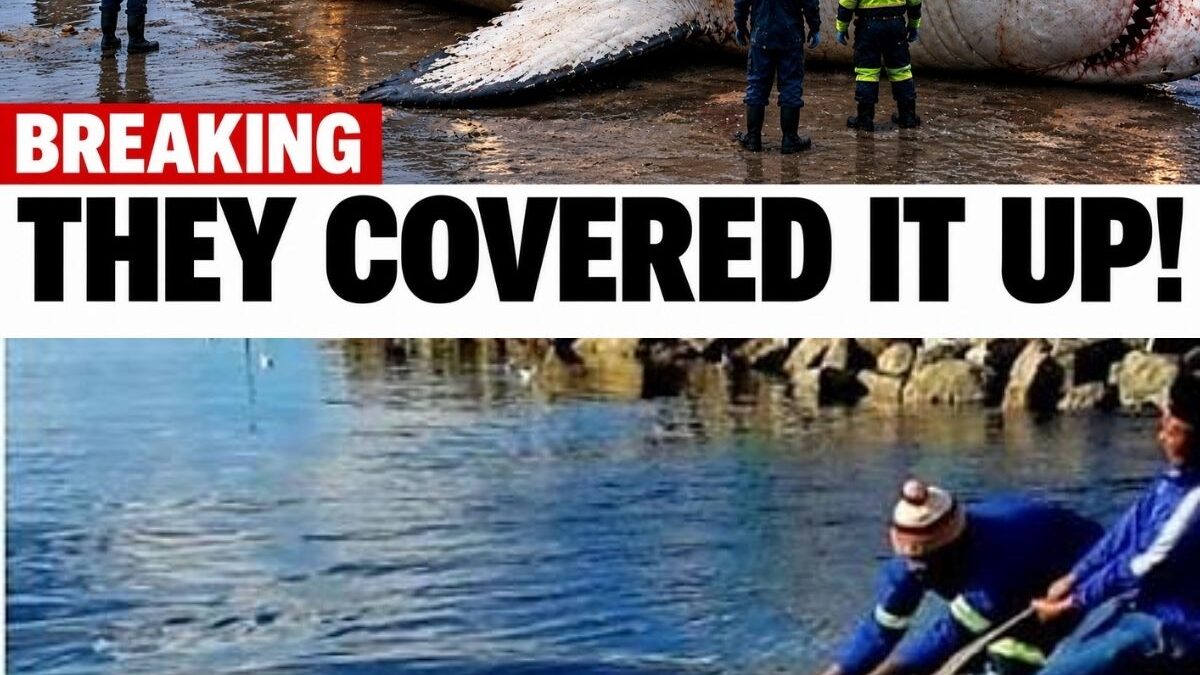
Someone was hosing blood off the sand before sunrise. No cameras, no statement, just a truck idling with its lights off, waiting on a beach outside Gans by South Africa’s own great [music] white shark capital. The whole operation was finished before the first tour boats even left the harbor. The skipper watching from the water couldn’t get close enough to see what they were loading, only that it took four men and a winch to manage it.
Cole Bramwell cut his engine and drifted in anyway, close enough to catch the smell before anyone waved him off. What Cole saw loaded onto that truck that morning is the reason he still won’t run his own boat past a certain reef line today, and the reason nobody from the Marine Reserve office has ever given him a straight answer about what it actually was.
“You need to move back,” the man on the sand called out, not shouting exactly, just pitch to carry over the winch noise. Cole knew that voice. Maro Delport ran the reserves beach office and in 11 seasons running charters out of this harbor. Cole had never once heard him sound like that. Not angry. Careful. Maro, Cole called, cutting the distance a little further.
You going to tell me what that is or am I finding out from someone at the dock in an hour anyway? Maro didn’t answer that either. He waved one of the four men over instead. said something Cole couldn’t catch over the winch, and the tarp got pulled tighter at the corners before anyone lifted it any further.
Cole idled closer anyway, close enough now to see the shape under the tarp clearly for the first time. A curve of pale belly too wide for anything he’d hauled a paying customer out to see in years of doing this exact job. The winch strained once, twice, the truck’s suspension dropping visibly on one side as the weight finally cleared the tailgate.
One of the four men working the tarp said something low to the others, and all four of them went quiet in a way that had nothing to do with the early hour. “That a shark?” Cole called back. Maro didn’t answer the question. He answered a different one instead. The one about whether Cole planned on causing a problem before the morning tourist started loading tourists at the dock. Cole backed his boat off.
He didn’t stop looking. By the time the truck pulled away, there was nothing left on that beach but wet sand and a smell that took two tide cycles to fully clear. Nobody at the harbor office would confirm what had been found. Nobody would deny it either, which told Cole more than a denial would have. He tied up at his own slip 20 minutes later and sat in the wheelhouse without starting his morning checklist, replaying the shape of that tarp against his own memory of a wound he’d already measured with his bare hands. 3 days earlier,
none of this had a name yet. It was just Trevor and Dovvu. Cole’s deck hand calling out that something had washed up against the kelp line before either of them had finished their coffee. They found her a/4 mile out, floating high and wrong. The way something floats when whatever should be keeping it upright from the inside isn’t doing that job anymore.
Trevor cut the engine well short of her, out of habit more than caution. And the two of them just watched the swell roll her gently against her own dorsal fin for a long moment before either of them said anything. Gauls hadn’t found her yet. That was the detail that stuck with Cole longest afterward.
How quiet the water was around something that size. Like even the birds knew to wait. She measured longer than Cole’s own boat. That alone wasn’t unheard of in these waters. Big females have always come through this stretch of coast. Decades of tagging data prove that much. What stopped Trevor cold wasn’t the size. It was the single wound behind her pectoral fin.
Precise enough that his first thought was surgery, not attack. Cole had spent 11 seasons reading white sharks off this exact coast. Close enough some mornings to count individual scars along a dorsal fin from the boat rail. He’d never once needed to look twice at a wound to know it didn’t belong. This one he looked at three times before he trusted his own red on it.
Here’s the part everybody in Gansby already knows. The part any local kid could tell you. [music] Orcas working this coast have been killing great whites for years now. Extracting the liver with a kind of surgical patience that still unsettles marine biologists who’ve watched the footage.
It’s the reason white sharks abandoned this stretch of water almost entirely for a stretch of seasons not long ago. The whole ecoourism economy here rebuilding itself around an absence nobody fully explained at the time either. [music] So the working theory wrote itself before anyone had even radioed in. Orcas again. Cole called Len Abrahams before he called anyone official because Len had fished this coast since before the reserve even existed and Len’s opinion mattered more to Cole than any report ever would.
Len came out that same afternoon, circled the carcass twice in his own skiff, and said the wound didn’t sit right to him. “Wrong angle,” Len said, tracing it with two fingers a foot above the actual wound, careful not to touch it. Orca’s come up from underneath. “This came in from the side.
” “Nobody argued with Len about sharks. Nobody ever had. Not once in the decades Cole had known him. Len had grown up on this exact harbor, [music] fishing it as a boy alongside his own father, before the reserve existed, before cage diving existed, before this town had any economy built around the animal at all. He didn’t say much else that afternoon.
He just kept circling slower each time, like a man checking his own memory against something he was hoping not to recognize. Dr. Braum Kowetsi arrived from the university research station the following morning. kit bag already out before his boat had fully tied off. He worked the wound margins the way Cole imagined a jeweler might work a stone.
Patient, wordless, occasionally asking Trevor to hold a light at a different angle without ever once looking up to check that he had. The liver was gone, same as every other case on this coast for the past several years. That part fit the pattern exactly. What didn’t fit was the entry wound itself.
A single puncture, not a bite, wide enough that Kowitzy measured it three separate times before writing the number down. He asked Trevor to hold the light steadier. His voice had changed by then. The careful flatness of a man narrating something for a report he already suspected he’d have to rewrite. A hard fact dropped with no cushion.
An adult orca’s jaw simply cannot open wide enough to leave a single puncture that size. Coetsi said it plainly the way you say something you’ve checked twice already. Then he went quiet for a long moment, running his glove along the wounds inner edge. He didn’t finish his sentence about what could leave a wound like that instead.
He started a new one about tissue samples, and Cole understood exactly why he’d changed the subject. Trevor asked quietly whether it could be a boat strike after all, a propeller catching her at some strange angle. Kowitzy said propeller’s tear. This wound hadn’t torn anything. They worked another hour in near silence after that.
Coitzi narrating measurements for a recorder nobody was really listening to anymore. All three of them just watching the water instead, as if something might surface to explain itself. Nothing did. The tide came in around their boots, and nobody moved to higher ground until it forced them to. That same afternoon, word reached Marno’s office before Cozy had even packed up his kit.
Someone on the dock had mentioned the wound measurement to someone else. The way things travel on a harbor small enough that everyone knows everyone’s boat by sound alone. Maro drove out himself, polite as always, and asked Coetsy for a preliminary copy of his notes for the reserve’s own records, a request that sounded routine enough that Cozy handed them over without thinking twice.
It wasn’t until that evening back at the station that Coitzy realized his own copy was now the only copy anyone could verify against. He told Cole about it that same evening, apology plain in his voice, the two of them standing on the dock in the kind of light that makes everything look calmer than it is. Cole didn’t say what he was thinking, which was that a man protective of his own paperwork usually has a reason beyond tidiness.
Peak season in Ganspy runs a matter of weeks, not months. And the whole town’s economy leans on tourists who book boats specifically to see white sharks that on a bad year may not even show up. Cole’s own boat had come back with empty cages more mornings than full ones over the past two seasons.
Same as every other charter working this harbor. All of them quietly hoping the sharks were simply late rather than gone for good. A story about something bigger than an orca working this same water wouldn’t just scare off one afternoon’s bookings. It could undo years of the town’s own slow rebuild. Maro never said any of that to Cole directly.
He didn’t have to. Cole had lived in this town his whole life. He understood the math without anyone walking him through it. Maro wasn’t a villain in this the way Cole sometimes wanted him to be. He’d grown up two streets over from Cole’s own childhood house, coached the same youth rugby side Cole’s nephew now played for, and had spent his entire career trying to keep a small town’s one real industry from collapsing under news it couldn’t control.
That didn’t make what he’d done with Kets’s notes right. It just made it harder for Cole to stay angry at him in any simple, satisfying way. Trevor’s own family ran the dive shop two doors down from the harbor office, a business that had survived one bad shark season already and likely couldn’t survive a second, worse one. That math sat with him differently than it sat with Cole.
Two mornings after that, the carcass disappeared from the cold room at the research station before Cozy had finished his own full workup. The paperwork authorizing its removal cited standard disposal protocol for a specimen posing a public health concern signed by an official at the reserve whose signature coetsi didn’t recognize from any prior case.
That removal is what Cole watched happen from the water at dawn 3 days after Trevor first spotted her floating in the kelp. The scene that opens this whole account. The truck, the winch, Maro’s careful voice telling him to back off. Worth sitting with for a second. The same skipper backing his boat away from that beach that morning had measured a wound with his own two hands three days earlier that no orca on this coast could have made. Len wasn’t surprised by any of it.
Not really. Once Cole finally sat with him properly over coffee, the old man admitted something almost identical had happened once before back when Len was young enough that nobody thought to ask his opinion about anything. A shark had washed up wrong that season too. he said quietly handled no report anyone ever saw gone from the beach within a day.
He’d never had a reason to think about it again until this week gave him one. His own father had been the one to find it decades before Len ever ran a boat of his own. And the old man had never once spoken about it again after that single afternoon. Len asked him about it exactly once, years later, and his father had only said that some things weren’t worth being right about [music] if being right meant nobody believed a word of it anyway.
Len didn’t have documentation. He didn’t have a chart to unfold on a kitchen table. No coordinates, nothing beyond a boy’s memory of a smell and a truck. What he had instead was a version of the same conclusion arrived at from a completely different direction, decades apart. Some things on this coast get handled quietly because handling them loudly costs someone money.
He looked older, saying that than Cole had ever seen him look on the water. What would you do running a business that depends entirely on an animal that’s already vanishing from these exact waters? That question sat with Cole longer than any answer Maro ever gave him. He kept taking bookings that week, same as always, telling paying customers the same honest halftruth every other boat on this harbor was telling theirs.
Sightings were down. Nobody knew exactly why. Hopefully, next season would be better. He stopped believing his own halftruth around the same time coits he called to say the tissue samples he’d managed to keep. The ones he’d quietly split off before handing over his notes hadn’t matched anything in the national reference database at all.
Not orca, not any cataloged shark species capable of that kind of bite. Nothing. Coetsi wouldn’t put that finding in writing yet. Not without more material to work from. and the only more material anyone had access to was already gone in the back of an unmarked truck. He told Cole off the record that he intended to keep looking regardless of what any official report eventually said.
2 days after that call, Cole took a cage diving charter out to the same general stretch of reef, further from the actual site than he’d ever admit to a paying customer on the boat that morning. Halfway through the second dive rotation, something passed beneath the cage close enough that every tourist aboard felt the pressure change through the hole before Cole saw a single thing on the surface.
He pulled the cage early, told the group it was standard caution around an unconfirmed large animal, and didn’t mention that his own hands were shaking on the winch worse than any clients ever had been. Nothing surfaced. Nothing [music] needed to. 10 days after the carcass disappeared, a research vessel running routine tagging work off the same reef line lost an expensive piece of equipment off its stern in about 4 seconds.
Cable and all in water calm enough that the crew initially assumed mechanical failure. They [music] hadn’t. The severed cable end recovered later matched nothing in the boat’s own maintenance log. The tagging crew’s own footage, what little of it survived the equipment loss, showed nothing useful. Just a sudden hard pull on the line and then slack gone before anyone on deck had time to look up from the winch.
Cole heard about it before Maro’s office issued any statement, the same way he heard about most things in this town from another skipper over radio in a voice trying hard to sound unbothered. He didn’t need Cozy to tell him what that meant. He’d already measured one wound with his own hands that fit exactly this pattern. Maro’s office called it publicly an unfortunate but unremarkable equipment failure.
[music] Cole has stopped expecting that office to call anything by its actual name. The research vessel’s own captain, a man Cole had never met before that week, called him directly two nights later, having heard through the same small harbor grapevine that he’d measured a similar wound himself. He didn’t ask Cole to go on record.
He just asked quietly whether Cole thought it was safe to keep running tagging operations anywhere near that reef at all. Cole told him the truth, which was that he genuinely didn’t know, and that not knowing was the part of this whole thing that scared him most. Cole still runs charters out of that same harbor, same boat, same reef line he’s fished his whole working life, [music] though he gives that one particular stretch a wider pass than he used to.
He started logging every unusual carcass, every strange sonar return, every severed line in writing now, copied to three separate people the same day it happens, a habit that cost him nothing and that Maro’s office has never once acknowledged receiving. Trevor still works the deck beside him, steadier now than he was that first morning, though he checks the kelp line every single trip out of habit that never quite wore off.
His family’s dive shop made it through that season after all, barely. On bookings that came back once word spread that Cole’s boat was still willing to go out and look plainly for whatever was actually left to find. Coy left the university research station within the year, citing reasons that had nothing to do with a missing shark carcass in any resignation letter he filed. He and Cole still talk.
Neither of them has stopped wondering what exactly took that single measured bite out of an animal already fighting to survive in these waters at all. Cozy kept his own tissue samples in the end, split off before Maro’s office ever asked for a copy of anything. Stored somewhere with no reserve paperwork attached to them at all.
He’s shown them to exactly two other researchers since. Both times off the record. Both times getting the same careful unfinished sentence back that he’d once given Cole and Trevor on that beach. Neither of those researchers has offered a name for it either. One of them, before hanging up, admitted he wasn’t sure he wanted to be the one who did.
Kowitzy told Cole that admission bothered him more than any measurement ever had. A scientist unwilling to name something isn’t being cautious. He said he’s being honest about what he’s actually afraid of. Len passed just last winter and at his memorial more than one old fisherman mentioned quietly a story from decades back about a shark that washed up wrong and disappeared just as fast.
Stories that had never once been compared against each other before that week finally forced the comparison. Maro still runs the beach office and he and Cole are civil now in the way two men are civil when they’ve both decided arguing further wouldn’t change anything either of them actually did. Whatever left that wound is presumably still working this coast, patient in a way.
Nothing this size should have any reason to be. The tourist boards still call this coast the great white shark capital of the world. On the brochures anyway, though nobody who works this harbor for a living says it quite that plainly out loud anymore. Trevor’s little cousins have started asking him the way kids do whether it’s true that something out past the reef ate a whole shark in one bite.
He tells them the honest version now mostly though he still leaves out the parts that would actually keep them up at night. If you’ve ever watched the people meant to protect something quietly protect themselves instead, tell us what that looked like where you live because Gans’s bias sharks are already disappearing faster than any one official wants to explain.

