20 Brutal Truths About Wedding Nights In The Victorian Era
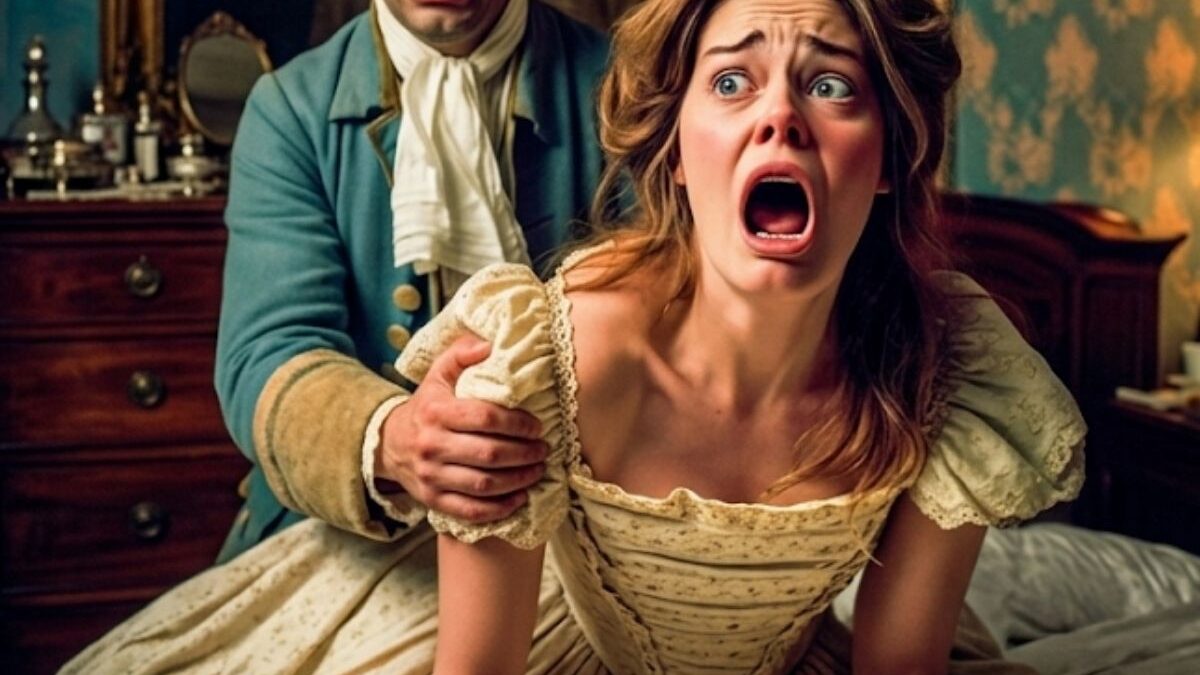
The heavy white cotton nightgown fell straight from her neck down to the cold floorboards. A solitary wax candle flickered quietly upon the dark mahogany nightstand beside the high bedstead. Outside the window panes, the dense London fog pressed damply against the glass in the late chill.
She sat perched upon the edge of the mattress, listening intently to the clock striking nine. She had never once in her entire eighteen years been left entirely alone in a room with an adult man. Her upbringing had been an unyielding exercise in supervision, designed to shelter her from the world.
Her mother had entered her bedchamber early that very morning, adjusting the lace veil with rigid fingers. The older woman had leaned close, exhaling a quiet breath scented with peppermint and faint lavender water. She had spoken only a single, cryptic phrase before departing for the church nave.
“A wife’s true honor lies in quiet endurance, my child.”
The girl had blinked back her questions, completely unable to decipher the cryptic warning. She had waited for some clearer explanation of what lay ahead, but none had followed. Her mother had simply pressed her dry lips together and turned away toward the hallway.
Now the heavy brass latch clicked into place, and the bedroom door closed from within. The voluminous wedding gown of pristine silk had already been removed and carefully set aside. Everything else awaiting her within this chamber was ancient, far older than the modern fabric of her trousseau.
It was older than the Common Law statutes that had bound her into this private room. It was older than the solemn liturgy of the church that had blessed their union that afternoon. The groom turned slowly away from the locked door, his tall shadow stretching across the floral wallpaper.
Popular modern imagination has long romanticized the nineteenth-century wedding night as a tableau of tender discovery. The period dramas of the contemporary screen offer viewers a vision of trembling innocence met by patient devotion. They bathe the chamber in soft golden light, lingering upon hesitation before discreetly fading away into darkness.
That sanitized rendering serves the commercial appetite of modern audiences seeking comforting nostalgia. The historical reality preserved within archival documents tells an entirely different and harrowing tale. It survives not in romantic fiction, but within coroner reports, court depositions, and medical treatises of the period.
Those yellowed pages do not describe a tender awakening between two willing partners. Instead, they outline an elaborate, institutionalized machine constructed to guarantee domestic submission. Every social convention and statute worked in harmony to isolate the bride beyond the reach of help.
The white dress that she had worn that morning was never originally conceived as an emblem of chastity. When young Queen Victoria married Prince Albert on February 10, 1840, her choice was driven by economic patriotism. She had commissioned an exquisite flounce of handmade Honiton lace from the artisans of Devon.
Her primary desire had been to provide a plain backdrop that would display the delicate English needlework. Before that royal ceremony, ordinary brides simply wore the finest, most serviceable gown hanging in their wardrobes. They married in deep blue, somber gray, practical brown, or even plain black cloth.
Those sturdy garments were intended to be worn to church services and social visits for years afterward. The mythology linking pristine white cloth to bodily purity was manufactured decades later by Victorian moralists. Etiquette manuals from the 1860s onward retroactively attached strict theological virtues to the immaculate white palette.
The popular press amplified this romantic invention until the myth thoroughly displaced the practical history. By the end of the century, brides were cloaked in artificial symbols of angelic cleanliness before dusk arrived. The innocent costume served as the first deception of the day, disguising property transfer as holy perfection.
For a young middle-class woman preparing for marriage, education regarding physical intimacy was nonexistent. Conduct manuals rigorously instructed mothers to safeguard a daughter’s modesty by maintaining absolute silence. Ignorance was deliberately mistaken for purity, and curiosity was treated as an alarming symptom of moral degeneration.
Writing in 1887, Dr. Charles Hoff described the ideal bride in terms that revealed the era’s bizarre priorities. He painted her as an exquisite, helpless creature trembling beside her new master in complete mystification. Society took profound pride in ensuring that an educated girl remained entirely blind to basic human anatomy.
George Hudson’s 1883 marriage guide for young gentlemen went even further down the path of paranoid suspicion. He cautioned grooms that any bride who displayed the slightest awareness of marital duties was already corrupted. He explicitly cited vigorous horseback riding and overly frequent warm baths as dangerous, lewd influences.
“A maiden’s mind must remain as unblemished as unprinted parchment,” one widely read pamphlet declared.
Most young women stepped across the threshold having received nothing beyond a vague whisper about wifely patience. Others entered the bedchamber with zero preparation, expecting merely to converse quietly until dawn arrived. Working-class women often possessed slightly clearer notions, gained from living within crowded, single-room tenements.
Yet witnessing the unavoidable physical realities of adult life in cramped quarters did not equal true agency. Information acquired through spatial poverty without legal power to refuse access provided no genuine defense. It was merely exposure to vulnerability without any recognized vocabulary to negotiate boundaries.
The groom’s preparation stood as the mirror image of the bride’s total deprivation of knowledge. While women were kept in deliberate darkness, young men were directed toward authoritative medical manuals of the day. The most influential voice on sexuality in Victorian Britain was undeniably Dr. William Acton.
In 1857, Acton published his definitive medical study regarding the reproductive organs and their functions. His authoritative verdict became the unquestioned doctrine across middle-class dining rooms and medical consulting chambers. He assured his male readership that respectable women were practically devoid of physical passion.
“The majority of women, happily for society, are not very much troubled with sexual feelings of any kind,” Acton wrote. “A modest woman seldom desires any sexual gratification for herself. She submits to her husband, but principally to gratify him.”
This declaration provided a convenient moral absolution for the demanding young husband. If a respectable wife was physiologically incapable of pleasure, her audible distress required no hesitation on his part. Her shrinking horror was not read as terror, but as welcome validation of her feminine virtue.
The medical literature did not encourage a groom to cultivate reciprocal affection or gentle patience. It trained him to expect passive compliance from a person whom science declared to be inherently numb. The stage was deliberately set for an encounter that resembled an entitlement far more than mutual intimacy.
The clothing constructed for the night reflected this profound dread of the human body. The Victorian bridal nightgown was an architectural feat of thick, unyielding white cotton or heavy flannel. It was cut to fall straight from a collar buttoned tightly under the chin down to the slippers.
The sleeves were gathered tightly at the wrists with stiff cuffs, completely obscuring the arms. Some garments featured a tiny vertical slit in the lower front seam, secured by fabric loops. Others were cut with voluminous folds designed to be partially gathered upward without uncovering the torso.
Wealthier families purchased gowns constructed of finer cambric or lawn cloth trimmed with expensive thread. Poorer women wore coarse, unbleached calico that scraped harshly against the skin in the chill. Yet the underlying principle governing the design remained perfectly identical across every social stratum.
The garment was meticulously engineered to minimize the surface area of skin exposed to human sight. Modesty was not treated merely as an abstract state of mind within the Victorian domestic sphere. It was physically stitched into heavy textile, measured in linear yards, and anchored with dozens of porcelain buttons.
The human body was treated as something inherently scandalous that must not be revealed even during consummation. The act itself was reduced to an unacknowledged necessity that should ideally remain invisible to both participants. The thick cotton stood as a tactile barrier between two strangers who happened to share a legal name.
The physical setting in which this encounter took place was dictated entirely by social class. For a wealthy couple, the first evening might unfold in a private suite at a fashionable coastal hotel. Even there, the presence of maidservants and traveling companions hovered just beyond the heavy wooden portal.
For the vast majority of the population, however, true architectural privacy remained an impossible luxury. Historian Vicky Holmes documented the domestic arrangements of ordinary working-class families through nineteenth-century inquests. Her research revealed that newly married couples rarely possessed the means to secure an isolated bedchamber.
Many young couples spent their first marital evenings sharing an unheated room with parents or in-laws. Some shared a wide straw mattress with siblings, while others huddled behind a tattered suspended curtain. The romantic trope of the solitary, candlelit chamber was a reality reserved exclusively for the wealthy elite.
For millions of ordinary subjects, the initial marital act occurred within direct earshot of waking relatives. Every sound, hesitation, and muffled cry was audible through thin plaster walls or flimsy cloth partitions. The harsh exposure of poverty stripped away even the illusion of personal dignity from the newly wedded pair.
The post-wedding journey itself bore little resemblance to the restorative vacation known as the modern honeymoon. The term existed, yet the traditional bridal tour was an exhausting exercise in social obligation. Newly married pairs embarked upon an extensive circuit of formal visits to distant relatives across the counties.
The Marriage Acts of 1753 and 1836 had legally standardized the civil and religious requirements of weddings. However, the subsequent weeks remained strictly governed by familial protocol rather than romantic seclusion. Couples traveled across soot-stained railways to sit uncomfortably in drawing rooms, accepting congratulations over cold tea.
Literary scholar Helena Michie noted that contemporary travel guides carefully danced around the true nature of these tours. Writers employed elaborate, strained euphemisms, circling around marital consummation without ever daring to name it directly. Family chaperones frequently traveled alongside the newly married pair during the opening days of their excursion.
The concept of two lovers retreating entirely alone to a scenic landscape remained rare until late century. Only families possessing substantial disposable income could afford extended hotel lodgings without hosting relatives. For everyone else, the bridal tour was a public performance staged for the approval of an extended clan.
The morning after the wedding brought a silent, harrowing evaluation of the bed linen itself. Across Britain and wider Europe, the cultural demand for proof of virginity remained absolute and unforgiving. A spotless white sheet was expected to bear visible crimson stains when the chambermaid arrived to stoke the grate.
The presence of blood was treated as definitive physical evidence of an intact, untouched maidenhood. Its absence immediately triggered quiet suspicion that could sour an entire domestic lifetime within a few moments. A young husband might keep his grievance private, yet the doubt lingered permanently over the household.
Victorian medical understanding of the female anatomy was astonishingly crude, dogmatic, and flawed. Most practicing physicians taught that bleeding was universal, inevitable, and entirely necessary during initial intercourse. They completely ignored the physiological variability of tissues, condemning innocent women through gross ignorance.
Resourceful women across continental Europe and rural districts occasionally devised desperate remedies to survive the morning inspection. Folklore records brides concealing tiny vials of animal blood or pricking their fingers to mark the cloth. In British towns, the expectation remained unspoken aloud, yet it hung over the chamber like an executioner’s blade.
A young woman whose body failed to produce the required stain was marked by lifelong distrust. No subsequent devotion, church attendance, or domestic thrift could ever entirely erase that initial, secret failure. Her physical biology had been placed on trial, and the verdict was rendered without recourse to appeal.
When the minister concluded his blessings and the chamber door locked, the bride ceased to exist legally. Sir William Blackstone had defined this reality unequivocally in his famous Commentaries on the Laws of England. Under the common law doctrine of coverture, the legal existence of a woman was suspended during marriage.
“By marriage, the husband and wife are one person in law,” Blackstone famously summarized. “And that person is the husband.”
Her land became his land to manage, lease, or sell according to his sole personal judgment. Her wages, if she worked long hours in a textile mill, belonged exclusively to his pocket. Most crucially, her physical person was transferred into his absolute custody as an item of property.
The Married Women’s Property Acts of 1870 and 1882 slowly restored financial rights to wedded women. Yet those reform statutes addressed ledgers, stocks, and family inheritances rather than physical personhood. The husband’s unyielding legal claim over his wife’s flesh remained embedded in the bedrock of British jurisprudence.
Under this legal framework, a Victorian wife possessed no recognized right to refuse her husband’s advances. The very concept of marital rape was an impossibility within the language of nineteenth-century English law. Sir Matthew Hale had formulated the foundational doctrine centuries earlier, and it governed the courts without interruption.
Hale had decreed that upon entering the marriage contract, a woman surrendered her body to her husband irrevocably. That ancient vow was interpreted as permanent, unconditional consent that could never be retracted under any circumstance. Neither tears, illness, nor vocal objection carried any weight before the magistrates of the realm.
A man who overpowered his wife behind closed doors broke no law and violated no legal statute. The criminal codes did not even possess a name for an assault committed against an unwilling spouse. English law maintained this brutal doctrine until the House of Lords finally dismantled it in the autumn of 1991.
If a wife fled her home or refused to share her husband’s bed, he turned to the courts. He could petition the legal system for what was termed the restitution of conjugal rights. This process empowered the law to command an estranged wife to return immediately to her marital obligations.
Prior to 1884, a woman who defied that judicial decree was promptly arrested and thrown into prison. She was locked away inside a cell not for theft or violence, but for withholding access to her flesh. The state operated directly as the enforcement agent for the husband’s bedroom demands.
The Matrimonial Causes Act of 1884 eventually removed imprisonment as a penalty for domestic disobedience. Yet the judicial decree itself remained intact, operating as a weapon of public humiliation and financial ruin. A woman’s bodily autonomy was not treated as a human right, but as a breach of civil contract.
This entire framework was justified by medieval canon law, which framed marriage as an inescapable physical debt. The doctrine claimed that each party owed a mutual sexual obligation to the other partner throughout life. In daily practice, however, that mutual obligation flowed in precisely one direction down the social ladder.
The husband was the sole creditor who demanded payment, while the wife was the eternal debtor who submitted. The bedroom was never a private domestic sanctuary shielded from the cold reaches of government power. The authority of the state stood firmly behind the husband, brandishing the keys of the church.
The grotesque reality of this legal tyranny was demonstrated clearly in the famous 1891 Clitheroe abduction case. Emily Hall had married Edmund Haughton Jackson in Lancashire in 1887, but soon refused to reside with him. Jackson obtained a court order demanding the restitution of his conjugal rights, which Emily firmly ignored.
On March 10, 1891, as Emily was stepping out of church, Jackson ambushed her in the public street. With the help of hired accomplices, he dragged her screaming into a waiting carriage and sped away. He brought her to a residence in Blackpool, stationing six guards around the doors to prevent her flight.
When relatives summoned the local authorities, Jackson merely held up his legal court order to the constables. The lower courts initially ruled in his favor, affirming an Englishman’s ancient right to imprison his own wife.
“Ill-treatment apart,” the lower bench affirmed, “a husband has the right to detain his wife if he chooses.”
Emily’s family pursued an emergency appeal that eventually reached the high bench of the Lord Chancellor. Lord Esher reviewed the lower decision with searing indignation, striking down Jackson’s claim of physical ownership.
“If this is the law,” Lord Esher declared, “then an English wife is the mere slave of her husband.”
Emily was formally liberated from the house, but the victory brought little peace in her home district. When she returned to Clitheroe, a furious crowd gathered outside her windows, singing songs in Jackson’s honor. The local community stoned her family home, enraged that a woman had defied her husband’s ownership.
Beyond the severe legal constraints, the raw physical pain of the initial encounter was deliberately obscured. Nineteenth-century medical journals acknowledged that initial intercourse often resulted in physical trauma for the woman. Yet this agony was casually dismissed as an inevitable milestone of maturation that required no mitigation.
Dr. Elizabeth Blackwell, the first woman listed on the British Medical Register, dared to write the truth. In 1878, she published her groundbreaking volume, Counsel to Parents on the Moral Education of Their Children. She wrote courageously of the severe physical and emotional suffering inflicted upon brides by hasty, ignorant men.
Blackwell stood virtually isolated among her medical peers in acknowledging the brutality of these unguided unions. The overwhelming majority of family health manuals addressed the groom’s pleasures and rights with clinical detachment. The bride’s internal experience remained completely absent, deemed inappropriate for print or open conversation among respectable folk.
No parent explained to a daughter that initial intimacy might cause physical tearing, bruising, and severe bleeding. No physician provided practical advice on easing physical tension or allowing the body time to adjust naturally. Women were expected to suffer in total, bewildered silence, lacking even the words to describe their distress.
A silent, devastating hazard frequently accompanied the young husband into the bridal bedchamber without warning. The prevailing social double standard actively encouraged young gentlemen to sow their wild oats before marriage. Wealthy men routinely visited brothels or seduced working-class domestic servants throughout their university and bachelor years.
These premarital encounters frequently left the men infected with virulent, poorly understood strains of venereal disease. Syphilis and gonorrhea were rampant throughout Victorian towns, lurking beneath fine wool coats and distinguished manners. Grooms frequently entered the wedding chamber carrying active infections, mistakenly believing themselves cured by primitive mercury treatments.
One London physician writing in the late 1890s recorded the tragic deterioration of an innocent newlywed patient. Just six weeks after her joyous church wedding, the young woman presented with severe internal pain and fever. Her husband was a respected vestryman and pillars of local society, considered by all to be spotless.
It took the physician four agonizing years to diagnose the cause of her irreversible pelvic inflammatory condition. Her pious husband had contracted gonorrhea during a drunken bachelor party shortly before the ceremony. The bride, kept ignorant to protect her innocence, had been permanently crippled by the man she trusted.
The medical establishment of the period routinely conspired to keep such catastrophic truths hidden from wives. When a husband transmitted a venereal infection to his bride, doctors almost universally concealed the true diagnosis. The medical practitioner was employed and paid by the husband, and his professional loyalty remained there.
The woman was informed that she suffered from routine inflammation, nervous fatigue, or constitutional delicacy of the womb. Medical textbooks even coined a specific Latin classification to describe these countless domestic tragedies: Syphilis insontium. It translated literally as “syphilis of the innocent,” a term reserved exclusively for afflicted wives and newborns.
The husband who had introduced the disease into the nursery was never characterized as an innocent victim. Yet his reputation was protected by the family doctor, while his wife swallowed toxic mixtures without understanding. In numerous documented case files, physicians watched wives lose their sight or fertility without ever offering a warning.
The wedding night served as the opening act of an exhausting, decades-long cycle of rapid childbearing. Modern contraceptive methods were strictly forbidden to respectable Victorian women, denounced as sinful and morally degraded. Within mere weeks of their first night together, a newly married bride frequently found herself pregnant.
Queen Victoria herself conceived within fourteen days of her wedding, writing bitterly in her private diaries afterward. She despised the physical indignities of pregnancy, complaining that childbearing reduced an educated sovereign to a common animal. Yet for women without royal wealth, endless pregnancies were a direct path toward bodily ruin and death.
The prestigious pages of The Lancet were filled with grim case reports of maternal exhaustion and mortality. Repeated annual births depleted calcium from the bones, decayed teeth, and brought premature aging to youthful faces. The initial marital night was not an isolated event, but the commencement of an inescapable biological sentence.
To escape this relentless physical toll, wealthy couples frequently established separate bedchambers across their estates. This domestic separation was publicly rationalized as a sensible measure for maintaining refined decorum and proper air circulation. In reality, it constituted the sole practical defense of bodily autonomy accessible to a married woman.
A wealthy wife with her own dressing room could secure the door with a sturdy brass bolt. She could claim sudden invalidism, headaches, or nervous exhaustion to keep her husband outside her private territory. For a working-class woman sharing a solitary straw mattress in an attic, no such evasion existed.
The physical layout of the Victorian residence directly reflected the harsh realities of power and class control. Privacy was a commercial luxury purchased with high rents, heavy draperies, and sprawling architectural layouts. For the poor, the legal obligation of conjugal access was enforced every single night upon a shared bed.
When the reality of marital life became unendurable, some desperate brides simply ran away into the night. Archival court files contain accounts of young women fleeing their marital chambers within hours of the ceremony. Some ran through dark streets back to their childhood homes, weeping hysterically and pounding upon locked family doors.
In 1859, eighteen-year-old Mary Sedgwick was wed to an older gentleman and fled almost immediately after the ceremony. The surviving legal fragments describe a young girl plunged into overwhelming, bewildered terror by the unexpected demands made of her. Yet nearly every documented bride who sought refuge with her family was firmly delivered back to her husband.
Parents feared the catastrophic social scandal that followed an abandoned marriage far more than their daughter’s distress. Furthermore, the husband retained absolute legal authority to demand his wife’s return through the local magistrate’s court. A wife who abandoned her post brought financial disgrace upon her parents and legal complications regarding her dowry.
If a desperate bride sought a legal annulment, she was subjected to an excruciating public ordeal. An annulment required definitive proof that the union had never been physically consummated by the parties. This demanded intrusive physical inspections performed by teams of male physicians, followed by humiliating testimony in open court.
Most women quickly realized that the legal machine possessed no mechanism to register their absence of consent. The law recognized no grievance, the church recognized no grievance, and the community demanded immediate obedience. Those who fled were returned, and those who remained learned to endure their circumstances without speaking.
The suffocating silence surrounding these bridal experiences was finally challenged directly in the late nineteenth century. In 1893, an author writing under the pseudonym George Egerton published a scandalous short story collection titled Keynotes. The author was Mary Chavelita Dunne Bright, an observant woman who refused to romanticize domestic captivity.
Her most daring story, titled “Virgin Soil,” laid bare the wedding night of an innocent, unprepared young bride. Egerton depicted the encounter not as a romantic awakening, but as an act of physical violation. She demonstrated how societal ignorance and male legal entitlement combined to crush a woman’s spirit on her wedding night.
The conservative literary press erupted with fury, condemning the stories as thoroughly unwomanly and grotesque. Critics were horrified that a female writer had pulled aside the velvet curtains to reveal domestic coercion. Yet Egerton had accurately named what generations of women had suffered in isolated silence across the empire.
Modern costume dramas have systematically erased this legacy, replacing systemic coercion with charming cinematic romance. We are served handsome actors, tender hesitations, and delicate lace drifting toward a soft feather pillow. We observe the opulent four-poster bed behind velvet museum ropes, accompanied by neatly scripted educational placards.
The museum showcases the handmade Honiton lace, the monogrammed silver brushes, and the delicate embroidered slippers. It does not display the court orders for marital restitution, the medical speculums, or the Blackpool barricades. The sanitized fantasy remains profitable, while the historical reality of domestic subjugation is quietly pushed aside.
The locked door of the Victorian bedchamber was never installed to protect the fragile modesty of the bride. It was constructed to conceal the operations of a state-sanctioned transfer of human liberty and property. It hid the legal fiction of coverture that erased her identity the moment she spoke the vows.
It masked the medical dogma that declared her body incapable of feeling natural passion or acute pain. It shielded the social convention that demanded she enter the room in total blindness to the world. It preserved the economic system that denied her custody of her own wages, her children, and her flesh.
The woman entered the marital chamber as an individual possessing thoughts, hesitations, and an independent human spirit. Under the laws of the realm, she emerged the following dawn as the legal possession of her master. The door was locked not to guarantee her safety, but to ensure that society never looked upon the price exacted.

