Why Was the Nazi Hunter Built in Argentina Erased from History?
Why Was the Nazi Hunter Built in Argentina Erased from History?
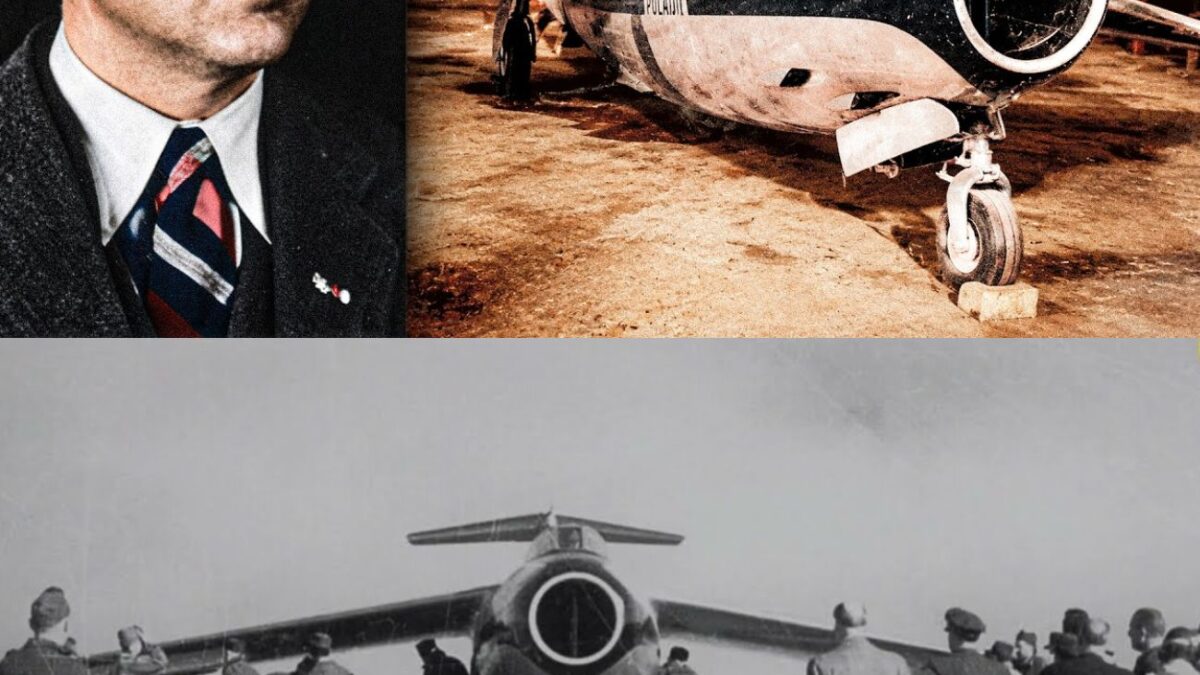
One of the greatest fighter engineers of the Third Reich fled devastated Germany using a false name on his passport. Years later, he was building the most advanced fighter jet in Latin America for the government of Juan Domingo Perón. Today, you will learn the story of the Pulqui II, a Nazi-designed fighter plane built on Argentinian soil. Pay attention, because this story is controversial and nobody is talking about it.
To better explain the history of this fighter jet, we need to go back quite a bit in time, more specifically to 1945, with Germany in ruins and a man named Kurt Tank needing to quickly decide what to do with the rest of his life. Tank was no ordinary man; he had been one of the leading aeronautical engineers of the Third Reich, the technical director of Focke-Wulf, and the mastermind behind legendary fighters such as the Fw 190, considered to this day to be one of the best piston-engined fighters of the entire Second World War and a true nightmare for any Allied pilot who crossed its path. At the very end of the war, he also worked on the Ta 152, a high-performance variant of the Fw 190 designed to operate at high altitudes—an aircraft so advanced that it practically had no time to see action before the German surrender.
He also held the blueprints for a jet fighter that never got to fly: the Ta 183, an aircraft with swept wings designed to fight against Allied bombers that Germany could no longer stop. It was a project that existed only on paper and in a wind tunnel, but one that carried such advanced ideas that it would years later help shape other fighter jets far beyond German borders. But that is a topic for a little later.
With the war lost, engineers like Tank became treasure items. The victorious powers knew exactly the value of what they held: cutting-edge technical knowledge, hastily constructed under the pressure of war, capable of accelerating aeronautical development by years for whoever managed to secure it first. The United States took its scientists into secret programs. The Soviets, in turn, simply dragged German engineers by force into the Soviet Union itself, without much ceremony. But unlike many of his colleagues who were recruited practically by kidnapping, Tank tried to negotiate his own exit as a free man, choosing his own employer. He knocked on the British door, but they were not interested enough. He knocked on the Chinese door in a negotiation that also went nowhere. He even flirted with a Soviet offer through a contact who would later defect to the West. None of those doors opened the way he wanted.
That is when Argentina entered the story. In the late 1940s, the country was under the rule of Juan Domingo Perón, a leader who wanted to put Argentina on the map as an industrial and military power at all costs. At a time when much of Latin America was still viewed by the major powers as merely a supplier of raw materials, Perón saw a rare opportunity in the scientists and engineers defeated in Germany—people with cutting-edge knowledge, desperate for a place to start their lives over, and willing to work for far less than they would be worth abroad. The country opened its doors in a way that no other South American nation had done at that time. And it was not just aviation engineers; doctors, physicists, and other German professionals also crossed the Atlantic in this same wave, seeking in Peronist Argentina the fresh start that a ruined Europe could no longer offer.
Kurt Tank entered Argentina in 1947 under a false name, Pedro Matthies. But curiously, he did not need to maintain that facade for very long. He was received with a surprisingly warm welcome, with no one demanding many explanations about his recent past in Nazi Germany, and soon he was officially working for the Argentine Aerotechnical Institute on a project that promised to place the country among the few nations in the world capable of building its own jet fighters.
However, Tank did not arrive at the project alone. Before him, the Argentines had already put another figure with a murky past to work on a national fighter jet: the Frenchman Émile Dewoitine, designer of the D.520, one of the best French fighters of the Second World War. After the fall of France, Dewoitine had collaborated with the Nazis building training planes for the Luftwaffe. Accused of treason by the post-war French government, Dewoitine fled first to Spain and from there to Argentina, where he helped develop the country’s first jet prototype, named Pulqui, a word in the Mapuche language meaning arrow.
In other words, even before Kurt Tank set foot on Argentine soil, the country already had quite a club of foreigners with complicated resumes, all working side by side in the same city, pursuing the same goal: to give Perón’s Argentina a domestically manufactured jet fighter.
Remember that this first plane, the Pulqui I, is just the prologue to our story, but it matters because it explains why Argentina went after Kurt Tank in the first place. Designed with the participation of Dewoitine, the Pulqui I was the first jet aircraft designed and built entirely in Latin America. In appearance, it looked very modern: swept wings, a single British jet engine, and a tricycle landing gear. From a distance, it could be mistaken for anything the Soviets or Americans were producing at the time. But appearances were deceiving. In practice, the Pulqui I had a top speed of just over 700 kilometers per hour, essentially the same performance as a World War II propeller-driven fighter like the American P-51 Mustang. Furthermore, its flight qualities were terrible. The plane was unstable, difficult to fly, and the Argentine engineers themselves soon realized that the design had reached the limit of what could be improved. Only one prototype was ever built.
It was precisely during this moment of frustration that Kurt Tank emerged as the next big gamble. He brought with him something the Argentines did not have: the microfilm drawings of the Ta 183. The German fighter plane, despite never having flown, was considered one of the most advanced designs of the entire Second World War. And here is the most ironic part of this whole story: those same Ta 183 designs, captured by the Soviets at the end of the war, had directly influenced the development of one of the most important fighter jets of the Cold War, the Soviet MiG-15, the exact aircraft that years later would face Americans in the skies over Korea. In other words, the framework of ideas that gave rise to the Soviet aircraft that terrified the West was essentially a cousin of the aircraft that was about to be born in Argentina.
Faced with this scenario, the Argentine government made a pragmatic decision. Instead of choosing between Dewoitine’s team and Tank’s team and risking seeing one of the projects fail alone, Perón decided to merge the two into a single venture. Thus, the Pulqui II was born. Kurt Tank took the old Ta 183 project—that German fighter that never made it past the drawing board—and adapted everything to a British Rolls-Royce Nene engine, which was far more powerful and much more reliable than anything Germany had available in 1945. It was practically a marriage between cutting-edge German aerodynamics and British engine technology, which at the time was considered among the best in the world.
The result was a larger, heavier aircraft, but also far more ambitious than the Pulqui I had ever been. On paper, the numbers were impressive: the Pulqui II reached speeds of around 1,000 to 1,120 kilometers per hour, bringing it very close to the sound barrier. Its service ceiling reportedly varied between 11,000 and nearly 15,000 meters in altitude, with an autonomy of more than two hours of flight. They were designed to compete on equal terms with the most modern fighter jets of the early Cold War, such as the Soviet MiG-15 and the American F-86 Sabre—the very same two planes that shortly afterwards would star in the first jet-versus-jet duels in history in the skies of Korea.
On June 27, 1950, the Pulqui II took off for the first time. It was a moment of immense national pride for Perón’s Argentina. The country that just a few years earlier barely had its own aeronautical industry now boasted a front-line jet fighter, designed by one of the biggest names in German military aviation, technically competing with the most modern aircraft in the arsenals of the United States and the Soviet Union. The government press treated the flight as concrete proof that Argentina was definitively entering the exclusive club of major industrial powers—a speech that perfectly matched Perón’s political project, which was always willing to use technological achievements as a showcase for the nation.
However, behind the impressive numbers on paper and the euphoric headlines in the official press, the program was already silently sinking into serious problems that nobody wanted to see. Investigations and tests gradually revealed that the Pulqui II had a severe structural flaw: it was aerodynamically unstable. At certain angles of attack, the aircraft would enter a deep stall, a dangerous condition in which the plane loses lift in a way that is almost impossible to recover in mid-flight, and which at that time was still a poorly understood phenomenon even by the most experienced engineers in the world. It was not a problem unique to the Pulqui II, but that did not make the situation any less frightening for the test pilots trying to bring the plane back to the ground intact.
And the troubles did not stop there. Although Argentine industry was modernizing by leaps and bounds, it still did not possess the same level of manufacturing technology as the major powers that had dominated military aviation for decades. Parts manufactured with inferior-quality welds compared to those used in Europe and the United States became a constant hazard—the type of invisible flaw that does not show up on a quick inspection, but can rupture at the worst possible moment thousands of meters high in the air. During one of the test flights, that exact scenario played out when a poorly executed weld failed, costing the life of a test pilot. Out of the four prototypes built during the program, two were lost in fatal accidents. This was an enormous loss rate by any aviation standard, reflecting less on the competence of the Argentine engineers and more on the immense difficulty of trying to build a cutting-edge aeronautical industry practically from scratch in a country with virtually no prior experience in the field.
Interestingly, even with this turbulent history, the aircraft’s performance still impressed foreign observers whenever everything functioned as intended. There were even genuine signs of interest from countries like Egypt and the Netherlands, which seriously considered purchasing the Argentine fighter jet to equip their own air forces. Domestically, the Argentine Air Force even proposed purchasing 100 Pulqui II aircraft to re-equip its fleet—a far from modest number for a program that had already suffered numerous setbacks. It seemed that, despite everything, the program still had a promising path ahead. The growing pains appeared manageable, international interest was real, and all that was lacking was time and money to mature the project.
Then, an adversary entered the scene that no engineer, however brilliant, could defeat on paper alone: politics and a financial break with the government. Kurt Tank had a contract with the Argentine government that was set to expire in January 1955, and when it came time to renegotiate, he made a demand that was poorly received: he asked for almost double his previous salary to continue on the project.
Perón himself refused. It is not hard to understand both sides of this negotiation. On one hand, Tank knew exactly how much he was worth. He was, without exaggeration, one of the most capable aeronautical engineers still alive at that time—someone whom major powers like Great Britain and the Soviet Union had tried to recruit years before. A man like that is rarely content to receive the same salary forever, especially after years of delivering concrete results, even if imperfect ones. On the other hand, the Argentine government, which was already facing mounting economic difficulties well before any clear sign of political crisis, was simply not willing to double the fee of a single man, however talented or irreplaceable he might seem.
It was an impasse that was easy to understand and difficult to resolve, as neither side wanted to give in. The result was Kurt Tank’s departure from the program he had shaped from its very inception—from the initial drafts based on the old Ta 183 to the aircraft that took off in 1950. After years of shaping every detail of that project, the creator himself walked out the door, leaving behind an initiative that, without his guidance, lost its technical direction.
Without its lead engineer, the development of the Pulqui II virtually stalled. A third prototype flew in August 1953 featuring modifications designed to correct the instability problems, such as small fences installed on the wings, reinforcements to the rear fuselage, and a pressurized cabin. There were even preliminary plans to manufacture 100 units, including a radar-equipped version for day and night operations. But Tank’s departure stripped away the technical momentum needed to turn those ambitious plans into mass-produced realities within the deadlines and budget the Argentine government was willing to finance.
The story reached a strange and dramatic climax in September 1955, when Argentina plunged into an armed revolution against Perón’s government known as the Liberating Revolution. In a bizarre twist of fate, the sole remaining prototype of the Pulqui II—the very plane meant to symbolize the industrial pride of Peronism—ended up being used during the conflict that ousted Perón from power. The exact details of how the aircraft participated in the fighting remain murky to this day, but the symbolism is undeniable: the fighter that was supposed to secure the strength of a regime was dragged into the very revolt that brought it down.
Following Perón’s downfall, devoid of political backing, lacking its visionary engineer, and drowning in unsolved technical and financial hurdles, the Pulqui II program was quietly cancelled. Argentina’s dream of becoming a global aviation powerhouse died alongside the government that funded it.
Kurt Tank did not remain idle. He spent some time working in Argentina on another ambitious project called the Condor, which never advanced past the mock-up stage, before moving to India. There, in 1956, he helped design the HF-24 Marut, the first domestically manufactured jet fighter for the Indian Air Force, an aircraft that would later see combat against Pakistan. This proved that Tank’s technical ingenuity remained globally sought after, even after his South American venture concluded.
Today, a restored Pulqui II sits on display at the National Aeronautics Museum of Argentina in Morón, greater Buenos Aires, serving as a tangible monument to an era when the nation dared to dream big. What remains of this story is more than just the memory of a flawed plane; it is a vivid portrait of how the devastation of a world war scattered the remnants of a fallen regime across the globe, unexpectedly shaping the destiny of countries far removed from the conflict itself.

