Why do we know that the woman was already dead?
Why do we know that the woman was already dead?
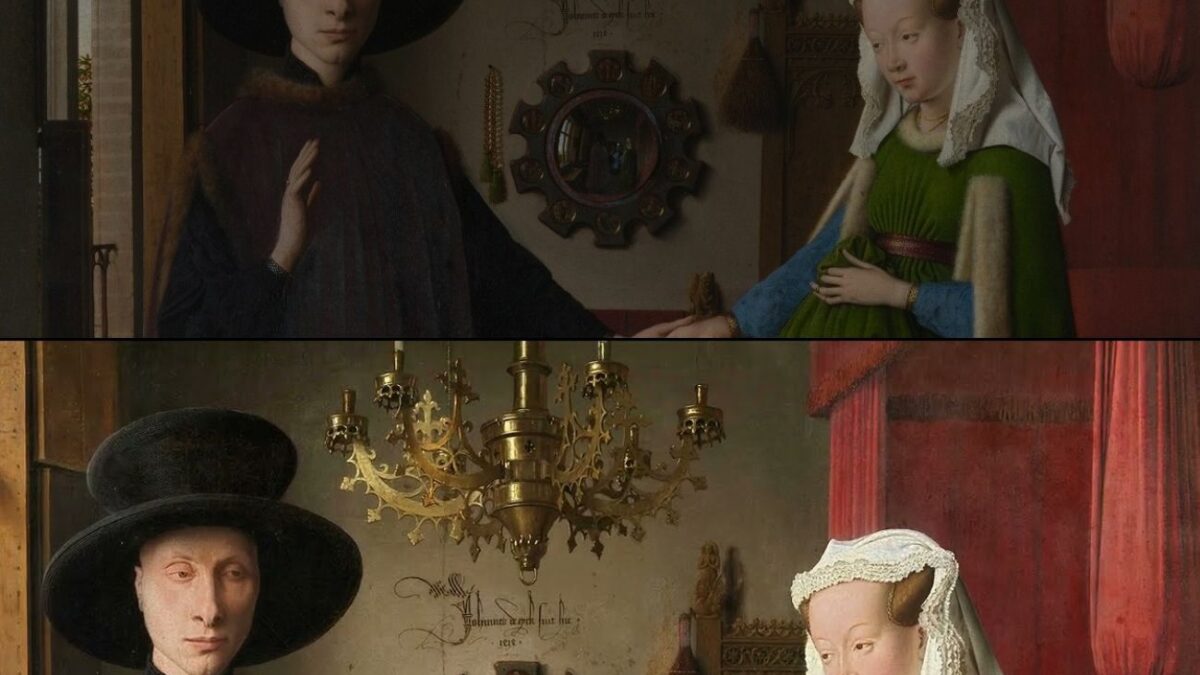
There’s writing on the wall. Not a signature in the corner where a painter would normally put one. Not small, not discreet, ornate looping script painted directly onto the plaster above the mirror in the exact center of the composition in the style used by notaries for legal documents. It says, “Jan van Eyck was here.” 1434. Not made this, not painted this. Was here. That’s a strange thing for a painter to write. It’s the sentence of a witness, someone attesting that they were present in a room while something happened. And directly underneath it, van Eyck put a mirror the size of a coin showing the back of the room. Inside it, there are two people standing where you’re standing. Nearly 600 years later, we still don’t know what he was witnessing. We’re not even certain who the woman is. What we do know is that almost everything most people believe about this painting is wrong.
Here’s the version most people carry around. A wedding, a man and his bride hands joined exchanging vows in a bedroom in Bruges. She’s visibly pregnant. The little dog is a symbol of faithfulness, sweet, domestic, warm. Start with the pregnancy because it’s the easiest one to clear up. She almost certainly isn’t. In the 1430s, the fashionable silhouette was exactly this, an extremely high waist and enormous quantity of heavy fabric gathered and held up at the front because it was too voluminous to let hang. Look at other portraits from the same decade and you’ll see unmarried women, elderly women, and saints holding their trowel in their dresses the same way. She isn’t expecting. She’s holding up a very expensive dress, and that’s the real subject of the surface of this painting, not romance, money, oranges.
In Bruges, in the 15th century, oranges had to be shipped from the south of Europe at enormous cost. Painting them casually scattered on a windowsill is the equivalent of leaving something absurdly expensive lying around where visitors will see it. A brass chandelier, elaborately cast, hanging in a private bedroom, a bed with heavy red woolen hangings, and in a wealthy Flemish house of this period, the bed in the receiving room wasn’t only for sleeping. It was furniture you displayed the way you display a car. An oriental carpet on the floor, a convex mirror with an ornate frame, one of the most expensive objects a household could own because glass that size and shape was extraordinarily difficult to make. Even the shoes, his wooden patterns kicked off in the foreground, her red slippers behind. Some read this as a sign of standing on holy ground, others simply as two people at home.
And the man in the middle of it all, Giovanni di Nicolao Arnolfini, an Italian merchant from Lucca, who’d been living and trading in Bruges since he was a teenager, moving in the circles of the Burgundian court. This is a man displaying what he has. Now the mirror, it’s about 8 cm across. Inside it, Van Eyck painted the entire room in reverse, the backs of both figures, the window, the bed, the ceiling beams. At that scale on a curved surface with correct distortion. And in the doorway behind them, two figures who are not otherwise in the painting. One of them, most people assume, is the painter.
Then look at the frame around the mirror. There are 10 small roundels set into it, each a few millimeters wide. Each one contains a complete scene from the Passion of Christ, painted with a brush at a scale where individual figures are smaller than a grain of rice. Nobody standing in that room in 1434 could have seen those scenes with the naked eye. Van Eyck painted them anyway, which is really the point of this channel. Almost nothing that matters in these paintings is visible from a normal viewing distance. If you’re enjoying looking this closely, a like genuinely helps other people find this, and subscribing means the next painting comes to you because we still haven’t answered the obvious question. Who is she?
For most of the last two centuries, the answer looked settled. The painting was identified as the marriage of Giovanni Arnolfini and a woman named Giovanna Cenami, and the great art historian Erwin Panofsky built an enormously influential reading on top of that. This was a wedding ceremony, and Van Eyck’s inscription was his legal signature as a witness. It explained everything. The joined hands, the raised hand mid-oath, the mirror showing witnesses, the single candle as a marriage right.
Then archives were checked. Giovanni Arnolfini and Giovanna Cenami were married in 1447. Jan van Eyck died in 1441, 13 years after the painting and 6 years after the painter was in his grave. Whoever is standing in that room, it isn’t them. So, attention turned to a cousin, a different Giovanni Arnolfini, Giovanni di Nicolao, who was certainly in Bruges, certainly knew van Eyck, and was certainly painted by him again a year later. His wife was a young woman from Lucca called Costanza Trenta, betrothed to him at 13, married in 1426. That fits until you check when she died.
On the 26th of February 1433, Costanza’s mother wrote a letter to her sister in Italy listing which of her children were still alive. Costanza is listed among the dead. The painting is dated 1434. She was about 20 years old. The likeliest cause in that century was childbirth. And as far as the records show, Giovanni never remarried, which leaves a problem. If this is Costanza Trenta, van Eyck painted her at least a year after she was buried.
In 2003, the art historian Margaret Costa put that reading forward directly. This is not a wedding portrait. It’s a memorial. A widower having his dead wife painted back into the room. And once you hold that idea in your head, the painting rearranges itself in front of you. Look at the chandelier again. Above the man, a single candle lit, burning in broad daylight. Above the woman, nothing. An empty socket with only a trace of wax left behind. One candle burning, one extinguished.
Now, go back to those 10 scenes around the mirror and notice how they’re arranged. On his side of the mirror, the scenes show Christ alive. On her side, they show the death and the resurrection. The two of them are standing on opposite sides of a line. Even the color does it. He is painted in dark, somber tones. And this is before black became fashionable at the Burgundian court, so it reads as mourning. She’s idealized, luminous, generalized in the greens and blues of love and faith. His face is a specific human face with specific flaws. Hers is a type. And on the bedpost beside her, a tiny carved female saint, most often identified as Margaret, the patron saint of childbirth, placed at the head of the bed beside the woman who may have died in one.
None of this is proof. Art historians still argue about every part of it, and there are good scholars who think the memorial reading goes too far, that these are simply the objects of a rich household, and we are reading grief into a brass chandelier. But, go back to what Van Eyck wrote on the wall, not painted by, not made by, was here. A statement that someone was present in a room, written above a mirror showing a room with more people in it than the painting admits to.
We don’t know what he witnessed. We know he wanted it recorded that he was there. And that a woman who was already dead is standing in the light holding up her dress with an unlit candle above her head. As the ambient daylight slowly shifted across the wooden floorboards of that quiet room in Bruges, the quiet testimony of the painted plaster remained absolute. Jan van Eyck had witnessed a ghost brought back to life through the immortal alchemy of oil and pigment, sealing a final, silent farewell that centuries of human curiosity would forever try to decode.

