Why did doctors diagnose a painting?
Why did doctors diagnose a painting?
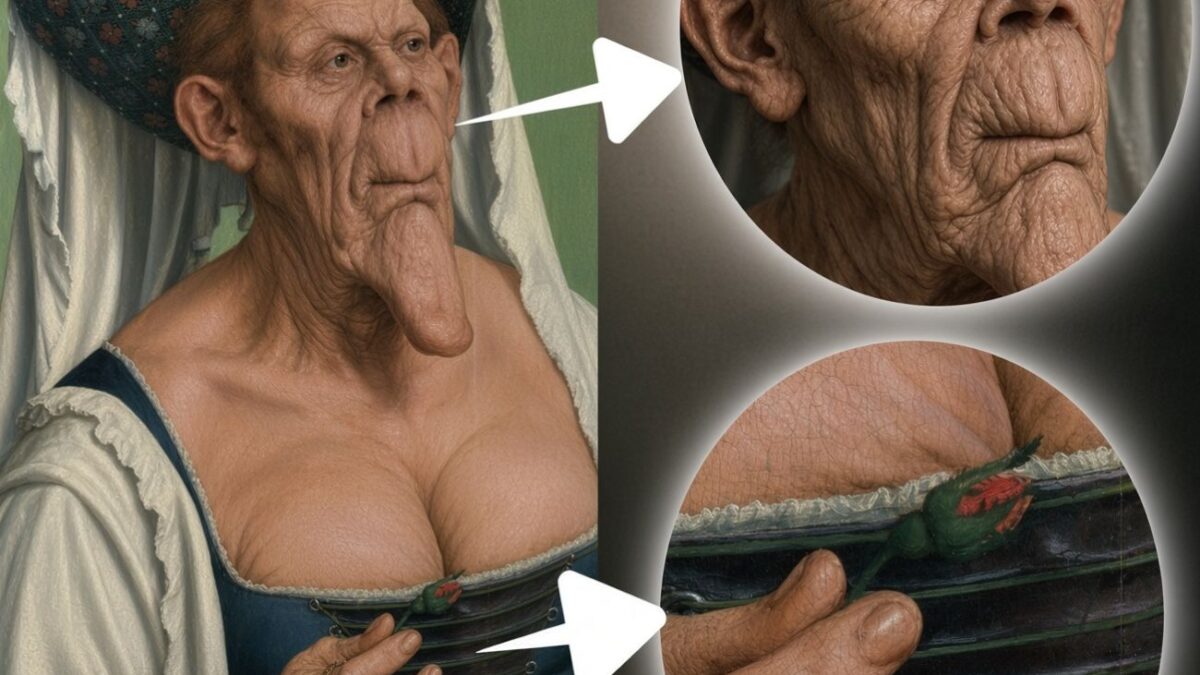
You have seen this face before. It has hung in the National Gallery in London for over 80 years. It is one of the most photographed, most reproduced, most argued about faces in the building. Some visitors love it, some refuse to look at it. And if it looks familiar, even to people who have never been to London, that is because John Tenniel copied it. The Duchess in Alice’s Adventures in Wonderland is this face redrawn.
For most of the last 40 years, there has been a standard explanation for what you are looking at. It appeared in a medical journal, it spread everywhere, and it is repeated on tour guides and websites to this day. But the National Gallery’s own curator says it is wrong. She also says this is probably not a portrait of anyone, and that it may not even be a woman.
Start with the clothes because they are doing more work than the face. That headdress is called a horned hennin. In 1513, when this was painted, it had been out of fashion for roughly a century. Nobody in Antwerp was wearing that. It is the equivalent of painting somebody today in a costume from the 1920s and expecting you to notice. The dress is cut low and tight in the style of a young woman at court. Beneath it, painted with complete unsparing precision, is an aged body. And in her right hand, held up carefully between finger and thumb, is a rosebud. That flower is not decoration. In this period, a rosebud offered in a portrait means one thing: courtship and engagement. It is being presented to somebody. So, the picture in front of you is an elderly person dressed 100 years out of date in the clothes of a young bride, holding out a flower to somebody we cannot see. Remember that flower, because it becomes important later.
Now, consider the face itself, which is where the trouble starts. The forehead is enlarged, the jaw is heavy and pushed forward, the upper lip is unusually long, and the whole skull has an odd overgrown quality that reads immediately as medical rather than simply old. In the 1980s, the painting was examined by a doctor at University College London, and the resulting suggestion was published in the British Medical Journal that Quentin Massys painted a real woman suffering from Paget’s disease of bone, a condition in which bone remodeling goes wrong and bones thicken and deform, sometimes dramatically in the skull. It is a satisfying explanation. It fits the visual evidence, turning a grotesque into a document—a real unnamed woman with a real illness painted with unusual honesty 500 years ago. It has been repeated in newspapers, textbooks, television programs, and gallery talks for four decades. If you have ever heard anything about this painting, you have almost certainly heard this.
And this is the kind of thing that only comes apart when somebody goes back to the object itself. In 2023, the National Gallery took this painting off the wall and looked at it properly. The gallery’s Renaissance curator, Emma Capron, built an exhibition around it, and her assessment of the medical theory was blunt. It isn’t Paget’s disease. It isn’t dwarfism. It isn’t elephantiasis. She also expressed reluctance to have doctors walking around galleries handing out diagnoses because the diagnosis rests on an assumption nobody had checked: it assumes this is a portrait, that Massys sat a real person down and painted what he saw. There is very little reason to think he did.
Look again at what is in the picture. Clothing a century out of date, a courtship flower, an old body dressed as a young one—those are not the observations of a painter recording an unfortunate sitter. They are jokes, and they are aimed at a specific target. This is not a document; it is a punchline. In 1511, two years before this was painted, Erasmus of Rotterdam published In Praise of Folly, one of the most widely read books in Europe. Among its targets are old women who refuse to behave like old women, who dress young, chase young men, and put themselves forward as objects of desire. Massys knew Erasmus personally and painted his portrait; the two men were part of the same Antwerp intellectual circle. Furthermore, carnival—the pre-Lent festival where the social order is deliberately inverted for a few days—was full of exactly this kind of figure: grotesque old brides, men dressed as women, and standard recognizable characters that everyone in the crowd already knew.
So, Massys takes a stock figure of fun from the street and paints her in the most prestigious format available: the formal three-quarter portrait, the kind of commission used to record a merchant or a bishop for posterity. That is the joke, not the face itself, but the frame around it. He is using the visual language of dignity on a character from a carnival float.
This raises the obvious question: if she is offering a rosebud to somebody, who is she offering it to? This painting has a partner. Massys painted a companion panel, an old man turned to face her in the same format and at the same scale. They are a pair, made to hang together and look at each other. Every double portrait convention of the period—husband on the left, wife on the right, dignity in both—is being invoked here simply so it can be broken. Look at him: he is not returning the gesture. His expression is closed, his hand is raised, and he is quite clearly declining. She is offering, he is refusing. That is the entire picture, and you cannot see it if you only have one half. For most of their existence, that is exactly what happened. The panels were separated, hers went to the National Gallery and his went into a private collection, until they were finally reunited in London in 2023 for the first time ever as far as anyone can establish. For decades, people diagnosed a disease in a face that was merely making a joke to somebody who wasn’t even in the room.
There is one more part of Capron’s argument, and it is the one that got the headlines. She has argued that the figure is most likely male—a man dressed as a woman of the kind Massys would have seen at carnival, where men impersonating women was a standard part of the entertainment. If you accept this, it reframes every feature people were diagnosing: the heavy jaw, the broad brow, the long upper lip are not symptoms, but a man’s face under a woman’s headdress as the joke requires. While that reading is not universally accepted and shouldn’t be presented as completely settled, and other scholars keep the figure as a female folkloric type without the cross-dressing element, both readings agree on the part that actually matters and the part the last 40 years got wrong: nobody sat for this. There is no real woman here, and there is no patient. The most repeated fact about one of the most famous faces in London is about a person who never existed.
There is one last thread that is still being argued about. There is a drawing in the Royal Collection of almost exactly this face—a grotesque old woman in red chalk—connected to Leonardo da Vinci and generally now cataloged as the work of his pupil, Francesco Melzi. Whether Leonardo came first or Massys came first is genuinely disputed. The National Gallery’s own position is that the drawing inspired the painting, meaning a grotesque head traveled north from Italy and Massys built a picture on it. Others argue the traffic went the other way, suggesting Massys and Leonardo were in contact, exchanged drawings, and that the Italian grotesques owe something to the north rather than the reverse. Nobody has closed that question. What is clear is that this face was traveling between studios across Europe as an idea, being copied and adapted, which is exactly what you would expect of an invented character, and exactly what you would not expect of a specific woman with a specific illness in Antwerp.
Ultimately, what is left is a carnival figure invented, drawn, and redrawn across a continent, painted as a joke about an old body in young clothes, offering a flower to a man who is turning her down. Three centuries later, an illustrator borrowed the face for a children’s book, and it became one of the most recognizable images in English literature. Then, for 40 years, people looked at the funniest painting in the National Gallery and tried to diagnose a patient who was never ill and never even existed. As we reflect on how easily art history can invent narratives to fit our assumptions, we are reminded that sometimes the most famous stories attached to a canvas tell us far more about the viewers who came after than the brilliant minds who created the work in the first place.

