What the Shawnee Warned About the Ridge Diggers — Recorded in 1871
What the Shawnee Warned About the Ridge Diggers — Recorded in 1871
There is a ridge in the western part of the state, the part that broke off during the war four years before this record was written, that you will not find on any survey map printed after 1872. It was on the maps in 1869 and 1870, but then it was cleared from the plat books by the county. The land office in Charleston pulled the deeds and stored them in a locked drawer, and the rail company that had begun to grade a spur down toward the coal at its base tore its rails up in one week, paid three landowners to move their houses two miles to the east, and abandoned the account without ever writing why in the ledger.
The ridge is still there, and nobody argues that, but if you ask the sheriff of the nearest county for its name, he will tell you it does not fall under his jurisdiction. If you press the clerk at the land office, he will tell you very slowly that the county does not maintain records for land that is not for sale. And if you go to the last three men who worked that ridge in the summer of 1870 and ask them what they saw, two of them will not speak. The third one will, and he is the reason this record exists.
It was set down on the 22nd of March 1871 by a man named Absalom Vestri in a rooming house in Wheeling, four rooms up from the street, with the rain coming down against the window. He was 27 years old that spring and had been, up until the previous autumn, an assistant surveyor for the Baltimore and Ohio. He had spent the early summer of 1870 on a ridge in a county he does not name plainly, coming down from it as the one man of the survey crew who still spoke. The transcriber was a Methodist reverend named Amariah Crane, 58 years old, whose hearing was failing, so he brought a young man with him to do the actual writing.
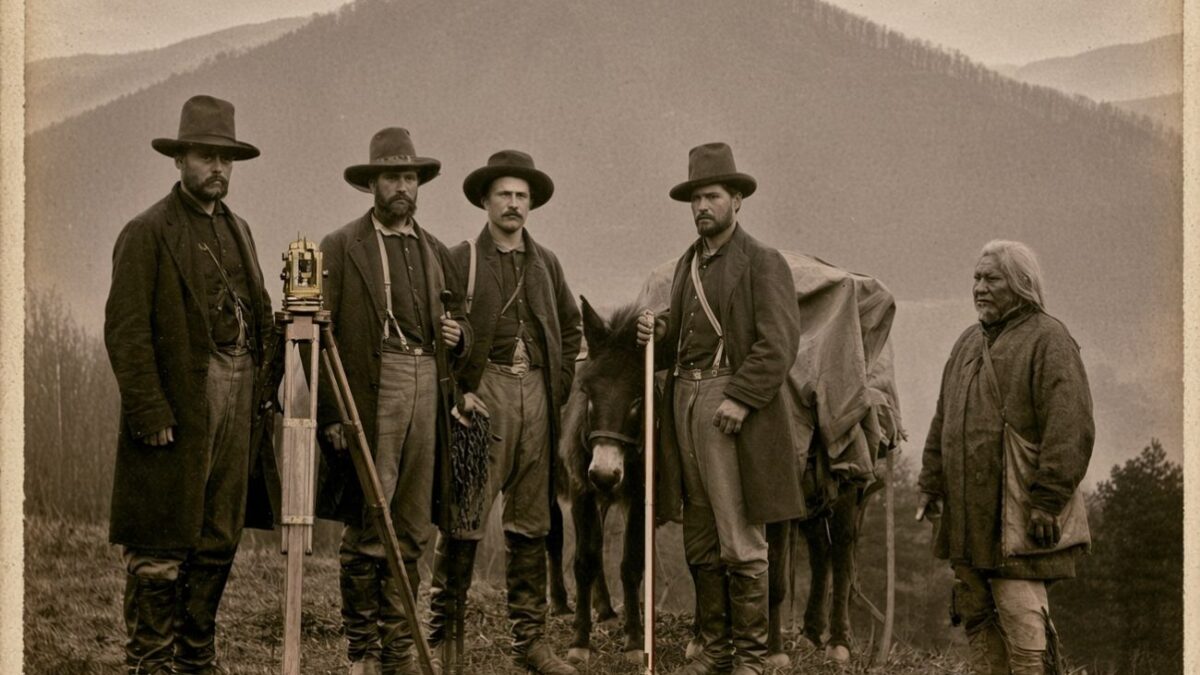
The crew consisted of six men: the foreman Cyrus Thrill, 51, a veteran railroad surveyor with a bad left knee; Jeff the Wexler, 38, a blacksmith turned railworker; Ren Fratic, 44, a heavy axeman who hummed under his breath; Cester Molyneux, 31, a chainman; Boaz Trumble, 26, the youngest and best rodman Vestri ever worked with; and Vestri himself. They left Grafton on the morning of the 10th of May 1870, riding south for three days before cutting east into roadless country to camp at a settlement called Tanner’s Cross.
The purpose of the trip was to inspect a reported thick seam of good coal running under the east face of a ridge about seven miles beyond Tanner’s Cross, marked on some maps as Long Bend Ridge, but called Cold Bone Ridge by the locals. When Vestri asked the store owner, Ailia March, about the name, she warned him that there was no coal on that ridge and advised him not to waste his time walking it. The local smith, Holloway Fen, likewise refused to fix their chains or shoe their mules for anyone going up onto that ridge, warning that he valued his sleep.
They started up the ridge on the 12th of May. Though just under 700 feet tall, the ridge was long, narrow, straight-spined, and looked unsettlingly like a very long, low animal lying on its side breathing. They set their base camp on the west side along a small stream called the Halibbron and began leveling.
On the second day, an elderly Shawnee man walked silently out of the trees to their survey line. He handed Vestri a folded page from an old French book with a marked passage, pointed up the ridge, and delivered a stark warning: do not open the skin of the hill, do not put metal under it, do not stay after dark, and do not sleep on it, because the ones there were older than anything they knew. Thrill thanked him respectfully but insisted the survey had to proceed using only wooden stakes. The old man warned them that wood was metal to those entities and advised them never to look back once they left.
For the first few days, they worked in agreement, but the atmosphere quickly soured. Chainman Cester Molyneux went up early alone one morning and returned quiet and shaken, claiming he heard a woman arguing beneath the ridge. That night around the campfire, the men were shocked when Kester accused Wexler of calling his dead mother’s name out on the line—only for Wexler and Thrill to realize the name called was actually their respective wives’ names.
Despite mounting dread, they pressed on to finish the survey. On the 16th of May, Boaz Trumble became completely catatonic on a west flank stump, staring blankly at the ground for six hours without blinking or reacting, only to snap out of it at dusk with no memory of the lost time, bewildered by his companions’ terror.
That night, a steady, hissing rain fell. Vestri awoke to the sound of slow, unhurried footsteps pacing back and forth along the crown of the ridge. The footsteps eventually descended to the camp perimeter. A voice mimicking Vestri’s dead father at Antietam called out from outside his tent, followed by the voices of his mother and dead uncle, urging him to come out into the cold because the other men had already done so. Vestri covered his mouth with both hands and stayed completely silent until morning.
At dawn, they discovered a wide circle of footprints in the mud completely surrounding their tents—footprints of boots, moccasins, and bare feet of varying sizes, every single one facing inward, with none leading away. Furthermore, Boaz’s missing survey rod was found driven upright into the ground 700 feet up on the crown of the ridge, marking a point with zero footprints approaching or leaving it.
Terrified, Thrill ordered an immediate retreat. They packed up and started down the wagon track, but realized they had left behind their small tin box of black powder. Wexler and Kester were sent back down the track to retrieve it while the rest waited. When they failed to return, the remaining men tracked them down. They found the powder box sitting upright in the middle of the track with a round stone placed on it. A short distance further, they found Wexler sitting against a tree, breathing calmly but entirely unresponsive, his mind seemingly miles away. A bit further on, they found Kester standing frozen in a clearing, staring blankly toward the ridge with open, unblinking eyes.
Thrills and Fratic lifted Kester and placed him alongside Wexler in the back of the second wagon. With the crushing weight of the silent, breathing forest pressing in on them, Thrill drove the remaining men and wagons away from Cold Bone Ridge for good, leaving the cursed hills behind. Though they eventually escaped the valley, the men who had looked upon the ridge never truly returned whole, and Absalom Vestri spent the rest of his days burdened by the heavy, unending memory of what lived beneath the skin of the mountain.

