Their Forbidden Love Affair Turned Deadly – The Story of Madeleine Smith & Emile L’Angelier
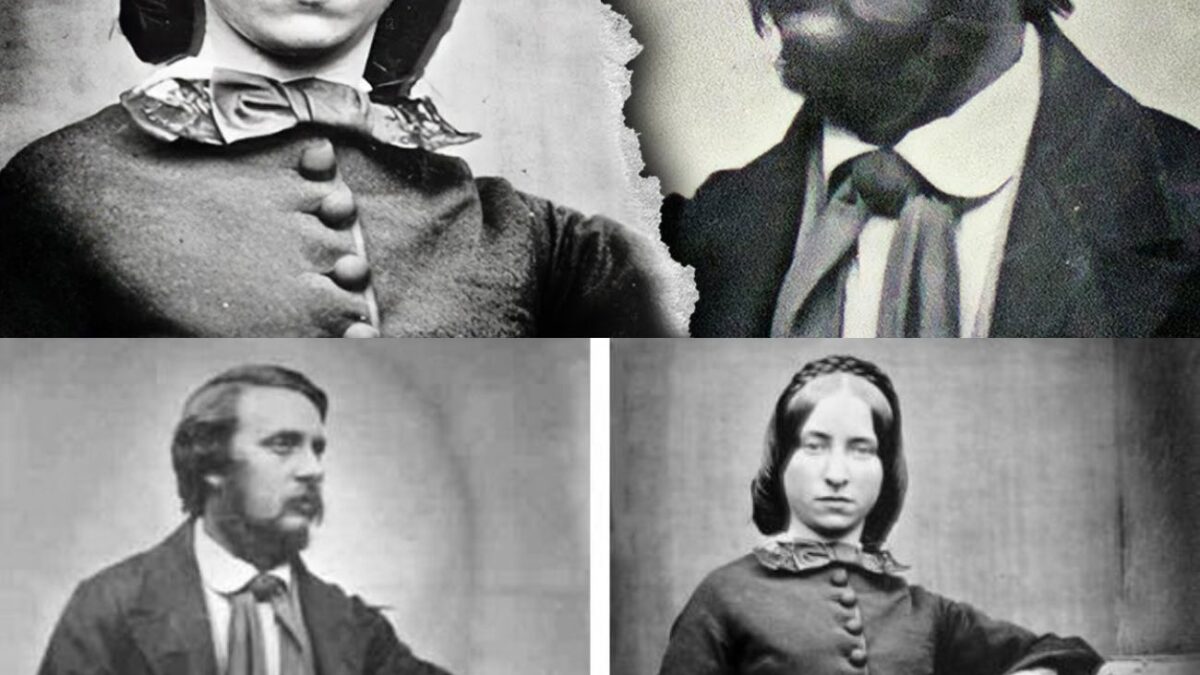
Their Forbidden Love Affair Turned Deadly – The Story of Madeleine Smith & Emile L’Angelier
In most criminal trials when the jury returns a verdict there are two possible outcomes: guilty or not guilty. But in Scotland you may hear a third verdict: not proven. Not proven is a strange bit of legal wording with no specific definition and no different legal implications than the verdict of not guilty. In both cases the defendant is acquitted of their crime and faces no punishment. Even the history of the verdict of not proven is murky; it likely dates back to the early 17th century where juries were used to decide whether or not specific individual facts of a case had been proven and then judges ultimately determined whether or not the defendant was guilty.
One of the most notorious Scottish cases in which the not proven verdict was issued is that of Madeleine Smith, the Glasgow socialite who starred in a murder trial so scandalous that it remains an object of fascination to this day. In the early morning hours of March 23rd, 1857, Emile L’Angelier stumbled into his Glasgow lodging house doubled over in pain. His landlady helped him to bed and summoned the doctor at 5 a.m. Six hours later, Emile was dead. Inside his vest pocket was a letter from his lover asking him to meet with her secretly. When Emile’s postmortem revealed a lethal amount of arsenic in his stomach, Glasgow police set out to question the woman who had signed the letter: Madeleine Smith.
Madeleine was the daughter of the prominent Glasgow architect James Smith. The family occupied a sprawling ground floor apartment on Blythswood Hill, one of the wealthiest parts of central Glasgow. By all measures, Madeleine was a textbook example of an upper-class young woman. She took courses at Mrs. Alice Gorton’s Academy for young ladies in London, accompanied her parents to parties and social gatherings, and was betrothed to a wealthy merchant selected by her father.
But Madeleine was not as she appeared. In 1855, when she was 20 years old, she was introduced to Emile L’Angelier, a local apprentice nurseryman. This role involved the cultivation and sale of plants and trees, a manual task seen as far below those within the Smith social circle. And though Emile was unsuitable for her in every way, Madeleine fell instantly in love.
Emile’s background was nothing like Madeleine’s. He had been born in the Channel Islands to French parents who ran a small seed business out of their home. As a teen, Emile was sent to apprentice at a local nursery that catered to the British gentry. He learned English there and was eventually offered work on an estate near Edinburgh. When his employer died a year later, Emile was left stranded working on various estates until he moved to Glasgow in 1852. He was working as a packing clerk in a warehouse on Bothwell Street when he first spotted Madeleine, some 10 years his junior, and asked a neighbor to arrange an introduction.
The pair began speaking frequently, and Madeleine’s parents were fast to quash the budding friendship, forbidding Madeleine to see him any longer. If anything, her parents’ disapproval only made her more interested in Emile, and the pair began an illicit secret affair, meeting unchaperoned at friends’ homes, at Madeleine’s bedroom window during the night, and in a wooded area near her home. The relationship was absolutely taboo. Not only was the apprentice nurseryman far below Madeleine’s social class, but for a proper Victorian lady to have sexual relations with a man before marriage was unthinkable. If the affair had been discovered, her life would have been effectively ruined. To aid the secrecy of their relationship, she burned all Emile’s love letters to ensure no one in the house would come across them and discover what was going on.
As time went on, the seriousness of the forbidden relationship only increased, with the pair seemingly getting engaged, though this too was kept from Madeleine’s parents. Their wedding was apparently meant to take place in September of 1856, and Emile did all he could to become acceptable to his fiance’s parents, to the point where he was sent to take a high-paying job in Lima, Peru, until Madeleine took him out of it. In a letter she stated: “My dearest Emile, I hope you have given up all idea of going to Lima. I will never be allowed to go to Lima with you so I shall fancy you want to get quit of your Mimi. You can get plenty of appointments in Europe, any place in Europe. For my sake do not go.”
September came and went with no wedding taking place, and soon a new obstacle to the union would appear in the shape of a wealthy merchant named William Minnoch. James Smith had met the 30-year-old bachelor on a business trip and thought him a perfect match for his daughter. With this, he began inviting Minnoch to the Smith home, with the businessman eventually securing a flat above them, staying there when he was in town.
Letters from Madeleine to Emile showed that she was initially cold towards the man chosen for her by her father. But as time progressed, her affection for him grew. Not wishing to hide anything from her lover, Madeleine was very open in her correspondence with him about her interactions with William. While this may not have been an issue during the early days when she actively disliked the man, as her feelings changed, these revelations only served to hurt Emile and inflame his jealousy.
This culminated in January of 1857 when Madeleine accepted a marriage proposal from William Minnoch. Madeleine knew that her family would never accept Emile as her husband, and she may never get such a promising proposal again. She needed to marry Minnoch, and she needed to break things off with Emile. While she was open about William before, she could not bring herself to tell her already enraged lover of the engagement. Instead, intending to end their relationship, she tried to put it down to him returning one of her letters: “I felt truly astonished to have my last letter returned to me, but it will be the last you shall have an opportunity of returning to me. When you are not pleased with the letters I send you then our correspondence shall be at an end, and as there is coolness on both sides our engagement had better be broken altogether. I think owing to coolness and indifference nothing else that we had better for the future consider ourselves as strangers. I trust your honor as a gentleman that you will not reveal anything that may have passed between us.”
She went on to state that despite loving him once, her love had now ceased. She also asked that he return all of her letters. Instead of doing as he had been asked, the now-jilted Emile threatened to reveal the letters to Madeleine’s parents. She believed doing so would see her thrown out of the family, and so she now begged her one-time lover not to do so. The following weeks were marked by repeated attempts to convince Emile to turn over the letters, requests for a secret meeting, and a growing desperation to conceal her secret. By now Emile had heard rumors of the engagement, but Madeleine denied their truth.
This back and forth abruptly ended on March the 23rd, 1857, when Emile suddenly passed away, with the death quickly becoming a source of local gossip and speculation. Undoubtedly Madeleine learned of Emile’s untimely demise soon after it happened, and on March 26th the family awoke to find that she was gone. William Minnoch and one of Madeleine’s brothers discovered her on a steamer bound for Rowallan, 25 miles along the river Clyde where the Smith family owned a country property. Madeleine told the man she had run because she was ashamed of something and worried her parents would be upset with her.
After a brief stay at Rowallan, the trio returned to Glasgow. By the time they returned, the police had discovered stacks of letters from Madeleine in Emile’s room and office. These, along with the results of an initial autopsy, led to the socialite being arrested and charged with murder on March 31st.
Naturally there was widespread public interest in Madeleine’s trial, so much so that it was moved to Edinburgh where proceedings began on June 30th, 1857. The prosecution was allowed to admit Madeleine’s letters into evidence, but not Emile’s private diary, which contained entries about their meetings. When the contents of the nearly 200 letters were revealed, their often salacious nature shocked the puritanical Victorian public. In addition to sharing details about secret late night meetings, the letters were full of stark expressions of desire and intimacy, leaving no question as to the physical nature of the couple’s relationship.
While the letters may have proven that Madeleine had motive for the murder, what convinced the prosecution she had committed it was the proof they had that she had purchased arsenic on three occasions leading up to Emile’s demise. On Saturday, February 21st, Madeleine purchased a small amount of arsenic from a local apothecary, signing in the poison book that it was for use on rats. After a night out on February 22nd, Emile suffered a severe attack of stomach pain that left him bedridden for over a week. On March 6th Madeleine purchased more arsenic from the apothecary, and again on March 17th a third purchase. Emile went out of town on the 19th, but returned unexpectedly on the 22nd, telling his landlady that he received a letter calling him back. He asked her for a key to the front door, explaining that he expected to be out late. When he returned, he was already sick from arsenic poisoning.
Due to laws at the time, Madeleine was not allowed to take the stand in her defense, but the deposition she gave to police upon her arrest was shared with the jury. In it she claimed that she had not seen Emile for three weeks before his death. She did not deny their affair nor purchasing the arsenic, but she said that she had mixed the arsenic with water and washed her arms and face with it, a cosmetic use she had learned about at school. She lied to the apothecary about her intended use because she was embarrassed to admit it was for her complexion.
The defense was unable to produce any witnesses who could prove that Emile and Madeleine had been together in the three weeks before his death. Their storyline relied on Madeleine’s letters, but only the envelopes were dated, and a discovery of multiple letters stuffed into a single envelope suggested that Emile may not have been a fastidious recordkeeper. There was no way to prove that the letters referred to meetings following Madeleine’s purchase of the arsenic. Madeleine’s sister Janet, with whom she shared a bed, testified that she did not recall Madeleine rising in the middle of the night on the 22nd.
The defense presented expert witnesses who testified to the cosmetic use of arsenic, which lent credibility to the defendant’s claims. But the defense’s best argument was that Emile had a known history of dabbling in arsenic and had spoken of suicide to a valet at least once. He had also spoken to a friend of wishing to seek revenge on Madeleine for choosing Minnoch over her. And while there was a mountain of circumstantial evidence against Madeleine, the medical examiner had not explicitly checked to see if the arsenic in Emile’s body was colored, but did not notice that it was. At the same time, the apothecary testified that the product he sold had been colored to prevent accidental consumption.
The nine-day trial dominated the front pages of newspapers across Scotland. Crowds gathered at the courthouse each morning and evening to catch a glimpse of Madeleine, and her love letters were published for all to read. For her part, Madeleine was composed and quiet throughout the ordeal, refusing food and drink during the proceedings and showing only some discomfort when her letters were read aloud. She did not appear to mourn for her dead lover or be shocked by any of the allegations against her.
On July the 9th, the jury deliberated for just 30 minutes before announcing their verdict: not proven. The sentiment was shared by most. Madeleine Smith had killed her lover to avoid the affair becoming public, but without someone to testify to seeing them together, there was no way to convict her.
Madeleine was never able to escape the stigma that followed the verdict. She left Scotland for London, eventually marrying George Wardle, the business manager of artist William Morris. She had two children with George, but the couple separated in 1890. After that, Madeleine’s movements became a mystery. There is some evidence to suggest that she moved to New York, but where she died and when isn’t known for certain.
Madeleine Smith’s innocence is still widely debated. There are some who think Emile killed himself to frame Madeleine for murder and ensure her affair was revealed to the world, but many more think Madeleine was clearly the murderer and only got lucky enough to not be spotted with Emile in the weeks before his death. But why did she never make any attempt to collect the letters she was so fearful of being discovered? Did she assume that the belongings of a dead man would be of no interest to the police? She was, after all, an upper-crust socialite with little knowledge of how something as distasteful as an arsenic death at a lodging house would be handled. If you think that Emile subjected himself to a long, painful death in the vague hopes that it might be traced back to Madeleine is a farfetched theory, you’re not alone. Even Madeleine’s legal defense, John Inglis, seemed to fall into the not proven camp when asked at a dinner party if he genuinely believed she was innocent, responding that he would rather have danced than sinned with her.
As the decades slipped away, the mystery of 163 Blythswood Hill quietly transitioned from the bold headlines of Victorian broadsheets into the shadowy folklore of Glasgow’s legal history. No headstone marks the final resting place of the woman who walked out of the High Court of Justiciary a legally free soul, and the unanswered questions of that bitter March morning remain as potent today as they were when the verdict was read, leaving history to ponder forever whether justice was truly served or simply slipped through the cracks of a flawed legal loophole.

