The Wrotham Hill Murder | Fabian of the Yard Investigates
The Wrotham Hill Murder | Fabian of the Yard Investigates
The year 1946 in England was one of uneasy transition. The Second World War had ended the previous year, but rationing remained. Bomb damage scarred many towns and cities, and German prisoners of war were still working in Britain. It was against this backdrop, in the county of Kent, commonly known as the garden of England, that a senseless and tragic murder unfolded. On Thursday, 31st of October, around noon, lorry driver Joe Hammond was traveling from Aylesford to Dartford, a journey of about 20 miles. As he drove along Wrotham Hill on the A20, he noticed a woman’s blue suede shoe lying at the side of the road near a hedgerow.
Despite the wet and windy weather, Joe pulled over and climbed down from his cab to take a closer look. The shoe was a size six, the same size as his wife wore. With rationing still in force and new clothing hard to come by, he began searching for the other shoe, imagining how pleased his wife would be if he brought them home. As he looked around, Joe noticed that the nearby hedgerow had been disturbed. He carefully parted the brambles and then stepped back in horror. Inside the tangle of foliage, just out of sight of the road, lay the body of a woman.
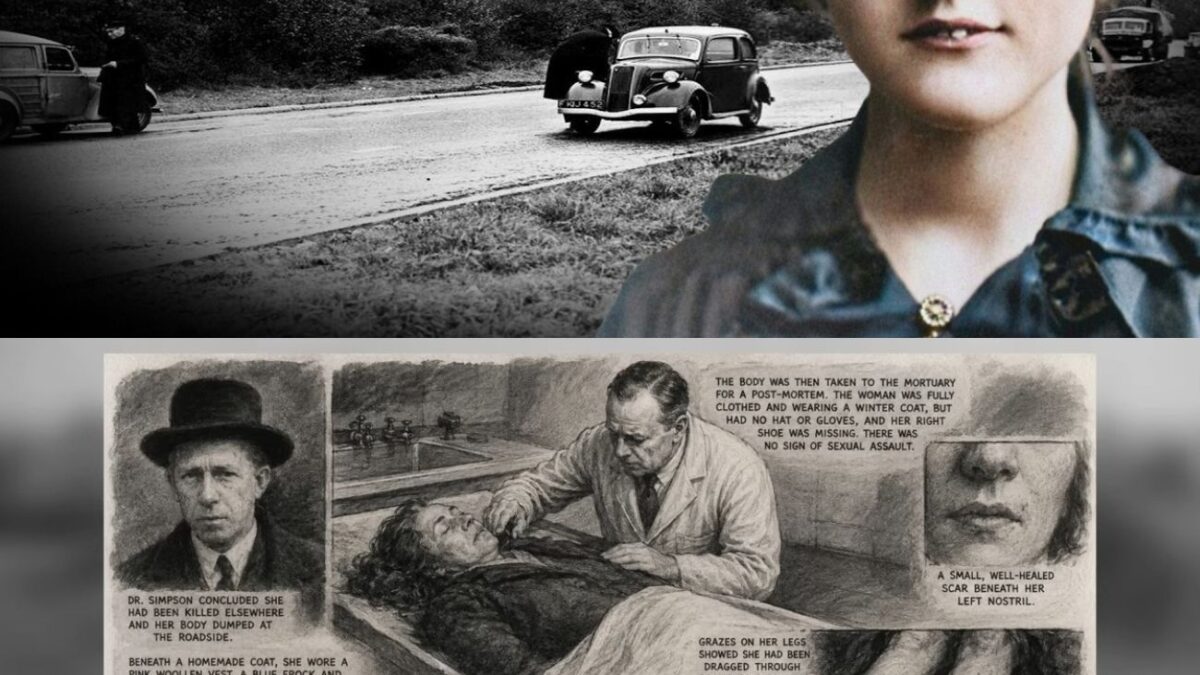
After discovering the body just off the A20, Joe Hammond drove quickly to the nearest telephone box and called the police. Officers arrived soon afterwards, accompanied by a local doctor who confirmed the woman was dead. The area was cordoned off, including a narrow path behind the hedgerows called Labor in Vain Road. Wrotham Hill, normally known for its sweeping views across the Kent Weald and the North Downs, had become the scene of a murder. Chief Inspector Robert Fabian of Scotland Yard and Detective Superintendent Frank Smeed of Kent CID were placed in charge of the investigation. Photographs were taken at the scene and Home Office pathologist Dr. Keith Simpson arrived later that evening to examine the body in situ, working by the headlights of police cars. He also collected loose strands of hair and samples of earth for analysis at the lab.
The body was then taken to the mortuary for a postmortem. The woman was fully clothed and wearing a winter coat, but had no hat or gloves and her right shoe was missing. There was no sign of sexual assault. Dr. Simpson concluded she had been killed elsewhere and her body dumped at the roadside. The woman had blue-gray eyes and brown hair and there was a small well-healed scar beneath her left nostril. They found no identification or purse and there were no labels in her clothing to indicate where they had been purchased. Beneath her homemade coat, she wore a pink woolen vest, a blue frock and a blue jumper. She looked to be around 50 years old. There were no rings on her fingers and no marks to suggest she usually wore one, suggesting she was unmarried. Grazes on her legs showed she had been dragged through brambles and twigs. The cause of death was strangulation with a cloth or scarf, and her neck had been fractured. Lividity, the settling of blood in the body after death, suggested she had remained upright in a sitting position for some time before being moved. Dr. Simpson estimated that she had died between 7:00 and 9:00 that morning.
A description of the woman was circulated to police stations and published in the press in the hope that someone might recognize her. The following morning, Friday, 1st November, a 79-year-old widow named Mayme Petcheyvalsky, known locally as Mrs. Peters, was sitting in a bungalow on Heaver Avenue in the village of West Kingsdown, about 4 miles from the murder scene. She was growing increasingly worried about her daughter, Dagmar. Dagmar had gone to visit Ralph and his wife in Surrey, and she should have returned home by now. When Mrs. Peters opened her morning newspaper and read the description, she immediately recognized the details and contacted the police.
Mrs. Peters met Chief Inspector Fabian and confirmed that the clothes found on the murdered woman belonged to her 48-year-old daughter. She was too distressed to view the body, so she contacted her son, Ralph, who traveled from Surrey to make the formal identification. Together, the grieving mother and brother provided police with details about Dagmar’s life. Dagmar Peters had been born on 25th of October, 1898, in Catford, South London, and had celebrated her 48th birthday just 6 days before her death. The family later moved to nearby Lewisham. Her father, Francis Raphael Jules Petchey Bowalski, known as Jules, had worked as a tobacconist, a warehouseman, and a French translator. Dagmar had grown up with four brothers, but by 1944, only she and Ralph were still alive. One brother had been killed in the First World War at the age of 26. Another died from a heart attack. And a third had died when Dagmar was just a year old.
By all accounts, Dagmar was a quiet and solitary woman and had worked as a telephone operator at the London Telephone Exchange near London Bridge for 25 years. In 1941, she suffered what was then described as a nervous breakdown and took early retirement. A bomb blast during the Blitz destroyed her lodgings, killing her landlord, and she lost all her possessions. Another loss followed in January 1946, when her father died after a long illness. Her mother moved to the Heaver estate in West Kingsdown, and Dagmar had a small wooden hut built on a piece of former farmland, a short distance from her mother’s bungalow. There, she lived a simple, self-sufficient life, growing her own vegetables, keeping a few chickens, and making her own clothes. She had no known romantic relationships and few close friends, though she occasionally visited seaside towns like Margate and Herne Bay with former colleagues.
Mrs. Peters told police that the last time she had seen her daughter was on Wednesday, 30th of October, the day before her death. They had visited the local market together, where Dagmar bought a white vest, intending to turn it into something useful. She also bought a Jack Russell puppy, which she planned to give to her brother Ralph and his wife Helena when she visited them in Surrey. But Dagmar never arrived. Also missing were her brown attaché case and a distinctive yellow string bag that Helena had crocheted for her as a birthday gift. The puppy, too, had disappeared. The police asked Helena to make a duplicate bag and then took a photograph which they printed in the newspapers in the hope that it would trigger the memory of someone who had seen it.
Officers carried out extensive searches around Wrotham Hill, combing the hedgerows and visiting nearby garages, farms, and haulage companies. Mrs. Peters also told police that her daughter was wary of accepting lifts from private motorists. On one occasion, a driver had made inappropriate remarks that made her feel uneasy. After that, Dagmar would only accept lifts from lorry drivers, believing they were more likely to behave responsibly as they would usually be traveling on work business in a company vehicle. This meant investigators were likely looking for a lorry driver who had passed along the A20 that morning. Police began stopping early morning vehicles on the road and questioning the drivers. Transport cafes were checked, and appeals for information were circulated in the press.
Dagmar’s small wooden hut, which measured just 10 feet by 7 feet, was photographed by police and guarded around the clock. The tiny dwelling had no electricity and was lit only by oil lamps. Inside, there was little more than a bed, a table, and chairs, some basic pots and pans, and a Singer sewing machine, which Dagmar used to practice the wartime habit of make do and mend, turning old blankets into coats and curtains into dresses. Outside, there was a water butt collecting rainwater, an improvised toilet, and a simple shed containing her gardening tools. Dagmar was described as a quiet and somewhat eccentric woman, but always polite, respectable, and honest. Several lorry drivers who had given her lifts in the past came forward, saying that Dagmar always insisted on paying them in return, usually the equivalent of a rail fare, even when they told her it was not necessary.
Meanwhile, a number of sightings were reported. Some motorists remembered passing a woman in her 40s walking along the road around 5:00 that morning. She appeared to have something white tied around her neck, which police thought might be the vest she had bought the day before. Could it have been used to strangle her? At about the same time, witnesses recorded seeing a lorry loaded with bricks driving along the road in the opposite direction. Police believed the driver of that vehicle may have seen Dagmar, too. Another report described a van parked near the murder site at around 6:00 a.m. and a man seen walking into the nearby bushes.
It wasn’t long before a significant clue emerged. A 16-year-old farm worker named Peter Nash, the son of a retired police officer, had been reading the newspaper coverage of the case. When he saw the photograph of the distinctive yellow string bag, he immediately knew he had seen it somewhere before. Not long earlier, Peter had pulled an identical bag from a private lake at Clare Park in Maidstone, where he had been doing some laboring work. Realizing it might be connected to the investigation, he handed the bag over to the police. Although it had been in the water for some time, forensic examination revealed hairs caught in the fibers that matched those of Dagmar Peters. Helena also confirmed that the bag was the one she had crocheted for her sister-in-law.
One detail in particular caught investigators’ attention. The lake was not open to the public. Chief Inspector Fabian soon discovered that the lake was fed by a stream that flowed from the Goldwell Cider Works in East Malling, about a mile away. To test whether an object thrown into the stream could reach the lake, Fabian carried out an experiment, placing a message in a bottle and dropping it into this water at the Cider Works. Three hours later, the bottle arrived at the Clare Park lake. Fabian interviewed the foreman at the Cider Works, who revealed that a delivery of bricks had arrived on the morning of Thursday, 31st of October. He showed the inspector the delivery note, which listed the Cambridge company Dickerson’s Yard as the sender, and the driver’s name as Sydney Sinclair. The fact that a lorry full of bricks had now been mentioned twice during the investigation suggested it could not be a coincidence.
On the evening of 9th of November, police visited Sydney Sinclair at his home in Little Abington, Cambridgeshire, initially telling him they were just making routine inquiries. Sinclair lived there with his wife Daisy, and appeared friendly, offering them a cup of tea. However, they noticed he seemed slightly nervous. He had been employed by Dickinsons for about 4 years, had no criminal record, and was well-respected in the village. When asked about his movements on the morning of the murder, he provided a detailed account, including spending 4 hours at a roadside cafe and stopping to ask people for directions.
Other evidence began to fall into place. A constable discovered a man’s white vest lying on a grass verge, and when tested at the police lab, hairs found on the garment were matched to Dagmar Peters. Shortly afterwards, a brown attaché case was found in Winterfield Lane near the cider works, partially hidden beneath a layer of fallen leaves. On 13th of November, police visited Dickinsons yard and learned that Sidney Sinclair had left the company the previous day to take up work as a gardener. He had given them a doctor’s note, which stated he had anxiety neurosis, and he also mentioned that a recent accident had caused him distress. The company assured police that Sinclair had been a reliable worker, though there were a few driving incidents in his record, one where he accidentally knocked someone off a bicycle, and another in which a man had been pinned against a wall, but neither had resulted in criminal charges.
Chief Inspector Fabian realized it was time to bring Sidney Sinclair in officially. During questioning, it became clear that Sidney Sinclair was an alias. The lorry driver’s real name was Harold Hagger, a fact that even his wife Daisy didn’t know. Harold Hagger was the son of a dustman and came from a large family with a dozen siblings and almost as many aliases. He was born on 27th of March, 1901 in Hornsey, North London, making him 45 at the time of the murder. From a young age, he had been disruptive at school, frequently getting into fights and stealing. In 1925, while being pursued by a police constable, he jumped from a moving train and was hospitalized for 2 weeks with a fractured skull. After he recovered, he reinvented himself, fabricated details of his life, and spent the next several years in and out of prison on various charges. In 1939, he joined the army and the following year, he married 34-year-old Daisy, a widow with two daughters, wooing her with gifts obtained from friends on the black market. He went AWOL from the army and was later deemed unfit for military service due to headaches and hand tremors.
When police rechecked his criminal record under his real name, they discovered he had 16 convictions, including sexual assault, robbery, and assaulting a police officer. He was also a bigamist and was already married to a woman named Sophia, with whom he had a son, Ronald. Even more disturbingly, it transpired that he had molested Daisy’s 8-year-old daughter. In light of these discoveries, Sinclair made a revised statement. He claimed he had found the vest, attaché case, and yellow string bag lying in the road and had thrown them away when he realized they were worthless.
To investigate further, Chief Inspector Fabian and Detective Superintendent Smeed took Sinclair on a journey from his home in Cambridge to the Goldwell Cider Works in East Malling where he delivered the bricks. To put him at ease, they were not in uniform and told him they simply wanted his help with their inquiries, asking him to point out where he had found the items and where he had disposed of them. It was then that Sinclair mentioned for the first time that his lorry had overheated around 5:00 a.m. on the morning of the murder, so he had pulled over to check the radiator. He claimed he had been out of action for 15 minutes, but this was exactly the time that witnesses reported seeing a lorry loaded with bricks passing Dagmar Peters on the road.
Challenged about these inconsistencies, Sinclair then produced another statement. He claimed he had stopped his lorry for a second time to check the radiator and as he drove on, he saw a female pedestrian signaling who asked for a lift to London. Sinclair stated that the woman climbed into the cab carrying her attaché case. He recalled that she mentioned a puppy, though he didn’t see one, and assumed she had placed it by her side or tucked it inside her coat. A short way down the road, she asked him to pull into a small turning and stop. At this point, she allegedly requested money and offered sexual favors in return. Sinclair claimed that while she spoke, she touched his jacket and he noticed she was holding his wallet. “So that’s your bloody game, is it?” he said, then struck her across the face. A struggle followed. He grabbed at the vest she had tied around her neck like a scarf, but pulled it too hard and she became motionless. “I shook her and she just slumped down,” he told the officers.
Sinclair claimed that in a panic, he shut the cab door, drove on, and then stopped halfway down Wrotham Hill, where he carried the body across the verge and hid it inside the hedgerow. Later, he remembered that he still had her attaché case, which contained gloves, the yellow string bag, and her jam sandwiches. So, after completing his brick delivery in East Malling, he threw the items into the stream and went about the rest of his day.
Following this sequence of events, Harold Hagger, alias Sidney Sinclair, was formally charged with the murder of Dagmar Peters. The trial began on 24th of February, 1947, at Maidstone Assizes. Representing the Crown were Mr. Derek Curtis-Bennett, KC, and Mr. E. J. P. Cussen, while Mr. Maxwell Fyfe Stevenson, KC, and Mr. W. Scriven led the defense. More than 30 witnesses were called to give evidence. The judge was Mr. Justice Byrne, who had famously prosecuted wartime traitor William Joyce, known as Lord Haw-Haw, in 1945.
Mr. Bennett, KC, told the jury that Sinclair’s claim that Dagmar had sexually propositioned him was implausible. The postmortem had shown that she was a virgin, and as a shy, mild-mannered woman, there was no reason to believe she would have behaved in such a way. In fact, other lorry drivers who knew her insisted that she was always the one to offer money in exchange for lifts. Bennett pointed out that the evidence of timelines, distances, and locations all matched witness testimony. Bennett pointed out that Sinclair was a habitual liar with multiple previous convictions and that it was likely he had invented past injuries to avoid army duty, and his supposed blackouts, headaches, and nervous episodes only appeared when convenient.
In his summing up, Mr. Justice Byrne told the jury that it did not matter whether Sinclair had intended to kill Dagmar. “He’s guilty of murder if a death results from that act,” the judge explained. He was found guilty and sentenced to death. On Tuesday, 18th of March, 1947, 45-year-old Harold Hagger, alias Sidney Sinclair, was hanged at Wandsworth Prison by executioner Albert Pierrepoint.
Dagmar Peters’ estate, worth £420 15s 3d, around £20,000 in today’s money, passed to her elderly mother, Mayme. Within a year, Mayme sold both her own small bungalow and Dagmar’s hut. The buyer, a local chicken farmer, demolished both buildings and replaced them with hen coops. Mayme moved to Woking to live with her son, Ralph, and his wife, Helena, the only family she had left after losing three sons, her husband, and her daughter. She died in January 1956, leaving her modest possessions to Ralph and his son, who was named Jules after his grandfather.
Hagger’s first wife, Sophia, remarried and their son, Ronald, kept the surname Hagger and went on to marry and have a family of his own. The fate of his second wife, Daisy, and her daughters remains unknown. Chief Inspector Robert Honey Fabian, sometimes described as the world’s greatest detective, went on to work on numerous high-profile cases. He wrote two best-selling memoirs, Fabian of the Yard in 1950 and London After Dark in 1954. Fabian of the Yard was later adapted into a television series starring Sir Bruce Seton.
One final note offers a glimmer of comfort. Hedy, the Jack Russell puppy Dagmar had bought for her brother and her sister-in-law, was reportedly found wandering in the countryside by a local Thatcher a couple of weeks after the murder. He took her home, where she lived out her life alongside his spaniel Webster, in a rare happy ending amid a case full of tragedies. Justice Lawrence Byrne, who was the judge in this case, was the Crown Prosecutor 2 years earlier at the controversial trial of Elizabeth Jones and Karl Hulton, the criminal duo who shot taxi driver George Heath in 1944. The Hulton and Jones case became the subject of a subsequent book by the author, published to reveal new details about the case and what happened to Elizabeth Jones after her release from prison, ensuring that while the darkness of human nature was exposed in such trials, the full historical record of these tragic human stories would never be forgotten.

