The Wardells of Cutthroat Gap — The Family the County Refused to Count in Any Census for 60 Years
The Wardells of Cutthroat Gap — The Family the County Refused to Count in Any Census for 60 Years
In the summer of 1942, a census clerk drove 17 miles into the folded hills of the Southern Range, parked his sedan at the edge of a rutted dirt road, and began the long walk toward a place the county map refused to name. He carried a leather satchel, a fountain pen, and a printed list of household questions issued by the federal government. He came back three hours later without the satchel, without the pen, and without a single answer written down. When his supervisor asked what he had seen inside Cutthroat Gap, the clerk said only one sentence, and that sentence became the first written record the state ever kept of the family that lived there. He said, “They are not to be counted, and I will never go back.”
For sixty years before that morning, and for many quiet decades after, the Wardells of Cutthroat Gap did not appear in any census, any tax roll, any birth registry, or any death record kept by the county. They were not forgotten; they were refused. To find Cutthroat Gap on any modern map, you have to know exactly where to look, and you have to know what name to search under. The gap does not appear under that name on the official cartographic survey of the county, and it did not appear on any of the four regional maps drawn between the years 1860 and 1920. Instead, if you take a careful ruler and lay it along the eastern face of the long ridge that separates two river valleys in the deep Southern Range, you will find a small unnamed notch labeled only with the abbreviation for private land. That notch, roughly a mile and a quarter across at its widest, rising sharply on both sides into pine and weathered rock, is what the older residents of the surrounding valleys have always called Cutthroat Gap.
There is a story, told and retold in kitchens and on porches for at least four generations, that the name has nothing to do with any violence committed by human beings. The name, they say, refers to a cut in the throat of the ridge itself, a long wound in the mountain, and the family that lived inside that wound had been there for far longer than the county had existed to try to count them. The county in question was established in the year 1847, carved out of two older jurisdictions to serve a growing population of farmers, timber cutters, and railroad surveyors. The first county clerk was a meticulous man from the coast, and he opened a ledger on his very first day and began the work of counting every household within the new boundary. His records, still preserved in a fireproof vault in the county archive, list 647 households counted in that first year. There is a line in his personal correspondence, dated to the autumn of 1848, in which he mentions in passing that he had been told by a local guide about a settlement in the high notch of the eastern ridge, but that he had been advised to leave that one alone, for it was older than the county and older than any law they had set upon it.
He never went there. His successor never went there. And for the next sixty years, no county clerk, no census taker, no assessor of property, and no keeper of vital statistics ever set foot in Cutthroat Gap. The first federal census taker who tried was a young man from the northern part of the state, sent out in the spring of 1880. His name is preserved in a training log kept by the census office of that period, and his assignment book, later recovered from an estate sale in the 1960s, contains a single entry for Cutthroat Gap that reads, “Refused entry by the resident male, told to depart before sundown, complied.” He wrote no further explanation. He did not return the following day, and when his supervisor asked him to try again the next week, he requested a transfer to a different territory. The transfer was granted.
The second federal census taker who tried was an older man, a veteran of the war between the states, not easily turned back from a task. He rode into the gap in the summer of 1890, and he stayed for two nights before returning to the town below. His report to the census office, still archived in the regional records division, contains a strange and careful paragraph that reads as follows: The family in question consists of an unknown number of individuals, all of whom declined to state their given names, their ages, their places of birth, or their relations to one another. They speak an accent that is not local to this region, and that I cannot place. They are courteous. They are not hostile. They are outside. I do not believe they can be counted by the methods available to this office, and I do not believe any subsequent attempt will produce a different result. I recommend that the household be marked as uncounted, and that the recommendation be preserved for the guidance of my successors.
That recommendation was preserved. It was preserved for sixty years. The name Wardell first appears in written record in the year 1791, in the ledger of a settler post that operated below the ridge before the county was formed. The ledger lists a man named only as Wardell, no first name given, who came down from the high ground once every two months to trade cured pelts and small quantities of a dark reddish salt for coffee, coarse cloth, and iron nails. The salt is mentioned in three separate entries, and is described in one of them as being unlike any salt the trader had ever seen, having a smell close to burnt cedar and a color close to old blood. The trader does not say where the salt came from, only that Wardell brought it in small leather pouches and would trade it only in exact measured amounts.
The trader also notes, in the margin of one entry, that Wardell wore a small pendant of dark metal on a cord around his neck, and that the pendant was marked with a symbol the trader had seen once before on a piece of pottery unearthed by a farmer plowing a field in the next valley over—a piece of pottery that no one in the region had been able to identify or date. The pendant is important. It appears again in the record twice more across the following century. It appears in the 1867 diary of a traveling preacher who claimed to have been offered lodging by a man named Elias Wardell during a heavy snow, and who wrote that the man wore, beneath his shirt, a small dark disc stamped with what the preacher described as a spiral inside a spiral with a mark in the center that made him feel he was standing in a place older than the mountain around him.
It appears again in the field notes of an amateur naturalist who, in the spring of 1903, spent an afternoon at the mouth of the gap sketching birds and who was approached by a woman identifying herself only as a Wardell and asked to leave before evening. He complied. In his notebook, alongside the sketch of a Carolina wren, he drew the pendant she wore at her throat. The drawing is preserved in the archive of a small natural history society in the next state over, and it shows, in careful pencil, a spiral inside a spiral with a central mark that is neither a letter nor a number of any alphabet the naturalist recognized.
For sixty years, from 1880 to 1940, the county refused to count them and the family refused to be counted. The refusal was mutual, and it was maintained by both sides with a discipline that borders on the ceremonial. Every ten years, when a new federal census was ordered, the county clerk would forward the standard forms to a rotating assortment of local men, and every ten years those men would either decline the assignment outright or return from the gap with no data written down. The county clerk of the year 1920, a woman of unusual thoroughness who kept careful personal notes on every household in her jurisdiction, wrote in her ledger that she had personally asked three separate men to attempt the count in Cutthroat Gap and that all three had returned unwilling to speak of what they had seen. She wrote in a private letter later donated to the state historical society that she believed the family in the gap were not hiding from the county; they were, in her words, keeping something for the county, keeping something that the county had agreed long ago and without any written treaty not to touch.
What were they keeping? The answer, if there is an answer, is buried in fragments across the record, and none of the fragments make complete sense in isolation. The pendant is one fragment; the dark reddish salt is another. A third fragment appears in the geological survey of the eastern ridge conducted by the state in the spring of 1912. The survey was routine, part of a larger effort to identify mineral deposits across the range, and the surveyor spent four days walking the ridge, taking samples, and noting rock types. His report is unremarkable except for one paragraph in which he describes a rock face on the inner wall of a small side canyon within Cutthroat Gap.
The rock face, he writes, is covered in what appear to be deliberate carvings arranged in horizontal rows and containing symbols that do not match any known indigenous script of the region. He estimates the carvings to be several centuries old based on the weathering, but he notes that he cannot rule out a date far older than that. He writes that the carvings continue down into a small opening at the base of the wall—an opening that appears to lead into the interior of the ridge itself. He did not enter the opening. He writes, in the last line of that paragraph, that a man in dark clothing appeared at the mouth of the side canyon while he was working and stood watching him without speaking, and that he found himself, without deciding to, packing his tools and walking back toward the main trail. He did not return.
The surveyor’s report was filed and shelved. It sat in a state records office for nearly forty years before anyone read it with any care. In the winter of 1950, a graduate student researching pre-colonial rock art across the range came across the paragraph while going through boxes of unrelated material. She wrote to the county clerk requesting permission to visit the site and to attempt a survey of the carvings. The county clerk wrote back within a week. The letter, preserved in the student’s personal papers, is short and precise. It reads: “The site to which you refer is on private land held by a family that has never consented to any outside survey, and the county does not have the authority to grant you access.” It also reads, and this is the line the student underlined twice: “I would advise you, respectfully, to select a different site for your research.” She selected a different site, published her dissertation two years later on a set of pictographs in a neighboring county, and never returned to the matter of Cutthroat Gap.
The clerk who visited the gap in the summer of 1942 was not a young man. His name appears in the personnel records of the census office, and he had worked in the field for eleven years by the time of the assignment. He had been briefed by his supervisor and was aware of the long history of refusals. He had asked for the assignment specifically, believing that a patient and respectful approach could succeed where earlier attempts had failed. He walked up the trail from the road at roughly nine o’clock in the morning. He was seen by two witnesses at the foot of the trail, both of them local farmers, and both of them later testified that he appeared calm and unhurried. He returned at approximately noon, walking quickly, and did not speak to either farmer as he passed. He drove back to the county seat, wrote his one-sentence report, and resigned within the month, moving with his wife to a town on the coast where he lived quietly for another twenty-three years and, according to his obituary, never spoke of his work in the Southern Range.
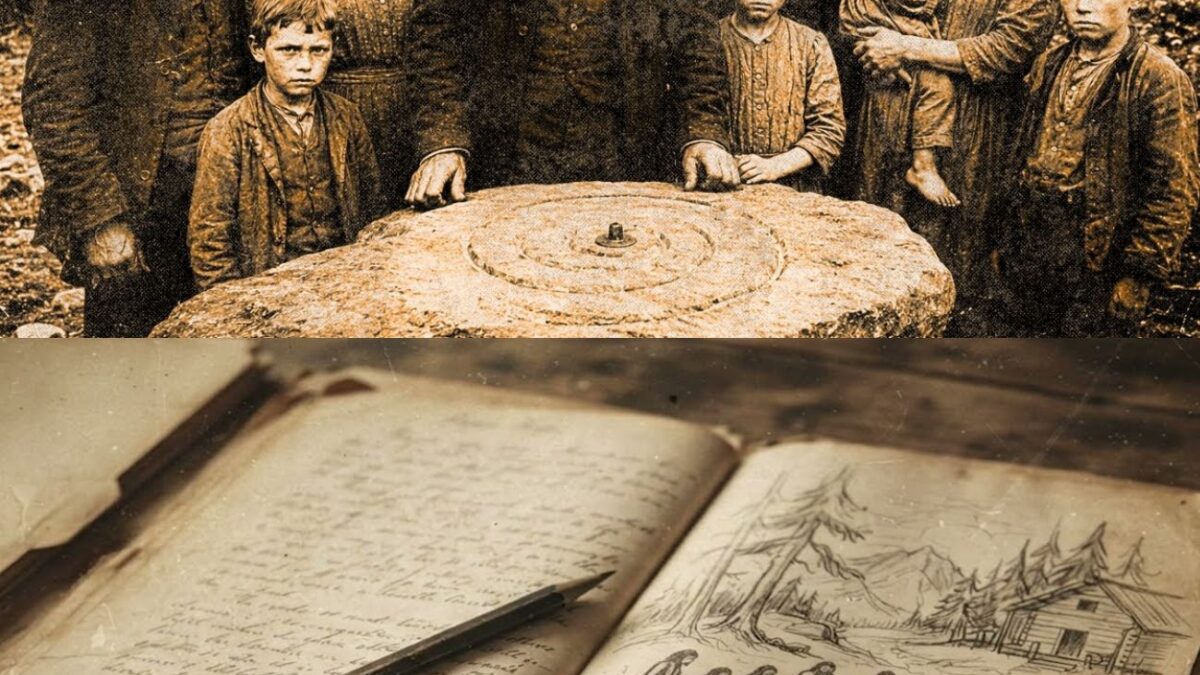
There is a follow-up account, and it is the closest thing the record has to a description of what he saw inside the gap. The follow-up account comes from his wife, given to a local historian in the year 1968, three years after his death. She said that on the night after he returned from Cutthroat Gap, her husband sat at the kitchen table for several hours without moving, and that he eventually told her, in a low voice, that he had walked up into the gap, and that the family had been waiting for him at the edge of a clearing. He said there were nine of them, five adults and four children, and that they had stood in a loose half-circle around a low flat stone. He said the stone was carved with the same spiral inside a spiral that he had been briefed about, and that in the center of the spiral, set into a small depression, was a piece of dark metal that he could not describe further because, in his own words to his wife, he had not been able to look at it directly for more than a moment.
He said that the oldest of the adults, an older man with white hair, had spoken to him in a quiet voice, and had told him that the family had been keeping this place for a very long time, and that they had been keeping it not for themselves, and not for the county, and not for the government of the United States, but for something that had been placed here long before any of those things had come into being. The older man had told him, and this is the line his wife repeated most carefully to the historian, that the family were not the owners of what was in the gap, only its wardens, and that the county had known this once and had forgotten it, and would remember it again when the time came for the thing to be uncovered. He was told to leave. He left.
The historian who recorded that account did not publish it. His notes were donated to a regional archive after his death in the 1980s, and the folder containing the interview sat unread for another two decades before a graduate student in oral history stumbled upon it. She published a short paper on the account in a small folklore journal, framing it as what she called a guardian family narrative—a category of oral tradition in which remote families are described as the caretakers of ancient sites or objects. Her paper received little attention outside the narrow academic subfield in which it appeared, and she did not attempt to visit Cutthroat Gap. She wrote, in the final paragraph of the paper, that whatever the historical reality of the account, the mutual silence between the county and the family was itself the phenomenon worth studying because it represented, in her words, a form of unwritten treaty that had persisted across at least four generations without ever being spoken aloud.
The unwritten treaty held for another three decades after 1942. The federal census of 1950 listed the gap as uninhabited. The census of 1960 listed it as uninhabited. The census of 1970 again listed it as uninhabited, though by that year the surrounding valleys had begun to grow rapidly, and a state highway had been extended within four miles of the mouth of the trail into the gap. In the spring of 1973, a survey party from a private timber company obtained what they believed was legal permission to walk the ridge and assess the standing timber for purchase. They entered the gap on a Tuesday morning. They did not come out that day. They did not come out the following day. On the third day, a search party was sent up the trail. The search party found the survey equipment neatly stacked at the mouth of the gap, arranged in a straight line. And beside the equipment, they found a folded piece of paper on which was written in a careful hand a single line. The line read, “The men are unharmed and will return to the town below by sundown.”
The men did return by sundown. They were unharmed. They refused, then and afterward, to speak of what had happened. Two of the three left the timber company within the year; the third stayed on and rose to a senior position, and he was known for the rest of his career to refuse any assignment within twenty miles of the gap.
The name Wardell has not appeared in any public record of the county since the year 1986. In that year, the assessor received a small package by mail, sent from a post office in the town below the gap. The package contained a folded document handwritten on heavy paper and a small object wrapped in dark cloth. The document was a formal notice addressed to the county stating that the family known to the county as the Wardells had completed their long stewardship of the land within Cutthroat Gap, and that the stewardship would now pass to a party whose name and location the county did not need to know. The document requested, politely and firmly, that the county continue its practice of leaving the gap uncounted and unsurveyed, and it thanked the county for its cooperation across the preceding 139 years.
The small object wrapped in dark cloth was a pendant of dark metal on a leather cord stamped with a spiral inside a spiral with a mark in the very center that no one in the assessor’s office could read. The pendant was placed in a small locked drawer in the assessor’s office, where it remains to this day.
The gap itself is still there. The trail still leads up from the old dirt road. The rock face with the carvings is still on the inner wall of the small side canyon, weathered a little further by another four decades of rain and wind, and the small opening at the base of the wall is still there, though no one who lives in the surrounding valleys will speak of it directly, and no state surveyor has visited it since the report of 1912. In the year 2008, a research team from a small independent institute proposed a formal archaeological survey of the site. Their proposal was submitted to the county for review. The county returned the proposal within two weeks, marked with a stamp that read, “Request declined. No further correspondence.” And no formal reason was given. The research team appealed the decision. The appeal was denied. The team did not attempt to visit the site without permission, and no formal survey of the carvings has ever been conducted.
There are questions the record does not answer, and perhaps was never intended to answer. Who were the Wardells in the deepest sense of the question? Where did the name come from, and where did the family come from, and how long before the year 1791 had they been living in the gap? What was the dark reddish salt they traded with the settler post in the years before the county existed? And why did the trader describe it in terms that suggest he had never encountered anything like it in his life? What is the meaning of the spiral inside a spiral and the mark in its very center? And why does the same symbol appear on a pendant worn by generations of one family, on unidentified pottery in a neighboring valley, on the carvings of a rock face inside a private canyon, and on the flat stone at the edge of a clearing where a census clerk in 1942 saw a piece of dark metal he could not look at directly? What is inside the opening at the base of the rock face, and inside the ridge itself, and what did the older man with white hair mean when he said the family were only the wardens of what was in the gap, and that the county would remember one day what it had once known and chosen to forget?
The record does not answer. The record was not built to answer. It was built by clerks and surveyors and preachers and naturalists who each glimpsed only a fragment of the shape of the thing, and who each, for their own reasons, walked back down the trail and did not return. What we have is not a history of the Wardells. What we have is the shadow of a history, the shape of an agreement between a county and a family that predated the county and outlasted the family. The Wardells are gone from the record now, or so the record tells us, but the gap is still there, and the carvings, and the opening at the base of the wall, and the pendant sits in a locked drawer in a county office, waiting for someone able to read the mark in the center of the spiral.
As the years drifted past the turn of the new millennium, the silence around Cutthroat Gap began to fray not from human intrusion, but from time itself. The older generation in the valley towns passed on, taking their whispered warnings with them, and a younger populace moved in, unaware of the old unspoken treaties. In the autumn of 2024, an unseasonable wildfire tore through the southern ridge, scorching the thick underbrush that had choked the old trail for decades and exposing the rutted path to the open air. Local authorities, checking the perimeter of the burn zone, noticed that the heavy iron lock on the assessor’s office drawer containing the Wardell pendant had inexplicably jammed and turned cold to the touch, refusing to open for the first time in nearly forty years. Simultaneously, hikers reported hearing a low, resonant vibration echoing through the pine trees near the mouth of the gap—a sound like grinding stone mixed with the distant tolling of a bell, though no machinery operated for miles.
On a quiet night in late November, a local ranger patrolling the lower perimeter of the ridge noticed that the dense brush blocking the entrance to the gap had entirely withered away, revealing the trail clear and bare, as if freshly walked upon. At the very edge of the tree line, resting on a flat stone, lay a small leather pouch tied with sinew. When opened, it did not contain gold or artifacts, but a handful of dark reddish salt that smelled faintly of burnt cedar. Looking up toward the high notch of the ridge, the ranger saw a single line of blue fire burning deep within the side canyon—not leaping or destructive, but steady and precise, tracing the exact pattern of a spiral inside a spiral. No one climbed the trail that night, and the county records remain blank, leaving the gap open and waiting, as the mountain slowly prepares to settle a debt that has been pending for centuries.

