The Strangest Farmhouse Ever Uncovered Deep in the Ozark Backcountry
The Strangest Farmhouse Ever Uncovered Deep in the Ozark Backcountry
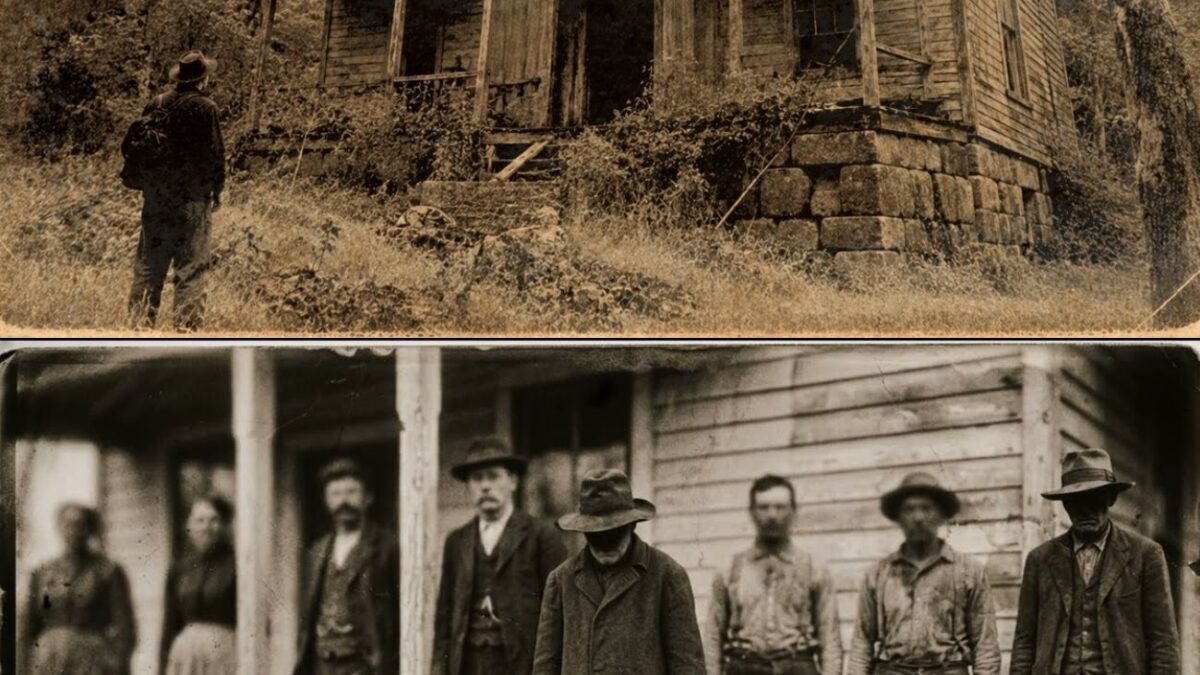
There is a photograph. It was taken in the summer of 1973 somewhere in the deep folds of the Ozark backcountry. And for almost 40 years, it sat in a manila envelope in the basement of a county records office in Arkansas. In the photograph, a farmhouse leans slightly to one side, its porch sagging under the weight of a roof that does not match the walls beneath it. The windows are too tall. The door is too narrow. And carved above the doorframe in a language nobody in that county has ever been able to identify are seven symbols that appear again and again in places they have no business appearing. On a rusted plow, on the underside of a rain barrel, on the inside of the chimney bricks, on the bones of a horse buried 6 ft below the barn floor. The land records say the farmhouse was built in 1882 by a man named Elias Holay who paid for the property in silver coins that a local historian would describe as unlikely. The county register lists his occupation as farmer. It lists his wife as unnamed and it lists his children, all four of them, as, and I want you to hear this exactly as it was written, of unclear origin.
Elias Holay walked out of that farmhouse on the morning of October 11th, 1906, and was never seen again. His wife, unnamed, his four children unclear, all of them gone by sunset. The doors were left open. The stove was still warm. A pot of stew on the table had barely cooled. And in the parlor, a book was found open to a page that had been written in the same seven symbols carved above the door. For the next 67 years that farmhouse sat empty. Locals would not go near it. Hunters reported that their dogs would not cross the tree line at the edge of the property. Two separate attempts to demolish the structure in the 1940s failed for reasons the workers refused to explain. And when a state surveyor finally set foot inside in 1973, what he found in the cellar would end his career, put him in a psychiatric hospital for three years, and cause the entire property to be quietly delisted from every public record in the state of Arkansas.
This is the story of the Holay farmhouse. And by the time we are done, you are going to understand why this is not just another abandoned building in the American backcountry. You are going to understand what it was built on, what it was built for, and why the more you look at it, the more it starts to look like it was never a farmhouse at all.
To understand what was found in that cellar, you first have to understand where the Holay farmhouse actually stood. And that is not as simple a question as it sounds. The property is listed on old county maps as sitting on a 200-acre parcel in the northwestern corner of what was then called Cross Hollow Township. That township no longer exists. It was absorbed, split, and reabsorbed by three different county reorganizations between 1890 and 1912. And the land itself was quietly transferred to federal holdings during a period in the 1930s when a great deal of Ozark land was being consolidated for reasons that were never fully explained. But the strange thing about that parcel is not just that it kept moving on paper. It is that the parcel itself does not match the terrain around it. The Ozarks are old mountains. They are worn down, folded, layered with limestone and dolomite that geologists have mapped in exhaustive detail. And on every geological survey ever conducted in that region, the 200 acres surrounding the Holay farmhouse show up as an anomaly. The soil composition is wrong. The magnetic readings are inconsistent. And when a private survey team came through in 1994 with ground-penetrating radar, they found something that no one has ever satisfactorily explained. Beneath the farmhouse at a depth of approximately 40 ft, there is a structure. It is roughly square. Its walls are approximately 6 feet thick and it appears to be constructed of a material that the radar could not properly identify. The surveyors marked the anomaly, filed their report, and were told by the landholder, whoever that landholder actually was, that no further surveying would be permitted on the property. The report was sealed. The team disbanded and two of the four surveyors involved died within the following 18 months under circumstances that their families still consider suspicious.
The first of those surveyors was a man named Devon Roush, 47 years old, an engineer with over 20 years of field experience. He was found in his car parked on the shoulder of a rural highway in southern Missouri approximately 11 months after the Holay survey. The engine of the car was running. The keys were in the ignition. There were no signs of struggle, no signs of a medical event, and no signs of external injury. The cause of death was recorded as undetermined natural causes, a phrase that his family later described as one meaning the coroner did not want to say what he actually thought.
The second surveyor, a woman named Patricia Lomax, was found in her apartment in Little Rock, Arkansas, 17 months after the Holay survey. She had, according to the responding officers, been dead for approximately 3 days. Her television was on. Her front door was locked from the inside. And on her kitchen table, arranged in a careful row, were seven objects that the officers documented in their initial report, but that were, by the time the case was closed 6 weeks later, no longer in the evidence log, and no longer, as far as anyone was able to determine, in the physical custody of any agency involved with her death. What those seven objects were is a detail that has never made its way into the public record. But one of the responding officers, in a brief and off-record conversation with a local journalist over a decade later, is reported to have said that the objects were small stones roughly identical in size, each one carved with what he described as one of those symbols. He would not clarify what he meant. He would not speak to the journalist again. And when she attempted to contact him for a follow-up two years later, she was informed by his family that he had moved out of state and had asked that his forwarding address not be shared.
The seven symbols. This is where the story of the Holay farmhouse begins to overlap with something much older and much larger than one abandoned building in the Ozarks. Because those seven symbols, the ones carved above the door and pressed into the bricks and etched into the bones of that buried horse, are not unique to Elias Holay. They have been found in over 40 other locations across North America. From the ruins of a mill in upstate New York to the foundation stones of a courthouse in central Missouri to the interior walls of a mineshaft in the Colorado Rockies. And in every single case, the buildings they appear on share three characteristics that mainstream architectural history cannot account for.
The first characteristic is age. According to official records, all of these structures were built between 1860 and 1910 during the boom of American westward expansion. But the construction techniques, the materials used, and in many cases, the level of craftsmanship do not match what was possible in those regions during those decades. The Holay farmhouse itself is a small example. Its foundation stones, according to a geologist who examined them in 1973, appear to have been cut with a precision that would have required industrial machinery not available in rural Arkansas in 1882. The stones fit together so tightly that no mortar was used in the lower courses. A knife blade cannot be inserted between them. And the corners of the foundation are cut at angles so precise that a modern stonemason shown photographs of the joins in 2007 reportedly said, whoever did this either had equipment nobody sold in America at the time, or they were not building this the way we build things.
The second characteristic is inconsistency. The Holay farmhouse was described in county records as a modest two-story wooden structure. And from the outside, that is more or less what it looked like. But when the state surveyor entered the building in 1973, he found rooms that did not match the exterior dimensions. He found a staircase that descended into a stone corridor that could not, according to any measurement of the property, actually exist beneath the visible foundation. He found windows that opened onto walls. He found doors that led to nothing. And in one particular room on the second floor, he found a hearth that appeared to have been built into a stone wall predating the wooden structure by, according to the geologist who later examined a chip of that stone, somewhere between 400 and 600 years. Let me repeat that. In an American farmhouse supposedly built in 1882 in a region that was not permanently settled by Europeans until the 1830s, there is a stone wall carbon-dated to somewhere between 1,200 and 1,400 years of age at the time of examination. Meaning the wall was built somewhere between 1370 and 1570. Meaning the wall was there before Elias Holay, before the settlers, before the mapping of the interior of North America by any European power. And built into that wall in the same seven symbols carved above the front door is a single line of text that no linguist has ever been able to translate.
The third characteristic is disappearance. This is the one that keeps researchers awake at night. Because in every single one of those 40-plus buildings marked with the seven symbols, at some point in their history, the occupants vanished. Not died, not moved, vanished. In the case of the mill in upstate New York, the owner and his three workers were reported missing on the same night in 1891 with the mill wheel still turning and the grain of the day still in the hopper. In the case of the Missouri courthouse, a night watchman named Perry Colton disappeared from a locked and guarded room in 1904, and the only trace of him ever found was his lantern, still lit, sitting on the floor of a hallway that had no exit. In the case of the Colorado mine, an entire shift of 11 men walked into the shaft on the morning of March 14th, 1897, and were never seen again. The mine was sealed. The company folded. And to this day, no explanation has ever been offered that accounts for the fact that the shaft was fully lit, fully ventilated, and monitored from the entrance by two foremen who swore under oath that no one had come out.
Elias Holay and his family fit this pattern exactly. And that is the part of the story that begins to shift the ground beneath your feet. Because once you notice the pattern, you cannot stop noticing it. It is not one farmhouse. It is not one mine. It is not one courthouse. It is a system, a network, something that stretched across the interior of the North American continent during a period of about 50 years. And then sometime between about 1910 and 1920, it stopped. The symbols stopped appearing on new buildings. The disappearances slowed and then for the most part ended. And whatever had been happening at those 40-plus locations quietly, deliberately was buried under decades of official recordkeeping designed to make it look like it had never happened at all.
So who was Elias Holay? That is the question that Marcus Bain, a retired archivist from the Arkansas State Historical Society, spent the last 22 years of his life trying to answer. And by the time he died in 2019, he had assembled a file that ran to over 1,100 pages, most of which has never been publicly released. What follows in this next section is drawn from portions of that file that were shared with a small circle of researchers before the death of Bain and from interviews he conducted with descendants of families who lived in the Cross Hollow area during the late 1800s. It is not a complete picture. Bain himself said in one of his last recorded conversations that a complete picture may not be possible. But it is enough to tell you that Elias Holay was not a farmer and he was not from Arkansas. And depending on which of the sources of Bain you believe, he may not have been who he said he was at all.
The first document Bain found was a bill of sale dated April 16th, 1882, transferring the 200-acre parcel from a man named Josiah Trent to Elias Holay. The bill of sale is unremarkable in almost every respect. It uses standard legal language for the period. It lists a reasonable purchase price of $180. And it bears the signature of a county clerk who is known from other records to have been in office at that time. But there are two things about the document that Bain could not explain.
The first is that the signature of Elias Holay does not match any other signature attributed to him in any subsequent document. The Elias Holay who signed the bill of sale in April of 1882 wrote with a heavy slanted hand using a formal cursive style that was already going out of fashion in America at that time. The Elias Holay who signed the baptismal record of his son in 1884 wrote with a light upright hand in a much more modern script. And the Elias Holay who signed a tax assessment in 1891 wrote in a hand so different from either of the first two that a forensic document examiner shown all three signatures by Bain in 2007 concluded that they had almost certainly been produced by three different people.
The second thing Bain could not explain is that Josiah Trent, the man who supposedly sold the land, does not appear in any other record in the state of Arkansas. There is no birth certificate. There is no marriage certificate. There is no death certificate. There is no census record. There is no tax record. There is a bill of sale from April 16th, 1882. And there is nothing else. Bain spent four years trying to find any other trace of Josiah Trent. And at the end of those four years, he wrote in his personal notes, I have come to believe that Josiah Trent did not exist as a person, but was rather a name used by whatever institution or organization actually owned that land before it was transferred to Holay.
That word institution is important. Because as Bain dug deeper into the origins of the Holay property, he began to find fragmentary evidence that the 200-acre parcel had been under some form of continuous management since long before 1882. He found references in Cherokee oral histories collected in the 1890s by a Presbyterian missionary named Reverend Ambrose Kellerman to a place in what the Cherokee called the Folded Hollow that no member of their people had entered for as long as anyone could remember. He found accounts from French trappers in the 1760s describing a clearing in the Ozark interior where, according to the trappers, the compass would not settle and the game would not enter. And in a Spanish colonial document dated 1592 which had been misfiled for almost 400 years in an archive in Seville and only came to the attention of Bain through a chance conversation with a Spanish researcher in 2011, he found a reference to an expedition that had been sent from Santa Fe into the northeastern interior to investigate reports of a structure of stone in the wilderness that our men who saw it would not describe to us upon their return.
-
That is the earliest known reference. And it puts a structure made of stone in the exact geographical region where the Holay farmhouse would later stand, more than 250 years before Elias Holay supposedly bought the land and built his house. The Spanish document itself deserves a moment of attention because the language it uses is not the language of ordinary colonial reportage. Bain obtained a photocopy of the original and paid a specialist in 16th-century Castilian to produce a careful translation. The relevant passage in that translation reads as follows:
The company of eight men returned to us in Santa Fe on the seventh day of September, being reduced from 12, of whom four remain in that country by choice or by other cause we cannot discover. The senior among the returned, one Captain Ordonire, related to us that the company had entered upon a valley of some considerable depth, wherein was standing a structure of dressed stone the size of a fair church, though of no order of architecture known to any of us present, and marked upon its face with characters of a kind that Captain Ordonire requested we should not press him further to describe. The company did not enter the structure. The company did not approach nearer than a distance of some 400 paces. The four men who did not return had, according to Captain Ordonire, approached and had entered, and had not come out, and could not, by any signal or shouting, be made to answer. Captain Ordonire, upon the third day of waiting, ordered the remaining company to withdraw. He would not speak further of the matter. He would not accept promotion in the following year, and in the year 1595, upon the death of his wife, he entered a monastic house and did not, so far as we know, ever again leave it.
Bain spent seven months trying to trace Captain Ordonire in the Spanish colonial and ecclesiastical archives. He found evidence of the existence of the man up to 1592. He found records placing him in a specific Franciscan monastery in central Mexico from 1595 onward. And he found in the archives of that monastery a slim volume of what appear to be devotional writings composed by Ordonire in his last years. The writings are for the most part unremarkable expressions of the religious sentiment of the period, but interlinked with them in the same hand are four pages of what Bain described as drawings of a structure that no 16th-century Spaniard should have been able to draw.
The structure in the drawings is not a church. It is not a Spanish colonial building. It is not any indigenous architectural form documented from that period of New World exploration. It is, according to the carefully hedged conclusion of Bain himself, either a purely imaginary building conjured up in the tortured memory of a man haunted by something he had witnessed, or it is a reasonably accurate depiction of a stone structure that had been standing in the Ozark interior in 1592, and that predated by an unknown span of time the arrival of any European in the region.
The drawings show a building with a square footprint, walls of dressed stone, a single door on the eastern face, and rising from the northwestern corner, a cylindrical tower. A tower approximately three times the height of the main structure, windowless, featureless, ending in a flat top with no visible parapet or crenellation. And carved into the stones above the eastern door in the hand of Ordonire himself are three of the seven symbols later carved above the door of the Holay farmhouse. Three of the seven in a Franciscan monastery in central Mexico written down in the private devotional papers of a Spanish captain who had entered a valley in what would three centuries later be the state of Arkansas and who had watched four of his men walk into a stone building and never come out.
This is the point at which the ordinary categories of historical explanation begin to fail because there is no chain of transmission by which Ordonire in 1592 could have known about symbols that would appear on an American farmhouse in 1882. There is no chain of transmission by which the builders of the Holay farmhouse could have known about the drawings of a Spanish captain buried in a Mexican monastery for 300 years. The only way both of them could have the same symbols is if the symbols were in some sense already there waiting to be found by both parties independently at intervals of centuries. Which is to say the symbols belong to whatever built the structure Ordonire saw and whatever inspired the construction of the Holay farmhouse and whatever, if anything, still persists in the space between those two events.
Bain, in the margin of his notes on Ordonire’s papers, wrote a single sentence in his own hand in ink that had faded slightly with age but that was still perfectly legible. The sentence reads: We are not looking at coincidence. We are looking at continuity, and the question is not whether the continuity is real, but what kind of thing is capable of maintaining continuity across 400 years without leaving any explicable trace.
That sentence, more than any other single line in the 1,100-page file, captures the peculiar difficulty of the Holay case. It is not a case that can be resolved by more evidence. Every new piece of evidence deepens the mystery rather than solving it. And every new site that turns up marked with the same seven symbols only widens the gap between what the official history says happened during the last several centuries and what the physical record patiently and quietly insists upon.
Now, at this point, you might be thinking that the obvious explanation is that whatever was in that hollow in 1592 was a natural rock formation or perhaps a structure built by an indigenous people that predated European contact. And that would be a reasonable assumption except for one thing. The Cherokee oral histories collected by Kellerman are very specific on this point. The Cherokee did not build the structure. Their traditions held that the structure was there before their people arrived in the region, which by their own reckoning was somewhere in the early 1600s. And the structure was not, according to those traditions, a natural formation. It was described as a hall with walls, with a door, with a roof, and with, and this is a phrase that appears in three separate transcriptions of the oral history, marks upon the stone that were not for our eyes.
Marks upon the stone, not for our eyes, which brings us back to the seven symbols. The symbols themselves have been the subject of intense study by a small number of researchers over the last several decades, and there is no consensus on what they represent. They are not, as far as anyone can determine, a form of writing in any known human language. They do not correspond to any alphabet, syllabary, or logographic system that scholars have identified. And they do not match any of the pictographic or petroglyphic traditions of indigenous North American peoples.
What they do have, and this is the part that makes people uncomfortable, is a striking visual similarity to certain markings that have been documented at a small number of other sites around the world. Sites that mainstream archaeology considers unrelated and coincidental, but which the researchers looking at the Holay symbols do not consider unrelated at all.
The first of those sites is a set of underground chambers in the Bolu province of Turkey. First documented by a Turkish geologist in 1984 and largely ignored by international archaeology because the chambers do not fit into any accepted historical timeline for the region. The chambers are carved into solid basalt at a depth of approximately 80 meters below the surface, and the walls of the innermost chamber bear a series of markings that include among other symbols three of the seven symbols found at the Holay farmhouse. The Turkish geologist who documented the chambers, a man named Halit Ozer, attempted to publish his findings in a western archaeological journal in 1989 and was rejected. He attempted again in 1992 and was rejected. In 1994, his research materials were removed from his home during a burglary in which nothing else of value was taken. And in 1997, Halit Ozer died in a car accident on a stretch of road he had driven every day for 20 years in weather conditions that his family and colleagues described as unremarkable.
The second site is a stone structure on a small island in the Baltic Sea off the coast of Estonia that has been dated by local geologists to somewhere between the 9th and 11th centuries. The structure is unusual because it does not match any known Viking, Slavic, or Baltic architectural style of that period. It is a single-room building made of granite blocks fitted together without mortar. And on the interior lintel above the door, there is a carving of two of the seven Holay symbols arranged in an order that appears in exactly one other place in the world. And that other place is the interior wall of the buried horse pit at the Holay farmhouse.
The third site, and this is where the story begins to move into territory that many mainstream researchers refuse to engage with, is a set of ruins in the interior of Siberia in a region called Zabaykalsky Krai that were first reported by a Russian expedition in 1868 and then essentially forgotten. The ruins consist of what the original expedition described as the foundations of a great city that had been leveled, but not by any natural cause we can identify. The foundations extend over approximately 14 square kilometers. They include what appear to have been streets, plazas, and the bases of large public buildings. And carved into the stones of what the expedition believed was a central temple or civic structure are all seven of the Holay symbols in the exact same sequence in which they appear above the door of the Holay farmhouse.
Let that settle for a moment. In 1868, more than a decade before Elias Holay supposedly built his farmhouse, a Russian expedition documented the same seven symbols in the same sequence carved into the ruins of a leveled city in the middle of Siberia. And no one in the century and a half since has ever been able to identify who built that city, when it was built, when it was destroyed, or what the symbols mean.
This is the point at which the story of the Holay farmhouse stops being a story about one abandoned building in the Ozarks and starts being a story about something much older. Because if you accept the evidence that the same symbols appear at sites separated by continents and by centuries, then you have to accept one of two things. Either those symbols represent an idea so universal and so basic that unrelated peoples in unrelated places independently invented them in the same sequence and the same style, which is statistically speaking not something that happens. Or there was at some point in the past a network, a civilization, or a series of connected civilizations, or an institution that persisted across generations and across borders that placed those symbols on structures in Turkey, in Estonia, in Siberia, and in the Ozarks. And that institution, whatever it was, either ended abruptly at some point in the deep past or, and this is the possibility that the researchers looking at the Holay case cannot quite bring themselves to say out loud, it did not end at all.
The word that comes up when researchers do finally bring themselves to say something out loud is Tartaria. And I want to be very careful here because Tartaria is a word that has been used and misused in a great many ways over the last few years. And much of what has been written about it is not in my opinion useful. But the underlying observation, the observation that maps of the world produced by respected European cartographers between roughly 1500 and 1800 consistently show a vast interior empire in Eurasia labeled Tartaria or Grand Tartary. And that this empire simply disappears from maps sometime in the 19th century without any corresponding conquest, revolution, or catastrophe recorded in mainstream history, is an observation worth taking seriously. Something was there. Something was on the maps and then something was not on the maps. And nobody in any history textbook I have ever read has ever satisfactorily explained where it went.
The Holay farmhouse and the network of 40-plus buildings that share its markings may be the physical remnants of that something. Or they may be something else entirely. But they are without question evidence that the official history of the last several hundred years is incomplete in ways that most people are not prepared to grapple with.
And that brings us to what the state surveyor found in the cellar in 1973. His name was Harlon Pike. He was 41 years old at the time, a career state employee with the Arkansas Department of Public Lands, and he had been assigned the task of conducting a routine assessment of the Holay property in preparation for a proposed transfer of the land to a federal wildlife management program. The assignment was on paper one of the most boring tasks in the department. Walk the property, measure the boundaries, note any structures, check for hazards, file a report. Pike had done hundreds of these assessments over the course of his career, and he was, by every account of the people who knew him, one of the least imaginative, least excitable, least emotional men who had ever worked for the state of Arkansas.
Pike arrived at the Holay property on the morning of June 8th, 1973. He was accompanied by a junior surveyor named Ellis Warden and by a local contractor named Jim Sutherland, who had been hired to provide access to any locked structures on the property. The three men parked their truck at the end of the county road, walked approximately a mile and a half up an overgrown wagon trail, and arrived at the farmhouse a little after 10 in the morning. The weather was clear, the temperature was in the mid-70s, and by all three later accounts of the three men, the property was, until they entered the house, entirely unremarkable, aside from the fact that it was quieter than any of them had ever heard the woods to be. No birds, no insects, no wind in the leaves, just the sound of their own footsteps on the packed dirt of the yard.
The front door was unlocked. Sutherland pushed it open, and the three men stepped inside. What they saw in the main room of the farmhouse has been described in three separate written accounts. One by Pike himself, one by Warden, and one by Sutherland. The three accounts do not perfectly agree with one another, which is what you would expect from three men trying to remember a traumatic experience decades later, but they agree on the essential facts.
The main room was clean, not merely tidy. Clean in a way that no house left empty for 67 years should have been. There was no dust on the surfaces. There were no cobwebs in the corners. There was no accumulation of leaves or debris that would have blown in through the windows over more than half a century. The furniture, according to all three accounts, appeared to be in the same positions in which it had been left in 1906, and on the dining table in the center of the room there was a pot of stew.
Pike stepped closer to the table, lifting the heavy iron lid. Inside, the meat and root vegetables were neither spoiled nor dried out; they appeared as though they had been removed from the fire only moments before, though the hearth beneath the brick chimney was cold and dead. It was at this moment that Warden noticed the cellar door, set flush into the floorboards near the base of the staircase, standing ajar by precisely three inches. A thin ribbon of vapor, completely odorless and faintly luminescent in the dim light, drifted upward from the opening.
Sutherland initially refused to descend, arguing that the air down there felt wrong, heavy and metallic. But Pike, bound by the rigid protocols of his office, unclipped his flashlight and pulled the heavy wooden door all the way back. The stone steps leading down into the darkness were wet, yet when Pike touched the moisture with his fingertips, it did not feel like water. It was viscous, warm to the touch, and left a faint, indelible stain of silver upon his skin that no soap would wash away for weeks.
As the three men descended into the subterranean chamber beneath the house, the walls ceased to be ordinary cellar stone. They morphed into smooth, seamless blocks of an unknown dark material that absorbed the beam of their flashlights rather than reflecting it. In the center of the room stood a vertical stone pillar reaching from the floor to the ceiling, etched continuously with the seven symbols, which pulsed with a faint, synchronized heartbeat of blue light. At the base of the pillar rested a collection of modern artifacts from 1906—pocket watches, leather shoes, iron keys—arranged in neat, concentric circles.
Pike walked forward, ignoring the frantic warnings of Warden and Sutherland, and placed his palm directly against the pulsing pillar. Witnesses outside later reported hearing a sharp, metallic ring that vibrated through the very roots of the mountain, followed by total, suffocating silence. When Warden and Sutherland finally dragged Pike back up the steps, he was no longer screaming, but his eyes had lost all focus, staring fixedly at something only he could perceive in the dark.
The authorities who subsequently descended upon the property found no trace of the cellar, no trace of the farmhouse interior as it had been described, and no record of the files Harlon Pike had carried in his leather satchel. The house itself was burned to the ground within forty-eight hours under the cover of a fabricated forest fire directive, and the surrounding 200 acres were sealed beneath a permanent federal exclusion zone. Pike spent the remainder of his life in a secluded ward, speaking only when the room went entirely dark, repeating a single phrase in an unidentifiable tongue: “The door was never closed, it was only waiting for someone to knock from the inside.”

