The Story of the Hessek Folk (1877) —The People Found Deep in the Smokies Speaking No Known Language
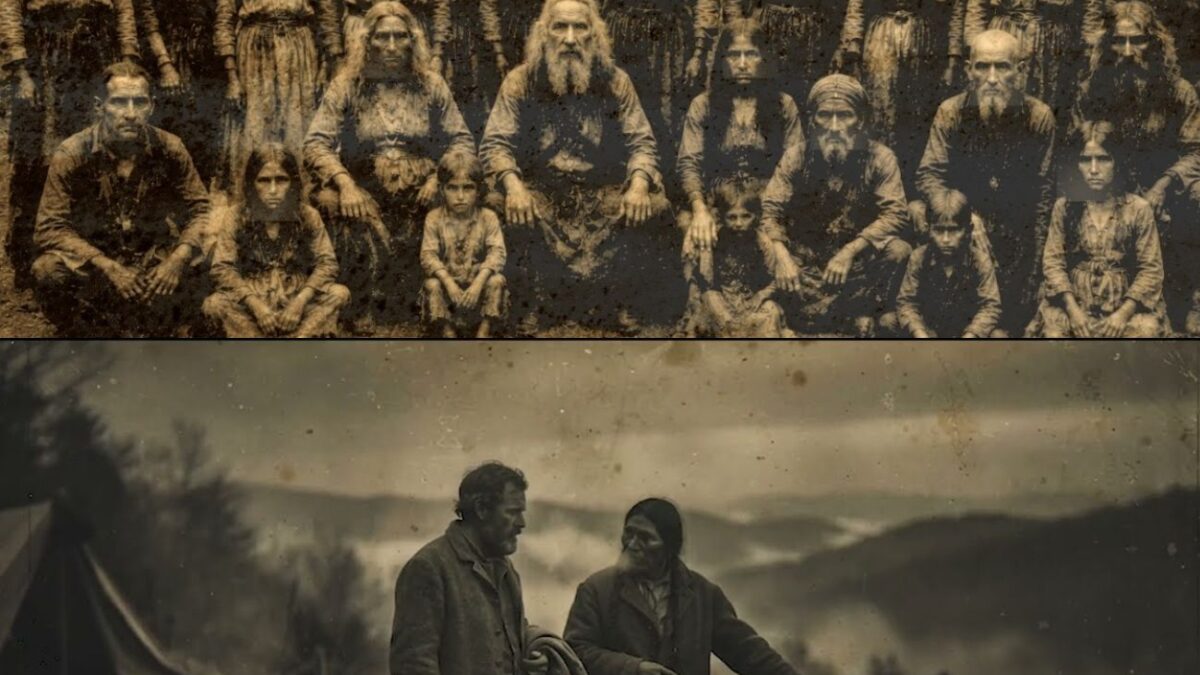
The Story of the Hessek Folk (1877) —The People Found Deep in the Smokies Speaking No Known Language
In the autumn of 1877, a United States geological survey team led by a cartographer named Elias Faren walked into the Great Smoky Mountains to map a stretch of uncharted ridge line between North Carolina and Tennessee. Faren had been assigned the route because nobody else wanted it. The terrain was vertical. The canopy was so dense that sunlight barely touched the forest floor. And the only people who had ever lived in those hollows, according to every settler record available, were a handful of Scots-Irish families who had drifted down from Virginia two generations earlier.
Faren expected to find nothing but rock, timber, and silence. What he found instead was a village—not a ruin, not an abandoned camp, but a living, breathing settlement of roughly 200 people tucked into a narrow valley between two ridge lines that did not appear on any existing map.
The structures were not log cabins. They were not Cherokee winter houses. They were long curving buildings made from dry-stacked stone with roof lines that followed the contour of the hillside in a way that made them nearly invisible from above. The people who lived inside them were not indigenous to any known tribal nation. They were not European settlers. They were not of African descent. Their skin was described by Faren in his field journal as pale but weathered with a reddish undertone he compared to old copper. Their hair was uniformly dark. Their eyes were narrow and deep set.
And when Faren attempted to speak with them, he realized that their language was not English, not Cherokee, not any dialect of any tongue he had ever encountered in 20 years of survey work across the Appalachian range. It was not French. It was not Spanish. It was not German. It was not any pidgin or creole. It was something else entirely, a spoken system with sounds and structures that did not correspond to any known language family on Earth.
Faren wrote a single sentence in his journal that night that would come to define everything that followed. He wrote, “These people have been here longer than the trees.” That sentence was not poetry. It was a professional surveyor’s observation. The trees around the settlement were old-growth tulip poplars and hemlocks, some of them dated by ring count to 500 years or more. And the foundations of the Hessk buildings, as they would later be called, were worn smooth in a way that suggested not decades of use, but centuries. The paths between the structures were grooved into the bedrock itself, polished by the passage of bare feet over a span of time that Faren could not bring himself to estimate.
Nobody in any government office in Washington had any record of these people. No treaty mentioned them. No census included them. No missionary had ever reported contact with them. No trader, no trapper, no militia, no land speculator had ever noted their existence. They were by every official measure impossible. And yet there they were, 200 souls living in stone houses speaking a language that no scholar on the continent could identify deep in the interior of a mountain range that the United States government believed it had already surveyed, already mapped, already claimed.
This is the story of the Hess folk: the people who were found where no people should have been, speaking words that no one could understand, living in buildings that no one could explain; the people who were studied, cataloged, measured, transcribed, and then within less than four years of their discovery, erased from every official record as though they had never existed at all.
To understand what Faren walked into that October, you have to understand the state of the Great Smoky Mountains in the 1870s. The Smokies were not empty. They had never been empty. The Cherokee had lived across those ranges for thousands of years before removal. And even after the Trail of Tears in 1838 and 1839, scattered bands remained in the deepest hollows—families who had hidden from the soldiers or who had granted exemptions through land deals that barely held up in court. White settlers had pushed into the lower valleys by the 1840s and 1850s, mostly subsistence farmers who wanted isolation more than they wanted fertile soil.
By the time Faren arrived, there were small communities dotting the edges of the range. Gatlinburg was a crossroads. Cades Cove had been settled for decades. The lowlands were known, but the interior was something else. The ridge lines above 4,000 feet were almost entirely unmapped. The slopes were so steep that horses could not navigate them. The rhododendron thickets, locally called laurel hells, grew so dense that a man could spend an entire day cutting through 50 yards of growth. The fog that gave the mountains their name rolled in without warning and could reduce visibility to arm’s length. Survey teams avoided the high interior because it was dangerous, expensive, and by the consensus of the time, worthless. There was no farmland up there. There was no accessible timber. There was no mineral wealth that anyone had yet identified. The government wanted the mountains mapped for completeness, not for exploitation.
Faren was 43 years old when he received the assignment. He had spent two decades working survey lines across Virginia, Kentucky, and the Western Carolinas. He was methodical. He was not given to exaggeration. His field journals, which survive in partial form in the archives of the Smithsonian’s National Anthropological Archives, are written in a dry, precise hand that reads more like an equipment log than a personal diary. Distances are measured, elevations are estimated, rock types are noted, weather conditions are recorded each morning and each evening. He was not the kind of man who invented stories.
He departed from a staging point near present-day Bryson City, North Carolina, on October 4, 1877, with a team of four. His assistant surveyor was a man named Calvin Teague. The two chainmen were brothers from Haywood County whose last name appears in the journals as Krider. And the team’s cook and packer was an older Cherokee man identified only as George, who had worked with survey teams in the region for more than a decade and who spoke both English and the Kittoah dialect of Cherokee fluently. George’s presence would become significant later because he was the first person to hear the Hess language and confirm without hesitation that it was not Cherokee, not any Cherokee dialect, and not any tongue he had ever heard spoken by any people in the mountains.
The team moved northwest along a ridge system that Faren designated in his notes as the Tuckeri divide, though this name does not correspond to any modern topographic feature. They climbed steadily for three days, mapping as they went, marking trees with blaze cuts, recording compass bearings, and setting reference stakes at quarter-mile intervals. On the evening of October 7, they camped at an elevation Faren estimated at just over 5,000 feet on a narrow saddle between two peaks. The fog was heavy. The temperature had dropped below freezing. Faren noted that the forest around them was old-growth hemlock and tulip poplar of extraordinary size, some of the trunks measuring more than 6 feet in diameter. He wrote that the forest felt ancient in a way he had not encountered before, even in the most remote sections of the Virginia Highlands.
On the morning of October 8, George woke the camp before dawn. He told Faren that he had heard sounds during the night—not animal sounds, but human sounds—voices carrying through the fog from somewhere below the saddle to the north. Faren noted that George appeared unsettled, which was unusual. George was not a man who startled easily. They broke camp and descended the north slope of the saddle into a narrow drainage that Faren had not identified from the ridge above.
The drainage was steep but navigable, and it opened after approximately half a mile into a valley that Faren described as unlike any landform he had seen in the Smokies. The valley floor was relatively flat, perhaps a quarter-mile wide and three-quarters of a mile long, oriented roughly east to west, with sheer rock walls on the north and south sides that rose several hundred feet. A small stream ran through the center. The canopy overhead was thick enough that the valley floor was in permanent twilight. And along both sides of the stream, built against the base of the rock walls, were the structures.
Faren counted 19 buildings in his initial survey. They were long and narrow, some of them extending 40 or 50 feet in length, but only 12 or 15 feet wide. The walls were dry-stacked stone fitted without mortar in a technique that Faren compared to nothing he had seen in Appalachian construction. The stones were not rough cut. They were shaped, smoothed on their contact faces, and laid in courses that followed subtle curves rather than straight lines. The roof lines were covered with layers of bark, earth, and living vegetation so thoroughly integrated into the hillside that from above the buildings would have been invisible. Faren wrote that he walked within 30 feet of the first structure before he recognized it as a building and not a natural rock formation.
There were people inside. The first person Faren saw was a woman. She was standing at the entrance of one of the long stone buildings, holding a clay vessel of a type Faren did not recognize. She was small, perhaps 5 feet tall, wearing a garment made from woven plant fiber that covered her from shoulders to ankles. She did not run. She did not call out. She looked at Faren and his team with an expression he described as calm but attentive—the way a person looks at something unexpected but not necessarily threatening. Behind her, in the dim interior of the building, Faren could see others: children, older adults, all of them watching.
George stepped forward and spoke in Cherokee. The woman did not respond. George tried again using a different phrasing. Nothing. He tried a third time using what Faren described as a trading language, a simplified pidgin that George said was used between Cherokee and Creek speakers in the lowlands. The woman watched George’s mouth as he spoke, then looked at the other members of the team, then back at George. She spoke a single word. It was a sound that Faren attempted to render in his journal as something like tessic or hessk, a guttural syllable that none of them could place. George turned to Faren and said plainly, “I do not know what she is saying.”
Over the next two hours, more of the valley’s residents emerged from the buildings. Faren estimated between 40 and 60 individuals visible at any given time, though he believed the total population was larger based on the number and size of the structures. The people were not hostile. They did not carry weapons. They did not attempt to block the survey team’s movement through the valley, but they did not smile and they did not attempt to communicate further after the initial exchange. They simply watched.
Faren spent three days in the valley. During that time, he made observations that would later become the foundation of a controversy that consumed the small world of American anthropology for nearly two years before being abruptly and completely silenced. The buildings were not primitive. The stonework was sophisticated. The joints between stones were so tight that Faren could not insert the blade of his knife between them in most places. The interiors of the buildings were divided into rooms by interior stone walls, and several of the larger structures contained what Faren described as acoustic features—concave stone surfaces set into the walls at specific intervals that amplified sound within the room. He tested this by speaking at a normal volume near one of these surfaces and found that his voice carried clearly to the far end of the building, a distance of more than 40 feet, without raising his volume. He had ever seen anything like it in any structure, European or indigenous, anywhere in North America.
The valley itself showed signs of deliberate modification. The stream had been channeled through a series of stone-lined basins that Faren believed served as a water management system. The forest immediately surrounding the settlement had been selectively maintained, with certain species of trees preserved and others removed, creating a managed canopy that provided both shelter and filtered light. The paths between the buildings were not dirt tracks, but stone-paved walkways worn smooth to a gloss by what must have been generations of foot traffic.
Faren was not a linguist. He had no formal training in the study of language. But he was a meticulous recorder, and over the three days he spent in the valley, he filled 17 pages of his field journal with observations about the Hess language. He wrote down every word and phrase he could capture using a rough phonetic system based on English spelling conventions. He noted the rhythm and cadence of conversations he overheard. He recorded the sounds that did not exist in English, describing them in terms of their physical production. One sound he called a wet click, made by pressing the tongue against the roof of the mouth and releasing it with a burst of air that was neither a stop consonant nor a fricative, but something between the two. Another sound he described as a throat hum, a sustained vibration in the larynx that accompanied certain words and seemed to change their meaning depending on its pitch.
The language was not simple. Faren noted that conversations between adults were rapid, fluid, and appeared to contain a wide range of expression. He observed what he believed were jokes, arguments, instructions, and storytelling. The children spoke a version of the language that seemed simplified, which suggested to him that the language was learned rather than innate, that it had grammar, structure, and levels of complexity that took years to master. He wrote that the language sounded to his untrained ear as complete and as ancient as Greek.
He also noted something that would later attract significant attention from the linguists who eventually reviewed his journals: the Hess language appeared to have no borrowed words from any neighboring tongue. Not a single term that sounded Cherokee. Not a single term that sounded English, French, Spanish, or any European language. In a region where every indigenous language showed at least some influence from trade contact, missionary work, or territorial overlap, the Hess language was entirely isolated. It was as though the people who spoke it had never had sustained contact with any other language community at all.
George, the Cherokee member of the survey team, spent more time with the Hessk than anyone else on the team. He sat with the women while they worked. He watched the children. He listened. On the second evening, he told Faren that he had identified what he believed were approximately 30 distinct words, but that he could not determine the meaning of any of them through context alone. He said the language did not sound like anything he had ever heard, and he had heard many languages in his years working the mountain trade routes. He said it did not sound like a language that had grown from any root he could recognize. He said it sounded old. And when Faren pressed him on what he meant by that, George said something that Faren recorded verbatim in his journal: “It sounds like a language that finished growing a long time ago.”
Faren left the valley on October 10, 1877. He did not take any artifacts. He did not attempt to bring any of the Hess people with him. He marked the location on his survey map with a small circle and the notation settlement unknown origin approx 200 persons. He then continued his survey work along the ridge line for another two weeks before returning to Bryson City and filing his report with the regional survey office.
It was this report that set everything in motion. The regional survey supervisor in Asheville was a man named James Alderson. Alderson had been managing geological surveys across western North Carolina for six years, and he had never received a field report that described anything remotely like what Faren was describing. Alderson’s first instinct was skepticism. He told Faren that the people were likely a mixed-race community of Cherokee and European descent, a maroon settlement, or a group of people who had retreated into the mountains to avoid the census, the draft, or the law. These communities existed throughout Appalachia. They were not uncommon. They were not newsworthy.
Faren pushed back. He told Alderson that these were not settlers. These were not Cherokee. These were not any people he had encountered in 20 years of mountain survey work. The buildings alone should have warranted investigation. He said the language was unlike anything he had ever heard. Alderson was unmoved until Faren handed him the 17 pages of phonetic transcription and the detailed sketches of the settlement’s architecture. Alderson read them in silence, then read them again, then locked them in his office safe and told Faren not to discuss his findings with anyone outside the survey office.
Alderson sent a letter to the Smithsonian Institution’s Bureau of Ethnology on November 2, 1877. The bureau had been established just that year under the direction of John Wesley Powell, the same Powell who had led the first documented expedition through the Grand Canyon eight years earlier. Powell’s mandate was broad. He was tasked with the systematic study of the indigenous peoples of North America, their languages, their customs, their material culture, and their histories. He was building the most comprehensive anthropological catalog the United States had ever attempted, and Alderson’s letter landed on his desk at exactly the right moment.
Powell was intrigued not by the description of the people, which he initially regarded with the same skepticism as Alderson, but by the language transcriptions. Powell was a linguist himself, one of the foremost authorities on Native American language classification in the country. He had spent years developing a taxonomy of language families across the continent, a project that would eventually be published in 1891 as the landmark Classification of North American Linguistic Stocks. Powell looked at Faren’s phonetic transcriptions and could not place them. The sounds Faren described did not match any language family Powell had cataloged. The consonant clusters were wrong. The vowel patterns were wrong. The tonal elements, if Faren’s descriptions were accurate, did not correspond to any tonal system known in North American indigenous languages.
Powell authorized a formal expedition to the valley in the spring of 1878. The expedition was led by a man named Doctor Haron Crew, an ethnologist attached to the bureau who had spent the previous three years studying the languages and customs of the Eastern Band of Cherokee in the same region of western North Carolina. Crew was considered one of the bureau’s most capable field workers. He was fluent in Cherokee, possibly fluent in Creek, and had a working knowledge of Choctaw. He had studied comparative linguistics at Yale under William Dwight Whitney, one of the most respected linguists in the country. If anyone could identify the Hess language, Powell believed it was Crew.
Crew arrived in Bryson City on April 12, 1878, with a team of seven. His team included two additional linguists, a photographer, a geological surveyor to verify Faren’s mapping, a medical doctor, and Faren himself, who served as guide. They departed for the valley on April 15. The approach took four days. Faren led them along the same route he had taken six months earlier, but the conditions were worse. The spring rains had turned the slopes into mud. The laurel thickets had leafed out and were even more impenetrable than they had been in autumn. The fog was constant. One of the mules carrying photographic equipment lost its footing on a switchback and tumbled nearly 100 feet down a slope, destroying the glass plate camera and most of the chemical supplies. This meant that the expedition would produce no photographs of the Hess settlement or its inhabitants, a fact that would later be cited by skeptics as evidence that the entire story was fabricated.
They reached the valley on April 19. The settlement was exactly as Faren had described it. The stone buildings were there. The paved walkways were there. The channeled stream with its stone basins was there. And the people were there. Crew estimated the population at between 180 and 220 individuals, roughly consistent with Faren’s early account. The Hess showed no surprise at the team’s arrival. They did not flee. They did not gather weapons. They observed the newcomers with the same calm, watchful attention that Faren had described.
Crew spent 43 days in the valley. His field notes, portions of which were later transcribed into a report filed with the Bureau of Ethnology, run to more than 300 pages. They constitute the most detailed record of the Hess folk that has ever been produced, and they are the primary source for nearly everything that is known about these people today.
The first thing Crew confirmed was the language. Within two days of arrival, he wrote in his notes that the Hess tongue was not Cherokee, not any Iroquoian language, not any Algonquian language, not any Muskogean language, not any Siouan language, and not any language isolate he had encountered in the literature or in the field. He wrote that the phonological inventory of the language included at least 42 distinct consonant sounds, which was far more than any indigenous language he had studied, and that the vowel system appeared to include tonal distinctions that changed the meaning of words based on pitch contour—a feature common in many African and Asian languages, but extremely rare in the Americas. He wrote that the syntax appeared to be verb-final with the subject and object preceding the verb in a pattern that reminded him tentatively, and with many qualifications, of certain Caucasian languages he had read about but never heard spoken.
He spent the first two weeks developing a phonetic transcription system specifically for the Hess language, refining Faren’s earlier attempts into something more systematic. He assigned symbols to the sounds that did not exist in English, borrowing notation from the systems used for Sanskrit and Arabic transcription. By the end of his second week, he had cataloged more than 800 distinct words and had begun to identify grammatical patterns. The language had a complex case system for nouns. It used agglutination, stringing multiple meaningful elements together into single long words in a way that Crew compared to Turkish. It had at least three tenses, two moods, and an evidential system that required speakers to mark whether they had witnessed something directly, heard about it from someone else, or inferred it from evidence. This last feature, the evidential marking, was something Crew had never encountered in any North American language. It was a feature associated with languages spoken in the Andes, in Tibet, and in the Caucasus—all regions separated from the Great Smoky Mountains by thousands of miles and thousands of years.
Crew also studied the material culture of the Hess. Their clothing was made from woven plant fibers, primarily bark cloth processed from tulip poplar and basswood. The weaving technique was sophisticated, producing a fabric that was flexible, water-resistant, and durable. They made pottery, but their pottery did not match any known ceramic tradition in the southeast. The vessels were thin-walled, fired at high temperatures, and decorated with incised geometric patterns that Crew described as precise and repetitive, resembling textile patterns more than the freehand designs typical of Cherokee or Creek pottery. They did not use metal. They did not have firearms. They did not appear to have any trade goods of European origin.
Their diet consisted primarily of cultivated plants, wild game, and fish from the stream. They grew a variety of beans, squash, and a root vegetable that Crew could not identify, and that he described as a tuber with reddish skin and white flesh, roughly the size of a fist, with a taste he compared to a bland turnip. They did not grow corn. This was significant because corn cultivation was nearly universal among indigenous agricultural societies in the southeast. The absence of corn suggested to Crew that the Hess agricultural tradition had developed independently of the broader Mississippian cultural complex that had dominated the region for centuries before European contact.
Their social organization was unlike anything Crew had studied among the Cherokee or any other southeastern people. There was no visible chief or council of elders. Decisions appeared to be made collectively through extended discussions that could last hours, conducted in low voices inside the largest of the stone buildings—a structure Crew designated as the meeting hall. Men and women participated equally in these discussions, which Crew noted was markedly different from the gender-segregated political structures of most indigenous societies he had studied.
The Hess did not appear to practice any religion that Crew could identify. There were no altars, no sacred objects, no ritual dances, no priesthood, no ceremonies that he observed during his 43 days in the valley. This absence puzzled him more than almost any other aspect of the community. Every human society he had ever studied or read about had some form of religious practice. The Hess appeared to have none. When he attempted to ask about their beliefs through gesture and demonstration, acting out the motions of prayer and pointing to the sky, the Hess watched him with polite confusion and then returned to their work.
But Crew did observe one practice that he could not explain. Every evening, as the light faded from the valley, the Hess gathered outside their buildings and stood in silence for approximately 10 minutes. They did not speak. They did not move. They stood facing the western wall of the valley where the last light of the sun touched the highest stones. Then, without any signal that Crew could detect, they turned and went back inside. He observed this practice every evening for 43 days. It never varied. Every member of the community participated, from the oldest adults to children who could barely stand. Crew called it “the standing” in his notes and devoted several pages to describing it in detail, but he never determined its purpose or significance.
Crew’s most important work during his time in the valley was his linguistic analysis, and it is the linguistic data that has provoked the most intense debate among the small number of scholars who have examined the records in the century and a half since the expedition. The Hess language, as Crew documented it, had features that did not belong together. Every language on earth belongs to a family—a group of languages that share a common ancestor the way siblings share parents. English belongs to the Germanic family. Cherokee belongs to the Iroquoian family. Spanish belongs to the Romance family. Languages within a family share grammatical structures, core vocabulary, and sound patterns that reveal their common origin, even when the languages have diverged so far that their speakers can no longer understand one another. This is how linguists trace the history of human migration and settlement across the globe. Languages are maps of movement.
The Hess language did not fit on any map. Crew identified structural parallels with at least four different language families, none of which were related to one another and none of which had any known historical presence in North America. The agglutinative morphology resembled Turkic languages. The tonal system resembled certain Sino-Tibetan languages. The evidential marking resembled Quechuan languages of the Andes. The consonant inventory, with its clicks and glottal stops, resembled certain Khoisan languages of southern Africa. But the core vocabulary—the basic words for body parts, kinship terms, numbers, and natural phenomena—did not match any known language at all. Crew ran comparisons against every word list in the bureau’s collection, more than 200 languages and dialects, and found no correspondences. Zero.
This was not supposed to be possible. Even the most isolated languages on earth show traces of contact, borrowing, or common descent. The Basque language, which linguists have never successfully linked to any other language family, still contains loan words from Latin, Arabic, and the Celtic languages that once surrounded it. The Ainu language of Japan, another famous isolate, contains recognizable borrowings from Japanese. The Burushaski language of northern Pakistan, perhaps the most enigmatic isolate in Asia, still shows evidence of areal influence from its Indo-Aryan and Tibetic neighbors. But the Hess language, at least as far as Crew could determine in 43 days of intensive study, contained no borrowed material from any source. It was as isolated as a language could theoretically be.
Crew left the valley on June 1, 1878. He took with him more than 300 pages of field notes, including the 800-word vocabulary, approximately 60 transcribed sentences with grammatical analysis, detailed descriptions of the settlement’s architecture and material culture, and a series of measurements of several Hess individuals who had voluntarily allowed him to record their height, weight, and physical proportions. He did not take any artifacts. He did not take any biological samples, and he had been unable to produce any photographs.
He returned to Washington in late June and spent the next three months preparing a formal report for Powell and the bureau. The report was completed in September of 1878 and ran to 147 pages. It was titled Preliminary Report on an Unclassified Ethnological Group in the Great Smoky Mountains, Western North Carolina, and it contained Crew’s full linguistic analysis, his ethnographic observations, Faren’s original survey notes, and a series of hand-drawn maps and architectural diagrams.
Powell read the report and immediately restricted its distribution. He did not publish it. He did not circulate it to other bureau staff. He placed it in what he called the “held” category—a designation used for reports that required further administrative or political review before release. But nothing further was ever done. Within two years, the files were quietly transferred to a secure archive, and the Bureau of Ethnology acted as though the Hess settlement had never been found.
By the winter of 1881, the government archives had absorbed the papers, sealing them away from public view for decades. Yet, in the quietest corners of the archive, rumors persisted among those few who had glimpsed the documents. Some believed the community was relocated under federal secrecy during the expansion of the park lands; others whispered that when a follow-up military detachment was finally sent back to the valley in the late 1880s to secure the territory, they found only cold stone walls, completely empty of life, with no footprints, no ash in the hearths, and no trace of where the 200 people had gone. They had vanished just as silently as they had lived, leaving behind only the polished bedrock, the silent stone halls, and a language that refused to belong to this world.

