The Story of the Drelmont Clan (1902, TN) — They Fed Something Beneath Their House With Family Blood
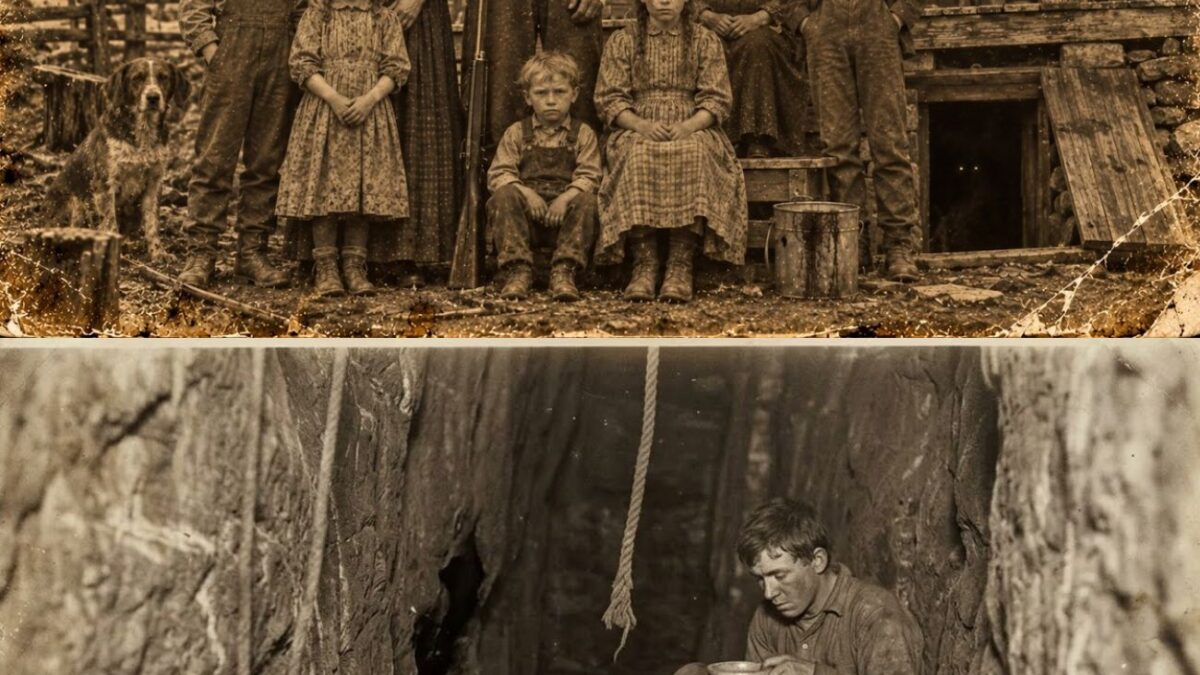
The Story of the Drelmont Clan (1902, TN) — They Fed Something Beneath Their House With Family Blood
In January 1902, county surveyor Lyall Concincaid rode out from Cedar Fork to inspect a cracked chimney footing at the Dellmont farm. The house stood alone beyond the last wagon bridge, a two-room cedar structure with a winter cellar beneath its east side. Its stone foundation had opened under the chimney by nearly half an inch. If it moved farther, the family would lose both the hearth and the stored potatoes, apples, and canned meat below it. Concincaid expected to measure a wall, recommend braces, and return to town. Instead, he found three glass jars on the stove shelf, each stoppered and scratched with a name beneath the rim.
Mara Dellmont, the widowed head of the household, stood beside them with a sewing needle, a strip of boiled cloth, and a small crock. Her daughter Ruth had already given a spoonful of blood into her jar. Mara’s own jar stood beside it. The third, marked Silas, was empty.
Seventeen-year-old Silas Dellmont refused to fill it. “It is a jar,” he told his mother. “It cannot hold up a house.”
Mara did not argue at first. She only moved the empty jar farther from the stove, as though heat mattered more than the blood it lacked. Then she said the jar had to remain on the shelf until the ground was quiet. The family’s custom was carried out every winter, usually before the cellar furniture was shifted and the east wall was checked. Each living Dellmont gave separately, and the jars were never pulled. Mara wrote their order and condition in a ledger wrapped in oilcloth. After the jars had stood on the stove shelf, they were taken through a locked cellar hatch. Mara would not tell Concincaid what the family watched for below. Silas called it feeding the ground.
By dawn, he was gone. The jar marked with his name had vanished from the shelf. The floorboards over the cellar had become warm underfoot, and beneath the east window, the foundation crack had widened enough to shed mortar onto the frozen ground.
Concincaid’s inspection had become a missing person inquiry. Sheriff Ephraim Bell was sent for from Cedar Fork. Before Bell arrived, Ruth noticed a low tremor in the dining room floor, slow enough to make the water in a wash basin shiver, but not strong enough to disturb the dishes. Mara told Concincaid to leave the cellar hatch sealed. He refused.
The hatch lay behind the root bins in the low cellar, where the air smelled of turnips, damp earth, and soot. It was made from old oak boards fitted flush to the floor. Mara kept the key on a ring at her apron, and when Bell arrived, she produced it only after he told her the disappearance could not be treated as a private household matter.
Under the lifted hatch, Concincaid found no stairway. There was a round black opening in the earth, its rim covered by removable boards and worn smooth in several places. Warm air rose from it in intermittent breaths, descending beyond the reach of their lantern light. Silas’s jar stood on the cellar floor beside the hatch, still empty. Fresh rope fibers had caught in the waxed edge of its paper label. A muddy boot print led from the kitchen toward the root bins, then disappeared. Where the cellar floor had been swept, Ruth crouched by the hatch and found a pale thread trapped under one board. It matched the torn cuff of Silas’s homespun shirt, which had been hanging beside the stove since the evening before.
At first, Bell considered the obvious explanation: Silas had quarreled with his mother, taken the jar in mockery, and run away. The rope fibers might have been old, and the warm boards might have come from a disturbed stove flue or a buried spring. But the chimney stood on the east footing directly above the cellar opening, the crack had widened during the night, and there was one more detail—the rope fibers on Silas’s jar were clean and pale, not darkened with cellar dust. Someone had handled a rope after taking the jar below.
Concincaid barred Mara from replacing the hatchboards, set a measuring rule across the open footing, and marked the gap in his field book. Then he asked for the ledger. Mara would not surrender it, but Ruth did. She waited until her mother had gone upstairs to gather blankets from Silas’s room, then took the oilcloth-covered book from a shelf above the cellar door and placed it in Concincaid’s hands.
It contained forty-one winters of entries. The first pages were written in an older, narrow hand; later entries belonged to Mara. Each recorded the family members present, the condition of the jars, and changes in the house: Ruth glass warm at base, east floor trembles, no one to the bins, chimney braced, plaster down by pantry door, keep east window lifted. Several older entries repeated the same sequence: Set each glass on the stand below. Note any warmth, foam, or separation. Pour the remaining blood down the vent, then close the east air until morning.
The words that most interested Concincaid were not about blood. They were about repairs. Years when a jar had warmed or foamed beside the vent were followed by practical work: new footing stones, chimney braces, cellar closures, replacement boards over the opening. The details were too regular to be a collection of superstitious memories. The Dellmonts had been observing something beneath their house, and their jars had become part of the observation.
Ruth found a penciled note in the margin beside an entry from the previous winter. The handwriting was Silas’s: Does it warm or feed?
Concincaid read the question aloud. Mara, returning with the blankets, did not deny that Silas had written it. She said he had been asking since autumn why every jar had to bear a name, why one person’s blood could not be used for all, why their grandfather had called the practice a warning in one old entry, then crossed out the word and written quieting over it.
Mara had no complete answer. Her father had taught her that when the jars grew warm, the cellar was shut, the east side of the house was aired, and no one leaned over the opening. He had said the ground below disliked being disturbed. She had repeated that language to her children because it kept them away from the hatch.
“But you let him know it was there,” Bell said.
“I thought fear was enough,” Mara replied.
Concincaid turned back through the ledger. The book’s spine was unusually thick near the rear cover. Ruth noticed it too; she pressed the oilcloth binding and heard a faint scrape from inside. The ledger had a false back. Before opening it, Concincaid laid the book flat on the kitchen table and asked Mara whether she knew what was concealed there. She said no. Bell watched her face as Concincaid eased out a stiff panel of pasteboard.
Behind it lay a folded repair sketch dated 1881. The paper showed the Dellmont east foundation, the cellar hatch, and beneath them a vertical feature labeled vent. A line curved from its upper rim toward a side shelf marked inspection stand, confirming where the ledger placed the jars. Another note, written in faded pencil, warned: Warm draft. Do not lower man head-on. East air first.
Concincaid carried the sketch back to the cellar. At the shaft rim, just below the boards, he found dark grooves circling toward one side. They looked at first like marks left by some repeated rite, but under closer examination, they were worn by rope. Fresh abrasion brightened one of the old grooves. Silas had not simply fled Cedar Fork; he had used an old descent route to enter the shaft under the house.
That changed the case. Until then, Concincaid had been trying to decide whether the Dellmonts had frightened, confined, or concealed a boy who rejected their family custom. The sketch proved that the opening was real, old, and dangerous. Silas’s note supplied his purpose: he had gone down to test whether the blood rite was nonsense. If he had reached the side shelf, he might still be alive; if he had missed it, the shaft continued below the limit of the lantern light.
Concincaid sent Bell for Amos Riddle, a retired copper miner who had worked repairs around Cedar Fork in the 1880s. While they waited, he ordered the family out of the east room and had two neighbors brace the exterior wall with timbers. No one would enter through the cellar opening directly; the sketch gave a second instruction: Air from the east side.
Once the wall was supported, Concincaid had loose stones removed from the outside footing. Behind them was a narrow service void beneath the east foundation, barely high enough for a man to crawl through on his elbows. Cold daylight entered through a small vent grill near the chimney base. The passage ran alongside the upper part of the shaft instead of directly above it, giving them a safer approach.
Riddle arrived near dusk with a brass plumb bob in his coat pocket and spectacles hanging from a cord around his neck. He had not seen Mara in more than twenty years. Concincaid showed him the sketch before explaining Silas’s disappearance. Riddle studied it a long time, then placed his finger over the mark for the side shelf.
“I stood above that,” he said. “Or near enough. We called it a breathing hole.”
In 1881, Riddle had helped repair a collapse under the Dellmont chimney. He remembered hot air lifting dust from the east footing. He remembered one laborer becoming dizzy after bending over an opening in the cellar; they had dragged him out by his heels and worked from the side afterward. There had been talk of mineral water far below, heated rock, trapped gases. Riddle could not identify the source, knowing only that the shaft breathed in pulses—during one pulse, it could send warm air upward, and during another, the air near the rim could leave a man weak or unconscious.
“The old woman was right about one thing,” he said, meaning Mara. “Never go over it head-on when it is working.”
Mara heard him from the cellar doorway and answered quietly, “My father said the jars told us when it was working.”
Riddle glanced at the ledger on the table. “Maybe they told you when to be afraid. That is not the same as telling you why.”
Concincaid did not claim the blood could detect danger. The ledger and sketch placed the older jars on the inspection stand beside the vent, not beside the kitchen stove when their changes were judged. There, warmth, foam, clotting, or condensation might have accompanied pulses of heat and foul air. He could not establish whether the blood itself reacted, whether temperature and condensation altered what the family saw, or whether they had only learned to associate those changes with dangerous drafts. Over decades, a crude warning practice could become a rite of appeasement. But the timing in the ledger was real enough to act upon: the house was warming, the floor tremor had returned twice, and Silas had entered during the cycle the family feared most.
Concincaid prepared a test before committing anyone to the shaft. From the east crawl space, where the outer vent had been opened and the air moved more freely, Riddle anchored a rope around a foundation timber, and Bell held the line. Concincaid lowered a hooded lamp, a thermometer tied beside it, and Riddle’s plumb bob on a separate cord.
The lamp descended through the upper darkness. At first, its flame remained upright, but then the cord began to draw sideways. A warm draft rose sharply from below, strong enough to bend the flame toward a narrow fissure in the shaft wall. The thermometer climbed several degrees in less than a minute. The plumb bob struck stone and scraped along a curved groove.
Riddle leaned close, but not over the opening. “There,” he said. “The shelf will be past that pull.”
The grooves were not ceremonial marks. They were rope guides worn by people who had once approached the shaft from the safer east side, then worked around its upper rim toward the fissure. The sketch had preserved that route because an ordinary descent would place a man directly above the low-air pocket.
The test gave Concincaid the information he needed, but it also created a deadline. The draft was strengthening, and the east footing creaked under its braces. If the warm pulse widened the crack further, the house could shift over the shaft. If Silas was on the lateral shelf, the same pulse might be depriving him of air.
Mara asked Concincaid to stop. He told her that the old rule had been meant to keep living people out of danger, not leave one below it.
Before they entered, the rescuers tied themselves separately to the anchored rope. Concincaid went first, wearing his wool survey coat over his shirt and keeping the folded sketch in his field satchel. Bell followed with a second line. Riddle remained at the crawl space mouth to manage the rope and watch the foundation braces, while two miners from the neighboring ridge held the outside anchor.
The route was narrow but usable. From the crawl space, Concincaid could reach the shaft’s upper rim without standing directly above it. The stone curved away under the east foundation, and the old rope grooves gave his boots and hands a direction. He moved sideways, lowered by Bell’s line until the lamp’s bent flame marked the fissure. Warm air pressed against his face, and beneath it came a dull vibration from farther down.
The fissure widened after several feet into a ledge of wet stone. Concincaid called Silas’s name. Nothing answered at first; then there was a scrape followed by a weak voice from below the lip of the ledge.
“I’m here.”
Silas had fallen onto the inspection shelf after his rope slipped from the upper groove. His left ankle was swollen, his lamp had gone out, and he had survived the night and most of the following day on rainwater collected in a shallow stone pocket and by keeping his face near the fissure when the air turned foul. Beside him lay the chipped jar marked Silas.
Concincaid reached it before he reached the boy. The label had been torn away, but Silas recognized a small chip on its stopper. He said he had carried it down empty to prove the right had no purpose. When the warm draft began, he had set it beside him, never having filled it. The glass felt warm—not hot enough to burn, but distinctly warmer than the wet ledge and the cold air in the east crawl space. Concincaid put the jar into his satchel. Then Bell and he secured Silas beneath the arms and lifted him through the fissure, along the rim grooves, and back into the crawl space.
The rescue line tightened twice when the shaft pulsed. Dust shook from the braced foundation, but the rope held. By the time they brought Silas into the open air, he was conscious, ashamed, and unable to stand.
“I thought she wanted it fed,” he told Bell. “I thought all of it was to make us obey.”
Mara knelt beside him in the frozen yard. She did not defend the language she had used, only holding his hand until the wagon from Ruth’s aunt’s farm arrived. Silas was taken there for fresh air, warmth, treatment for foul air exposure, and his injured ankle. He would recover, though he did not return to live beneath the Dellmont roof.
The disappearance inquiry was closed as accidental entrapment. Bell found no evidence that Mara or Ruth had forced Silas into the shaft, but the county recorded that the opening had remained accessible beneath an occupied house, and that the Dellmonts had inherited a safety rule and allowed it to decay into a secret enforced by fear. Concincaid’s later report was less forgiving about the building: the east footing had been undermined, the chimney could no longer be trusted, and the county condemned the house and ordered it vacated rather than sealed. Riddle warned that closing the shaft tightly might drive gas into the remaining cellar void.
Mara and Ruth left Cedar Fork before dismantling began. The house was taken down in sections, and when the cellar boards and east stones were removed, the survey crew confirmed the shaft’s location beneath the former root bins. They lowered lines beyond the lateral ledge, but no line reached bottom.
That resolved most of what the Dellmont family had called feeding. They had poured family blood into a real shaft beneath their home, but the practice had not been evidence of an underground creature receiving offerings. The ledger recorded the repeated pouring, but not its original purpose. Jars observed separately on the inspection stand may have served as a crude warning practice; later generations treated the disposal step as feeding the ground. The shaft’s heat, gas, airflow, and unstable footing explained the danger without proving that blood itself detected any of it. Their phrase, “Keep the ground quiet,” had survived after the practical language of vents, gas, and bracing had been forgotten.
Yet Bell did not discard the chipped jar found beside Silas. At the rescue site, he recorded that it was empty. Concincaid had carried it from the ledge in his satchel, and Bell took custody of it before returning to town. At the sheriff’s office, he rinsed no residue from it, fitted its ground glass stopper, wrapped the joint with sealing wax, and entered the time in his evidence notebook. The county clerk, who had no connection to the Dellmonts, co-signed the entry. Together, they placed the jar on a high shelf in the unheated evidence room, away from the office stove.
The cellar hatch had already been closed, and the Dellmont house had been evacuated; no one carried the jar back to the farm. The following morning, Bell opened the evidence room with the clerk present. The room was cold enough that the ink in the log had thickened overnight.
The jar was still warm.
The clerk noted the condition beside Bell’s original entry—not warm from a hand, not simply less cold than the room, but warm enough that Bell wrote plainly: sensible through glass.
The county retained the jar record with the condemnation survey. Bell formally closed the missing person inquiry as accidental entrapment after Silas’s voluntary entry into the shaft, recording no evidence sufficient to charge an abductor or any member of the Dellmont family, and no criminal prosecution followed. The vessel itself disappeared from the county evidence inventory years later, but Bell’s notebook and the clerk’s temperature notation survived in Cedar Fork’s files. Beneath them lay Concincaid’s final survey: Shaft located under former Dellmont cellar. Lateral ledge confirmed. Bottom not attained.
Was the retained warmth mineral contamination, an error in custody, or the one part of the Dellmont belief that the geological explanation could not reach? The old records never settled it. And down in the dark earth, miles beneath the abandoned foundation where the heavy stone still settles against the quiet pressure of the deep, something continues to breathe.

