The Story of the Alderlys (1865, Appalachia) — The Family That Fed the Youngest First, Always
The Story of the Alderlys (1865, Appalachia) — The Family That Fed the Youngest First, Always
In the fall of 1865, a circuit doctor named Corwin Leam was called up a hollow in the western Carolina mountains to look at a boy who would not stop shaking. The boy was eleven years old, the second youngest of six children in the Alderly family, and by the time Leam reached the cabin, he had been shaking for nine hours straight, eyes open the whole time, saying the same four words over and over. He was not calling for his mother or for God, but kept repeating in a flat, mechanical voice, “I ate before Lark.”
Lark was his baby sister, just three years old, and in the Alderly house, no one—not the father, not the mother, not any child, no matter how hungry, sick, or young—was permitted to eat before Lark did. That rule had held in that family for eleven years without a single exception, until the night Laam arrived, when it was broken by accident by a boy too weak with fever to wait his turn. Leam wrote in his daybook that he expected to find a case of nervous shock brought on by guilt, but he did not expect to find three days later that the boy who broke the rule would be dead, and that the family would tell him calmly, without tears, that they had known he would be.
The Alderly family lived in a hollow the locals called Cold Water, tucked under a limestone shelf in what was then Garnet County in the far western mountains of North Carolina. The county no longer exists on any modern map, having been folded into two neighboring counties in 1907, with most of its records burned in a courthouse fire in 1931—which is why this story sat unread for so long in boxes across three attics until a records researcher named Pearl Hartzel pulled the pieces together in the early 2000s.
The rule the family kept did not begin with Ezra Alderly; it began with his grandfather, Obadiah Alderly, who settled Cold Water Hollow around 1789 after a winter so hard that three families on the far side of the ridge lost every child under the age of six. Obadiah’s own journal describes a spring behind the cabin that never went dry, even in the worst drought years, and a strange understanding he claimed to have reached with it, though he never explained how or with whom. His words read: “The spring will keep this family fed so long as this family keeps its own order. Feed the youngest first, always, whole and full, before any other mouth touches food, and there will be food. Break that order once, and the ground will collect what it is owed.”
For seventy-six years, the family kept that order without deviation. Whoever was youngest ate first and as much as they wanted before anyone else, including the parents, touched a plate. When a new child was born, the rule passed to them, and the former youngest quietly moved down the line. By 1865, the rule was not a superstition to them, but a law of physics. Ezra Alderly was forty-four that fall, his wife Naomi thirty-nine, and their six children—Solomon, Ruth, Caleb, Hosea, Delia, and Lark—had never known a meal any other way. The hollow was poor, yet somehow never starving, even through the worst years of the war.
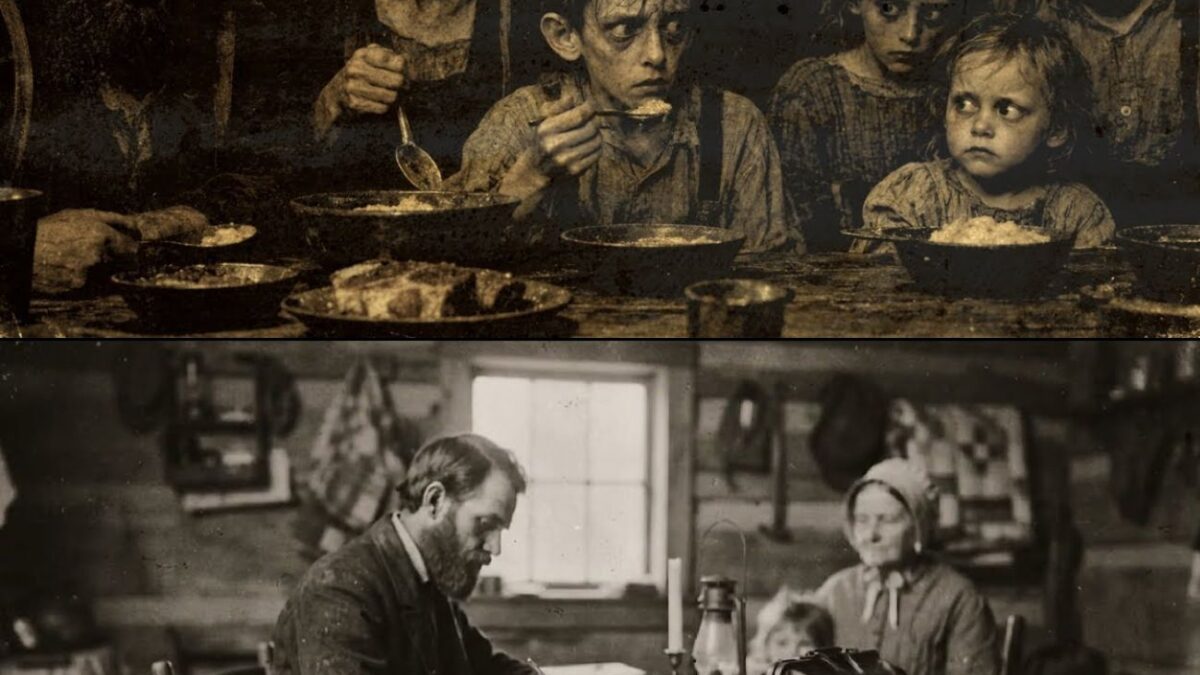
The night the rule broke was an ordinary Tuesday in late October. Naomi had put on a pot of cornmeal mush and a small side of salted pork, setting Lark’s bowl first as always. Hosea, running a fever since morning, reached across the table while Lark was still being seated, took a spoonful of mush meant for his own unfilled bowl, and ate it standing up three full seconds before Lark took her first bite. Naomi went white, while Ezra simply set down his spoon and said, “Now we wait and see what it wants back.”
They finished in total silence. Past midnight, Hosea woke screaming that something was standing at the foot of the loft ladder, looking up. By the time Naomi lit a lamp, he had stopped screaming and started shaking, a tremor that lasted nine hours until Dr. Laam arrived. Leam found no high fever, no wound, no poison, and no sign of a seizure disorder, yet the boy repeated the same four words on a loop. Leam left instructions for rest, but three days later, Ezra rode down alone to announce that Hosea had died in the night, sitting upright at the foot of his bed with open eyes, and asked for a certified death before word spread.
What Leam found on that second visit stunned him. Hosea’s body showed no violence or fever, but his stomach was concave like that of a man who had gone weeks without food, despite having eaten a full supper just before his death. His lips were cracked from thirst, and his hands were curled like those of an old man from a lifetime of gripping tools. Leam recorded the distinct, unsettling impression that something had continued eating the boy from the inside for three straight days after he had stopped eating himself.
Ezra buried his son on family ground above the spring rather than in the church cemetery. When Minister Micah Senate rode up to offer a service, Ezra told him Hosea belonged to the hollow now in a way the churchyard could not account for. Senate felt as though the ground itself was listening with unusual attention, while a dry-eyed Naomi said only, “He knows now he wasn’t supposed to be first.”
Following Hosea’s death, the family tightened around the rule. Naomi weighed portions carefully, Ezra built a second small table just for Lark to avoid confusion, and eight-year-old Delia stood guard behind Lark’s chair. For nearly a year, it worked. But the second break came in March of 1866, when Solomon, the eldest, returned home unexpectedly after fighting with a Confederate cavalry unit since 1863. Thin and sick, he arrived after dark, and an overjoyed Naomi put bread and broth in front of him before waking Lark. Solomon ate two full bites before Naomi snatched the bowl away, but it was already too late; they all understood the order had been broken again.
Uncannily, nothing happened to Solomon. He recovered within a week and lived into old age. Instead, the debt fell six weeks later on Ruth, the sixteen-year-old second eldest, who had not even been in the room when Solomon took those bites, having been out at the springhouse fetching milk. She was found seated upright on her bed in late April, bearing the exact same symptoms as Hosea: a hollowed stomach, cracked lips, and curled hands. Standing at the graveside, Naomi uttered a chilling realization: “It does not take the one who broke it. It takes in order starting from the top until it reaches the one it was always owed.”
Understanding the shape of the debt, Solomon left Cold Water Hollow for good within three weeks, walking out with a single pack and never returning. Ezra came to believe that leaving the ground left the debt behind, but those who stayed remained bound to the line. Caleb, fourteen, was next in order after Ruth, and he died in September of 1866 in the exact same posture and condition. Called out for a third time, Dr. Laam realized medical science could no longer explain what he was witnessing. He privately noted that the spring behind the house ran noticeably louder and more agitated for days after each death, as though something was being satisfied and digesting.
To protect ten-year-old Delia, who was next in line after Caleb, Naomi made the painful decision in late 1866 to send her away to live with a cousin two counties over under the guise of schooling. It worked; Delia lived a full life, married, and raised four children, later becoming the primary source for everything Senate recorded.
That left only Naomi, Ezra, and little Lark on the land. In February of 1867, sixteen months after Hosea, Naomi died in the same mysterious posture at the small foot table built for Lark, having fed Lark first and never picked up her own spoon. Ezra buried his wife beside the others and lived alone with Lark for two more years, speaking almost entirely to his daughter and maintaining an exact, ritualistic precision at every meal, muttering to visitors, “I am the last one owed. When I am gone, it will have all of us but her, and it will stop.”
Ezra died in the spring of 1869, found on the same rise. Six-year-old Lark was discovered sitting quietly beside her father’s body, unharmed and calm. She went to live with Delia, grew up as an ordinary child, married in 1884, and had five children of her own. Yet, for the rest of her life, she kept one unexplainable habit: at every meal in every house she ever kept, whoever was youngest ate first and fully before anyone else could touch a plate, and Lark refused to sit down until she watched that child finish. None of her descendants ever knew why.
Cold Water Hollow did not stay empty. The Turle family bought the land cheap in 1871 without asking questions and lived there through the 1890s before transferring their membership out in 1893. A surviving letter from the eldest Turle daughter mentioned that her mother strictly refused to let any child touch food until the youngest had eaten their fill—a habit she never questioned until reading about the family before them. The letter closed with a haunting, underlined line: “нять never asked why we kept it. We only knew what happened when a meal at that house ran short.”
A state land surveyor named Olden Grace passed through in 1911, and his field report included a strange half-page note about the abandoned Alderly cabin. He wrote that the spring behind it ran unusually loud the evening he camped nearby, and that he woke twice with the distinct, overwhelming sense that something very close by was hungry and waiting. Driven by a deep, instinctive dread rather than reason, he broke camp before dawn and fled.
Researcher Pearl Hartzel visited the site in 2006. The cabin is long gone, and the five graves above the spring remain unmarked, yet the ground above them stays noticeably greener than the surrounding slope, even in dry years. The spring still runs cold and constant, and locals who fish the creek it feeds still repeat an old piece of hollow wisdom, handed down without context: “Feed the little one first, and don’t ever forget why.”

