The Story of Marlow Bend (1860, Appalachia) — The Underground People Who Came Up Only at Night
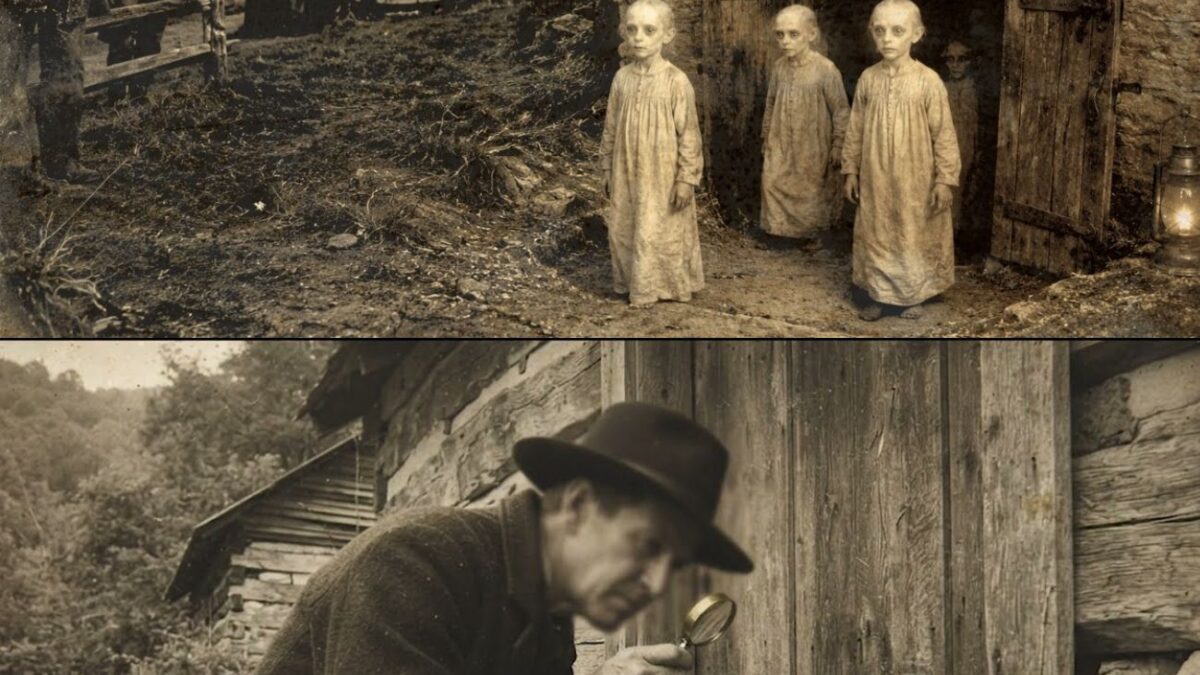
The Story of Marlow Bend (1860, Appalachia) — The Underground People Who Came Up Only at Night
On the morning of October 14th, in the autumn of 1861, a Methodist circuit rider named Elias Beckwith rode into a small Appalachian settlement called Marlo Bend and found every single house standing open, every door, every shutter, every gate on every animal pen. The livestock were still in their pens, calm and fed. Bread was still cooling on kitchen tables. A kettle was still warm on one of the stoves, but there was no one there. Not one man, not one woman, not one child. 47 people had lived in Marlo Bend the night before. By sunrise, every single one of them was gone, and the only thing they had left behind was a message carved into the wood of the meeting house door. It was written in a language that Elias Beckwith could not read, and that no linguist consulted afterward could identify, and it was carved from the inside. However, what Beckwith found in the second cellar of the old Marlo house is what actually changed everything because it proved that the people of Marlo Bend had not simply vanished. They had been called down.
Before we go any further into what happened at Marlo Bend, do one thing for us. In the comments below, write the name of the town or the hollow or the county road nearest to where you grew up. Just the name. Because part of what we are about to uncover in this story is that Marlo Bend was not unique. There are places like it scattered across the ridge country of the eastern United States. Places that had names on old survey maps and then quietly stopped having names. Places where the road just ends and nobody remembers why. Your comment is going to help pull those names back to the surface. So drop it below before you forget and then stay with us because what Elias Beckwith found in that cellar is only the beginning. To understand what happened in Marlo Bend and to understand why it matters even now more than 160 years later, you have to first understand where Marlo Bend actually was. And this is where the story starts to get strange even before the disappearances. Because Marlo Bend is not on any modern map. It was never incorporated. It was never given a post office of its own. It is not listed in the 1860 federal census, even though we know from private letters and church records and freight receipts that at least 47 people were living there in that year. Most of what we know about the settlement comes from the papers of the Beckwith family, from a bound ledger kept by a general store operator named Zebulun Foss who lived one valley over, and from a series of survey notes made by a young engineer for the Baltimore and Ohio Railroad, whose surveying party passed through the region in the summer of 1858. Everything else, every other written trace of the place is gone. Whether that is coincidence or whether that is something more deliberate is a question we are going to keep coming back to.
Marlo Bend sat in a narrow B-shaped valley along the upper reaches of what the settlers called the Yellow Snake Creek in the western Appalachian Range in a stretch of ridge country that was already considered remote by the standards of its day. To reach it, you had to leave the last real wagon road at a crossroads called Danver’s Fork, follow the creek south for about 11 miles through timber so heavy that the sunlight barely touched the ground, cross the water three times at shallow fords, and then climb a short switchback trail up over a shoulder of exposed limestone. On the other side of that limestone shoulder, the land opened up into the bowl, and the bowl was Marlo Bend. It was almost perfectly circular, about a mile across, ringed on all sides by ridges that rose 400 to 600 feet above the valley floor. In the center of the bowl, there was a small stream, a scatter of cleared fields, an orchard, a burying ground, a meeting house, and 11 cabins. The soil in the bowl was good, better than it had any right to be at that elevation. The stream ran clear, even in dry summers. There was a natural salt lick at the northern edge of the fields that drew deer down out of the ridges every autumn. And the ridges themselves were riddled, absolutely riddled with caves and sinkholes and vertical shafts that opened up into the limestone beneath.
This is important because the limestone in that stretch of Appalachia is the kind that carves itself out over time. Water eats it, ice eats it, and what it leaves behind is a network of hollow spaces underneath the surface that in some places runs for miles. A brief note on the geology because it turns out to matter: the particular stretch of limestone that underlies Marlo Bend is part of a formation that geologists now call the ridgeback karst, which extends in an irregular band from central Pennsylvania down through eastern Tennessee and into northern Alabama. Karst is the technical name for the kind of terrain that forms when soluble rock like limestone is slowly eaten away by underground water over the course of millions of years. What karst produces at the surface is a landscape that looks entirely ordinary from the outside: rolling hills, wooded ridges, creeks running through narrow valleys. But what karst produces underneath the surface is something else entirely. It produces cave systems that can extend for hundreds of miles in a single connected network, punctuated by vertical shafts that open into caverns the size of cathedrals and threaded through with underground rivers that in some documented cases have never been fully mapped by any modern surveying effort. The Ridgeback karst is one of the largest and least explored karst formations in North America. Most of it is on private land. Most of the private landowners either do not know what is under their property or, in a small handful of documented cases, know very well and prefer not to discuss it.
The people who first settled Marlo Bend seem to have arrived sometime in the late 1790s, though the exact date is disputed. The dominant family was the Marlos themselves, from whom the settlement took its name. There were also families named Perch, Culiver, and Austin, and a widow named Ruth Fay, who had come down from Pennsylvania with two grown sons. By the standards of Appalachian settlement in that era, this was a small and self-contained community. They kept mostly to themselves. They traded a little through Zebulon Foss’s store at Danver’s Fork, mainly wax, honey, cured hides, and a peculiar dark salt that they seem to have been harvesting from somewhere inside the ridges, though nobody outside the settlement ever saw the source. They did not attend church elsewhere. They did not send their children to any outside school, and they did not accept visitors overnight.
That last detail is one that appears again and again in the outside accounts. If you rode into Marlo Bend during the day, you would be received politely, given water for your horse, and sold whatever small goods you had come to buy. But you would be gently and firmly encouraged to be back over the limestone shoulder and out of the bowl before the sun went down. One outside visitor whose account has survived is worth mentioning briefly because his description of the settlement gives us the most vivid firsthand picture of daily life in Marlo Bend that we have. His name was Reverend Amos Thood, and he was a Baptist itinerant preacher who passed through the region in the summer of 1847, and who, unlike the Methodist circuit riders who serviced the settlement regularly, had no prior connection to the community and no reason to see it as anything other than one more remote hollow among the many hollows he visited that year. Thood spent one afternoon in Marlo Bend. He was received courteously. He was fed a good midday meal at the Perch Cabin. He was offered a cup of cider that he described in his travel journal as “the finest small drink I have taken this side of the Susquehanna,” and he was shown briefly the meeting house, which he noted was tidy, well-swept, and equipped with a pulpit Bible that appeared to have been printed in Philadelphia in the 1790s and that showed signs of regular use.
He also noted, and this is the passage from his journal that Karin Halbastam would eventually track down and photocopy for her own files, that the settlement had an unusual quality of stillness about it that he could not entirely account for. He wrote: “The folk here are kind, and their houses are in good order, but I cannot shake the sense that the settlement holds itself in a kind of listening posture, as if attending to a sound that I cannot hear.” He was gently reminded as the afternoon wore on that he would want to be over the limestone shoulder before dark, and he was helped politely onto his horse and pointed toward the trail. He looked back once, as he was cresting the switchback, and saw that three of the adult residents were still standing in the yard of the meeting house, watching him go. They did not wave. They simply watched.
At first, the outside settlers who dealt with them assumed this was simple frontier caution. The ridges above Marlo Bend were known to have wolves and later panthers, and the trail out was genuinely difficult to navigate in the dark. But over time, it became clear that the rule was not really about danger from the outside. It was about something else. Zebulun Foss in his ledger made a note in the margin next to an entry from 1843 that reads, and this is a direct quote from his ledger which is now preserved in a private collection in Wheeling, West Virginia: “They do not want us to see who comes up.” Just that one sentence in the margin next to a routine sale of nails and lamp oil. He never expanded on it in his ledger, but we know, because his grandson wrote about it in a memoir published in 1921, that Foss believed until the day he died that the Marlo Bend settlers were sharing their valley with somebody else. Somebody who came up at night, somebody the outside world was not supposed to know about.
Now, for a long time, this was treated as the kind of eccentric old man story that gets attached to any isolated Appalachian community. Every hollow in that country has a ghost story or a witch story or a lost silver mine story. The Marlo Bend story, in the version that survived into the 20th century, was usually dismissed as another one of those. But then in 1953, a graduate student at the University of Virginia named Karin Halbastam went looking through the Beckwith family papers as part of a thesis on rural Methodism in the antebellum South. And what she found in those papers was Elias Beckwith’s original report from the morning of October 14th, 1861—the full report, 14 pages of dense handwritten script, including a sketch of what he saw when he went into the second cellar of the Marlo house. And once you read that report, once you actually sit with what Beckwith described, the eccentric old man’s story stops sounding eccentric. It starts sounding like a warning that nobody outside the bowl was ever supposed to hear.
Before we move on to Beckwith’s actual report from the second cellar, let us look at what you just heard about the settlers of Marlo Bend and the rule about never staying past sunset—the part that changes everything, but only makes sense when you see it written out next to the original Beckwith report. The margin note, the cellar sketch, it is all in the document. Elias Beckwith arrived at the mouth of the Marlo Bend Trail on the evening of October 13th, 1861, and spent the night in a lean-to about a quarter mile up the switchback because it was already too dark to safely descend into the bowl. He was 34 years old at the time. He had ridden the Marlo Bend Circuit twice a year for the previous six years, and he knew the settlement well enough that most of the adults there would greet him by name. His purpose on that particular trip was to conduct a small baptism for a child born to the Culver family in early September and to collect a promised donation of tallow candles for the church at Danver’s Fork. He had every reason to expect a quiet, ordinary morning. Instead, he rode into a settlement that had been abandoned in the middle of the night.
The first thing he noticed as he came down the last stretch of the switchback and could see into the bowl was that no smoke was rising from any of the 11 chimneys. This was unusual because the mornings in the ridge country were already cold by mid-October, and every household would normally have had a breakfast fire going by that hour. The second thing he noticed was that the fields, which should have had figures moving in them, were empty—not just of people, of animals as well. No dogs, no wandering geese, nothing. And the third thing, which he described in his report as the moment his stomach began to turn, was that every single door on every single cabin was standing wide open.
He rode down into the bowl and dismounted at the meeting house first because that was the natural gathering point and because the meeting house door was open too. He called out. He got no answer. He went inside. The pews were empty. The pulpit Bible was open on the reading stand to the book of Isaiah, which was where it had been on his last visit. There was a single unlit candle on the pulpit. Nothing else. He came back out and started walking house to house. The Perch cabin, which was the closest to the meeting house, showed the same pattern: door open, fire cold, but not long cold. Bread cooling on the table, which meant it had been baked that morning or the night before, but nobody had cut into it. Two wooden plates were set at the table. A knife was on one of the plates. A shawl was hanging on the back of one of the chairs. Beckwith noted specifically that the shawl belonged to Mildred Perch, a woman he had known for years, and that she was the kind of person who never left the house without it once the weather turned. He walked through every room. He looked in the loft; there was no one there.
He repeated this process at the Ostend cabin, the Fay cabin, the two Marlo cabins, and the Culver cabin. In every single one, the same pattern: doors open, fires cold or cool, meals half prepared, personal belongings—including things that no rural 19th-century woman would ever leave behind willingly—sitting untouched on tables and beds. In the Culver cabin, he found the cradle he had come to bless. It was empty. The blankets in it were disturbed, as if a small child had been lifted out of it quickly, but there was no sign of struggle. The child, whose name was Amos, was seven weeks old.
Beckwith went to the livestock pens next because his mind was starting to look for any rational explanation. If the settlement had been raided, the livestock would be gone. If the settlement had been struck by disease, there would be bodies. If the settlement had been struck by fire, there would be ash. The livestock were all there: every cow, every pig, every chicken, every horse, all of them fed, all of them watered, all of them calm. Somebody had done the morning chores. That was the detail that made Beckwith sit down on the edge of a fence rail and try to think. Somebody, or several somebodies, had gotten up early, tended to the animals, and then walked away from the settlement so completely that not one adult and not one child remained, and they had done it without waking a single dog.
Because there were dogs in Marlo Bend—Beckwith knew this because he had scratched their ears on prior visits—he counted three dogs. All of them still there. All of them alive. All of them lying in the yard between the cabins in a strange loose formation that he described in his report as, and again this is a direct quote, “seeming to face outward as if watching for something.” None of the dogs would look at him. This was the detail he underlined in his report. None of the dogs would look at him. He walked among them. He crouched down in front of one of them, an old brown mongrel that he knew had belonged to the widow Ruth Fay. He put his face in front of the dog’s face. The dog was breathing normally. The dog’s eyes were open and clear, but the dog was looking past him over his shoulder toward the ring of ridges above the bowl, as if there was something up there that required its full attention. When Beckwith stood up and walked to the other side of the dog and crouched down again, the dog turned its head very slowly to keep looking at the same point on the ridge line. It never once, in the 15 or 20 minutes that Beckwith spent examining the yard, focused its eyes on him. He wrote later that he had never in his life felt more alone than he did in that moment, standing among three living dogs who could see him perfectly well and had decided, for reasons of their own, that he was not worth acknowledging.
It was while he was sitting on the fence rail that he saw the meeting house door from the inside for the first time. He had walked through it earlier, but he had not thought to close it and look at the interior surface. Something about the angle of the morning light must have caught the carvings. He got up, walked back over, pulled the door partly shut, and stopped. The message was cut deep—deep enough that Beckwith initially thought it must have been done with a wood chisel over the course of hours. There were 42 individual characters arranged in seven rows of six. None of them corresponded to any alphabet he recognized. They were not Cherokee syllabary, which he knew well enough to identify because there had been a small population of eastern band Cherokee still living in that part of the mountains at the time. They were not Greek. They were not Hebrew, which he could read as a Methodist minister trained in the biblical languages. They were not any variant of Latin or the runic alphabets he had seen in academic books. They were something else entirely. And the cuts, when he examined them closely, were not made with a chisel at all. They were made with something narrower, something that had left a distinct three-lobed groove at the base of each stroke. He could not identify the tool that would produce a mark like that. He copied every character carefully into his report, measured the depth of the cuts, and noted the direction of the wood grain.
And then he walked back to the Marlo house, which was the largest cabin in the settlement and which belonged to the family the settlement had been named for, because the front door of the Marlo house had been standing open like the rest. But there was one thing about the Marlo house that made it different, and that was the small square trapdoor set into the kitchen floor. The trapdoor was open, too, and a lantern, still burning low on almost the last of its oil, was sitting next to it. Whoever had been the last person in that kitchen had opened the trapdoor and gone down.
Beckwith had been in the Marlo house before. He knew that the trapdoor in the kitchen led down to a root cellar, which was the ordinary kind of cellar you would find in any Appalachian farmhouse of that era: stone walls, a dirt floor, shelves along one side for jars of preserves and burlap sacks of dry goods, a cool space kept at a steady temperature by the earth around it, useful for storing food through the summer heat and for keeping smoked meat through the winter. He had gone down into it once, at least on a previous visit, when old man Marlo, whose given name was Silas, had brought up a jug of cider for a shared meal after a Sunday service. It was, in every respect that Beckwith had ever noticed, an ordinary cellar. But when he picked up the lantern and started down the wooden ladder that morning, he noticed almost immediately that the cellar had been rearranged. The shelves along the eastern wall had been pulled away from the stone. The dry goods sacks that had been on them were stacked in a neat pile in the center of the floor, and behind where the shelves had been set into the stone of the wall was a second door.
Beckwith described this second door in his report with the kind of precise detail you get from a man who is making sure that if nobody believes him, at least the record will be exact. The door was rectangular. It measured approximately 3 feet wide by 5 feet tall. It was made of a dark wood that was not oak, not pine, not chestnut, and not any of the other timbers native to that part of Appalachia; he could not identify the species. The wood had been fitted directly into a frame that appeared to have been carved out of the living limestone of the wall, which meant that whoever installed the door had done so before the cellar itself was finished. The door had no visible hinges. It had no visible handle. It had no keyhole and no lock plate. There was a single symbol cut into the center of the door at about eye height—the symbol was one of the same 42 characters that Beckwith had copied from the meeting house door. When he held the lantern close to the wood, he saw that a very fine layer of pale dust had settled along the bottom edge of the door, and that the dust had been disturbed recently by something being drawn across it from the far side. Something had come through this door within the last few hours.
The door was standing open by about 4 inches. Beckwith could see nothing through the gap except black. He held the lantern up. He moved the lantern from side to side. He tried at one point to angle the lantern so that its light would fall through the gap and illuminate whatever was on the other side. The light did not seem to penetrate the gap in the way it should have. Beckwith noted this specifically in his report, and it is one of the details that has caused some of the more scientifically minded readers of his report over the years to argue that Beckwith must have been mistaken about what he was seeing, because light does not simply refuse to enter a space. But Beckwith was very clear about it. The lantern was a good lantern. The oil was fresh. The wick was trimmed. The lantern was throwing a strong yellow light in every direction on the cellar side of the door, and through the 4-inch gap, the light stopped as if it had run into a solid wall of dark water. He could see the edge of the door frame on the far side faintly, just at the extreme edge of what his lantern could reach. Beyond that, nothing.
There was also a smell coming through the gap. Beckwith described it as being like nothing he had ever smelled before, though he tried in his report to approximate it with a series of comparisons. It was, he wrote, faintly like cold riverstone, faintly like the inside of an old beeswax candle, faintly like the air inside a deep well that has not been opened in many years. And underneath all of those, there was a fourth note that he could not describe at all, except to say that it was not unpleasant, and that it made him want very strongly to walk through the door and go down.
He did not—and this is important—he did not open the door further. He stood in front of it for what he estimated in his report was, and this is his phrasing, “perhaps 3 or 4 minutes,” holding the lantern up, listening, and trying to understand what he was looking at. And in those three or four minutes, twice he heard something on the far side of the door: not footsteps, not voices, but a soft, dry, repetitive sound that he compared in one of the more chilling passages of his entire report to the sound of somebody very slowly and very carefully unrolling a large sheet of parchment. It came from below, and it came from a considerable distance away. And after the second time he heard it, he backed up the ladder, closed the trapdoor, and walked out of the Marlo house.
He got on his horse. He rode back up the switchback. He did not stop. He did not look back. And when he reached Danver’s Fork three hours later, he went directly to Zebulun Foss’s store and told Foss exactly what he had seen. Foss, according to his grandson’s memoir, did not seem surprised. Foss’s only reaction, according to the memoir, was to sit down heavily on a stool behind the counter, close his eyes, and say, “So they finally called them all down.” That was the sentence that would appear decades later in the margin of Foss’s private ledger as a kind of dated confirmation of a suspicion he had held for at least 18 years.
Now the natural question here, and the question that Beckwith himself asked in the second half of his report, is what exactly Marlo Bend had been doing all those years. Because you do not build a hidden door of foreign wood into the back wall of your root cellar by accident. You do not carve an unknown alphabet into your meeting house door on the last night you are ever going to be in your house by accident. And you do not have three separate settlements worth of adults simply walk away from every material possession they own, including the babies in their cradles, unless somebody or something has convinced them that walking away is the only option they have.
Beckwith understood this, and in the second half of his report he began cautiously and carefully to reconstruct what he thought the settlement of Marlo Bend actually was. His conclusion, based on the note from Zebulun Foss, based on his own six years of observation, based on the character of the settlers he had known, was that Marlo Bend had never really been a Christian frontier settlement in the ordinary sense. It had been a caretaker community—a very small, very quiet, very disciplined community whose real purpose generation after generation was to sit above a specific opening in the limestone and keep it managed, keep it fed, keep it acknowledged, and keep the outside world from noticing that there was anything down there to acknowledge. The Christian trappings, the meeting house, the circuit rider visits, the Sunday services were, in Beckwith’s carefully worded phrasing, a kind of protective coloration, something that made the settlement look normal to anybody who visited during daylight hours. But the actual life of Marlo Bend, the actual reason those 47 people were living in that particular circular valley in the middle of nowhere, had almost nothing to do with any of it. The actual life of Marlo Bend happened at night, and it happened underground, and it had been happening for a very long time before 1861.
To understand how a caretaker community ends up in the ridges of western Appalachia in the first place, you have to go back further than 1861. You have to go back further than the late 1790s when the Marlos and the Perches and the Culivers first arrived in the bowl. You have to go back actually to a set of much older stories: some of them Native American, some of them carried across the Atlantic by the earliest waves of Scots-Irish and German settlement, and some of them older than either. Because the pattern of a small human settlement built directly on top of a limestone opening for the specific purpose of managing something that lives beneath the surface—that is not a pattern unique to Marlo Bend. It shows up quietly in a handful of other places along the eastern ridges. And once you know what you are looking for, you can trace the same handful of families through several of them.
The Marlo name, for example, appears in a Moravian church record from a settlement in what is now central Pennsylvania in 1732. That settlement, called Austin Hook by its founders, was abandoned in 1741 under circumstances that the surviving Moravian records describe only as, and this is the surviving Latin phrase from the diocesan archive, “a matter unfit for further inquiry.” The Perch name appears in a colonial court record from western Virginia in 1768 in connection with a land dispute involving a small settlement called Kappla’s Sink, which was likewise abandoned within a decade and which sat directly on top of a documented limestone cave system. The Culver name appears in the passenger list of a ship called the Hanover Marie, which arrived in Philadelphia in 1721 carrying a small congregation of religious separatists from the Palatinate region of what is now western Germany, whose specific theological convictions were considered so unusual by the mainstream Protestant churches of the colonies that they were, in the language of the period, refused fellowship on arrival and directed westward to find land of their own.
What all of these threads point to when you pull them together is that the settlement of Marlo Bend was not founded in the late 1790s by pioneers who happened to stumble into a good valley. It was founded by descendants of a much older group who had been quietly moving west one generation at a time for at least three-quarters of a century and who were looking for a very specific kind of place: a circular limestone bowl sheltered by ridges with a clean water source in the center and with an existing opening in the rock that led down into a cave system large enough to matter. Once they found the bowl, they settled it. They built the 11 cabins in a rough ring around the meeting house. They dug the root cellar of the Marlo house directly on top of the primary opening. They fitted the second door into the wall of that cellar. And then, for the next roughly 65 years, they lived a double life. During the day, they were a small, quiet Appalachian farming community. At night, at least on certain nights, they went down, or they let something come up, and they kept records of what happened when they did.
Before we get to the ledger, a word about Karin Halbastam, because her role in this whole story is often understated in the summaries that get passed around, and because without her, the rest of what we know would still be sitting in a private family collection in Wheeling, unexamined. Karin Halbastam was 26 years old in the spring of 1953. She had come to the University of Virginia after finishing her undergraduate work at Bryn Mawr, where she had studied both religious history and anthropology, and she had chosen the topic of rural Appalachian Methodism for her graduate thesis in part because she was tired of the fashionable topics of the day and in part because her grandfather Emmett had grown up in western Maryland and had taught her when she was a child to love the ridge country. She was, by every account of every person who knew her personally, quiet, exacting, extremely patient with primary sources, and completely without any interest in the sensational.
When she stumbled into the Beckwith report during a routine survey of Methodist minister papers in the university’s rare books collection, her initial reaction, according to her own field journal, was mild irritation. She thought at first that the report must be a fabrication of some kind—either a hoax that Beckwith himself had produced for reasons of his own, or a later insertion into the family papers by a descendant with a taste for the Gothic. She spent almost four months verifying the paper, the ink, the handwriting, and the correspondence surrounding the report before she was willing to accept that the report was what it appeared to be, which was a firsthand contemporaneous account of an event that mainstream Appalachian history had somehow completely lost track of. Once she accepted that, she went back to Marlo Bend twice in the summer of 1954 to see what was left of the valley.
What she found, according to her final field notes, was a landscape that had already begun to reclaim itself. The cabins had long since collapsed into grey rectangles of rotting timber choked with blackberry briars and wild sumac. The meeting house was gone, reduced to a low mound of rotting floorboards and rusted wrought-iron nails hidden beneath a thick carpet of fallen oak leaves. The stream still ran, clear and cold, cutting its way across the center of the bowl through banks of wild ferns. But the most important discovery she made on her second trip, and the one that brought her investigation to a definitive and terrifying close, was the Marlo house root cellar. The stone walls were still standing, though they were half-buried in dirt and leaf mold washed down from the hillside above. The wooden ladder was long gone, rotted away to nothing. But when she lowered herself down into the damp dark using a rope tied to a fallen ash tree outside, she found that the stone wall at the back had shifted, perhaps due to a minor tremor or the relentless subterranean working of the water, and the second door—the dark, hinge-less door of unknown wood—was no longer closed. It was standing wide open, revealing a downward-sloping tunnel carved into the living limestone, its walls polished perfectly smooth as if rubbed by millions of unseen hands, leading straight into the absolute pitch black of the earth below, from where a faint, dry rustling sound, like parchment unfolding in the dark, still drifted upward into the quiet air of the valley.

