The Sikes Kin of Blackjack Ridge — Bald Knobbers Rode Around Their Land, Not Through It
The Sikes Kin of Blackjack Ridge — Bald Knobbers Rode Around Their Land, Not Through It
There is a ridge in the Ozarks where the Bald Knobbers never rode. They rode everywhere else. By the winter of 1884, the night riders of Taney County had burned the barns of men who would not pledge, beaten circuit preachers who spoke against them, dragged a tax collector off his mule in broad daylight on the Forsyth Road. They rode in companies of 20 and 30, masked in flour sacks with the horns cut from yearling goats stitched to the crown, and the sound of that many horses at a canter on a gravel trace after dark was, by every account, the sound that decided men. Whole families packed a wagon and left the county on the strength of that sound alone. But, they did not ride through Blackjack Ridge. The ridge sits in the broken hill country south and west of Forsyth, running roughly north to south for a little more than 4 mi, timbered in blackjack oak so thick a man on horseback cannot pass between the trunks without turning sideways in the saddle. The Sykes family had been on that ridge since before the county was organized. The territorial deed is dated 1809, but the family was there before that. How long before depends on which Sykes you asked, and how much of the answer you were prepared to believe. The Bald Knobbers controlled the county. They held the roads, the fords, the crossings, the church steps on Sunday morning. They held everything worth holding in that country, and they rode around Blackjack Ridge the way water goes around a stone in a creek bed, without discussion, without decision, as though the going around were the natural thing and the going through had never been considered. That is the part that matters, not that they avoided it, that they never seemed to consider not avoiding it.
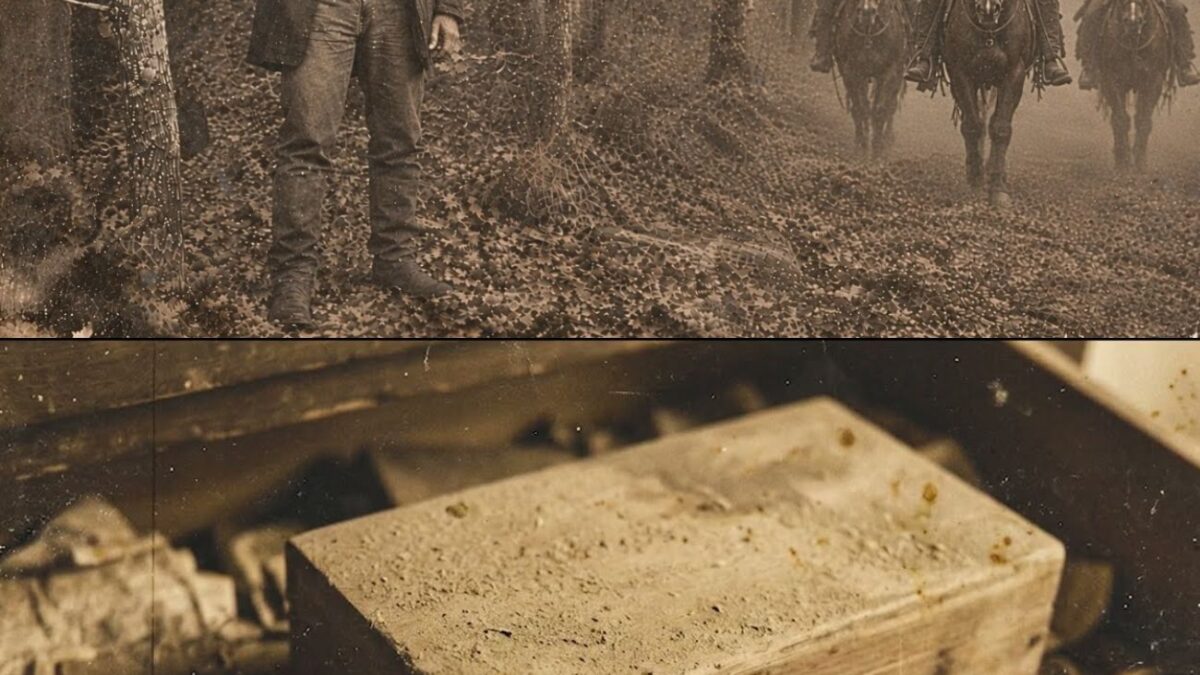
If you find this channel for the first time, tell us where you are watching from, country, state, county, whatever you are comfortable with, then hit subscribe because there is another one of these next week. The first outside account of the ridge comes from a man named Haskell Crew, a contract surveyor working for the state out of Springfield in the autumn of 1861. Crew was running a section line through the southern hills when his chain crew refused to carry the line across Blackjack Ridge. He wrote about it in a private field book that his grandson donated to a county historical society in 1947, where it sat between a stack of unbound church minutes and a box of canceled land warrants for 60 years before anyone read it carefully. Crew was a practical man. His official report closed the section with the standard language about broken terrain and heavy timber. His private book told a different story. He walked the ridge alone after his crew turned back. About 200 yards in on the spine where the blackjack oak thinned enough to see the ground, he found fitted stone. Not loose field stone, not a natural ledge. Dressed stone, jointed, level, running under a few inches of leaf litter in both directions as far as he could clear it with his boot. The joints were tight enough that he could not fit his surveyor’s pin between them. The surface was flat to a degree he had never encountered outside a finished floor. He knelt and put his palm on it and felt what he described in a careful hand as a hum. Not a vibration in the way a bridge deck vibrates when a loaded wagon crosses it. A hum, steady, faint, felt through the bones of the hand more than through the skin. He held his palm flat for what he estimated was a full minute. The hum did not change. It did not rise or fall. It simply was, the way the temperature of deep well water simply is, neither warming nor cooling, set at something. He stood up. The hum came up through his boot soles. He took a step and the hum shifted. That is the word he used, shifted. The pitch changed. His single step on the dressed stone had changed the pitch the way a finger pressed to a vibrating string changes the note. He took another step. The pitch shifted again. He stopped. And the hum returned to what it had been before he moved. He tried it four more times, stepping and stopping, stepping and stopping. Every step changed the pitch. Every stop returned it. The stone was reading his weight and answering it. He left the ridge and did not go back. In the margin of the field book, beside his account of the hum, he wrote three words and underlined them twice. The three words were, “The ground listens.”
The second record is medical. Dr. Prentice Shawl was a circuit physician who rode the hill country south of the White River from 1853 until his death in 1881. His casebook survive in a private collection in Green County. Most are ordinary, fevers, broken bones, difficult births. But the back pages of the fourth casebook, covering roughly 1868 through 1874, contain entries in a smaller, tighter hand. These entries are not about patients. They are about a sound. Shawl had been called to the Sykes place to set a broken arm. He stayed the night because of weather, and in the early hours before dawn, he heard what he described as a tone, not from the house or the timber. From the ground, low, sustained, even. The kind of tone an organ pipe makes when the bellows have been pumping long enough for the note to settle into itself. He lay still and listened. The tone held for what he judged to be 20 minutes without change. Then the old man of the family, the one they called grandfather, got up from his chair by the fire and walked out the front door. Shawl heard his footsteps cross the porch and step onto bare ground. And the tone changed. It did not stop. It shifted. The pitch moved. Shawl, who had some training in music, recognized it as a movement toward consonance. Under the old man’s footsteps, the tone became resolved, as if his walking had brought a chord into tune. The old man walked, perhaps 10 minutes, along the ridge and back. When he came inside and sat down, the tone held its new pitch for a while, and then drifted back to neutral. In the morning, Shall asked about it. Grandfather looked at him a long time and said, “That is the ridge talking. It does that. If you listen to it without answering, it does not mind. If you answer wrong, it does mind.” Shall asked what it meant to answer wrong. Grandfather said, “Walk wrong. Carry yourself across it in a way it does not recognize. The ridge knows a Sykes walk, has known it since before my grandfather put a house here. When a Sykes walks, the ridge goes quiet. When something else walks, the ridge asks a question. If the question is not answered right, the ridge answers itself.” Shall asked what happens when the ridge answers itself. The old man said, “The sound gets into the bones, not the sound you hear with your ears, the one underneath. It finds the note your bones are tuned to, and it plays it wrong. A man will walk onto this ridge feeling fine and walk off it feeling like his joints have been taken apart and put back together by someone who did not care whether they fit.” Shall went back to the ridge four more times over the next 6 years. Each time he heard the tone. Each time a Sykes walked the ridge in the early hours. Each time the walking resolved the tone toward something he could only describe as agreement.
The third source is the Sykes themselves. In 1953, a woman named Opal Jessup was cataloging donations at a small historical society in Taney County when she opened a cedar box that had been given to the society in 1931 by the last Sykes to leave the ridge. Inside the box, wrapped in oilcloth, were nine pages of handwritten instructions. The paper was old. The ink had gone brown. The handwriting belonged to at least three different hands, the earliest of which Jessup estimated to be from the late 1700s based on the letter forms. The pages were not dated. They were not addressed to anyone. They were not signed by anyone. They read like a manual. Jessup cataloged the pages as devotional writings and filed them. They sat in a drawer for 22 years until a retired school teacher named Pearl Grennan, working as a volunteer at the same society, read them carefully and recognized that they were not devotional at all. They were operational. The instructions described, in plain language, how to walk Blackjack Ridge. Not how to walk on it in the sense of navigating terrain, how to walk on it in the sense of maintaining it. The ridge, according to the instructions, was tuned. The dressed stone floor running under the soil of the ridge was a single continuous instrument, and it was running. It had been running when the first Sykes arrived, and the family’s understanding was that it had been running for a very long time before that. The instructions described the hum. They called it the tone without explanation, as though anyone reading the pages would already know what that meant. The tone was the sound the stone made when it was running unattended. The tone was neutral. Neutral meant the stone was reading the surface above it, taking in information about what was on it and how it moved, and had not yet formed a judgment. A judgment, according to the instructions, was what happened when the stone decided whether a thing on its surface belonged there. The test was resonance. Not resonance as a metaphor, resonance as a physical event, described with the kind of plain mechanical detail you would expect from a manual written for people who had to do the work every day. Every physical object that touches a vibrating surface either dampens the vibration, amplifies it, or changes its frequency. The dressed stone of Blackjack Ridge was vibrating at a pitch too low for the human ear to hear clearly, but high enough for the human body to feel. When a person walked on the ridge, their weight and their gait and the particular way their bones carried the impact of each step created a pattern of interference with the stone’s own vibration. If the interference was consonant, the tone resolved toward agreement. The stone read the walker as belonging. The surface stayed solid. The ground stayed warm. The walk was safe. If the interference was dissonant, the tone moved toward something the instructions described in the oldest hand as the answer the stone gives when it does not know what is on it. The instructions were clear about what that answer meant. The stone did not attack. The stone did not open. The stone did not swallow or consume. The stone played the dissonant frequency back into the body of the thing that produced it. It returned the wrong note. It found the frequency the body was already vibrating at, the natural resonance of bone and tissue and fluid, and it played that frequency back at the body, shifted by exactly the interval the dissonance had introduced. The body received its own note wrong. And a body receiving its own note wrong cannot tell where it ends and the wrongness begins because the wrongness is made of itself.
The effect of a returned wrong note on a living body was, according to every source that describes it, unmistakable. It began in the feet. A tingling closer to the feeling of a tuning fork pressed against the ankle bone than to numbness. It moved up through the shins and into the knees. The joints began to feel loose as though the connective tissue had softened. Within a few minutes, a person receiving the returned note would find it difficult to walk in a straight line. Not from pain, from a loss of coordination so fundamental that the body seemed to have forgotten how its own parts connected. Dr. Scholl documented three cases. A peddler named Wick Sutton tried to cross the ridge on foot in the spring of 1870. He came down the east side unable to stand without holding something. He told the people who found him the ground had hummed under his feet and his legs had gone wrong. His knees bent in the wrong direction. His ankles rolled with every step. He fell seven times in a quarter mile and crawled the last hundred. Scholl examined him two days later and found no injury, no fever, no stroke. Sutton recovered in a week and never went near the ridge again. A timberman named Coilus Pruitt was marking trees on the south end of the ridge in 1872. He described a sound from the ground that went through his boots and into his spine. After 10 minutes his hands could not hold the marking axe, not from weakness, from a loss of certainty about where his hands were. He would reach for the handle and miss by two inches, reach again and miss by three. He left his axe and walked down on his hands and knees. Scholl saw him the following morning. No injury, full recovery in five days. The third case disturbed Scholl the most. A boy of about 12, son of a family from the bottoms, went up the ridge on a dare. He came back unable to speak correctly. Not mute, he could make sounds, but the sounds did not match what he was trying to say. He told his mother he was fine and what came out was the name of a creek. He asked for water and what came out was a string of numbers. His speech returned to normal in three days, but for those three days every sound he made was wrong, as if the mechanism connecting thought to voice had been tuned to a different scale. Scholl wrote in the tight hand at the back of the casebook, “The ridge did not hurt these people. It untuned them the way you might untune a fiddle by tightening a peg a quarter turn. Everything still works. Nothing works right. And the wrongness is so precise it cannot be accidental.”
The Sykes instructions explained why the family was immune. It was not magic. It was not blood. It was practice. The ridgestone vibrated at a fixed pitch. A person walking on the ridge introduced a second vibration through their footfall. If the two vibrations were consonant, the stone accepted the walker. If dissonant, the stone returned the dissonance into the walker’s body. The Sykes had learned the consonant walk. The instructions described it in physical terms. The pace had to be steady, roughly the speed of a person walking to a familiar place with no reason to hurry. The weight had to be even distributed through the whole foot. The entire sole placed flat with each step. The steps had to be regular. The intervals between them as close to identical as a human gait could manage. And the walker had to be alone. Two walkers produced competing interference patterns. Three produced chaos. A group on the ridge, no matter how carefully each one walked, generated a compound vibration the stone could not resolve into a single consonant answer. An unresolved answer was, to the stone, the same as a wrong answer. This is why the Bald Noppers never rode through. Not because they were afraid. Not because anyone warned them. The Bald Noppers rode in groups of 20 and 30 on horseback at a canter. Every horse threw a different rhythm. Every rider sat a different weight. The combined percussion of that many hooves on ground above the dressed stone would have produced a dissonance so profound that every horse on the ridge would have gone wrong in the legs inside of a quarter mile. The horses knew. The Sykes instructions contained a passage about livestock. A cow led slowly across the ridge by a single person walking the consonant walk would make it safely because the cow’s footfall, slow and heavy and regular, produced an interference pattern close enough to the stone’s pitch that the stone read it as part of the walker’s signal. But a driven herd, or a galloping horse, or a pack of dogs running loose, produced exactly the kind of chaotic vibration the stone could not pass. The riders would have experienced it as their horses balking at bad ground. They would have turned around without ever knowing why. And after a while they would have stopped trying the way you stop trying a road that is always washed out. The ridge was tuned. Anything that walked it either matched the tuning or was sent away. The Sykes matched. The Bald Nobbers did not.
The instructions contained a section in the third and latest hand about what happened when no one walked the ridge for too long. The tone, left unanswered by a consonant walk, did not simply persist. It grew, not louder, but denser. The instructions described the sound filling up with itself. An unwalked ridge accumulated a tonal pressure, and that pressure expanded the range of frequencies the stone would reject. A ridge walked daily accepted almost anyone who moved slowly and steadily. A ridge unwalked for a week accepted only a Sykes. A ridge unwalked for a month might not accept anyone at all. The family had a rotation. Someone walked the ridge every morning. Not a patrol, a walk. A slow, deliberate, flat-footed passage from one end of the spine to the other and back. The instructions called it keeping the note clean. The walker’s consonant footfall acted as a reset, pulling the accumulated pressure back to baseline, reopening the range of frequencies the stone would accept. This is why the Sykes never left. If they left, the ridge went unwalked. If the ridge went unwalked, the pressure built. If the pressure built long enough, the acceptance window narrowed to nothing, and the ridge became impassable to everything, including them. Opal Jessup, who first cataloged the instructions, made a note in the margin of her catalog entry that has gone unremarked for 70 years. The note reads, “Family donated box in ’31. Last Sykes left the ridge in ’30. No one has walked the ridge since ’30. If the instructions are accurate, the stone has been accumulating tonal pressure for nearly a hundred years.” The acceptance window would have narrowed past the point where any human walk could produce a consonant pattern. The ridge, by now, answers only itself.
Pearl Grennan drove to Blackjack Ridge in the summer of 1975. She parked at the base and walked partway up the east slope. She made it about 150 yd. In a letter to her daughter that evening, she said the humming started in her feet before the tree line. By the time she was among the oaks, her teeth were vibrating, not chattering. Vibrating. Each tooth at what felt like a slightly different frequency, as if every separate piece of bone in her skull had been found and played individually. She turned around. The sensation stopped within a few steps of leaving the ridge. She sat in her car for 20 minutes, then went home and wrote the letter. At the bottom, she wrote, “The instructions are not folklore. The instructions are an operator’s manual, and the machine is still running.”
There is one more piece of the Sykes account, and it is the hardest to sit with. The instructions, in the oldest hand, contain a passage about the builders. They do not call them builders. They call them the ones who set the tone. The passage says, “The dressed stone floor under Blackjack Ridge is not a floor. It is a string. One string in an instrument the size of a continent. The ridge is tuned to a specific pitch because that is its position in the whole. Other ridges in other places are tuned to other pitches. Together, they would produce a chord.” The passage says the chord was set by the ones who built the instrument, and that the instrument was built for a purpose the instructions do not name. The builders left. They left the instrument running. They set keepers at intervals along the strings to keep the notes clean, so the instrument would still be in tune when they came back. The Sykes were keepers. Their whole life on that ridge, their deed and their house and their morning walk and their careful gait and their refusal to leave and their silence about why was the keeping. They were not settlers who happened to live on strange ground. They were staff assigned to a post, maintaining an instrument they did not build and did not understand against the return of builders who did not come back. The passage says one more thing. The instrument has another set of elements placed at the nodes where the strings cross. These elements are not keepers, but something else. The instructions use a word for them that Jessup could not read because the ink had bled, but Grennan believed the word was listeners. The listeners sit at the nodes, the keepers walk the strings, and the instrument does what it was built to do whether anyone remembers the purpose or not.
The Bald Knobbers rode around it because no horse could keep its legs on a vibrating string. The Sykes lived on it because someone had to keep the note clean, and now no one does. Grennan died in 2003. Her letter and her catalog notes are in a box in Branson. The Sykes instructions are still in the drawer at the Historical Society cataloged as devotional writings. Crew’s field book is still between the church minutes and the land warrants. Scholl’s case book is still in private hands in Green County. None of these records have been placed next to each other. None of these people ever met. They described the same thing across 120 years in language so similar that it is either the most remarkable coincidence in the history of the Ozarks or the plain description of a thing that is actually there. The ridge is still there. The blackjack oak is still thick. And the ground is still humming.
And next week we go east into the river bottoms where a family kept a leather-bound book of the years the old stone bridge carried a sound up from the water that was not water and was not wind. And beside each date they wrote one word which was answered. The bridge was pulled down in 1908. The creek has been dry ever since. Subscribe, hit the bell, and we will see you there, leaving the timeless machine to echo softly in the quiet hills of the Ozarks, forever waiting for a keeper who will never return.

