The Shocking & Sensational Crime of Henriette Caillaux
The Shocking & Sensational Crime of Henriette Caillaux
In the early 20th century, France had one of the most left-wing governments in Europe, a progressive mix of centrists and socialists. It passed laws guaranteeing freedom of religion and the complete separation of church and state. Government funding of churches was abolished, and all religious buildings were nationalized. A series of laws decreed free and compulsory education for all French children, both boys and girls. The government also introduced a progressive income tax with higher rates for higher earners, which was a very radical innovation for its time. Overseas, the French consolidated their empire and looked to expand it. They competed with Britain for new territories in Africa and strengthened their control of French Vietnam, Laos, and Cambodia. They also had to compete with Germany, which was looking to gain new locations overseas. French newspapers had a massive circulation as literacy rates were at an all-time high, so every decision the government made was scrutinized by the press, who held a very big influence on French society at the time.
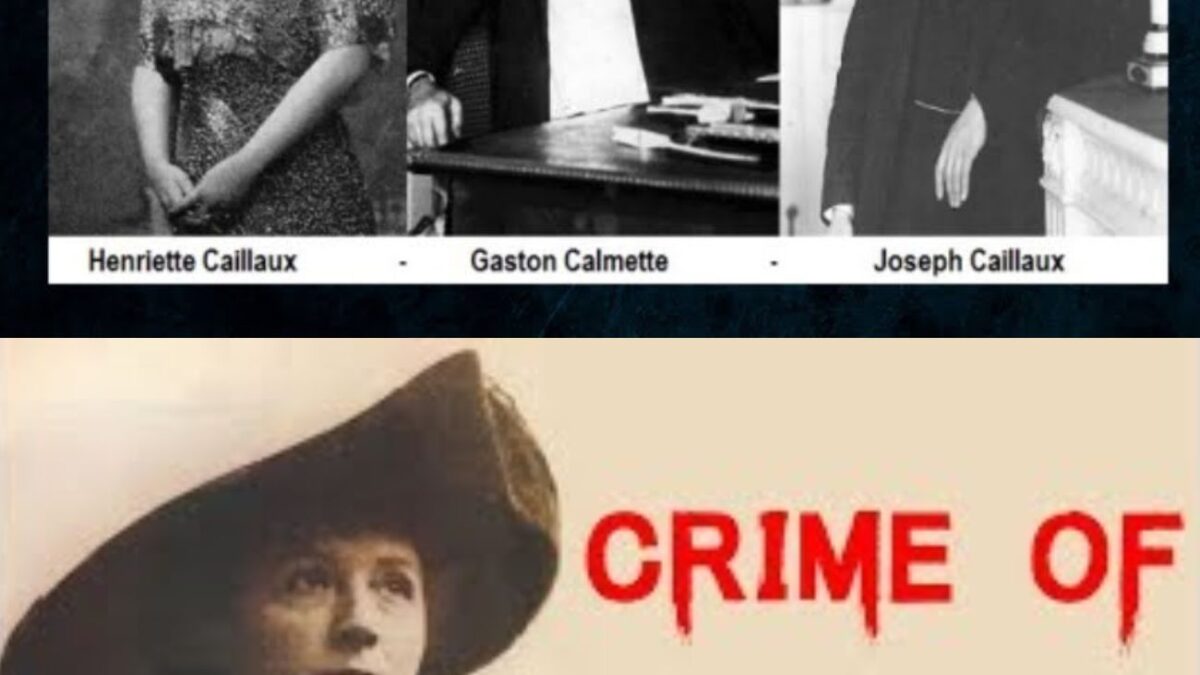
Henriette Caillaux was born on December 5, 1874, in a western suburb of Paris about 12 kilometers from the center. When she was a teenager, she began a friendship with Léo Claretie, a writer who was 12 years older than her. They were married in 1893, and over the next few years, she had two children. In 1907, she began having an affair with the French government minister Joseph Caillaux, while both he and she were still married. In 1908, when the affair became public knowledge, Henriette and Léo divorced.
Joseph Caillaux was born in Le Mans, France, on March 30, 1863. He was an educated man who served as a minister in the French government. He had a very publicized personal life as he paraded his mistresses around with him. Before he was married, he had a secret love affair with Henriette, his future second wife, while he was still married to his first wife. Despite this, he rose in the French government to become Prime Minister on June 27, 1911. His premiership was a short one, lasting only six months, as one of his first tasks was to attempt to defuse a crisis over Morocco. He negotiated a settlement that gave France a protectorate over the North African territory in exchange for generous concessions to Germany in central Africa—a compromise that brought a massive public attack upon his patriotism by the French press. When the French Senate investigated this negotiated settlement, it proved so embarrassing that Joseph Caillaux was forced to resign in January 1912.
Gaston Calmette was born on July 30, 1858, in Montpellier, France. He was a journalist, and in 1884, he joined the staff of Le Figaro in Paris. Ten years later, he became the paper’s editor. Le Figaro is the oldest daily newspaper in France and is considered to be a paper on the center-right of politics. This meant that it clashed with the more liberal views of Joseph Caillaux.
By March 1913, France had moved away from the left and had a more right-wing government. This government was concerned about mounting tensions in Europe, and as France only had a population of 40 million people while Germany had a population in excess of 70 million, they proposed legislation that would increase the required length of military service from two to three years. Joseph Caillaux and other liberals, including the country’s Socialist Party, were against the bill, but despite this, the bill was passed in June of the same year. Joseph did not like the outcome, and rather than accepting that the vote had not gone his way, he continued to attack it. This angered right-wing newspapers, which thought he was completely out of touch with the situation in Europe. The very popular newspaper Le Figaro then decided to make him the object of a major smear campaign, which was led by Gaston Calmette, by this time the most powerful journalist in France and editor of the paper.
At the beginning of December 1913, Calmette claimed that he would print in Le Figaro certain documents that would prove Caillaux had obstructed justice in a financial scandal while serving as minister of finance in 1911. Calmette also claimed that he had been given love letters exchanged between Caillaux and his second wife, Henriette, while he was still married to his first wife, and he threatened to publish them. He didn’t carry out his threat immediately, and the drama calmed down. Then suddenly, four months later, on March 13, 1914, on Calmette’s instruction, Le Figaro printed an embarrassingly intimate letter that Caillaux had written 13 years earlier to his mistress at the time, named Berthe Gueydan, who later became his first wife. The publication of the letter not only publicized the affair but also exposed Joseph Caillaux to suspected political dealings. Henriette believed the paper would follow this up by publishing her own correspondence, as they had previously threatened to do.
On March 16, 1914, just three days after the letter was published, Henriette instructed her chauffeur to drive her to the offices of Le Figaro. She was a strange and unexpected visitor to the offices, but Calmette did not hesitate to receive her. She was wearing a fur coat, and after being shown into his office, Henriette and Calmette exchanged a few words. Then suddenly, she pulled out an automatic pistol she had been concealing and fired six shots. Calmette was hit four times and was critically wounded. Henriette made no attempt to escape, and newspaper workers in the adjoining office quickly summoned a doctor and the police.
The police arrived, but she refused to be transported to police headquarters in a police van, insisting on being driven there by her chauffeur in her own car, which was still parked outside. Remarkably, the police agreed to this request, and she was formally charged upon reaching police headquarters. Gaston Calmette died six hours after being shot, and Henriette was arrested for murder and transported again in her car to the prison of Saint-Lazare, which was meant to be a very severe female institution. But within days of her arrival, prison officials showered her with unusual favors and comforts. She was given a private heated cell, was attended by her maid and hairdresser, was allowed special visitation privileges, and even dined with her husband in the prison director’s office. This special treatment greatly upset the other prisoners, and the newspapers wrote stories about the possibility of a prison mutiny in protest. The mutiny they wrote about never materialized.
On July 20, 1914, the sensational trial opened. The court was full of the finest journalists in France, and the case dominated newspaper headlines despite the fact that a war was threatening in the Balkans. The attention of much of the French people focused instead on the sensational case of Henriette. In addition to being a sensational crime, the case was also a clash between left- and right-wing politics. The papers limited their foreign affairs coverage during the trial to accommodate commentary, elaborate images, and even complete transcripts of trial proceedings.
In court, Henriette was represented by celebrity lawyer Fernand Labori, who had represented many high-profile clients and put together a very clever defense. Throughout the trial, the case was dominated by emotion, romance, hot tempers, and secret political dealings, with every dramatic turn carefully reported by the Parisian press. The daily newspapers reported Henriette’s dramatic fainting, described her husband rushing to take his wife in his arms, and recorded a violent altercation between Calmette’s supporter Henry Bernstein—a famed playwright—and Joseph Caillaux, which resulted in a massive uproar and ended with the trial’s temporary suspension. The trial seemed to consume French life. It even featured a deposition from the French president, an unheard-of occurrence at criminal proceedings not only in France but anywhere in the world, alongside the fact that many of the participants were among the most powerful people in the country.
When Henriette took the witness stand, her clever defense strategy evoked the romantic and idealized notion that women were ruled by their passions. Hers was simply a crime of passion, she claimed; at the time, she was unable to control her emotions, making her a victim and not a murderer.
The trial ended on July 28, 1914—the very same day that Austria-Hungary declared war on Serbia. The prosecution had a pretty stonewall case, as the accused admitted going into the office of the editor of Le Figaro and firing six bullets, four of which hit and killed him. The defense argued that she was a temporary victim of, as her lawyer put it, “unbridled female passions.” The all-male jury was sent out for deliberations, and after one and a half hours, they returned to give a verdict of not guilty.
Amazingly, the woman who had murdered an unarmed person by firing four bullets into him walked free from court like a superstar, with photographers taking her picture and reporters writing down her every move. The next day, the papers were full of her story, and world affairs seemed far less important to the French public. The trial possessed all the necessary characteristics required for an entertaining story: murder, romance, celebrities, and politics. It fed a national curiosity while providing a convenient diversion from the deeper problems facing the country. Yet, this fragile escape was short-lived, as just six days after the trial ended, the shadow of global conflict swept it all away when Germany officially declared war on France, plunging the nation into a reality far more devastating than any courtroom drama.

