The Shocking Case of England’s Most Notorious Incest Scandal
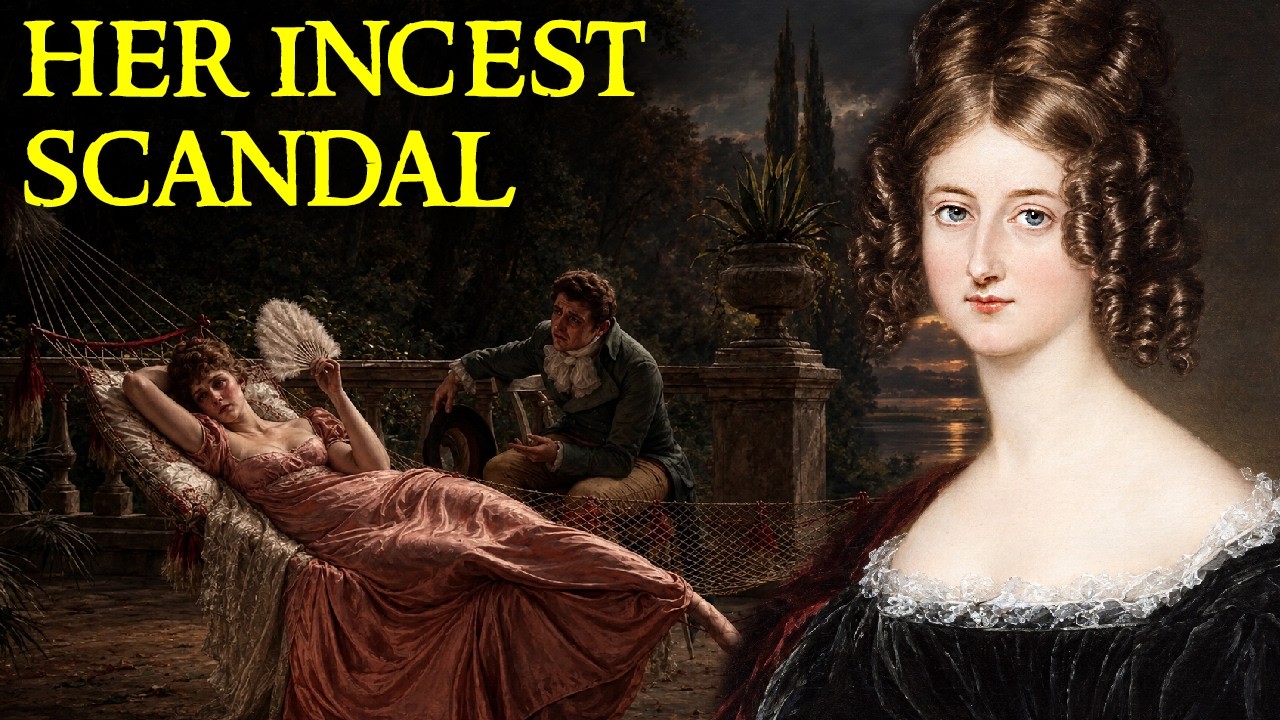
In the spring of 1816, one of Europe’s most famous poets was forced to flee his native England, driven into exile by scandalous accusations that threatened to ruin his reputation. While Lord Byron escaped the storm, the woman at the center of the controversy remained behind: his half-sister, Augusta Lee, whose shadow of alleged incest would haunt her for the next thirty-five years.
Augusta Mary Byron was born in Paris on January 26, 1783. Her father was Captain John Byron, known as “Mad Jack,” a handsome and catastrophically extravagant military officer who had already run through his family’s fortune and was hard at work eviscerating another. This second fortune came from Augusta’s mother, Amelia Darcy, Countess of Holderness’s daughter, who had left her first husband to elope with Mad Jack to France. Almost exactly one year after Augusta’s birth, her mother died, leaving her behind in France while Jack Byron headed to England to escape his creditors. Back home, he promptly married a Scottish heiress, Catherine Gordon of Gight, whose estate he managed to destroy with the same efficiency. In 1788, they had a son, George Gordon, better known to the world as Lord Byron. No sooner was Gordon born than Mad Jack returned to France and died there at thirty-five years of age in 1791, most likely from tuberculosis.
Thus, by 1791, Augusta had become an orphan, though she had been rescued from France several years earlier when her grandmother took her into her care. Separated from her half-brother throughout their childhood, Augusta was passed from one aristocratic household to another, living among the highest circles of English society from the Duke of Leeds to the Earl of Carlisle. As she grew into a young woman, she was described as beautiful and graceful with fine dark hair and a striking face, yet beneath her elegant appearance lay a deeply shy and reserved nature. At eighteen, her grandmother died and left her a trust worth £7,000—a small fortune at the time. For the first time, Augusta had wealth and a degree of independence, but money could not protect her from the scandal that would change everything.
It was around 1802, when Gordon was a teenager of fourteen and Augusta was nearing twenty, that the half-siblings finally met. He had become the sixth Lord Byron by then. They got along well from the beginning, writing to each other regularly and discovering a shared sensitivity that contrasted with the flamboyant and reckless lifestyle of their father. Scholars looking back have noted that Byron’s romantic poetry was shaped by his relationships with various female relatives, which was not entirely uncommon in the early nineteenth century. Augusta would also inspire his writings, but there was something deeply unusual about their relationship as half-siblings who had barely known each other before meeting as teenagers. What followed would soon attract the attention of Regency society as whispers began to spread.
In 1807, Augusta married her first cousin, George Leigh, a colonel in the 10th Dragoons and an equerry to the Prince of Wales. Though opposed by both families due to their modest means, the marriage suggested genuine affection, even if Lord Byron was horrified and called it “abominable.” The Prince of Wales gifted the young couple a house at Six Mile Bottom near Newmarket, right beside a famous racecourse. Unfortunately, whenever George wasn’t away on military service, he spent far too much time and money at the racetrack, leaving Augusta to deal with mounting debts and increasingly impatient creditors. History was repeating itself. Children also arrived steadily—seven in all—notable among them a second daughter born in 1811 who suffered from a mental abnormality requiring lifelong care.
Meanwhile, Lord Byron had returned from his travels in the east in 1811, and their correspondence resumed, growing remarkably close over the next few years. When Augusta came south to London in June 1813, the half-siblings spent extended periods together. Byron’s letters from this period, particularly to Lady Melbourne, became cryptic, prompting warnings that a continuation of their relationship would lead to him being driven out of English society for good. In January 1814, while staying at Newstead Abbey, the pair was snowed in together for three weeks. Just three months later, on April 15, Augusta gave birth to a daughter, christened Elizabeth Madora. The question of her paternity immediately became the subject of vicious gossip, with rumors spreading that Lord Byron was the father. Although George Leigh never appeared to doubt that Madora was his child, Byron’s own behavior—such as visiting the baby days after birth and writing veiled, ambiguous letters—only fueled the suspicion.
The obvious solution to the gathering storm of rumor was for Lord Byron to get married. Augusta encouraged him, and in January 1815, he married Annabella Milbanke. The union was a disaster, with Annabella quickly becoming convinced her husband was psychologically unstable. By then, Augusta had secured a respectable position as a woman of the bedchamber in Queen Charlotte’s household at St. James’s Palace, but behind palace walls, her private life was unraveling. She spent much of her time at Byron’s house attempting to mediate his troubled marriage while watching him spiral into opioid dependency and boast of numerous mistresses. In December 1815, Annabella gave birth to Augusta Ada Byron—later known as Ada Lovelace—before leaving London just five weeks later with her infant daughter. Augusta continued writing to Annabella about Byron’s erratic behavior, unaware that Annabella was secretly passing those letters to her lawyer to pursue a legal separation.
Facing accusations of incest and homosexuality, Byron signed a separation deed and set sail from Dover for the continent in April 1816, never to see Augusta again. What followed was a strange period where Augusta remained on good terms with Annabella, managing to retain her place at court through an unequal relationship that required her to send cold letters to Byron in exile. In Italy, Byron remained attached to her, his feelings reflected in his play Manfred, where the hero is destroyed by his love for his sister Astarte. In 1824, Byron traveled to Greece to join the struggle for independence and died of a fever at Missolonghi. His body was brought back to England and laid to rest in the family vault at Hucknall.
For Augusta, the story was far from over. The last quarter of a century of her life consisted of a slow demise within British high society as the scandal slowly subsided. Then, in 1831, another shock struck when Henry Trevanian, who had married Augusta’s eldest daughter Georgiana, abandoned his wife and began an affair with her younger sister, Elizabeth Madora—the very daughter long rumored to be Lord Byron’s child. Madora eventually fled to France with Trevanian and grew increasingly convinced that the rumors of her birth were true. Financial woes also plagued the family as Augusta borrowed heavily against her children’s reversionary interests in the Byron estate, ultimately facing the Court of Chancery and refusals of aid from the wealthy Annabella.
In April 1851, Augusta and Annabella met for the very last time, during which Annabella demanded that Augusta confess to poisoning Lord Byron’s mind—something Augusta refused to do. Augusta passed away months later on October 12, 1851, at the age of sixty-eight at St. James’s Palace, with her youngest daughter, Emily, by her side. While many historians and literary scholars believe Elizabeth Madora was indeed the product of an incestuous relationship between Augusta and her half-brother, conclusive evidence has never surfaced. Nearly two centuries later, the indisputable truth behind one of Regency England’s most shocking scandals remains a lingering mystery, leaving the ultimate verdict lost to the quiet passages of history.

