The Rancher Sent for a Delicate Bride… But a Big, Strong Woman Surprised Everyone
The Rancher Sent for a Delicate Bride… But a Big, Strong Woman Surprised Everyone
Let her go, I’m telling you. Don Ignacio Valverde de la Torre’s shout echoed between the quarry walls of the hacienda, breaking the silence of the early morning as he ran barefoot towards the stable, his shirt half-buttoned and his heart pounding in his chest like a war drum. Two foremen held Alta Gracia down on the packed earth floor, her wrists tied with rope that cut into her skin, her blue shawl stained with mud and the blood that trickled from a split lip. A third man, holding a folded piece of paper that he claimed represented an order from a neighboring court, waited by a closed wagon, ready to take her away. If they touch a single hair on her head, Ignacio continued in a voice that none of his workers had ever heard from him, not even in the worst days after his wife’s death, I will hang them myself from the oldest oak tree on this property, and then let whoever wants to come and make me pay for the offense. The silence that followed was absolute. No one working at the oak ranch had ever seen the boss challenge anyone like that, much less for defending a black woman who, according to rumors that had been circulating in the town for months, had arrived at the ranch as a mistake, a substitute for the delicate bride that everyone was expecting. But to understand how the most reserved ascendant in Guanajuato ended up risking his surname, his fortune, and even his own safety for a woman whom the entire society told him he should despise, we have to go back several months, to the exact day it all began. Now, I’m going to tell you how it all started. Guanajuato, 1788.
The dry heat of August clung to the skin like a second garment, and the dust from the silver mines surrounding the city turned even the greenest leaves of the oak trees that shaded the hacienda gray. Don Ignacio, a widower for three years, walked along the stone corridor with a crumpled letter in his hand, rereading for the tenth time the words of his mother, Doña Casilda de la Torre, who insisted in every line that her son needed a wife with delicate hands, a soft voice and pure blood, capable of restoring to the big house the luster it had lost since the death of the late Mrs. Valverde. The Ensinos estate stretched over a valley surrounded by hills that in the afternoons were tinged with a dusty orange, the result of the constant smoke that rose from the nearby mines. The main house, built with pink quarry stone brought from León, had two courtyards: one where carriages and farming tools were kept, and another more intimate one, where Doña Casilda cultivated rose bushes that never fully bloomed due to the dry climate. Since the death of Ignacio’s wife, a woman named Mariana, who had died of fever after losing her only child at birth, the house had fallen into a silence that not even the patron saint festivities could completely break. Don Ignacio, at 32 years old, was described by the people as a decent but distant man, more comfortable among the farm’s account books than among the people. He had inherited the oak trees from his father, a former miner who had made his fortune in the mother lode before retiring to farming and ran the property with a discipline that bordered on obsession, as if controlling every penny and every furrow of land could compensate for the emptiness he felt since burying his wife.
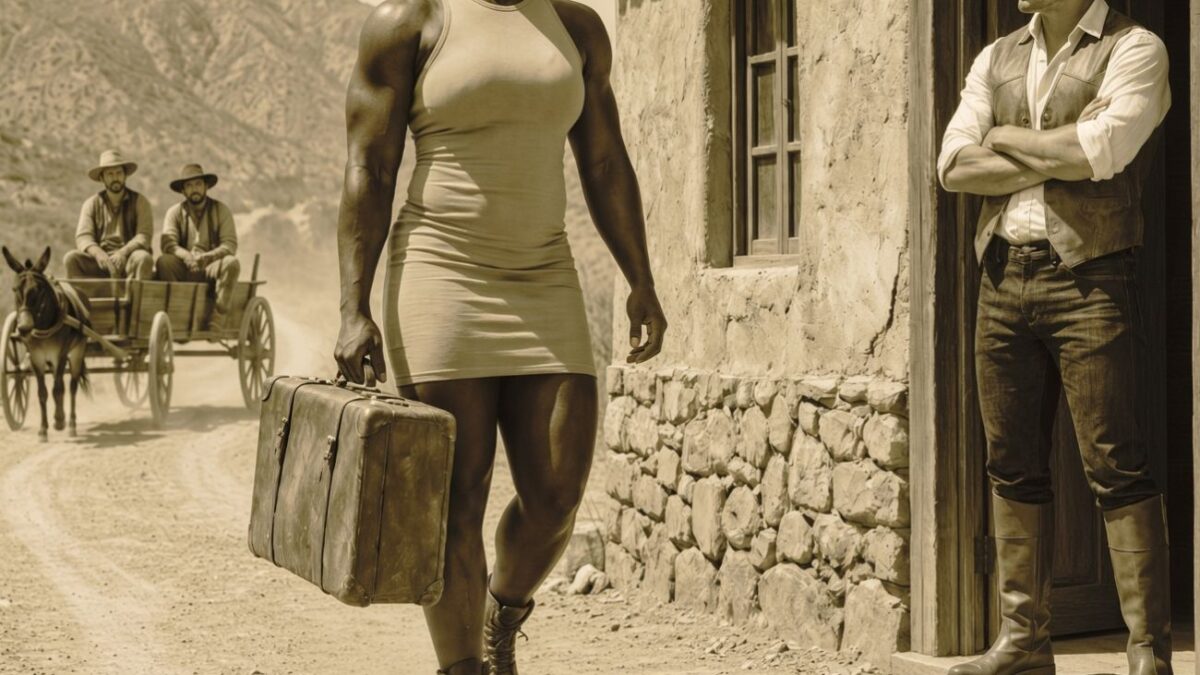
Doña Casilda’s plan had been simple, at least on paper. Doña Eulalia Montemayor, widow of a fabric merchant from Mexico City and an old friend of the family, had promised to send her goddaughter a young woman named Dorotea, described in the letters as petite, with porcelain skin and exquisite manners, so that Don Ignacio could meet her with a view to an arranged marriage that would restore to the Valverde family the social prestige that, according to Doña Casilda, had been fading along with her son’s laughter. But when the carriage stopped in front of the stone steps that morning in late September, enveloped in a cloud of reddish dust raised by two tired mules, and the door opened, what stepped out was not the fragile silhouette that everyone was curiously waiting for. She was a black woman, taller than any that had ever been seen in the region, far exceeding 2 meters in height. Her broad shoulders and arms, tanned by years of physical labor, contrasted with the simple but neat clothes she wore: a dark blue cotton dress hand-sewn with a precision that betrayed craftsmanship, a woven shawl that covered part of her hair. Her dark skin shone in the morning sun, and her braids, gathered tightly against her skull, framed a face with firm features, high cheekbones, a wide nose, and lips pressed into a line that did not tremble under the gazes that were already beginning to pierce her like needles from the windows of the big house.
The Ensinos estate awoke every morning to the distant sound of the mine’s hammers echoing among the hills, a constant knocking that the inhabitants of the region had consciously stopped hearing for generations. It was already as integrated into the everyday soundscape as the crowing of roosters or the occasional braying of mules in the corral. The smell of damp earth in the early hours mingled with the aroma of nixtamal cooking in the clay pots of the kitchen, and the bells of the small chapel of the hacienda marked the hours with a punctuality that not even the pendulum clock in Ignacio’s office could match. It was in the midst of that familiar and repeated landscape, so well known to all the inhabitants of the Ensinos that it barely deserved a second thought, where the arrival of Alta Gracia that September morning would mark a definitive fracture between before and after. Her name was Alta Gracia and she wasn’t anyone’s goddaughter. She was the woman that Doña Eulalia had actually sent after Dorotea fell ill with typhus just two days before the scheduled date of the trip.
This is an insult, muttered Doña Casilda from the second-floor balcony, without coming down to greet her, her hand gripping the wrought-iron railing as if she wanted to break it. What kind of joke is this? I wrote, asking for a young lady.
Meanwhile, the coachman, an elderly man of few words named Don Camilo, clumsily lowered the trunks, avoiding eye contact with anyone like someone who knows he has brought trouble with him and prefers not to be part of the ensuing argument. Alta Gracia, however, did not lower her gaze or shrug her shoulders. She stood beside the carriage with her chin held high, waiting. It was Don Ignacio who, to the surprise of everyone present, including the young men who were carrying firewood through the courtyard, went down the stone steps himself, something he had never done for any previous visit, not even for the governor of the intendancy when he had passed through the estate two years before. He stopped in front of her, noticing that he had to slightly raise his gaze to meet her eyes, something that did not happen with any other man in the region, and extended his hand to her.
Welcome to the Ensinos, he said, and his voice sounded firmer than he himself expected, almost surprised by his own tone.
Alta Gracia observed him for a moment, perhaps evaluating whether that courtesy was genuine or a simple formality that would be broken as soon as the doors of the house closed.
I didn’t come here to lie about who I am, sir, she finally said, accepting the greeting with a firm hand, calloused from years of work. If my presence here is a problem, tell me now and I’ll ask the coachman to take me back to the capital before noon. I have no intention of staying where I’m not welcome.
Nobody has said I’m not welcome, Ignacio replied, ignoring the furious glare his mother was giving him from the balcony. Please come in, you must be tired from the journey.
Before night fell, however, Alta Gracia had her first encounter with someone who would not look at her with contempt or pity. It was Tomasa, the head cook of the hacienda, a middle-aged mestiza woman and widow of a muleteer, who approached her in the service yard while Alta Gracia arranged her few belongings in the room that had been assigned to her.
Don’t pay any attention to the gossip around here, Tomasa told her bluntly, drying her hands on her apron stained with lard. I arrived at this ranch 20 years ago alone, with a newborn son and no husband to support me, because the muleteer died on the way to Zacatecas before the child was born. They also gave me dirty looks at first. They also said that I had no place here.
And what did you do? asked Alta Gracia, grateful for the unexpected company.
I cooked better than anyone else in this kitchen until they had no choice but to shut up and eat what I prepared. People quickly forget their prejudices when their stomach is full, my daughter. Come here, I’m going to give you something to eat before those diners inside decide whether to let you sit at their table or not.
That first shared dinner in the kitchen, away from the eyes of the main dining room, marked the beginning of a friendship that Alta Gracia did not expect to find so soon in such a hostile place. As the weeks went by, Tomasa would become her closest confidante on the estate, the only person before whom she could remove the mask of strength she showed to everyone else. That night, while the servants murmured in the kitchen about the giantess who arrived instead of the young lady and Doña Casilda wrote in furious handwriting a letter to Doña Eulalia demanding an explanation, Don Ignacio sat down to dinner opposite the woman whom his mother had already begun to mutter under her breath as the mistake.
The dining room table, lit by tallow candles that cast long shadows on the portraits of the Valverde ancestors, seemed too formal for the conversation that was about to take place.
Tell me where you come from, Ignacio asked, more out of courtesy than genuine interest, or so he initially thought.
Alta Gracia, without drama or hesitation, told him that she had been born on a sugar plantation near Córdoba, Veracruz, owned by a Spanish count whose surname she preferred not to repeat; that her mother had died young, consumed by work in the sugar mills when she was only 8 years old; and that since then she had been raised among the kitchens and service corridors of different houses until, as a teenager, she came to work for Doña Eulalia Montemayor in Mexico City, where she secretly learned to read the letters she saw in the cookbooks and the correspondence she was asked to deliver.
And why you, if Dorotea was the chosen one? Ignacio asked, pouring her more wine without a second thought—a gesture that Doña Casilda, had she been present, would have considered scandalous.
Because someone had to accompany the carriage, sir, and Dorotea couldn’t travel with a fever. Doña Eulalia thought that, since the trip was paid for and the horses hired, it would be a waste not to take the opportunity to introduce herself as well, just in case, she said. And forgive me for repeating myself, but perhaps you needed someone to run the house with a firm hand, since your wife has died and you, according to your own mother’s letters, are lost amidst papers and silence.
Ignacio let out a brief laugh, the first in months that didn’t sound forced or polite. My mother shouldn’t write so many letters. Mothers rarely know when to stop, he replied with a touch of grace, and for an instant something resembling a smile crossed his serious face.
Among Alta Gracia’s few belongings was a rosary of hand-carved coral seeds, strung on a hemp thread darkened by the years, which had belonged to her mother and which she always wore tied to her left wrist, hidden under the sleeve of her dress. It was not an object of value to anyone but herself. The seeds were worn down from the constant rubbing of fingers, and the tiny crucifix that topped it had lost almost all of its original shine. But it was the only thing she had left of the woman who had carried her as a child among the furrows of Caña de Córdoba, and that’s why she never took it off, not even to sleep. No one in Ensinos, not even Ignacio, would know of its existence until much later, when circumstances forced Alta Gracia to show it as proof of something that words alone could not demonstrate.
The first full day of Alta Gracia at the hacienda began before dawn, more out of habit than obligation. She got up when the sky still had that dark blue color that precedes the crowing of roosters and went down to the kitchen expecting to find it empty, only to discover that Tomasa was already stoking the wood fire, heating the griddle for the first tortillas of the day.
You get up as early as I can see, Tomasa told her without surprise, handing her a jar of freshly beaten corn atole. I like that. There is no place here for those who stay in bed waiting for the world to serve them.
All my life I’ve gotten up before the sun, Alta Gracia replied, accepting the jug with both hands. It’s difficult to unlearn certain habits.
On that first day, Alta Gracia focused more on observing than acting. She memorized the corridors of the big house, the meal times, the names of the servants who carried water from the well, and the layout of the corrals where the pack mules were kept. Doña Casilda did not speak to her all day, limiting herself to giving her reproachful looks every time they crossed paths in the corridor. But Alta Gracia, accustomed to being invisible or despised according to the convenience of whoever observed her, did not flinch.
The second day brought the first concrete proof of her presence on the estate. One of the waiters, a boy named Praxedes, timidly approached to ask her if it was true what was rumored in the kitchen, that she knew how to read and write. When Alta Gracia confirmed that she did, the boy asked her, in the low voice of someone who fears being overheard, to teach him, because he had wanted to learn for years without anyone on the farm offering to do it. That afternoon, sitting under the same oak tree that would later become a symbol of so many things, Alta Gracia traced the first letters of the alphabet on the ground with a stick, while Praxedes repeated each sound with almost religious concentration.
On the third day, Ignacio summoned her for the first time since the welcome dinner, not to chat, but to ask her, with a certain timidity that did not fit with his reputation as a distant man, to accompany him to check some fabrics intended for the dining room curtains, which had been fraying for years without anyone taking care to replace them. It was such a transparent excuse that even Anselmo, who was watching them from a distance, had to hide a smile. Alta Gracia, however, accepted with the same professional seriousness with which she accepted any task, and spent the entire afternoon helping him choose between samples of cotton and linen, without either of them ever mentioning the obvious—that neither the curtains nor the conversation about fabrics were really the reason for that meeting.
By the fourth day, Doña Casilda, exasperated by her son’s obstinate silence in the face of her daily complaints, decided to change her strategy and try direct condescension. She called Alta Gracia into her own sewing room, a space that no maid ever set foot in without an express invitation, and offered her a bag of coins with a smile that did not reach her eyes.
This should be enough for you to return to the capital of your own free will, without anyone having to force you out, said Doña Casilda, extending the bag. Please consider it fair compensation for your inconvenience.
Alta Gracia looked at the bag, then at Doña Casilda, and made no move to take it. With all due respect, ma’am, I didn’t come to this house looking for money and I’m not going to leave for money either. If your son asks me to leave, I will leave that same afternoon without anyone needing to pay me for it. But as long as he decides that I stay, I will decide when to leave, not you.
Doña Casilda, furious at such a slight, put the bag away and did not try to bribe her again, although she also continued to look for other ways to get rid of her in the following weeks. The following days brought with them a tension that could be felt in every corner of the estate. Every morning during breakfast, Doña Casilda insisted that the situation had to be resolved as soon as possible by sending Alta Gracia back to the capital with the first available muleteer. But Ignacio, to everyone’s surprise, including his own, found reasons to delay that decision. First, there was the need to wait for Doña Eulalia’s answer about what had really happened to Dorotea. Then there was the convenience of having an additional person in the house while some issues with the estate accounts, which had been outstanding for months, were being resolved.
It was precisely under that pretext that Alta Gracia demonstrated, without intending to, a skill that would change the way Ignacio saw her. One afternoon, upon finding her sitting in the office, curiously reviewing the accounting books that the estate administrator, a man named Don Baldomero Saence, kept with supposed neatness, Alta Gracia frowned at a column of numbers that didn’t add up.
Excuse me for interrupting, sir, she said without looking up from her book. But these figures for July don’t match what was actually paid to the day laborers at the stone mill. It says here that 40 pesos were paid for the waterwheel repair, but I myself saw the blacksmith charge only 25.
Ignacio, skeptical at first, summoned the blacksmith to confirm and discovered that Alta Gracia was right. For months, Don Baldomero had been inflating the minor expenses of the hacienda and pocketing the difference—a practice that no other employee, not even Anselmo the old steward, had noticed, perhaps out of excessive respect for the administrator’s authority or simple negligence.
How did you learn to read numbers so accurately? Ignacio asked her that night, genuinely intrigued.
Doña Eulalia kept the accounts for her textile business herself, sir, a rare thing for a widow, and she didn’t entirely trust her employees. She taught me to help her, first as a small favor, then as a daily task. I learned that numbers don’t lie, although people do.
It was also around that time that Alta Gracia had to face, for the first time, the hostility of the town itself, beyond just the hacienda. Ignacio had asked her to accompany him to the central market to help him choose fabrics to repair the dining room curtains, and as soon as she set foot in the plaza, crowded with stalls selling vegetables, grains, and textiles, she felt the conversations around her die down and the stares fix on her height and the color of her skin with a mixture of morbid curiosity and open contempt.
Just look what the boss brought from the capital, a chili vendor murmured to her neighbor, not bothering to lower her voice much. She doesn’t even look like a woman, she’s so big. She’ll definitely never get a husband with that size of a beast.
Alta Gracia felt the blood rush to her face, but she maintained her composure, as she had learned to do since childhood in the face of similar comments in every house where she had served. It was Tomasa, who had accompanied them that morning to buy spices, who did not remain silent.
Watch your tongue, Cirila, nobody here asked your opinion about anyone’s size, she snapped at the chili vendor with her hands on her hips. And by the way, tell me, didn’t your husband leave you for someone else two years ago? Because I don’t go around commenting on the magnitude of your marital failure in public, do I?
The saleswoman, embarrassed, lowered her gaze and said nothing more. Ignacio, who had witnessed the scene without quite knowing how to intervene, felt a mixture of vicarious embarrassment and admiration for the courage with which Tomasa had defended Alta Gracia without hesitating for a moment.
You didn’t have to do that, Alta Gracia told Tomasa that night, back in the kitchen of the hacienda. I can defend myself. I’ve been doing it my whole life.
I know, my dear, that you alone can handle the whole world if necessary, Tomasa replied softly. But it’s also okay to let someone else carry some of the weight with you from time to time. That doesn’t make you any less strong.
From that day on, Ignacio began to consult her about other matters concerning the hacienda: the fair treatment of farm workers, the administration of corn rations during the months of scarcity, and even the negotiation with the muleteers who transported the production to the Guanajuato market. Alta Gracia, who had lived on the other side of the decisions that the bosses normally made, offered him a perspective that no other employee dared to share with such honesty.
It was Anselmo, the butler who had been serving the Valverde family for 30 years since Ignacio’s own father ran the hacienda, who first noticed the change in the boss. Anselmo was a man of mixed race, weathered by the sun and decades of loyal service, who had seen more than one generation of the Valverde family born and die, and who, behind his usual discretion, possessed an observational ability that few appreciated.
I’ve never seen you laugh like that, Don Ignacio, he remarked one afternoon, as they both watched from the corridor as Alta Gracia taught the children of the hacienda’s main house their ABCs, seated in the cool shade of a centuries-old oak tree with a patience that contrasted sharply with the reputation for severity the townspeople were already beginning to attribute to her without truly knowing her.
It’s no laughing matter, Anselmo, Ignacio replied, it’s just that for the first time in three years someone is speaking to me frankly, without trying to curry favor or flatter my family name.
With all due respect, boss, that’s exactly what you’ve needed since Doña Mariana died. Someone to tell you the truth, even if it’s uncomfortable.
But the people of Guanajuato, and with them the society surrounding the Valverde family, do not easily forgive those who break their unwritten rules, and soon the rumors circulating in the market would cease to be mere whispers among gossipy women. The first warning came in the form of a stone thrown at the window of the small room where Alta Gracia slept, located in the wing on a moonless night in late September. The stone didn’t hurt anyone, but the message wrapped in a dirty rag that accompanied it did say, in clumsy letters scribbled by someone who could barely write, that the giant black woman had to leave the oak grove before the town decided for her.
When Ignacio found out the next morning, he wanted to investigate immediately, summoning the foremen and threatening to fire anyone involved in such cowardice. But Alta Gracia, with the calm of someone who had faced these kinds of threats before in different forms throughout her life, asked him not to.
If you make a scene, sir, I’m the one who’s going to pay the consequences, not you. It’s always been that way. The town quickly forgets the names of those who throw stones, but it remembers forever the one who gets hit.
That phrase stayed with Ignacio for days, repeating itself in his head as he reviewed the hacienda’s books or rode among the rows of corn. He had lived 32 years and had never questioned the rules of the society into which he was born: the caste system that divided the population into rigid categories based on their bloodline, the taken-for-granted social distance between surnames like Valverde and women like Alta Gracia, the ingrained custom that certain bodies and certain voices were worth more than others simply because of the accident of birth. But now, every time he saw her cross the courtyard with her head held high despite the uncomfortable glances of the other servants, he felt that something in his entire upbringing had been, at best, a convenient lie he had never bothered to examine.
Doña Casilda, meanwhile, did not sit idly by watching her son drift away from the plans she had made for his future. With the help of the town’s own scribe, she wrote to a former suitor of the family, a young man named Cristóbal Andrade, owner of a neighboring cattle ranch with ambitions to expand his lands northward, inviting him to do business with Ignacio with the secret hope that his presence would remind his son of his place in society and what kind of wife truly suited his name and fortune.
Cristóbal Andrade arrived a week later, mounted on a fine black horse, with refined manners learned in the capital and a smile that, if one paid close enough attention, never reached his eyes. He had inherited his estate from a father who had made his fortune trading cattle to the mines and, from a young age, had developed a particular skill for detecting other people’s weaknesses and exploiting them, whether in business, card games, or matters of family honor. From the first day of his visit, Cristóbal made his opinion of Alta Gracia’s presence clear in front of all the servants gathered for dinner, disregarding decorum and the obvious discomfort it caused.
It’s remarkable, Valverde, how you let that woman wander around your house as if she were family, he said one night during dinner, without speaking directly to her, as if Alta Gracia weren’t sitting at the table pouring the wine with steady hands. On my ranch, someone of her size and station would be working in the fields under the sun, carrying sacks, not serving wine to the house guests.
Alta Gracia didn’t lower her gaze, nor did she let her voice tremble. On your ranch, Mr. Andrade, perhaps things are done that way. On this one, so far I serve because the boss decided it that way, not because someone is forcing me to.
The silence that followed was as tense as a rope about to snap. Doña Casilda held her breath, waiting for her son to immediately correct such insolence. But Ignacio, to his mother’s surprise and Anselmo’s silent delight as he watched everything from a corner of the room, didn’t correct Alta Gracia; on the contrary, he smiled slightly from beneath his mustache and deliberately changed the subject, making it clear, without needing any further words, which side of that silent dispute he was on.
That same night, after the guests had left, Doña Casilda stormed into her son’s study, slamming the door shut behind her.
Do you realize what people are going to say about us, Ignacio? Cristóbal comes from a good family, owns productive land, has a respected name throughout the region, and you prefer to humiliate him at your own table to defend a servant who shouldn’t even be here?
She’s not just any servant, Mother. And I’m not going to apologize for not allowing her to be treated in my own house as if she had no right to speak when someone attacks her without cause, Ignacio replied evenly.
Do you feel something for her? The question came out as a sharp accusation, not as simple maternal curiosity.
Ignacio didn’t answer immediately, weighing each word before speaking. The truth was, he had spent weeks unable to explain to himself, even in the solitude of his own thoughts, exactly what he felt for this woman who had moved into his house without his consent—that growing mixture of admiration, curiosity, and something deeper that he still didn’t dare to express aloud.
I feel, Mother, that she is the person in this house who speaks to me with complete truth, without embellishment or hidden agendas, he finally said. And that’s worth more than Cristóbal Andrade could ever offer me in land, cattle, or surnames.
Doña Casilda left the office without answering, but her face made it clear that the conversation was far from over. Cristóbal left to return to his hacienda a few days later, furious at the public snub he had suffered, but not before warning with a cold smile that did not bode well that in Guanajuato things have their established order for generations, and that order always ends up imposing itself sooner or later on those who try to ignore it.
Doña Casilda, momentarily resigned to her son’s unexpected firmness, devoted herself to silently observing during the following weeks, waiting for the opportune moment to act again. It was in the midst of that latent tension that Ignacio and Alta Gracia began to build, almost without realizing it, something that neither of them dared to name out loud. They would see each other in the afternoons, after she finished reviewing the account books with the new administrator Ignacio had hired, sitting on the corridor while the sun set behind the mining hills, tinting the sky with orange and purple tones that Alta Gracia described with unexpected poetry as the color that the day leaves when it is dying gracefully.
He would tell her about his late wife Mariana, about how much he had feared ever feeling curious about another person again after burying her, about the emptiness that had settled in his chest like a cold stone that even incessant work could not dissolve. She would tell him about her mother, who died in the sugar mills of Córdoba before Alta Gracia turned 9 years old, and from the nights when, as a child, she dreamed of a place where her excessive height and the color of her skin were not a constant source of ridicule, fear, or mistrust from others.
Do you know what the hardest thing is, sir? she confessed one night as the first stars appeared over the hills. It is not the physical work or the tiredness of years of carrying what others refused to carry. It’s that people decide who I am before they’ve even heard me say a single word. They see my size, they see the color of my skin, and they already think they know absolutely everything about me, my character, my destiny.
Not me, Ignacio said in a low voice, surprised by the sincerity with which the words came out of his mouth. I want to hear from you, Alta Gracia, not what people are whispering about you in the marketplace.
It was during those nighttime conversations that they both, without deliberately seeking it, began to share their deepest fears as well. Alta Gracia confessed that she had never allowed anyone to get too close to her, not for lack of desire, but because every time she had ever let her guard down in the past, the result had been pain—whether the contempt of some former employer or the cruel rumors of other maids jealous of any attention she received. Ignacio, for his part, admitted that since Mariana’s death he had built such a rigid routine around himself precisely so as not to have to feel anything too intensely ever again, fearful that another loss would completely destroy him.
There was also, in the midst of those weeks of growing closeness, an episode that almost separated them before the relationship could even fully consolidate, when Ignacio, wanting to share with Alta Gracia one of the few pleasures that still made him feel free, invited her to ride early in the morning to a natural viewpoint in the hills. From that high vantage point, the vast expanse of the valley stretched out below them, peaceful and untouched by the noise of the mines. As they stood side by side looking out over the landscape, the lingering hostility of the town and the cold judgment of Doña Casilda seemed momentarily far away, replaced by a shared quietude.
Looking back down at the whitewashed walls of the hacienda gleaming in the morning light, Alta Gracia finally let out a soft sigh, turning to Ignacio with an expression free of the guarded defense she usually wore like armor. For the first time since she had arrived at the Ensinos, her hand brushed against his on the saddle, and instead of pulling away, Ignacio gently intertwined his fingers with hers. In that simple, unspoken gesture, the invisible walls built by society, class, and fear finally crumbled away. They both knew the road ahead would not be easy—that Doña Casilda would continue to scheme, that the town would whisper, and that old prejudices would not vanish overnight. But as they turned their horses back toward the ranch together, the looming shadows of doubt were pushed aside by a newfound certainty: whatever came next, they would face it side by side, bound not by the rigid expectations of the world, but by a genuine love forged in the quiet truth of understanding one another.

