The Rancher Paid Three Dollars for the Giant Girl No One Wanted… and Found Her Entire Family
The Rancher Paid Three Dollars for the Giant Girl No One Wanted… and Found Her Entire Family
The promoter shouted, “Three pesos,” and the entire town square of Santa Rosa de Múzquiz burst into laughter. Three pesos of silver for a woman who was two meters tall. Three pesos for the black girl with arms as thick as mesquite trunks, whom the recruiters dragged from fair to fair because no one in four towns had wanted to hire her. The rich ranchers doubled over with laughter in their saddles. The contractor spat on the ground contemptuously, and the girl, standing on the wooden platform with her eyes fixed on her torn sandals, clenched her fists until her knuckles cracked, because she had learned long ago that crying in front of men only made them laugh harder.
What no one in that square could imagine—not the ruined landowner who had just spent his last coins, nor the ranchers who were mocking him, nor the contractor who was counting the money, nor the girl herself—was that those three were going to unearth a twenty-year-old secret. A secret that crossed the Rio Grande, a secret written in a song that she sang without understanding and on a blue glass bead that hung from her neck. A secret that would end with that same girl on her knees in the dust of a town hidden among the mountains of Coahuila, crying in front of a very tall old woman who sang the same song, while an entire town came out of their houses shouting a name she had forgotten was hers.
Now, I am going to tell you how it all started.
The Múzquiz hiring fair was held twice a year in the main square next to the arcades, and it smelled of leather, cheap mezcal, and desperation. That is where the recruiters would arrive with their gangs of landless laborers—people who owed money or who had nowhere to go. And that is where the promoted workers and the coal mine managers would arrive to buy employment contracts, like someone buying mules, checking teeth, squeezing arms, and haggling over pennies. The law stated that they were free contracts, but everyone in the square knew what they really were.
That October morning, the promoter Fulgencio Roldán brought his people up onto the stage one by one. First, a seventeen-year-old boy, strong and scared, was hired by the San Felipe mine for twenty pesos. Then, an entire family—father, mother, and three children—was taken away by the manager of a cotton plantation for forty. Then came two muleteer brothers, a weathered old man who knew about cattle, and a cook with cracked hands. They all found a master, all except the last one.
“And here I bring you,” Roldán announced, with the voice of someone who already knows he is going to make a fool of himself, “Bernarda, twenty-three years old, healthy, hardworking—that’s for sure, no one can deny it.”
The girl who went up on the platform didn’t just walk up; the platform seemed to shrink beneath her. Two meters tall, maybe a finger more. Broad shoulders like those of a dockworker, arms where muscles were visible under dark brown, almost black skin, glistening with sweat in the morning sun. She wore a blanket dress that was too short in the sleeves and tight in the back, because there was no dress made for a body like hers, and her hair was in short, tight braids close to her head. From her neck hung a single blue glass bead on a worn leather cord.
The silence lasted exactly two seconds. Then came the first laugh, and after the first one, all the others.
“Roldán, that’s not a farmhand, that’s a church tower! How much do you charge for the entire bell tower?”
“Be careful, if it falls it will crush us in the middle of the square!”
Roldán raised his hands asking for calm, although he himself was holding back laughter. “Gentlemen, gentlemen, look at those arms. This woman carries a sack weighing two arrobas on each shoulder by herself. I’ve seen her. She works like three men.”
“And she eats like five,” someone shouted, and the plaza erupted again.
“Three pesos is the contract offered,” Roldán continued. “Two years of guaranteed work. Three pesos, gentlemen, it’s a steal.”
No one raised their hand. A foreman from the mines looked her up and down and shook his head. “Too big, she scares the workers. A woman like that in the mines brings bad luck.”
An administrator muttered, “Where’s such a creature going to sleep? There isn’t even a cot big enough for her.”
The ladies watching from the doorways crossed themselves and whispered behind their fans.
“One peso,” Roldán lowered.
Nothing.
“Ten reals. Five pesos, gentlemen, for two years of work, that’s less than the price of a donkey.”
“Well, that’s why a donkey is useful.” And again, the laughter came, crueler now, because once cruelty takes flight, it cannot stop.
Bernarda didn’t move. She had learned in twenty-four years of going from hacienda to hacienda that there was a precise way to stand to receive humiliation: back straight, because crouching encouraged them; eyes lowered, because looking them straight in the face offended them; hands still, because any movement of those enormous hands frightened them, and the fear of small men always ended in blows or worse. So she stood as still as a post, staring at her sandals, while inside she repeated the only thing she had left in this world: words from a song she didn’t understand, in a language that wasn’t Spanish, with the voice of a woman whose face she no longer remembered.
Wind in the water. Wind in the water, children.
She didn’t know what it meant; she only knew that when she sang it to herself, the world hurt a little less.
“Three pesos,” Roldán said, and there was no more theatrics in his voice, only annoyance. “Either I take her back, and I swear on this one I’ll leave her in the mountains, because I’m not carrying her around for another season.”
And then, from the far end of the plaza, next to the watering trough where the poor people’s horses were tied up, a voice pierced the air like a gunshot. The whole plaza turned around.
The one who had spoken was a man of about thirty-five, tall—though not enormous—thin in the way that thin people are all nerve, wearing a hat faded from ten thousand suns and a suede jacket patched at the elbows. Half of Múzquiz knew him: Don Aurelio Quintanar, the owner of the San Cayetano hacienda. A landowner, yes, but in name only and out of pure pity. His grandfather had owned land as far as the eye could see; his father had lost half in lawsuits and the other half to droughts. All that remained for him was the main house of the hacienda crumbling to pieces, a few parched hectares, twenty head of scrawny cattle, a single farmhand older than the hills, and a debt hanging from his neck heavier than any glass bead.
“I’ll take her,” Aurelio said, walking through the people who parted to let him pass. “This is what I bring, and this is what I offer.”
The silence was broken by bursts of laughter again, but now the laughter had two edges: one for the giantess and the other for the starving man who wanted to buy her.
“The deal of the century!” shouted a rancher. “The landowner without a ranch and the two-meter-tall girlfriend! Quintanar, with three pesos you’d be better off buying a sack of beans, you need it.”
“Leave him alone, he’s taking her so she can carry his whole house when they repossess it.”
That last laugh hurt more than the others, because everyone knew who would soon own San Cayetano if God didn’t perform a miracle. And God was short on miracles in Coahuila.
Aurelio didn’t look at anyone. He went up to the platform, took three American silver coins—or fuertes—from his vest pocket, the only thing he had left from selling his good saddle, the money that was meant for this season’s corn—and placed them on the barrel that served as a table, one by one with three sharp taps that echoed throughout the plaza.
“Close or don’t close?” Roldán asked.
The recruiter looked at the coins, looked at the girl, calculated what it would cost to continue feeding her, and signed. The contract was drawn up right there, on the barrel. Bernarda, whose last name was unknown, was hired for two years to work at the San Cayetano hacienda, with room, board, and a monthly salary of one peso. Roldán signed with an elegant cross. Aurelio signed with the even handwriting of a man who had actually gone to school. And when they brought the paper to Bernarda so she could mark it, the girl drew her cross slowly with a strange care, like someone placing something fragile.
She stepped down from the platform, and when she stood before her new employer, towering over him by half a head, something happened that Bernarda hadn’t seen in her twenty-four years of life. The man took off his hat. He took it off in front of her, in front of the entire plaza, as if he were greeting a lady in the arcades.
“Aurelio Quintanar, at your service,” he said. “In my house, we work hard. I’m not going to lie to you, because everything is tough, but in my house nobody laughs at anybody. Do you think the deal is fair?”
Bernarda hesitated before answering, not because she didn’t know what to say, but because in twenty-four years no employer had ever asked her if anything seemed right to her. Employers gave orders, measured, paid, or didn’t pay; they didn’t ask questions.
“It seems fair to me,” she finally said. Her voice was deep and calm, a penetrating voice that didn’t match the fear in her eyes.
“Well then, let’s go. There’s still half a day’s journey left, and the cart doesn’t push itself.”
Aurelio put on his hat, picked up the contract, and added, without turning around, loud enough for those who were still laughing to hear, “Although, looking closely at my new crew, I think the cart can push itself if necessary—something none of you can say about yours.”
They left Múzquiz on the western road, he on top of the cart pulled by an old mule named Prudencia. She sat in the back between two sacks with her only luggage: a blanket bundle the size of a loaf of bread. The town was gone, leaving them behind with their laughter, and the desert received them as it receives everyone, without asking anything.
They walked for an hour in silence before Bernarda spoke first—unusual for her, but the question weighed more heavily on her than shame. “Why?”
“Why what?”
“Why did you pay for me? You didn’t even touch my arms like everyone else does, or ask me what I can do.”
Aurelio took his time. Ahead, the dirt road trembled with heat. “Look, I’m going to tell you the truth, because at this point, lies aren’t even enough for me anymore.” He clicked his tongue to encourage Prudencia. “I didn’t go to the fair to hire anyone. I went to buy corn with the last of what I have left in this world. But I saw you up there holding on. I saw them all spitting on you with laughter, and you standing tall, not giving them the satisfaction. And I thought: I know that way of enduring. It’s mine. It’s the way of all of us who have nothing left but sheer endurance.“
He shrugged. “And I thought, two can endure together. Maybe they can endure more than two who endure alone. That’s all.”
“If I was expecting a more intelligent reason, I didn’t get it,” Bernarda murmured.
Aurelio stared at the back of the man’s neck for a long time. Then she looked at the desert, the mesquite trees, the blue mountains in the distance, and for the first time in many years, she didn’t feel the need to sing the song to herself.
“Corn,” she said suddenly. “What’s wrong with corn? You didn’t buy it anymore; you spent the money on me. What are you going to eat?”
Aurelio let out a short laugh, without joy, but without bitterness—the laugh of a gambler who has already bet everything and finds a strange respite in having nothing left to lose. “That, Bernarda, is exactly the kind of question none of those people laughing in the plaza had the brains to ask.” He looked at her over his shoulder. “We’ll see what’s available. There are plenty of prickly pear cacti, and Cirilo, my foreman, swears his mesquite atole raises the dead. Lacking everything, except ways to avoid dying. You’ll see.”
The San Cayetano hacienda appeared at dusk, silhouetted against an orange sky: a beautiful ruin. It was a stone and adobe shell with chipped arches, the chapel without a bell, the empty granaries with their doors hanging from a hinge, the collapsed corrals, a clogged waterwheel, and all around, good land. It was clear that it was good land—dark, the kind that gives thanks, dying of thirst because the irrigation ditches had been clogged with earth and neglected for years.
Only one thing was alive in San Cayetano, and you could hear it before you saw it: the murmur of water. At the foot of a hill, among old cypress trees, a spring of clear, cold water gushed forth, the only source of clean water for ten leagues around.
“That you hear is the San Cayetano spring,” Aurelio said, stopping the cart. “The only wealth I have left.” He added, lowering his voice without realizing it, “And also the reason for all my evils. But I’ll tell you that story another day; we’ve had enough to bear today.”
In the yard, a gaunt old man, twisted like a cypress root, awaited them with a machete at his belt and piercing eyes. It was Cirilo, the foreman—the last farmhand left on the hacienda, the one who had carried Aurelio as a child and buried his father. He looked the newcomer up and down for a long moment, and then looked at his boss.
“And now this, lad? You went for corn and brought back a poplar tree.”
“Cirilo, I present to you Bernarda. She works with us starting today.”
“Bernarda, this slanderous old man is Cirilo, and don’t believe a word he says, except for the bit about the poplar tree.”
The old man circled her slowly, like one circles a new horse, and when he finished the circle, he held out a hand as hard as horn. “Do you know how to work, girl?”
“It’s the only thing I know,” Bernarda said.
“Then you’ve come to the right place, because this is all there is here.” And for the first time that day, after a very long walk, someone smiled at her.
They gave her the old pantry room next to the kitchen, with a cot to which Cirilo nailed a board extension that very night so her legs would fit. Bernarda sat on the cot while everyone was asleep. She unwrapped her bundle of blankets—a tattered shawl, a wooden comb, a rosary missing beads—and stared at the blue bead around her neck in the candlelight. It was her first memory. Her first memory was riding in a bouncing cart, hearing a woman crying, men shouting in the distance, and hands tying the cord around her neck with trembling fingers, while a voice sang, Wait in the water, children.
Later, the memory shattered like a mirror, and on the other side, there was only the road. They found her when she was four or five years old, speechless with fright, alone on a path near the Rio Grande. And from then on, she went from house to house, from ranch to ranch: the orphan, the black girl, the big one, the one no one ever claimed.
She blew out the candle. Outside, the San Cayetano spring kept flowing all night, like water to those who come from thirst, just like a promise.
The next morning, before the sun lifted from the mountains, Cirilo found the new girl standing in the middle of the large corral, studying the fallen posts with her arms crossed.
“Breakfast comes first, child.”
“Breakfast hasn’t been earned yet,” she replied, grabbing the first post.
What Cirilo saw that morning he recounted for years afterward, and each year the story grew, though the sheer truth was already hard to believe. He saw the girl yank out posts that two men with crowbars hadn’t been able to move. He saw her shoulder mesquite beams that weighed a ton, two at a time. He saw her dig new holes with the force of an iron bar, plant the posts plumb by measuring with her eye, and tamp down the earth with heavy blocks that made the ground tremble. By the time Aurelio came out with the coffee, the large corral had an entire wall erected, straight as a line of soldiers.
“Holy Virgin,” Aurelio said.
“I told you last night, boy,” Cirilo murmured, half-crossing himself. “You didn’t bring a farmhand, God sent you a poplar tree with hands.”
It was in the second week that San Cayetano truly understood what those three had bought. Bernarda had been hanging around the main irrigation ditch—the large trench that once carried water from the spring to the fields and was now a dry, silted scar of earth, stone, and twenty-year-old roots.
“How long has it been since the land was irrigated?” she asked one night in the kitchen.
“Since I was young,” Cirilo said, “and I don’t even remember when that was. Unclogging the main canal takes months of work for a crew. We got a quote once: forty pesos a day, practically nothing.”
Bernarda said nothing, but the next day at dawn she grabbed the big shovel, the crowbar, and a makeshift sledgehammer and went into the ditch. She didn’t come out except to eat and sleep. She worked waist-deep in the hard earth, breaking up the silt, pulling out roots that looked like the arms of a drowned man, and throwing out stones that a normal man could barely roll between two of them. Aurelio went down to help her with a small shovel, ashamed of his own thinness, and they worked together day after day, almost without speaking, understanding each other with gestures, with rhythms, with that silent grammar of people who work well together.
In eleven days—Cirilo counted them—the main canal was clean from the spring to the dividing point. They opened the sluice gate on a Thursday at noon. The water hesitated, as if it had forgotten the way. Then it remembered, rushed down the clean ditch, glistening in the sun, and spilled onto the black earth that had been waiting for it for twenty years. And Cirilo, who was as tough as nails and older than the hills, took off his hat and wept openly, because his father had seen that water flow.
They sowed late, but they sowed what the winter allowed: wheat, barley, and vegetables beside the irrigation ditch. And the land of San Cayetano, which was good and hungry, responded with a green fury that could be seen from the main road.
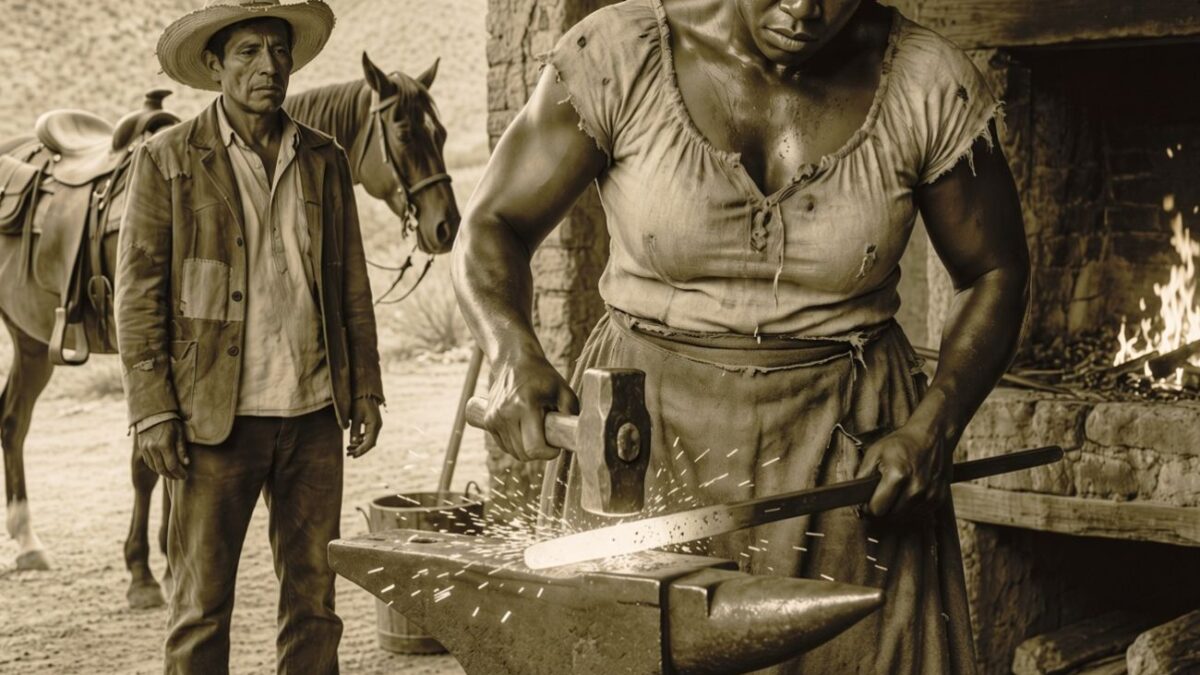
Bernarda was mending the tools in the abandoned forge of the hacienda—a stone shack with its anvil eaten away by rust and its bellows broken. And there something else happened that Aurelio noticed without saying a word. The girl, who swore she didn’t know any trade, gripped the hammer and the hot iron with a naturalness not learned by working as a farmhand. She straightened a plowshare in four precise strokes. She wielded a hoe as if the iron obeyed her out of affection.
One day, Aurelio found her staring at her hands beside the anvil with a strange expression, like someone trying to read a letter in a forgotten language.
“Where did you learn the trade, Bernarda?”
“Nowhere, boss.” She looked at her palms. “The hands know on their own. I just follow them.” And then she added softly, as if ashamed, “Sometimes I think hands remember things I don’t.”
In the village, meanwhile, tongues worked harder than the land. Word spread that at San Cayetano, the starving man from Quintanar had sown again; that the barren lands were green with wheat as far as the eye could see; and that the giantess had sown the entire crop with her bare hands, carrying a sick steer on her shoulders like someone carrying a cat. The kinder versions spoke of a miracle. Others said something different: that a woman of that size and color wasn’t natural; that who knows what pact the ruined man had made; and that the water had started flowing again for a reason, just when she arrived.
The ladies crossed themselves in the market, and the words, like flies, eventually reached the table of the richest man in the district.
Don Próspero Salazar was sixty years old, with the rosy, clean face of someone who had never worked under the sun and a gentle, almost sweet way of saying the most poisonous things. He owned three haciendas, the mill, the large store in Múzquiz, and the debts of half the district, which were his favorite crop, because debts, well watered, produce land. He had spent years pursuing one thing that wasn’t his: the San Cayetano spring. His own lands, which bordered Quintanar’s to the north and west, had brackish wells and springs that dried up in May. Whoever had the spring by the cypress trees would, sooner or later, have all the small ranchers of the region on their knees.
That’s why he had lent Aurelio six hundred pesos three years earlier, secured against the deed to the spring, smiling like a godfather while knowing he was lending to a man who was sinking. He wasn’t interested in the repayment; he was interested in the shipwreck. And now they were telling him the story that the shipwrecked man was swimming.
One Sunday after mass, Salazar arranged to run into Aurelio in the arcades. He was dressed in English cloth and smelled of cologne.
“Quintanar, son, what a pleasure. I hear wonderful things about your land.” His smile was broad, and his eyes were like nails. “I also hear that the wonders are two meters tall—the miracles of faith, right?” He placed his hand on Aurelio’s shoulder in a fatherly manner. “Take care, boy. Good harvests attract hail. It would be a shame if something happened to your miracle, or if the townspeople, who are so superstitious, got foolish. You know how they are. I’m delighted if you prosper after all,” and here his smile narrowed slightly, “because everything that grows in San Cayetano, in one way or another, grows for me.”
That night, Aurelio told Bernarda and Cirilo everything by the fire: the six-hundred-peso debt, the deed to the spring that had been pawned, and the deadline that expired by Saint John’s Day in June, after the harvests had already been gathered. Bernarda listened without interrupting, with that stillness of hers like a large stone, and in the end, she asked only one question—the question of someone who has been treated as merchandise and knows the business inside and out.
“If he scrapes together the six hundred pesos and pays him, will he accept the money?”
Aurelio and Cirilo looked at each other. Neither of them had ever wanted to say it out loud.
“The law obliges him,” Aurelio said slowly.
“I didn’t ask him about the law, boss. I asked him about the man.”
The fire crackled in the silence, an owl hooted outside, and Aurelio Quintanar understood with a chill in his stomach that the girl who had cost him three pesos had just seen in a minute what he had been refusing to see for three years: that Salazar didn’t want his money, he wanted his water, and that a man like that doesn’t lose easily.
“Then we’ll have to beat him the easy way, and be ready for the bad,” Bernarda said, and got up to wash her plate as if she had just discussed what she would have for dinner tomorrow.
The bad times started soon, and they started as they always do: in the dark and without warning. One December morning, the sluice gate of the water divider was found splintered, and the main irrigation ditch was broken at its deepest point, with the water rushing down the hillside. Bernarda studied the damage squatting, touching the edges of the breach.
“Crowbars,” she said. Three men, at most, had come on foot from the north. She looked up at Salazar’s land on the other side of the hill and said nothing more.
What Salazar estimated would take two weeks of damage, Bernarda repaired in a day and a half, working with a cold fury that was somewhat frightening.
They struck back two weeks later. The small watering hole where the cattle drank was found poisoned at dawn, with one steer dead and two sick. Bernarda carried the sick ones one by one to the corral, made them swallow water mixed with ground charcoal and ash as she had seen an old healer do on another ranch, and saved them. Afterward, she single-handedly built a stone wall around the watering hole with stones that no Christian in the area could even roll. The message was for those on the hill: You don’t come in here anymore, not even at night.
And then Salazar changed his tools, because men like him have many, and he took out the cheapest and oldest: other people’s fear. In the big store, in the mill, in the churchyard, his employees and his hangers-on began to spread the rumor that the black giantess of San Cayetano wasn’t a woman, but something else; that she made the crops grow with words that weren’t Christian; that they had seen her at night, enormous against the moon, talking to herself in the devil’s tongue—because Bernarda, when she was at peace, hummed her song. They whispered that the animals she touched were healed, and that whatever she did wasn’t from God.
The rumor caught on like kindling, and there were mothers who hid their children when the San Cayetano cart entered the town. One Saturday, someone threw a stone at her from an alley. Bernarda, who managed to catch the runner in four strides, stood still, picked up the stone, placed it neatly on the side of the road, and kept walking, because she had known since childhood that a giantess could never, ever afford the luxury of rage.
The one who didn’t remain silent was the priest of Múzquiz, Father Anselmo—a gruff old man in a patched cassock who knew his flock and his wolves. The following Sunday he climbed into the pulpit, stared fixedly at the pews in front where Don Próspero’s English cloth gleamed, and preached about the ninth commandment, naming names barely disguised.
“There are in this town,” he thundered, “very devout Christians who see the devil in the color of someone’s skin and not in usury, which is the only devil I’ve ever seen collecting interest!”
As they left mass, in front of everyone, the old man crossed the churchyard to where Bernarda was waiting by the cart, apart as always, and asked her in a loud voice to repair the gate of the parish garden, “because they say there are no better hands in the district than yours, my child.” Bernarda repaired the gate, and Pilón forged a simple yet beautiful iron cross for the door, and Father Anselmo hung it where all of Múzquiz could see it. The rumors didn’t die—rumors never die—but from that Sunday on, they had to speak more quietly.
And while the town murmured, in San Cayetano a quiet life grew. Another thing no one had intentionally planted were the evening literacy lessons at the kitchen table: Aurelio drawing the vowels on a smoked board, Bernarda copying them with charcoal, her small, neat handwriting flowing from that enormous hand, and Cirilo dozing by the stove, pretending not to care, until one night, quite dignifiedly, he asked to be taught the letter ‘c’ for his name. It showed in the way Aurelio left her the best coffee without saying a word, and the way Bernarda mended his suede jacket while he slept, with stitches so fine it took him a week to notice.
These were the long conversations of after-dinner hours—the kind that begin with the price of beans and dawn on matters of the soul. He told her about his father, about the once-great hacienda, about a sweetheart from his youth who married a merchant from Monclova. And because Bernarda, too, knew how to count, she told him how little she had: the cart, the woman’s weeping, the blue bead, the song.
“Sing it,” Aurelio asked one night.
“They’ll laugh.”
“In this house, no one laughs at anyone. It’s the law of the ranch. You accepted it by contract.”
And Bernarda, staring into the fire, sang for the first time in her life in front of other people.
“Wade in the water, wade in the water, children. Wade in the water. God’s gonna trouble the water.”
Her voice was deep and husky, and the song, even if unintelligible, was sad and powerful at the same time, like a river at night. When she finished, no one spoke. Cirilo stared at the hearth. And Aurelio looked at her in a way that made Bernarda not know where to put her eyes, because men had looked at her with mockery, with fear, with pity, and with malice, but never like this.
“What could it mean?” she asked to break the silence.
“I don’t know,” Aurelio said, “but whoever taught it to her loved her. That much is clear.”
Bernarda went to bed that night with those words swirling in her mind: Whoever taught it to her loved her. For the first time, she dared to think, with a new and strange pain, that the woman who wept in the cart perhaps hadn’t abandoned her, and that perhaps something else had happened on the other side of the broken mirror of her memory. She didn’t know—she couldn’t know—how right she was, nor how close the answer was after twenty years: nine leagues from her cot, on the other side of the mountains, in a village among walnut trees where every February a very tall old woman lit a candle and prayed to a memory.
But to get to that village, first she had to get through the winter. And winter brought Candlemas, and Candlemas brought Don Próspero Salazar.
January arrived with frost and a visitor. One Thursday mid-morning, a mule-drawn carriage entered the courtyard of San Cayetano, and three men stepped out: a thin clerk with a leather satchel, a rural police chief with a pistol at his belt to lend formality to the matter, and Don Próspero Salazar himself, smiling his godfatherly smile.
“Aurelio, son, I won’t take up any of your time.” He handed him a sealed document. “I’ve come about the loan. It turns out my administrator, reviewing papers, found a clause that we both missed. Read it carefully, or I’ll summarize it for you so as not to tire you: if the creditor has well-founded reasons to fear for their collateral, they can demand early repayment.” He clicked his tongue in regret. “And frankly, son, with so much rumor, so many stones flying, so many poisoned animals… this region has become dangerous. I fear for my collateral. It pains me, but I fear.”
Aurelio read the document twice. There it was, in the fine print of a contract signed three years earlier by a drowning man who hadn’t read the details. The due date was coming up: six hundred pesos, payable in thirty days on Candlemas Day, February 2nd, before the Múzquiz court. Otherwise, the deed to the San Cayetano spring, with its cypress trees, its hill, and its water rights, would pass into the ownership of Don Próspero Salazar.
“This is a trap, and you know it,” Aurelio said very calmly.
“This is the law, son, and we who read the law completely know it.”
Salazar got into his carriage, settled in, and from up there, without any sweetness, let the words fall like someone dropping coins to a beggar: “Thirty days and an old man’s advice. Don’t waste them getting angry. Spend them saying goodbye to the water. After all, you and your church tower are going to end up wandering the world.” He smiled toward the forge, where Bernarda, motionless, held the hammer. “You’ll have plenty of time to roll around in the world. That’s what you’re meant to do. Not own land.”
The carriage left the yard, and the silence it left behind was the thick silence that follows collapses.
“Six hundred pesos,” Cirilo finally said, and sat down on a log, splitting firewood in one swift motion as if his legs had been cut off. “Not by selling the whole herd, boy. Not by selling the harvest on credit. Not even by selling ourselves.”
Aurelio didn’t answer. He looked at the document with the gaze of someone who is already doing the math, and all the sums came out the same.
It was then that Bernarda’s shadow covered them both. She had approached from the forge without them hearing her—a very rare thing for a body of her size—and she took the paper from Aurelio’s hands, read the date and the amount with the slow concentration of someone spelling out their first vowels, and folded it with absolute calm.
“Where is his house?” she asked.
“In Múzquiz,” Aurelio said, surprised. “The large house with white columns next to the main store.”
“And the money?”
“In his safe, surely.”
Bernarda looked at her hands—those enormous hands that could lift mesquite beams, straighten iron plowshares, and mend fine jackets—and then looked at the horizon where the sun was beginning to set behind the mountains.
“Thirty days,” she said softly. “That’s a lot of time for hands that know what they have to do.”
That very night, without telling anyone, Bernarda packed her single bundle of clothes, put on her best sandals, and hung the blue bead around her neck. She didn’t say goodbye to Aurelio with words; she simply touched his shoulder as he sat staring into the dead embers of the hearth, leaving a warmth that stayed with him through the cold hours of the night.
She walked through the night under a sky full of indifferent stars, crossing the valley toward the mountains of Coahuila. She wasn’t running away, and she wasn’t seeking revenge. For the first time in her life, she was walking toward a destination chosen by herself.
When dawn broke over the peaks, lighting up the walnut trees of the hidden village across the valley, a very tall old woman stepped out onto the porch of a modest adobe house, holding a small wooden box and looking down the dusty road as if she had been waiting twenty years for a specific pair of footsteps.
As Bernarda stepped down the trail and approached the village, her fingers brushed against the blue bead at her throat, and she began to hum softly to herself. The notes of the old, forgotten song drifted across the morning air, blending with the murmur of the distant spring, signaling that the road had finally brought her home.

