The Nuns of Soot Hollow Who Left by the Back Stair — Then Stayed Gone
The Nuns of Soot Hollow Who Left by the Back Stair — Then Stayed Gone
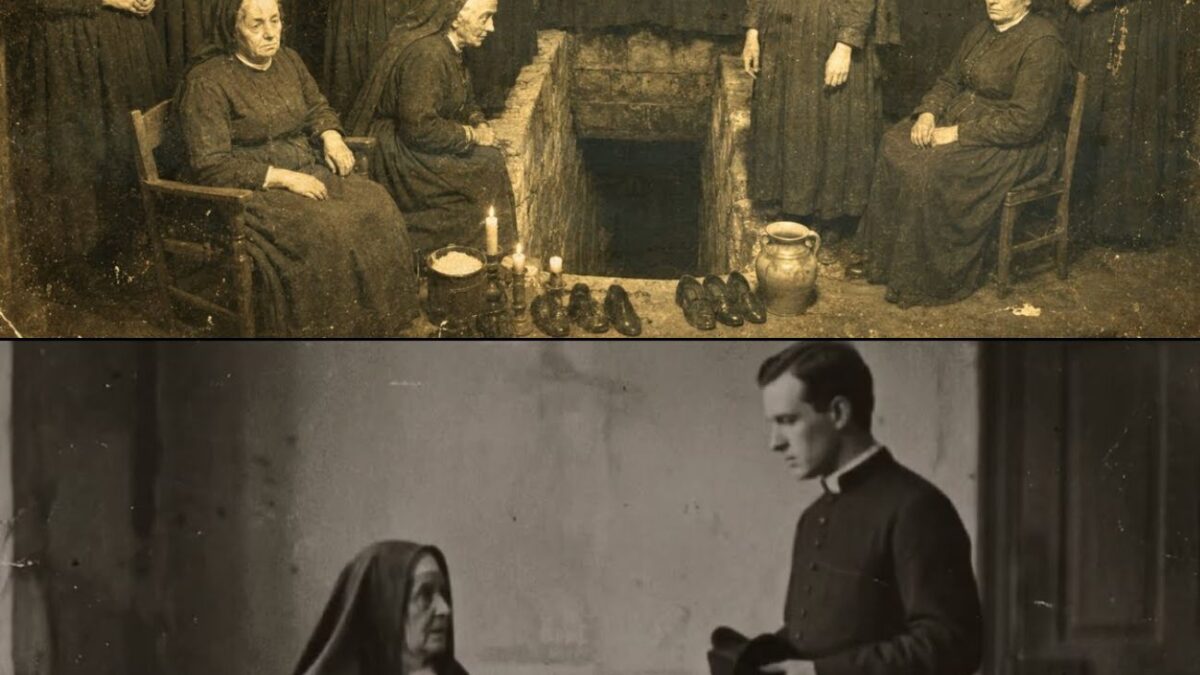
In 1987, a demolition crew cracked open the east wall of a condemned building in rural Pennsylvania. Behind that wall, they found a staircase nobody had seen in over 100 years. And at the bottom of that staircase, arranged in a perfect circle on the floor, were 14 pairs of shoes. Women’s shoes, black leather, buttoned at the ankle. The kind nuns wore in the 1870s. No bodies, no bones, no note. Just the shoes placed sole to sole, as if every woman who wore them stepped out of them at the same moment and walked barefoot into solid earth.
The building had been the Sisters of Sut Hollow Priory. And according to every record that survived, 14 nuns lived there in the winter of 1878. By spring of 1879, the priory was empty. The diocese filed no transfer papers, no death certificates exist. The local newspaper printed a single line about it, buried on page six. The sisters have departed. That was it. No follow-up, no investigation, no questions from anyone. 14 women vanished from a small town in coal country, and the entire community acted like it was perfectly normal. Like they expected it.
To understand what happened in Sut Hollow, you have to understand what Sut Hollow actually was. The town sits in a narrow valley in northeastern Pennsylvania, wedged between two ridges of anthracite coal. In the 1860s and 1870s, it was a mining town. Not a big one. Maybe 400 people at its peak. Maybe fewer in the hard winters when families packed up and followed work to Scranton or Carbondale. The kind of place where everyone worked the same seam, drank at the same bar, prayed in the same pew, and buried their dead in the same half-acre plot behind the church.
The church was Catholic, St. Bridget’s, built in 1858 by Irish and Welsh immigrants who came for the coal and stayed because they had nowhere else to go. The priory was attached to it, a long narrow stone building that ran along the eastern wall of the church and extended back toward the ridge. It housed the Sisters of Perpetual Devotion, a small teaching order that ran the town’s only school, and served as the closest thing Sut Hollow had to a charitable institution.
Now, here is where the first strange detail surfaces. The Sisters of Perpetual Devotion were not a recognized order, not by Rome, not by the Diocese of Scranton, not by any Catholic authority operating in the region at the time. They appear in no official Catholic registry from the period. The diocese acknowledged St. Bridget’s parish, collected tithes from it, and assigned priests to it, but the sisters themselves existed in a kind of administrative blank space. They were there. Everyone in the valley knew they were there, but on paper, they barely existed at all. This matters because when 14 women vanished from a place that officially never housed them, nobody has to answer for it. There is no file to close, no superior to notify, no bishop asking where his nuns went. They were ghosts on paper long before they became ghosts in fact.
The priory itself was a strange building, three floors, but the top floor had no windows, not bricked up windows, no window openings at all. The second floor had windows, but town records from an 1871 fire inspection described them as sealed from within by stonework. So, the only floor with functional windows was the ground floor, which contained the kitchen, a small chapel with a dirt floor, and a receiving room where parents dropped off children for school in the morning, and retrieved them in the evening. The school operated from a separate wooden building behind the priory. The children never went inside the priory itself.
Multiple accounts from former students recorded decades later by a Works Progress Administration interviewer in the 1930s confirm this without exception. The children were taught reading, writing, arithmetic, and catechism in the schoolhouse. The priory was off-limits. One former student, then in her 70s, told the WPA interviewer something that has stayed with every researcher who encountered it since. She said, “We never saw them come or go. They were just there in the morning and gone by evening. Like they lived inside the walls.”
The back stair. This is central to everything that follows. The priory had a main entrance facing the church courtyard, but it also had a rear staircase built into the eastern wall that descended below ground level into the earth behind the ridge. Town surveys from the period show this stair leading to a sub-basement, but the surveys do not show what the sub-basement connected to. The line just stops. The surveyor drew the stair going down and then drew nothing else. No room dimensions, no notation, no explanation, just the stair descending and then blank parchment where the rest of the drawing should be.
In 1876, two years before the disappearance, the parish priest at St. Bridget’s was a man named Father Emmett Callan. Callan was a prolific letter writer. Most of his correspondence was routine, exchanges with the diocese about money, building repairs, sacramental wine, and altar candles. But three letters from late 1876 stand out because they were addressed to someone he had no obvious reason to contact. A professor of geology at the University of Pennsylvania named Dr. Howard Brinton.
Callan asked Brinton very specific questions. He wanted to know about subterranean air currents. He wanted to know about underground water movement and whether flowing water beneath stone could create vibration. And he wanted to know whether it was possible for a natural cavern to produce sustained audible sound. He wanted to know if stone could hum.
Brinton’s responses, if he ever sent any, have not survived, but Callan’s questions tell us something important. He was hearing something beneath the priory, something that came from below the back stair, something he could not explain with prayer or theology, and so he reached for science.
Then in early 1877, the letters to Brinton stopped. And a new set of letters began. These were to the Mother Superior of a Carmelite convent in Baltimore, a woman named Mother Agnes of the Cross. Callan was asking whether the Carmelites had ever encountered what he called devotional fixation among cloistered women. He described the sisters as having become excessively and singularly attached to a practice that he did not name in the letter. He said they had begun conducting their devotions exclusively in the sub-basement. He said they refused to come upstairs for meals. He said the school had been unstaffed for two full weeks because the sisters would not leave the lower level for any reason.
Mother Agnes wrote back. Her response survives in the Carmelite archives. She told Callan to contact the bishop immediately and to physically remove the sisters from the building if necessary. She used the phrase disordered attachment and warned that isolation combined with singular devotional focus could produce psychological states that resembled holiness, but were, in her exact words, the opposite of grace.
Callan did not contact the bishop, at least there is no record that he did. Instead, the letters stop entirely for 11 months. No correspondence from Callan exists between March 1877 and February 1878. When the letters resume, they are addressed to his brother Thomas in Philadelphia, and they are short, almost terse. The first one simply says, “They have found something below the stair, and they will not tell me what it is.”
The second letter to Thomas, dated April 18, 1878, is longer and more disturbing. Callan describes the priory as transformed beyond recognition. He says the sisters have bricked up the main entrance from the inside using stones pulled from the interior walls. The only way in or out of the building is now the back stair, the one that descends into the sub-basement and whatever lies beyond it. He says he has not been inside the priory in four months. He says the sisters communicate with him by sliding notes under the bricked-up door. The notes request candles, salt, and water. Nothing else. No food, no medicine, no cloth.
He writes, “I do not know what they eat. I leave bread at the door and they do not take it. I leave milk and it sits until it sours.”
He also says the humming has gotten louder. He can hear it from inside the church now. It comes through the shared wall, a continuous vibration that makes the candlesticks rattle during mass. He describes it as a single sustained tone, like a pipe organ holding one note forever, but deeper than any organ he has ever heard. He says it never stops, day, night, rain, silence. It has been constant for at least two months.
His brother Thomas wrote back and urged him to leave Sut Hollow immediately. Callan’s response, the last letter in the entire collection, is dated June 1878. It says, “I cannot leave them. They are my responsibility before God. But I confess to you, brother, that I no longer believe God is what they are worshipping.”
After that letter, silence, complete and absolute. The next mention of Sut Hollow in any surviving document is the newspaper line from the spring of 1879. The sisters have departed. Five words, no byline, no explanation, just the fact stated as plainly as a weather report. But, departed where and how and why did nobody ask?
The demolition crew in 1987 found the shoes at the base of the back stair. The foreman, a man named Gerald Coots, later told a reporter that when they first broke through the wall and saw the staircase descending into darkness, he sent two men down with flashlights. They came back up within three minutes and refused to go down again. Coots went down himself. He said the air was warm and smelled like wet iron. He said he could feel a vibration in the stone steps under his boots, and he said when he reached the bottom and his flashlight swept across the floor, the circle of shoes was the first thing the beam hit, as if they had been placed precisely where someone standing at the base of the stair would look first.
The crew also found the bricked-up main entrance exactly as Callan had described it a century earlier, confirming that his letters were not exaggeration or delusion. They found the sub-basement. It was a single room, roughly 30 feet square, with a packed earth floor and stone walls that sweated moisture even in August. In the center of the floor was a circular depression, about 8 feet across, where the earth had sunk several inches below the surrounding surface. The crew foreman told a local reporter that the depression looked like something heavy had been sitting there for a very long time and then was removed, or like the ground itself was being pulled down from underneath.
The walls of the sub-basement were covered in marks, not writing, not symbols anyone could identify. Marks. Hundreds of vertical scratches in the stone, grouped in sets of five like someone counting days. The scratches covered every wall from floor level to roughly 5 feet high. Above 5 feet, the walls were smooth and clean. Whatever made the marks could not reach higher than that.
Here is the detail that changes the texture of the whole story. The scratches were on the inside of the walls. Whoever was counting was counting from within the sub-basement. But, the bricked-up entrance was also sealed from the inside. And, the back stair was open. Completely open. If the sisters wanted to leave at any point, they could have walked up the stair and out into the churchyard. They were not trapped. They chose to stay. And, they were counting. The question is, what were they counting toward?
In 1991, a graduate student at Penn State named Ellen Marsh wrote her master’s thesis on the Sut Hollow Priory. Marsh had access to the Callan letters, the WPA interviews, the demolition crew’s photographic record, and a set of detailed photographs taken by the crew foreman before the building was fully torn down. Her thesis remains the most complete academic account of the priory that exists in any archive.
Marsh focused on the geological context, and what she found reshaped the entire story. Sut Hollow sits directly above an abandoned anthracite mine called the Brennan Colliery. The mine operated from 1855 to 1869, when a catastrophic underground flood forced permanent closure. The water came in so fast that the miners on the lowest level barely made it out alive. Two did not. Their bodies were never recovered from the flooded tunnels. The mine was sealed at the surface with timber and earth, but the tunnels themselves were never filled, never collapsed, never remediated in any way. No one went back down. No one checked whether the water had drained or risen or found new paths through the rock. They are still down there, flooded or dry, depending on the water table, shifting with the seasons in ways nobody has measured since 1869. And the main shaft of the Brennan Colliery passed within 60 feet of the priory’s foundation.
Marsh argued that the sub-basement may have intersected with a natural cavern system connected to the mine’s abandoned tunnels. She believed the humming Callan described was nothing supernatural. It was air moving through underground passages under pressure changes, a phenomenon well documented in mining regions throughout Appalachia. Pressurized air moving through narrow stone channels can produce a sustained tone that sounds almost musical, almost intentional, almost alive.
But Marsh went further than geology. She noted that the circular depression in the sub-basement floor was positioned directly above the projected path of the Brennan Colliery’s main ventilation shaft. She theorized that the depression was caused by subsidence, the slow collapse of earth into the mine void below over decades. And she raised a possibility that she admitted openly she could not prove with the evidence available to her, that the floor of the sub-basement had at some point between 1827 and 1879 given way entirely. That a hole had opened in the earth beneath the priory, that the cavern below had become accessible, and that the sisters had gone into it, not fallen, not accidentally, gone deliberately, on purpose, barefoot.
Marsh based this partly on the shoes, 14 pairs arranged deliberately in a circle around the depression. You do not arrange your shoes in a geometric pattern if you are falling into a sinkhole. You arrange them if you are preparing, if you are leaving something behind on purpose, if you believe truly and fully that you will not need shoes where you are going.
The local community in Sut Hollow, what remained of it by the early 1990s, did not welcome Marsh’s research. She describes in an appendix to her thesis being asked to leave a diner after mentioning the priory by name. She describes a town clerk who refused to pull property records for the site. An elderly man at a gas station told her plainly, “We don’t talk about the sisters. We never did, and our grandparents never did. You shouldn’t either.”
This silence is itself a kind of evidence, and it is the kind that gets louder the closer you listen. Communities that experience a tragedy talk about it. They build monuments. They write songs. They name streets after the dead. They tell their children so the children can tell theirs, but communities that experience something they cannot categorize, something that frightens them at a level below language, at a level where words stop working, do the opposite. They seal it off. They brick it up from the inside, just like the sisters bricked up their own front door.
Father Callan disappeared as well. His name appears in no diocesan record after 1878. He was not transferred to another parish. He was not defrocked. He was not buried in any Catholic cemetery in Pennsylvania or any neighboring state. Like the sisters he served, he simply stops existing in the paper record. The last surviving trace of Father Emmett Callan is that final letter to his brother Thomas. “I no longer believe God is what they are worshipping.”
The priory was demolished completely in 1987. The site was graded flat and paved over for a parking lot that served a hardware store built on the adjacent lot. The shoes were taken by the demolition company, and according to the crew foreman’s later account, placed in a rented storage unit in Wilkes-Barre. When Ellen Marsh tried to locate them in 1990, the storage company had no record of the unit, no contract, no inventory. The shoes, like everything else connected to the priory, had disappeared into the kind of silence that Sut Hollow had always been so good at keeping.
There is one more detail. In WPA interviews from the 1930s, the former student who said the sisters lived inside the walls added something at the very end of her recorded session. The interviewer asked her if she remembered anything else unusual about the priory. Anything at all. She sat quietly for what the interviewer noted was a considerable time. The transcriptionist wrote that the silence lasted nearly a full minute. Then the woman said, “The building was always warm. Even in January when the snow was up past the windows. You could put your hand flat on the outside wall and feel heat coming through the stone. Real heat. My mother said it was because they kept a big fire going all winter. But I walked past that building every day for six years. There was no chimney. There was never any smoke.”
Heat without fire, sound without source, women without records, a staircase that led down into something that nobody mapped and nobody named. The nuns of Sut Hollow left by the back stair. Every piece of evidence, physical, documentary, geological, says they went down, not out. They arranged their shoes in a careful circle. They sealed their door. They refused food from the world above. They counted their days on the walls of a room that sat above a hole in the earth. And then, at some point between June of 1878 and the spring of 1879, they stopped counting. They did not come back up. The town did not look for them. The church did not look for them. The diocese, which had never acknowledged their existence in the first place, simply continued not acknowledging it.
109 years later, a demolition crew found their shoes, and then even those vanished into a storage unit that may never have existed. Whatever the sisters found beneath that priory, whatever was humming in the stone, whatever made the earth sink in a perfect circle, whatever produced heat without combustion and sound without machinery, it was enough to make 14 women walk barefoot into the dark and never return. And it was enough to make an entire town decide collectively and without discussion that the best thing to do was forget they ever existed.
Sut Hollow is a parking lot now. The hardware store closed in 2014. The lot sits empty most days, cracked asphalt splitting apart in long jagged lines, weeds pushing through, puddles forming in low spots that never fully dry even in August. Locals who drive past it on their way to the county road say they do not stop there. Not because of any story, not because of any belief, they just say they do not like the way it feels to stand on that ground. One woman interviewed by a podcast in 2019 said she parked there to check her phone and felt the car vibrating. She looked for a truck idling nearby. Nothing. She left, never went back.
The Brennan Colliery shafts have never been fully mapped. The cavern system, if it exists, has never been surveyed. And if Ellen Marsh was right about the ventilation shaft, then somewhere beneath that empty parking lot there is still an opening in the earth that leads to wherever the sisters went. Nobody has gone looking. Nobody in Sut Hollow ever will.
And yet, beneath the asphalt and the forgotten earth, the humming has never truly stopped. If you press your ear close enough to the cracked pavement on a quiet night, past the sound of the distant highway and the wind through the coal ridges, you can still hear it. A single, deep, unbroken tone, vibrating through the stone like a pipe organ holding one note forever. Waiting for someone to walk down the steps, take off their shoes, and listen.

