The Lucifer’s Den Clan (1856, AK) — The Ozarks’s Most Demonic Forest Family Finally Uncovered
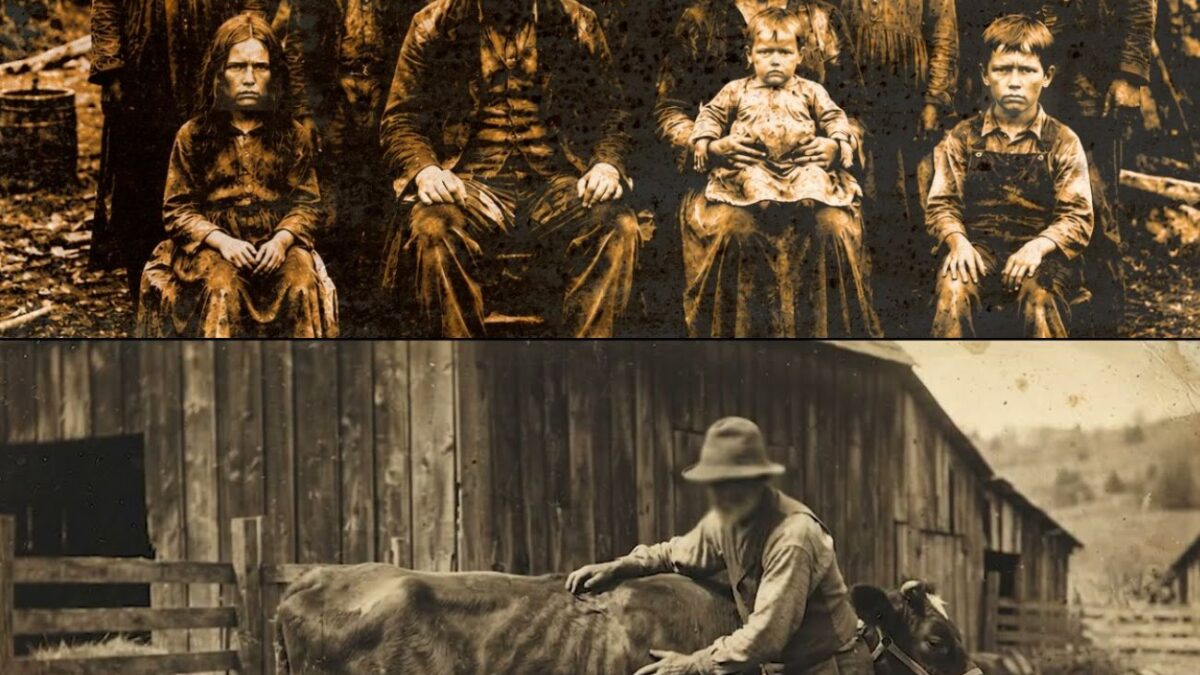
The Lucifer’s Den Clan (1856, AK) — The Ozarks’s Most Demonic Forest Family Finally Uncovered
In the winter of 1859, a party of 31 armed men rode into a hollow in the Boston Mountains of what was then the Arkansas territory. They came from four different counties, carrying muskets, pitch torches, and a handdrawn map that had been passed between preachers for almost three years. They were looking for a family. A family that lived so deep in the ridges that no census taker had ever recorded them, no tax roll had ever listed them, and no county clerk had ever registered a single birth or death against their name.
When those 31 men rode out of that hollow four days later, only 19 of them were still alive. The others were never found—not their bodies, not their horses, not their weapons. What those 19 survivors reported seeing in the clearing they called Lucifer’s Den, in the compound the locals had already begun to call the demonic farm, was so far outside the boundary of anything the frontier had ever documented that the territorial governor ordered the entire account struck from the record within the week.
The families were told to be silent, the ledgers were sealed, and the hollow was burned. For 167 years, the story of what actually lived in that clearing has been buried under a mountain of official denial.
To understand what happened in that hollow, you have to understand what the Ozarks were in the middle of the 19th century. The Arkansas of 1856 was not a place anyone alive today would recognize. The state was barely twenty years into the Union, and its northern half was a folded green wilderness of limestone ridges, sinking creeks, and hardwood valleys so thick with old-growth oak that a rider could pass through certain hollows in full afternoon sun and see the light on the forest floor turn the color of steeped tea. The population of the entire northwest quadrant—everything above the Arkansas River and west of the White—was fewer than 22,000 souls. Most of them were subsistence farmers who had come down from Kentucky, Tennessee, and western Virginia after statehood, following the game trails and the salt licks.
They were not, by and large, gentle people. They had fought the panther, the black bear, and the bitter winter for their acres. Yet even they, the toughest of the frontier stock, refused to settle in certain hollows. The one that would come to be called Lucifer’s Den sat in the folded country between what is now Newton County and Searcy County, in a limestone bowl carved by a spring branch that ran, according to the surveyors of the old military road, in the wrong direction for the surrounding drainage. Water in that part of the Boston Mountains flows generally south and east toward the Buffalo, but this particular spring branch ran north and then curved back on itself before disappearing into a swallow in the limestone floor of the hollow.
The Cherokee, who had passed through that country on the Trail of Tears 17 years earlier, had an oral tradition about the place, warning traders not to enter that valley, not to drink from that stream, and under no circumstances to allow themselves to be inside that bowl of land after the sun went behind the western ridge. The white settlers who came later did not initially take the warnings seriously. In 1841, a man named Isaac Reiner from Van Buren County drove a small herd of hogs into the hollow to fatten them on acorns and never returned. His brother-in-law found the hogs three weeks later wandering the ridgeline, uninjured but so agitated that six had to be shot on site because they would not stop running. Reiner’s saddle was recovered from a fallen log near the swallow, but his body was never found.
In 1843, a survey team from the General Land Office attempted to run a section line through the hollow, abandoning the effort on the second day after reporting an unnatural condition of the air within the bowl. By the mid-1840s, a pattern of strange occurrences had emerged. Hunters working the ridges reported hearing a low, continuous sound between a hum and a chant rising from the floor of the bowl on still nights. Hounds refused to enter, and horses balked at the crest. An old bear hunter named Emmett Chastain looked down into the bowl one October evening in 1847 and saw seven blue lights, steady and unmoving, arranged in a perfect circle at the bottom. He fled and took to bed for four days with nervous exhaustion, telling his story to a circuit-riding preacher named Josiah Weller, whose journal preserved the account.
By 1856, the first solid evidence of habitation reached the outside world. A trapper named Solomon Grady found a snare he had set on the ridgeline disturbed; in place of the missing rabbit, a small poppet doll woven from human hair over a green willow frame had been carefully laid across the wire. It had no face, and its eyes were two small stones of dark greenish malachite not native to the region. Grady brought it to a storekeeper named Cyrus Bledsoe in Deer, Arkansas. The object seemed to emit a faint whistling sound when uncovered and stopped when wrapped in cloth. On the twelfth day, Bledsoe found the locked drawer open, the object gone, and seven small marks resembling the bare feet of a five- or six-year-old child arranged in a perfect circle around the store counter, despite the building being locked from the inside.
The spring and summer of 1857 brought a slow accumulation of disturbing incidents. Farmers reported milk cows returning with flank markings that rotted unnaturally fast inside smokehouses. Hunters found white oaks marked at chest height with a carved symbol: a circle bisected by three vertical lines with a small inverted crescent at the base.
One of the most unsettling accounts came from a woman named Rachel Holcomb, living near Cave Creek. On July 12, 1857, while walking to her springhouse, she heard the sound of a small child weeping inside—not screaming, but the exhausted, unending crying of a child who could not stop. Her own children were safely playing on the porch. Opening the springhouse, she found the interior empty, yet the crying continued from a point in the air about three feet above the water basin. Her husband John checked later, heard nothing initially, but as he walked back up the path, the ragged weeping followed directly behind him. The family abandoned their cabin the next morning and never returned.
That autumn, a schoolteacher named Prudence Vanderver found three similar hair-and-stone braided objects left on her schoolhouse threshold. When she burned them in the stove, the smoke turned black at the top and an unhealthy green at the base, carrying a sickening sweet-and-rotten odor. She closed the school and moved back to Missouri. Around the same time, an 11-year-old boy named Ezra Cobb looked down into the bowl from the ridge and saw 13 figures dressed in gray garments the color of a dead person’s fingernail, standing completely still in a circle around a low stone structure. When all 13 heads turned simultaneously to look directly at him, he ran in terror, keeping the secret for 57 years out of fear that they would find him.
The winter of 1857 brought deep snows, during which a woodsman named Bartholomew Kesler spotted smoke rising from seven distinct cabins inside the bowl. Encouraged by his pragmatic wife Anna, he reported it to County Sheriff Reuben Ford. Once the snow melted in March 1858, Sheriff Ford and a small party rode to the ridge. They counted nine structures arranged in an outer ring around a central stone well covered with a wooden lid fastened by iron bands and a heavy lock. Though they observed 22 individuals moving between the buildings—including nine children and an older white-bearded man acting as a leader—the entire bowl was consumed by an unnatural, absolute silence. Not a single footstep, voice, or creak of a door traveled up to the ridge.
Sheriff Ford spent nearly two years quietly gathering men to uncover who these people were. They used the surname Vessel, claiming to come from a “low country” beneath the earth where light came from below, water ran in three directions, and stones grew like plants. The leader, Abselom Vessel, possessed milk-blue eyes that seemed to look straight through anyone standing before him. The children among them seemed to multiply inexplicably between observations, and the older women claimed the children were “given up” and “owed.”
The final physical artifact found before the raid was a heavy rag paper known as the Vessel deed, nailed to the door of Cyrus Bledsoe’s store on April 9, 1858. At its top was a handdrawn version of the symbol carved into the white oaks, accompanied by a single sentence written in a cramped, unsteady hand that looked less like ink and more like dried pitch: They are coming back up.
That was the final warning before Sheriff Ford gathered his 31 armed men in the bitter winter of 1859 and rode down into the hollow. What happened inside that limestone bowl during those four days remains the darkest secret of the Ozarks. The 19 men who staggered back out spoke of a light that did not cast shadows, of children who had no reflections in the spring water, and of a central well that seemed to drop endlessly into the earth itself. The 12 men who vanished were never found—no bones, no blood, no remnants of their heavy wool coats. Today, the hollow is still avoided by anyone who knows the old ways. The trees grow twisted, the water still runs backward into the dark earth, and if you walk too close to the ridge after sunset, you might just hear that tired, unending crying rise up from the air around you, waiting for someone to answer.

