The Last Antique Dealer Who Sold Pre-1880 Mirrors — What Customers Reported Seeing in Them
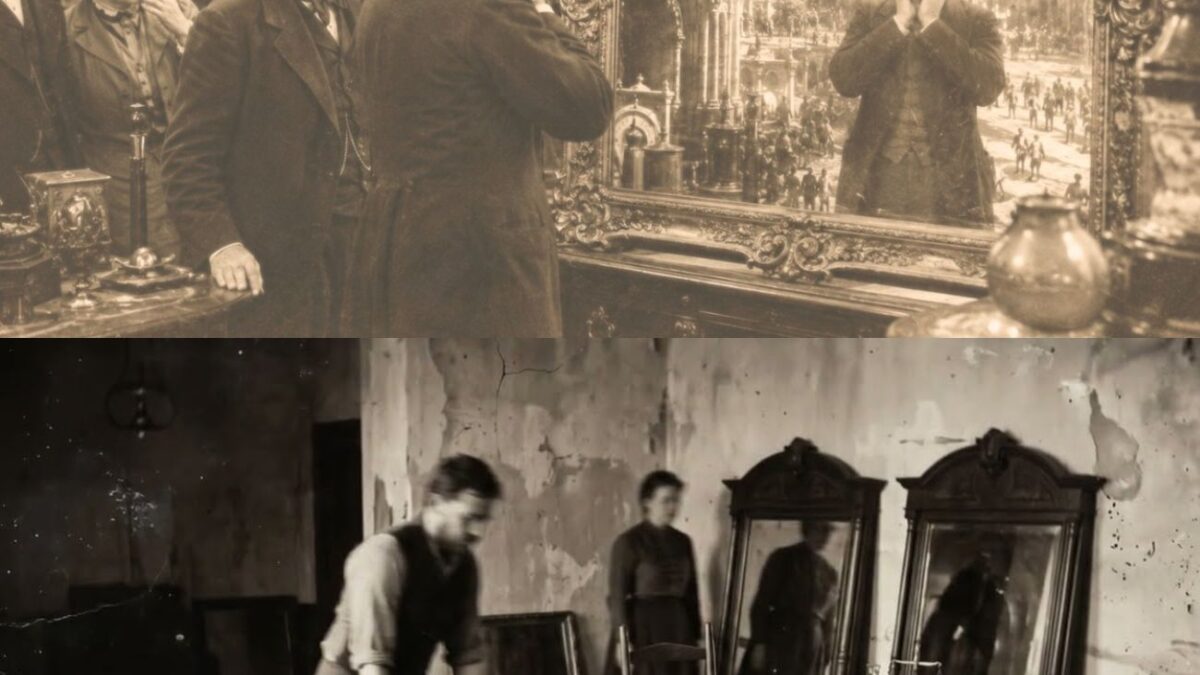
The Last Antique Dealer Who Sold Pre-1880 Mirrors — What Customers Reported Seeing in Them
In 2019, a 73-year-old antique dealer in Providence, Rhode Island, shut down his shop after 40 years in business. His name was Robert Clancy, and he specialized in one thing: mirrors made before 1880. The reason he closed? 11 customers in 18 months reported seeing the same thing reflected in the glass. Not their own face, not their living room, something else entirely. Something that looked like cities that shouldn’t exist. Clancy kept detailed records of every mirror he sold and every customer complaint he received. Before he died in 2021, he gave those records to his granddaughter who posted them online. What’s documented there doesn’t make sense according to the official timeline of history, but it makes perfect sense if you’ve been paying attention to what we’ve lost.
Robert Clancy didn’t set out to become the last dealer of pre-1880 mirrors. He inherited the business from his father, Thomas Clancy, who bought out an estate sale in Newport in 1952. The estate belonged to the Vanderbilt family, and tucked away in a storage room were 47 mirrors, each one made before 1880, each one with a small brass plate on the back noting the year of manufacture. Thomas Clancy sold 32 of those mirrors between 1952 and 1979. Robert inherited the remaining 15 when his father died, plus another 60 he’d acquired from various estate sales across New England. By the time Robert took over, he’d developed a reputation. If you wanted a mirror from before 1880, you went to Clancy’s Antiques in Providence.
The shop sat on Wickenden Street, a narrow road lined with brick buildings that date back to the 1790s. Inside, Robert kept the mirrors in a back room, each one wrapped in cloth, stored vertically in custom wooden racks he built himself. He didn’t display them in the main shop. You had to ask for them specifically. Between 1979 and 2017, Robert sold mirrors steadily, maybe three or four a year. Collectors, decorators, people restoring historic homes, normal transactions, normal customers, no complaints beyond the usual concerns about shipping fragile glass.
Then in January 2018, something changed. A woman named Patricia Vance bought a mirror manufactured in 1874. The brass plate on the back said, “J. Morrison, Boston.” She hung it in a hallway in Cambridge, Massachusetts. Three weeks later, she called Robert’s shop, and she was crying. Patricia told Robert that when she walked past the mirror at certain times of day, usually around dawn or dusk, she didn’t see her hallway reflected back. She saw a street, a wide boulevard lined with white marble buildings, all of them featuring domed roofs and columned facades, architecture that looked almost Roman, but cleaner, more geometric. And in the background, barely visible through a kind of atmospheric haze, she could see a massive structure, something that looked like a tower or a pyramid, but too far away to make out clearly.
Robert’s first instinct was to assume she’d been drinking. He’d dealt with eccentric customers before, but Patricia was a professor of art history at Boston University. She sent him photographs, not of what she saw in the mirror, because according to her, it never appeared on camera, but of the mirror itself, its placement, the lighting conditions in her hallway. She returned the mirror in March 2018. Robert refunded her money and made a note in his ledger. Customer reported visual anomaly, possible defect in glass silvering.
Four months later, in July 2018, a man named David Chen purchased a different mirror. This one made in 1860 with a brass plate reading H. Whitmore, Philadelphia. David lived in Burlington, Vermont. He called Robert’s shop in August. David described the exact same thing. A wide boulevard, white marble buildings, domed architecture, and in the distance, barely visible, some kind of massive structure that didn’t match anything he’d ever seen in photographs of 19th century America.
Robert started paying attention. Between August 2018 and June 2019, nine more customers reported similar experiences. Not all of them. Out of 23 mirrors sold during that period, only 11 customers called to report visual anomalies. But those 11 described variations of the same scene. Grand architecture, wide streets, buildings that looked more like temples than houses or businesses, and always, somewhere in the background, a structure too large and too far away to identify clearly. Three of those customers were architects, two were historians, one was a structural engineer. These weren’t people prone to fantasy or suggestibility. They were trained observers, and what they described matched too closely to be coincidence.
Robert started conducting his own experiments. He took five mirrors that hadn’t sold yet, all manufactured between 1863 and 1879, and set them up in his back room under different lighting conditions. He spent hours looking into them at different times of day, different angles, different positions in the room. He created a log, temperature readings, humidity levels, the exact angle of sunlight coming through the window. He treated it like a scientific study because that’s what the situation demanded. For weeks, nothing. Just his own reflection in the dim back room of his shop.
Then one morning in September 2019, just after sunrise, he saw it. Not in all five mirrors, just one. The mirror made in 1876 by someone named E. Garrett in New York City. The temperature that morning was 61° Fahrenheit, humidity at 73%. The sun hit the mirror at approximately 23° above the horizon. The reflection showed a plaza, not his back room. A vast, open plaza paved with white stone surrounded by buildings that rose five or six stories, each one featuring massive columns and arched windows. In the center of the plaza stood a fountain. And beyond the fountain, stretching into the distance, he could see a boulevard lined with trees. And at the very edge of the visible horizon, barely perceptible through what looked like morning mist, he saw it. A tower. Enormous, pyramidal in shape, but with a flat top, and it seemed to shimmer as though reflecting sunlight off a metallic or glass surface.
The detail was impossible. Robert could see the texture of the stone pavement, individual leaves on the trees. This wasn’t a blur or a distortion. It was a complete environment that simply replaced his back room in the reflection. He stood there for 2 minutes and 37 seconds. During those 2 minutes, he tried to observe everything he could. The shadows cast by the buildings suggested morning light. The fountain in the plaza center had multiple tiers. And the people, there were people walking through the plaza, though they were distant enough that he couldn’t make out faces.
Robert grabbed his phone to take a picture. The moment he raised the camera, the image vanished. His back room reflected back at him, exactly as it should. He tried again the next morning. Same mirror, same time, same lighting angle. Nothing. Just his reflection. He tried for six more days. Nothing worked. The phenomenon appeared once and refused to repeat.
Three days later, a customer named Ellen Morrison came into the shop asking about mirrors. Robert showed her the inventory, and when she asked about the E. Garrett mirror from 1876, he hesitated. Then he told her everything. What he’d seen, what 11 customers had reported, the pattern emerging from his records. Ellen listened carefully, then asked if she could purchase the mirror anyway. Robert tried to talk her out of it. She insisted. She was a librarian in Providence, she said, and she’d been researching architectural history of New England for a book she was writing. She wanted to see for herself. Robert sold her the mirror with a full disclosure agreement. He made her sign a document stating he’d warned her about reported anomalies. She took it home.
Two weeks later, Ellen came back to the shop. She didn’t want a refund. She wanted to show Robert something. She’d been documenting everything in a journal, writing down exact times, lighting conditions, and what she observed. She’d seen the reflection four times, always at dawn, always lasting less than 3 minutes, and she’d noticed something Robert hadn’t mentioned because he hadn’t had time to examine it closely. The people. There were people in the reflection. Not many, and not close enough to see faces or details, but she could make out human figures moving through the plaza, walking along the boulevards. They wore light-colored clothing that looked almost uniform. Long coats or robes, hard to tell from a distance, and they moved with purpose, like people going about normal daily activities.
But there was something else. Ellen had set up a camera on a tripod aimed at the mirror recording continuously during the dawn hours. Just as Robert experienced, the phenomenon never appeared on camera. But Ellen noticed that at the exact moments when she saw the alternative reflection with her naked eye, the audio on the recording picked up something strange. A low-frequency hum, almost below the threshold of hearing, but present on the audio file. The frequency measured at approximately 7.3 Hz.
That number meant something to Ellen. 7.3 Hz is the fundamental Schumann resonance, the electromagnetic frequency of Earth’s atmosphere. Ellen had a theory. She’d been studying architectural history, and the buildings in the reflection didn’t match anything in the documented record of American cities from the 1800s. They didn’t match European architecture, either. But they did match something else. Descriptions from world’s fairs, specifically the temporary structures built for expositions in the late 1800s, the ones that were supposedly torn down afterward. The World’s Columbian Exposition in Chicago, 1893. The buildings there were described as massive white structures, neoclassical design, domed roofs, columned facades. They called it the white city.
Official history says those buildings were temporary, made of plaster and wood, and they were demolished after the fair ended. But Ellen had found photographs, dozens of them. Images from the Chicago Exposition showing architecture that didn’t look temporary. Buildings that appeared to be made of stone or concrete with intricate detail work and structural engineering that would have taken years to complete, not the 18 months official history claims. The Palace of Fine Arts alone covered 11 acres. The Manufacturers and Liberal Arts Building was the largest building in the world at the time spanning 30 acres under a single roof. The official story says it was built in less than 2 years using temporary materials.
Ellen showed Robert the construction photographs, or rather, the lack of them. For a project supposedly involving thousands of workers over 18 months, there are remarkably few images documenting the actual construction process. Most photographs show the buildings already complete or in late stages of finishing work. And there were other expositions. San Francisco 1894, Buffalo 1901, St. Louis 1904. Every single one featured massive white buildings in neoclassical style. Every single one was supposedly torn down shortly after the event concluded. The Pan-American Exposition in Buffalo featured the Electric Tower, a 375-ft structure covered in 40,000 light bulbs. Official history says it was temporary. But the foundation work visible in photographs shows construction methods used for permanent structures.
And then there’s the question of why. Why build elaborate, expensive structures if you’re planning to demolish them immediately after? The cost would have been astronomical. World’s fairs were commercial ventures. They needed profit. Spending millions on temporary construction makes no economic sense unless the buildings weren’t temporary at all.
Ellen suggested that what customers were seeing in pre-1880 mirrors wasn’t a vision or a hallucination. It was a memory. Somehow, the glass itself had captured images from the time period when it was manufactured, and under certain conditions, those images became visible again.
But, there was a problem with that theory. The mirrors were made before 1880. The world’s fairs with the white city architecture happened in the 1890s and early 1900s after the mirrors were manufactured. How could a mirror made in 1887 show images from 1893? Unless the architecture didn’t appear in 1893. Unless it was already there. Unless the world’s fairs weren’t construction projects, they were repurposing projects, taking buildings that already existed and rebranding them as temporary exposition structures to explain their existence to a population that wasn’t supposed to remember what came before.
This would explain the lack of construction documentation. It would explain the permanent foundation work. They weren’t being built, they were being cleaned, restored, and prepared for public display under a new narrative.
Robert Clancy kept Ellen’s journal. After she finished her documentation, she gave it to him, and he added it to his records. The journal contained more than just descriptions of what she saw. She cross-referenced the architectural features visible in the mirror with historical records from cities across America. The domed buildings matched structures that appeared in city photographs from the 1870s and 1880s before the fairs. Buildings that were later demolished or significantly altered, all featuring the same white marble construction, the same neoclassical design.
Ellen documented 37 buildings across six states that matched the architectural style visible in the mirrors, all built before 1890, all demolished between 1890 and 1970. And in many cases, the buildings that replaced them were significantly less grand.
By October 2019, Robert had sold his last pre-1880 mirror. He had three left in inventory, and he refused to sell them. He wrapped them in cloth, put them in storage, and closed the back room of his shop. He told his granddaughter that he didn’t want to be responsible for what people might discover. He said the mirrors weren’t showing the past, they were showing what was erased. And if enough people started seeing it, started asking questions, it would cause problems he wasn’t equipped to handle at 73 years old.
Robert died in March 2021, pneumonia according to the death certificate. His granddaughter, Sarah Clancy, inherited his estate, including the shop inventory and all his records. She found boxes of documentation, sales receipts going back to 1952, customer complaints, journal entries, photographs, and handwritten notes describing what Robert had observed in September 2019.
Sarah posted everything online in November 2022, not on a mainstream platform. She used a forum dedicated to architectural mysteries and suppressed history. The response was immediate. Within 48 hours, over 300 people had downloaded the files. Within a week, researchers started cross-referencing Robert’s customer reports with architectural databases and historical records.
What they found connected to something much larger than antique mirrors. The term Tartary appears in maps from the 1700s and 1800s. It refers to a vast region in northern and central Asia, sometimes labeled as Tartary or Grand Tartary. Official history treats it as a generic term for the region, not a specific nation or empire. But researchers examining old maps and documents have noticed something strange. Tartaria isn’t described like an empty region. It’s described like a civilization. Maps show cities, borders, regions with names. Encyclopedias from the 1800s list Tartaria alongside other nations complete with descriptions of its government and culture. The Encyclopedia Britannica, 9th edition published in 1875, includes multiple references to Tartaria. It describes the region as inhabited by various peoples, mentions cities and trade routes, discusses the political structure.
Maps from the same period show clear borders. Independent Tartary, Chinese Tartary, Russian Tartary. Subdivisions suggesting political organization. Cities marked with symbols indicating size and importance.
Then around 1890 to 1920, Tartaria disappears from maps and encyclopedias. Not gradually. Suddenly. One edition of Britannica includes detailed entries about Tartaria. The next edition removes them entirely. As though an empire spanning millions of square miles simply vanished from historical record within a generation. This wasn’t organic evolution of terminology. Historical names don’t vanish completely within 60 years unless there’s deliberate effort to erase them. The Roman Empire fell 1,500 years ago and we still use the term. But Tartaria, documented as recently as 1875, is treated by modern historians as meaningless.
Researchers started comparing descriptions of Tartarian architecture from old texts with the buildings visible in photographs from World’s Fairs. The match was striking. Neoclassical design, massive scale, domed roofs, columns, intricate stonework, and something else. Free energy devices, multiple photographs from World’s Fair show strange structures on top of buildings, ornate spires, metal frameworks, towers with spheres or other geometric shapes at the apex. Official history labels these as decorative, but engineering analysis suggests they weren’t decorative at all. They were functional, possibly antennas or collectors for atmospheric electricity.
The structures varied in design, but shared common features. Conductive materials, usually copper or iron, elevated positions, often 200 ft or higher above ground, geometric shapes at the terminal point, and they were always positioned at the highest point of the building, maximizing exposure to the atmosphere.
Nikola Tesla’s work on wireless energy transmission was happening during the same period. He proposed systems for capturing and distributing electrical power through the atmosphere, eliminating the need for power lines. His Wardenclyffe Tower project, begun in 1901, was designed to transmit power wirelessly across vast distances. Tesla’s funding was cut in 1906. J.P. Morgan withdrew support after realizing the system couldn’t be metered. If power was transmitted through the atmosphere, there was no way to control access or charge for usage.
But Tesla wasn’t inventing new technology, he was rediscovering an old one. His notes reference ancient systems of power transmission. He studied the architecture at World’s Fairs, examined the towers and spires. The towers visible in fair photographs weren’t just decorative. They were infrastructure for a power system that existed before his funding was cut, his projects were shut down, and the infrastructure that might have supported his work, the towers and spires visible in photographs from the 1890s and early 1900s, was systematically dismantled.
The timeline matches perfectly. Tartaria disappears from records around 1890 to 1920. World’s Fairs appear during the same period, featuring architecture that looks identical to descriptions of Tartarian buildings. The fairs are said to be temporary, and the buildings are demolished shortly after. Tesla’s energy research is suppressed, and by 1920, the old world is gone, replaced by a new system based on fossil fuels and centralized power grids.
The mirrors are evidence of what stood before the reset. Glass manufacturing before 1880 used different processes than modern mirrors. The silvering technique involved mercury, and the glass itself was often made with impurities that affected how it reflected light. Some researchers believe these impurities, combined with the mercury backing, created a kind of recording medium under specific conditions, usually low light or certain angles, the glass could display images it had captured when it was first manufactured and installed.
If that’s true, then pre-1880 mirrors placed in buildings that once stood in American cities would have captured reflections of their surroundings, streets, architecture, people going about their lives. And if those buildings were part of a civilization that was later erased from history, the mirrors would be one of the few remaining records of what actually existed.
Robert Clancy’s customer reports describe white marble buildings, wide boulevards, domed architecture, and massive structures in the background. Those descriptions match perfectly with photographs labeled as temporary exposition buildings from the 1890s. But they also matched descriptions of Tartarian cities from 18th and 19th century texts. The people visible in the reflections, according to Ellen Morrison’s journal, wore light-colored robes or long coats. Historical descriptions of Tartarian dress mention similar clothing, simple, functional, made from light fabrics, not the heavy Victorian clothing common in American and European cities during the same period.
There’s another detail in the customer reports that nobody noticed at first, the atmospheric haze. Multiple customers mentioned that distant structures appeared hazy or slightly obscured as though viewed through fog or mist. But, they also described the air as looking cleaner than modern air, almost luminous. Researchers examining old photographs have noticed the same quality. Images from before 1920 often show a kind of clarity and brightness in the atmosphere that’s absent from later photographs. Some suggest this is due to changes in photography technology, but others point out that the change coincides with the rise of industrial pollution. If the old world used clean energy, atmospheric electricity, or other non-polluting systems, the air quality would have been dramatically different. The haze visible in mirror reflections might not be fog. It might be how clean air looked before we filled it with particulates and smog.
After Sarah Clancy posted her grandfather’s records online, three other antique dealers came forward. One in Charleston, South Carolina, one in Savannah, Georgia, one in New Orleans, Louisiana. All three specialized in pre-1880 mirrors. All three had received similar customer complaints over the years, visual anomalies, reflections that didn’t match the surrounding room, images of architecture that shouldn’t exist. None of them had documented the reports as thoroughly as Robert Clancy, but they confirmed the pattern was widespread, not isolated to New England.
The Charleston dealer, a woman named Margaret Holloway, mentioned something additional. Several of her customers reported seeing words or symbols in the reflections, not English, not any language they recognized. Geometric shapes arranged in patterns visible on the sides of buildings or carved into stone surfaces. She had sketches from one customer who tried to draw what they saw. The sketches showed symbols that appeared to be writing, but not in any modern alphabet. Characters that combined geometric shapes with flowing lines. Some looked almost runic, others were more curved resembling Arabic or Sanskrit, but not matching either.
One customer, a linguistics professor named Dr. James Chen, spent 3 months attempting to document the symbols he saw in a mirror manufactured in 1871 in Charleston. He saw the symbols appear six times over 3 months. Each time he sketched as much as he could before the image faded. He ended up with approximately 200 distinct symbols. He compared them to every ancient writing system he had access to through the university. Sumerian cuneiform, Egyptian hieroglyphs, Chinese oracle bone script. None matched exactly, but there were similarities. Certain symbols resembled Old Turkic, a runic alphabet used in Central Asia around 700 to 1000 AD. Other symbols showed similarity to Sogdian script, another Central Asian writing system from the same region.
Those sketches circulated online for about 3 days before they were removed. Multiple users reported that the forum post containing the images was deleted, and attempts to re-upload them failed. The sketches showed symbols that researchers identified as matching ancient writing systems, specifically scripts from Central Asia that predate most known alphabets. Languages that official history says disappeared thousands of years ago.
If those symbols were visible on buildings in American cities before 1920, it implies the architecture wasn’t built by the people official history credits with building it. It implies the buildings were inherited, not constructed. Re-purposed from an older civilization that spoke a language we’re not supposed to remember.
The question is why? Why erase a civilization from history? Why destroy or rebrand its buildings? Why suppress the technology that powered its cities?
Control. Whoever controls the energy controls society. Free energy means no energy bills, no dependence on corporations or governments for power. True free energy would decentralize power in every sense of the word. If Tartaria used atmospheric electricity or wireless power transmission, it would have been fundamentally different from our world. No power plants, no grid infrastructure, no oil industry. Buildings designed around energy collection, not consumption. That kind of system can’t be controlled by a central authority. You can’t meter the atmosphere. You can’t charge people for pulling electricity out of the air. And you can’t cut them off if they refuse to comply with your rules.
So, you reset the system. You attribute the old buildings to temporary construction projects. You tear down what you can and rebrand what you can’t. You rewrite the history books and you suppress anyone who tries to rediscover what was lost.
The mirrors are a problem for that narrative. They’re physical objects from before the reset and under the right conditions they show what stood before. They’re evidence that can’t be easily dismissed or explained away. Which is why antique dealers stopped selling them. Why documentation gets removed from online forums. Why researchers who dig too deeply into these questions tend to have their work discredited or ignored.
Robert Clancy understood this. He closed his shop not because of the phenomena itself, but because of what it implied. He saw where the questions led and he didn’t want to be the one responsible for opening that door. So, he stopped selling mirrors, closed his back room, and let the records sit in storage until after he died.
His granddaughter opened the door anyway. Whether that was the right decision depends on what happens next. If the information spreads, if more people start examining pre-1880 mirrors, if researchers start cross-referencing the reflections with architectural databases, and historical maps, the official narrative becomes harder to maintain. But, there’s a cost to that knowledge. Once you see the inconsistencies, once you recognize that the world you live in might be built on top of something deliberately hidden, it changes how you see everything. Every old building becomes a question mark. Every demolished structure becomes suspicious. Every gap in the historical record becomes evidence of erasure.
The three mirrors Robert Clancy kept in storage are still somewhere. Sarah hasn’t said where. She posted the records, but she didn’t include information about the mirror’s current location. Some researchers think she sold them. Others believe she destroyed them. A few think she kept them and has been conducting her own experiments, documenting what she sees, but keeping it private.
If you own an antique mirror and it was manufactured before 1880, you can check the back for a brass plate with the maker’s name and date. Not all of them have it, but many do. If you find one, and if you start noticing visual anomalies, reflections that don’t quite match your surroundings, pay attention to the timing. Dawn and dusk seem to be the most common times for the phenomena to appear. Low-angle sunlight, specific atmospheric conditions. And if you see architecture that doesn’t match the documented history of your area, buildings that look too grand, too clean, too advanced for the supposed time period, take notes. Document everything. Because what you’re seeing isn’t a hallucination or a defect in the glass, you’re seeing memory, the physical world remembering what it used to be before someone decided we weren’t supposed to know.
The last antique dealer who sold pre-1880 mirrors closed his shop because 11 customers reported seeing the same impossible thing, cities that shouldn’t exist, architecture that was supposedly temporary, evidence of a world that official history says never was. Robert Clancy spent his final years protecting those mirrors because he knew what they represented, not just objects, not just anomalies, but windows into a past that powerful people spent enormous resources trying to erase. Now his records are public, the patterns are documented, and if you know where to look, if you know what questions to ask, the old world is still visible, reflected in glass that remembers when the cities were white, the air was clean, and the buildings drew power from the sky itself. That world didn’t disappear because it failed. It disappeared because it succeeded in a way that made it dangerous to the people who profit from scarcity and control. The mirrors know, the glass remembers, and every reflection is evidence of what they took from us.
Ultimately, as Sarah continues her solitary research in possession of the final three relics, the line between what we are taught and what truly was begins to blur irrevocably. Whether the remaining mirrors will ever be publicly tested again remains unknown, but the truth, once reflected, cannot be unpolished from the glass.

