The Landowner Rescued the Slave Everyone Rejected… Her Secret Would Change Everything.
The Landowner Rescued the Slave Everyone Rejected… Her Secret Would Change Everything.
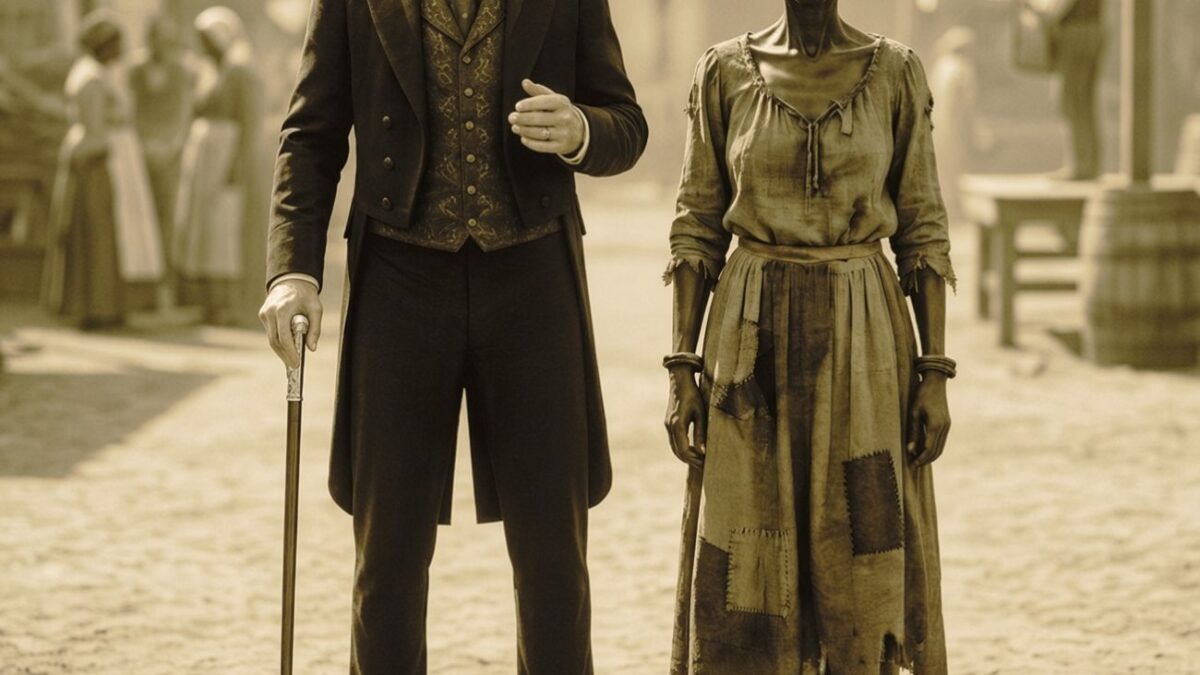
The sun beat down like molten lead on the Jalapa market that October morning in 1809. The air smelled of sweat, damp straw, and fear—that old and familiar fear that could be felt in the plaza every time the carts arrived from the port of Veracruz. Don Anastasio Landasuri stepped down from his carriage with his silver cane, tapping it on the cobblestones, and the merchants moved aside to let him pass because everyone in the region knew who he was: the owner of the Tres Ojos estate, the most prosperous between Jalapa and Coatepec, and also the quietest and most feared man in the entire party.
He stopped in front of the last platform. There were hardly any people left to sell to or buy from, and the traders were gathering their rusty chains and account books, satisfied with the day’s profits. But in a corner, tied to a post with a frayed rope, there was a young woman who did not lower her gaze like the others. Her dark, steady eyes held the gaze of anyone who dared to look at her.
“Her name is Alta Gracia,” according to the crumpled piece of paper that the dealer handed to Don Anastasio without him asking for it. “It’s the last one I have left, boss. Nobody likes her. They say she brings bad luck, that she’s argumentative, that she curses whoever buys it.”
Don Anastasio said nothing. He walked around the woman like someone inspecting a team of oxen, but stopped when she, instead of lowering her eyes, asked him in a hoarse voice, “Are you buying me for the sugarcane fields or for something worse, sir?”
The dealer paled and raised his hand to hit her, but Don Anastasio stopped him with a curt gesture.
“I’ll buy her,” he said simply. “Pay what is owed and bring her to my cart.“
Around him, the Jalapa market continued its usual hustle and bustle—indigenous women selling tamales wrapped in banana leaves, muleteers unloading sacks of freshly cut coffee from the orchards of Coatepec, and a Franciscan friar preaching without much success to a group of children distracted by the smell of freshly baked bread coming from a nearby stall. Nobody paid much attention to the last transaction of the day at the dealers’ corner. For most, it was just another sale among the hundreds that took place every week in that square, the same trade in human lives that New Spain had been practicing for almost three centuries without the collective conscience stopping to question it too much.
In the distance, the bells of the Jalapa parish marked four in the afternoon, and the sun was already beginning to dip behind the hills that surrounded the city, tinting with gold the dust raised by the last mules loaded towards the port. Nobody in the market understood why the richest landowner in the region was paying such a high sum for a woman whom everyone else considered useless. Not even his foreman, Prudencio Salas, who was waiting for him with a tense face next to the horses, dared to ask aloud, although something in the rigidity of his shoulders betrayed a disquiet that had been growing inside him for weeks.
Prudencio had been managing the Tres Ojos estate with an iron fist for twelve years, and since the death of old Don Casimiro Landasuri, Anastasio’s father, he had assumed that he would be the one to inherit the true power over the estate, even though he did not bear the surname. Any decision by his boss that he did not control beforehand produced in him an almost physical distrust, a discomfort that settled in his stomach like a stone. And this purchase—so sudden, so expensive, so inexplicable—seemed to him from the very first moment a sign that something was stirring beneath the surface of his careful control over the family’s affairs.
“Think of putting her to work in the big house, boss?” he finally dared to ask while helping to load the luggage onto the cart. “Should I warn the cook to assign her tasks?“
“It won’t be necessary, Prudencio. I’ll decide what to do myself,” Anastasio replied with a dryness so uncharacteristic of him that the foreman pressed his lips together and didn’t press the issue again, though the distrust he already felt multiplied immediately, like a seed finding fertile ground to germinate.
The return trip took almost three hours along the dirt road that wound through coffee plantations and mist. Alta Gracia rode in the back of the cart, her wrists still marked by the rope, watching the Veracruz mountains shrouded in a thick fog that seemed to swallow the roads. She didn’t cry, she didn’t beg; she just watched like someone memorizing every curve in case she ever had to flee.
When they arrived at the hacienda, the main house stood imposingly among the centuries-old oak trees that gave the property its name—a stone and lime building with arched corridors and a central courtyard where sour orange trees grew. Doña Eulalia, Don Anastasio’s wife, came out to greet them with a tense face. She was a woman of measured gestures and intelligent eyes, accustomed to her husband making decisions without consulting her, but this time, something in his expression told her that this purchase was no ordinary one.
“And this woman, Anastasio?” she asked as Alta Gracia stepped down from the cart, her back straight despite her weariness. “We have enough servants. We didn’t need anyone else in the house.“
“She won’t work in the sugarcane fields, Eulalia, nor in the kitchen. I want her to stay in the room next to the chapel and for no one to disturb her.“
The order left everyone bewildered. Prudencio clenched his jaw and left without a word, but before he departed, his eyes rested on Alta Gracia with a mixture of contempt and something darker—something she recognized immediately because she had seen it before in other men, in other markets, on other estates.
Alone in the room next to the chapel, with the scent of candle wax and old incense clinging to the walls, Alta Gracia allowed herself, for the first time in a long time, to let the hazy memories of her childhood rise to the surface without fighting them. She remembered an adobe hut with a palm roof, the sound of rain hitting the dry leaves during stormy afternoons, and her mother’s hands braiding her hair by the fire while telling her stories of a village in the mountains where no one belonged to anyone. She also remembered, less clearly, the day some men on horseback arrived at the hamlet where they lived then, near Córdoba, and took her mother away with shouts that she, being so small, didn’t fully understand, and how she herself was dragged along another road, to another hacienda, to another owner, while the face of her refuge was lost in the dust of the road, calling out her name until the distance swallowed her voice as well.
For fifteen years she had carried those memories like someone carrying a wound that refuses to heal, fearing that forgetting them, even a little, would be tantamount to betraying the memory of the only person who had loved her unconditionally before the world took it upon itself to separate them. And now, in that strange room next to the chapel of a hacienda she had never imagined she would set foot in, she felt that her wound was, for the first time, beginning to move toward something resembling the possibility of healing.
That night, while the rest of the house slept, Don Anastasio entered the room next to the chapel with a candle in his hand and a wooden chest under his arm. Alta Gracia stood up, alert, ready to defend herself if necessary. But the landowner didn’t approach. He placed the chest on the table and, in a weary voice, as if he had been carrying a weight for years that he could finally release, said, “I didn’t buy you for what you think. I bought you because I’ve been looking for you for fifteen years, though I didn’t know your name until today.“
Alta Gracia frowned, suspicious. “I don’t know you, sir. I’ve never been to this hacienda.“
“But you knew a woman named Refugio Bracamonte, a free woman born in San Lorenzo de los Negros, the town founded by the runaway slaves who followed Captain Yanga more than 100 years ago. A woman who worked in this house before you were born.“
The name struck Alta Gracia like lightning. Refugio was her mother’s name—the woman who had disappeared when she was just six years old, the woman of whom she only had the memory of soft hands smelling of cinnamon and songs she hummed softly before falling asleep. All her life she had searched for answers about her whereabouts. And now, on the last hacienda she ever imagined setting foot on, a stranger was pronouncing her name as if he held the key to everything.
“Tell me what you know,” Alta Gracia whispered, and for the first time in years her voice trembled. “Tell me everything.“
Don Anastasio opened the chest. Inside were yellowed letters, a rosary of black seeds, and a document sealed with wax bearing the coat of arms of the Audiencia of Veracruz. Outside, the wind began to stir the branches of the oak trees, and somewhere on the hacienda, someone listened behind the door, holding their breath.
Don Anastasio closed the door carefully before continuing, as if the very walls of the hacienda could repeat his words to someone who shouldn’t hear them. He sat down opposite Alta Gracia with the chest between them, and for the first time in his life as a stern landowner, his hands trembled as he untied the cord that held the letters together.
“My father, Don Casimiro, loved your mother,” he said at last, “not as one loves a servant, nor as one possesses a slave. He truly loved her, even though the laws of this land would never have allowed it. And although it took him half a lifetime to admit it, even to himself…“
Alta Gracia felt the ground shifting beneath her feet. She had imagined a thousand stories about her mother’s disappearance: that she had died of fever, that she had been sold downriver, that she had drowned trying to escape. She never imagined this.
“My mother was free,” she said, her voice hardened by distrust. “She was born free in Yanga, yet she ended up serving in this house.“
“Because my grandfather, before my father, made a deal with the town leaders to get reliable labor during harvest time. Refugio came here as a free day laborer, not as a slave. She received a salary, came and went as she pleased, but stayed longer than she should have, because my father, then young and foolish, fell in love with her. When a girl was born from that union, my grandfather flew into a rage and threatened to disinherit my father if he did not keep her away from the estate. And my father, a coward as he had been all his life, gave in.“
The words fell on Alta Gracia like stones. She was that girl. She was the fruit of that forbidden love that no one on the estate had dared to acknowledge.
“So, I’m his daughter,” she whispered. “I am the daughter of Don Casimiro Landasuri.“
“You are my half-sister,” Anastasio confirmed. And on his face there was no contempt or shame, but an ancient weariness—the weariness of one who has carried a family secret throughout his adult life. “My father paid for Refugio and you to go far away to Córdoba with the promise of sending you money every year. But times changed. There was a bad harvest, debts, and a legal dispute over land. My father stopped sending money, and without that support, without papers to prove your free status, you and your mother were exposed to traffickers who roamed the roads looking for unprotected people.“
“We were stolen,” Alta Gracia said, and the tears she had held back for fifteen years finally rolled down her face. “We were both robbed. They sold us like cattle even though we were free.“
“I know. And my father knew it too before he died. On his deathbed he made me swear that I would look for you, that I would repair what he did not have the courage to repair in life. He gave me these documents,” he said, pointing to the chest, “which prove that Refugio was born free in San Lorenzo de los Negros and that you, therefore, were born free too, regardless of what the sales papers that the dealer put in your hands today in the market say.“
Alta Gracia took the documents with trembling hands. They were written in tight handwriting with official seals that she couldn’t quite read, but she recognized her mother’s name repeated several times and a date: 1789, the year she had been born.
“And my mother?” she asked, her heart heavy with hope and fear. “Do you know where she is? Is she still alive?”
Don Anastasio lowered his gaze, and that gesture told Alta Gracia more than any words could have.
“I don’t know for sure. The last news my father had of her was from eight years ago, from a sugarcane farm near Córdoba, but I hired men to investigate before he died and all they found was that she had been sold again to a buyer whose name no one wanted to reveal.” He paused. “That’s why I looked for you, Alta Gracia, because every market, every trader, every estate between Jalapa and Córdoba has been watched for years, waiting for the day you or she would appear.”
A heavy silence filled the room. Outside, the wind continued to move the oak trees and the shadows of the branches danced on the whitewashed wall like hands stretching out without being able to reach anything. Alta Gracia felt for the first time in a long time something akin to hope, although she did not dare to call it that, because hope in her experience always ended up broken.
“Why are you telling me all this secretly at night?” she finally asked. “If I am his sister, why doesn’t he say it in front of his wife, in front of his foreman, in front of everyone?”
The question seemed to make Don Anastasio more uncomfortable than anything else that had been said that night. “Because if Prudencio Salas finds out that there are documents proving your freedom and that of your mother, before I can present them to the mayor of Jalapa, he will make them disappear, and you too.”
That phrase hung in the air like a warning that neither of them needed to repeat. Outside, through the half-open window, footsteps were stealthily moving away along the arched corridor, but neither of them heard them in time.
Prudencio Salas had served the Landasuri family since he was just a barefoot boy carrying firewood for the kitchen. Over the years he had learned to read the account books, to negotiate with the traders on the coast, to manage every penny that came in and out of Tres Ojos. And in that silent learning he had discovered something that neither Don Casimiro nor Don Anastasio suspected: that he himself had been diverting part of the profits of the estate to his own accounts for years, buying land in the name of distant relatives, slowly building a parallel fortune that one day would allow him to buy his own estate and stop being a simple foreman.
That night, huddled behind the window of the chapel room, Prudencio heard enough to understand that the woman Don Anastasio had bought that afternoon was not just any slave, but the illegitimate daughter of Don Casimiro, with documents proving her freedom. And if those documents reached the mayor, not only would Alta Gracia be freed; the investigation that would undoubtedly follow could also uncover the falsified books that Prudencio had been hiding for years—the same ones that showed sales of slaves that had never occurred, and free laborers registered as property to inflate the treasury before the banks of Veracruz.
Prudencio walked away from the room, his heart pounding. He knew he had to act before dawn.
The next morning, the farm awoke to news that spread like wildfire among the farmworkers: during the night someone had forced open the chapel door and stolen the chest of documents that Don Anastasio kept next to the altar. Doña Eulalia, who until then was completely unaware of the existence of those papers, demanded explanations from her husband with a contained fury that only increased when he, for the first time in twenty years of marriage, refused to answer her clearly.
“We’ve been married for twenty years, Anastasio, and I’ve never seen you keep secrets like this,” she reproached him, following him through the arched corridor as he hurried towards the chapel. “You buy a woman without explanation, you install her next to the altar as if she were a relic, and now it turns out that you kept documents for her that not even your own wife knew about. What did you expect me to think, locked up here knowing nothing, while the whole staff murmurs behind my back?”
“I was hoping to have time to tell you calmly, Eulalia, not in the midst of a crisis like this,” he replied, pausing for a moment to look her straight in the eye, genuine weariness etched on his face. “Believe me, not a single day has gone by since my father died that I haven’t wanted to share the weight of this story with you. But I also feared your reaction. And now I see that that fear, though understandable, wasn’t fair to you.”
“If that woman is truly your father’s daughter,” Eulalia said, her arms crossed, her eyes shining with a mixture of pain and suspicion, “then this house belongs to her as much as it does to you. Is that what you’re afraid to tell me, Anastasio—that you want to share with her what should rightfully belong only to our children?”
“I fear something far worse, Eulalia,” he replied, his voice cracking with exhaustion from a sleepless night. “I fear that without those papers we have no way to prove before the law that Alta Gracia was born free, and without that proof, any man with enough money and enough evil could claim her as his property, even within my own estate.”
Eulalia’s face slowly changed from anger to genuine concern, because despite her jealousy she was a woman raised in the fear of God and a certain code of honor that did not tolerate blatant injustice, especially when it touched so closely the memory of her father-in-law. But before he could answer, a shout from the yard interrupted them both. It was one of the maids running towards the big house with a distraught face.
“Patron, patroness, come soon! It’s the new woman you bought yesterday. She has disappeared from the chapel room and there is blood on the floor.”
Don Anastasio felt like the world was stopping. He ran towards the chapel with Eulalia hot on his heels, and what they found there filled him with dread: the door was wide open, the stone floor was stained with dark drops that faded into the backyard, and there was no sign of Alta Gracia anywhere.
Prudencio Salas appeared shortly afterwards with his face composed in a mask of such perfect concern that only someone who knew him very well could have noticed the slightest tremor in his hands. “She must have escaped during the night, boss,” he said calmly. “These market women are cunning. She probably hurt herself jumping out of the back window, or perhaps some day laborer, jealous of seeing her settled in the big house, decided to take justice into his own hands. I will send men to search for her along the roads immediately.”
But Don Anastasio, staring at the bloodstains that led towards the sugarcane fields and not towards the royal road, felt that something in his foreman’s story didn’t add up. And for the first time in years, he decided not to blindly trust the man who had managed his estate for a lifetime.
Don Anastasio ordered that no one touch anything in the chapel until he himself had examined every corner. He sent horsemen along the four roads leading out of Tres Ojos, but those that led towards the southern cane fields, where the bloodstains seemed to disappear, he took personally, accompanied only by his trusted servant—a young man named Wenceslao, who had been working on the estate since childhood, and whom Anastasio knew to be loyal above any other loyalty in that house.
Wenceslao had arrived at Tres Ojos when he was just an eight-year-old orphan, taken in by Don Casimiro himself after a smallpox epidemic that had wiped out half of a neighboring hamlet. He grew up among the stables and kitchens, learning to read thanks to the insistence of an itinerant priest who spent time on the estate, and from a very young age he had developed a silent capacity for observation that Prudencio, always busy with his own affairs, never knew how to value or fear. Over the years, he had seen strange entries and exits in the foreman’s books—day laborers disappearing overnight with vague explanations about debts incurred, and a prudent personal prosperity that did not match the modest salary of an administrator. He had never said anything because he had no proof, and because on a ranch where the foreman wielded almost absolute power, speaking without proof was tantamount to signing his own death warrant or worse.
“I’ve suspected him for years, boss,” Wenceslao confessed that same morning as they hurriedly saddled the horses. “But I never had the courage to tell you without something concrete to show you. Forgive me if my silence contributed to this going so far.”
“Your silence isn’t to blame here, Wenceslao. It’s mine for having trusted a man for so many years without asking the right questions,” Anastasio replied, leaping onto his horse. “Now let’s go. Every minute we lose could cost that woman her life.”
“Prudencio wanted to send us along the main road,” Anastasio told him as they rode between the rows of sugarcane, still green and tall for the upcoming harvest. “But the blood flowed south, toward the old mill. Why would a woman being pursued flee toward the heart of the plantation instead of away from it?”
“Unless she didn’t escape of her own free will, boss,” Wenceslao replied with the caution of someone who has silently observed the foreman’s shady dealings for years.
The old sugar mill, abandoned since a new and more modern one was built near the big house, was a stone construction blackened by the smoke of decades of past harvests, already half devoured by vegetation. Anastasio remembered playing there as a child before his father declared it a forbidden zone because it was dangerous—a prohibition that, thinking about it now, had always seemed strange to him for a simple disused building.
As they approached the entrance to the sugar mill, Wenceslao raised his hand to stop. He had heard a voice inside, a man talking to himself or perhaps speaking to someone who wasn’t responding.
Anastasio dismounted without making a sound and peered through a gap in the stone wall, and what he saw froze his blood. A burly laborer, nicknamed “the one-armed man” because of an old machete wound, stood guard by the beam where Alta Gracia remained tied up, with a knife in his hand and the express order—as he murmured nervously to himself—not to let her escape until the boss returned from settling his affairs in town.
Anastasio immediately understood that Prudencio, anticipating that someone might follow the trail of blood, had preferred not to remain at the crime scene himself, leaving his pawn as jailer while he arranged his own escape. He signaled to Wenceslao to go around the building on the opposite side and entered himself through the main door with his pistol drawn, surprising the one-armed man, who did not expect anyone to arrive so soon, much less the boss himself, armed and with his face hardened by a fury that was rarely seen in him.
“Drop the knife. It’s over,” Anastasio said in a voice that left no room for negotiation.
The one-armed man, quickly calculating his odds against two armed men, dropped the knife and raised his hands, babbling confused explanations about orders received that even he didn’t seem to fully understand, while Wenceslao subdued him and tied his wrists with the same rope that had held Alta Gracia.
Inside, amidst the shadows and the cloying smell of rancid molasses, they found Alta Gracia tied to one of the wooden beams, with a superficial cut on her arm from which blood was still flowing, but alive, conscious, and with the same firm gaze that she had held the day before in front of the dealer at the market.
“It was Prudencio,” she said as soon as Anastasio freed her from the ropes. “He came in before dawn, he hit me, he brought me here by force. He wanted me to tell him where you had hidden the chest of documents, but I didn’t know anything because you had it yourself when I fell asleep.”
“He was the one who stole it,” Anastasio said, putting two and two together with bitter clarity. “He pretended a thief broke into the chapel, but it was him, and then he brought you here to make it look like you had escaped or to get rid of you without witnesses if the plan failed.”
Wenceslao, who had been keeping watch at the entrance, suddenly entered with a pale face. “Boss, there’s more. Beneath this platform there is a hollow, and inside…” he hesitated, searching for the words, “…there are books inside. Many account books, hidden as if no one should ever find them.”
The three approached the designated platform and upon lifting it, they found a hidden compartment dug into the ground and lined with boards to protect it from moisture, where dozens of accounting books were piled up that did not match those that Prudencio officially presented to Don Anastasio at the end of each year.
Upon quickly skimming them, the truth began to reveal itself with devastating clarity. For more than a decade, Prudencio Salas had registered free day laborers from nearby communities, including San Lorenzo de los Negros, as purchased slaves, charging for their work as if they were property of the hacienda, while diverting the money corresponding to their wages into his own accounts and also falsifying fictitious sales to justify income that actually came from bribes and extortion of other landowners in the region, whom he helped to resolve land disputes through veiled threats.
“My mother,” Alta Gracia murmured, understanding at once. “She too could have been registered as a slave, when in reality she came here as a free laborer.”
Anastasio nodded slowly, and an expression appeared on his face that mixed fury with a kind of painful relief—the relief of someone who finally understands a mystery that had tormented him for years without a name or clear form.
“If Prudencio has been doing this for years with Refugio and who knows how many other people, then there must also be a record of who he sold your mother to. When my father stopped sending money to support them both, Prudencio wouldn’t let a source of income go without writing it down somewhere, no matter how much he wanted to hide it.”
The three spent the next hour leafing through book after book until Wenceslao, with trembling fingers, found an entry dated 1801: the sale of a day laborer from Yanga named Refugio, thirty-two years old, to a buyer identified only by the initials J.C.M., along with a note of a place—Hacienda La Concepción near Orizaba.
“La Concepción,” Anastasio repeated, and his expression darkened even further. “I know that estate. It belongs to Don Jacinto Corvera Mendiola, a man with whom my father had land disputes for years and who always hated him for having lost those disputes before the court.”
Alta Gracia felt her heart race. After fifteen years of not knowing anything, of imagining a thousand possible endings for her mother, finally she had a name, a place, a thread to pull.
“We must go to Orizaba,” she said with a determination that left no room for doubt or fear. “I need to know if she’s still there, I need to know if she’s still alive.”
But before they could organize any trip, a new, urgent problem demanded Don Anastasio’s attention. Prudencio Salas, upon discovering that his plan had failed and that the woman hadn’t died, nor had she been found by his own men before the landowner, had fled the hacienda during the morning’s confusion, taking with him not only money from the administration safe, but also the original documents proving the freedom of Refugio and Alta Gracia—the only proof that existed with irrefutable legal weight.
“Without those papers,” Anastasio said as they rode back to the main house under a sky that was beginning to darken with the gray clouds of the rainy season, “any claim we make to the mayor will be nothing but word against word. Prudencio is clever. He knows that without that proof, he could even accuse you of being a fugitive slave, Alta Gracia, and me for harboring a fugitive.”
“So we have to find him before he gets to Jalapa or Veracruz,” she said, her jaw clenched. “And we have to get to Orizaba, to that hacienda, before he decides to take revenge by warning that Corvera Mendiola fellow of what we know.”
Doña Eulalia, who was waiting for them in the courtyard—her face a mask of shock after hearing from a terrified maid everything that had happened at the old sugar mill—made a decision that surprised everyone, including her own husband.
“I will go with you to Orizaba,” she announced with the firm voice of someone who has decided not to remain on the sidelines of the truth, however painful it may be. “If my father-in-law committed a sin that this family must atone for, I prefer to confront him head-on than continue living under the shadow of a half-baked secret. And if that woman who sheltered my husband’s family is still alive, she deserves to know that there is someone in this house willing to return what was stolen from her, even if it costs me my pride.”
The journey from Jalapa to Orizaba, crossing the slopes of the Pico de Orizaba through mist and pine forests, normally took three days by oxcart. But Anastasio decided that he, Alta Gracia, and Wenceslao would ride ahead on horseback, while Eulalia would follow in the carriage along with two trusted servants and a letter addressed to the mayor of Jalapa, formally denouncing Prudencio Salas’s escape and requesting an investigation into the account books found in the old sugar mill.
They rode for two days through intermittent rain that turned the roads into mud pits, stopping only briefly to rest their horses at inns where Anastasio, thanks to his surname, always managed to secure the best lodging available. Alta Gracia, who had never traveled so far from Córdoba, observed the changing landscape with a mixture of wonder and anxiety as the coffee plantations gave way to cloud forests, and these, as they approached Orizaba, to valleys cultivated with sugarcane and surrounded by increasingly imposing mountains.
On the second night, while they camped near a place known as La Joya, Wenceslao awoke with a start to the sound of breaking branches—closer than the wind alone could explain. He sat up silently, his hand on the machete he always carried at his waist, and managed to make out among the trees the silhouettes of two men on horseback, motionless, watching the camp from a distance.
“Boss,” he whispered, waking Anastasio with a firm touch on the shoulder. “They’re watching us.”
Anastasio got up with feigned calm, as if he were only going to attend to the needs of the camp, but with his hand near the pistol he kept under the blanket. The riders, noticing that they had been discovered, galloped away into the undergrowth without giving anyone time to recognize them. Although Wenceslao could not catch their faces in the dark, he swore he recognized the distinctive hats worn by Prudencio’s hired enforcers.
The following evening, the silhouette of Hacienda La Concepción finally loomed against the twilight sky, its whitewashed walls stained with dampness and neglect. Don Anastasio, Alta Gracia, and Wenceslao approached the main gates quietly, knowing that element of surprise was their only remaining advantage against whatever forces Don Jacinto Corvera Mendiola or the fugitive foreman had mustered.
As they crossed the threshold into the inner courtyard, an elderly woman with silver hair tied in a simple cloth was sweeping the stone flags by the chapel entrance. She paused, leaning on her broom, and stared directly at Alta Gracia. Her breathing hitched, and the broom slipped from her weathered hands, clattering against the stones.
“Refugio?” Alta Gracia breathed, the word escaping her lips like a fragile prayer across fifteen years of silence.
The old woman rushed forward, her eyes wide with disbelief, and as they embraced under the fading light of the Veracruz dusk, the heavy burden of the past finally began to lift. In that quiet courtyard, the ghosts of the old estates were laid to rest, not through vengeance or hidden accounts, but through the enduring strength of a daughter who refused to let her story be buried in the dust.

