The Gault Sisters Disappeared for Nine Days in 1904 — When They Returned, Only One Would Speak
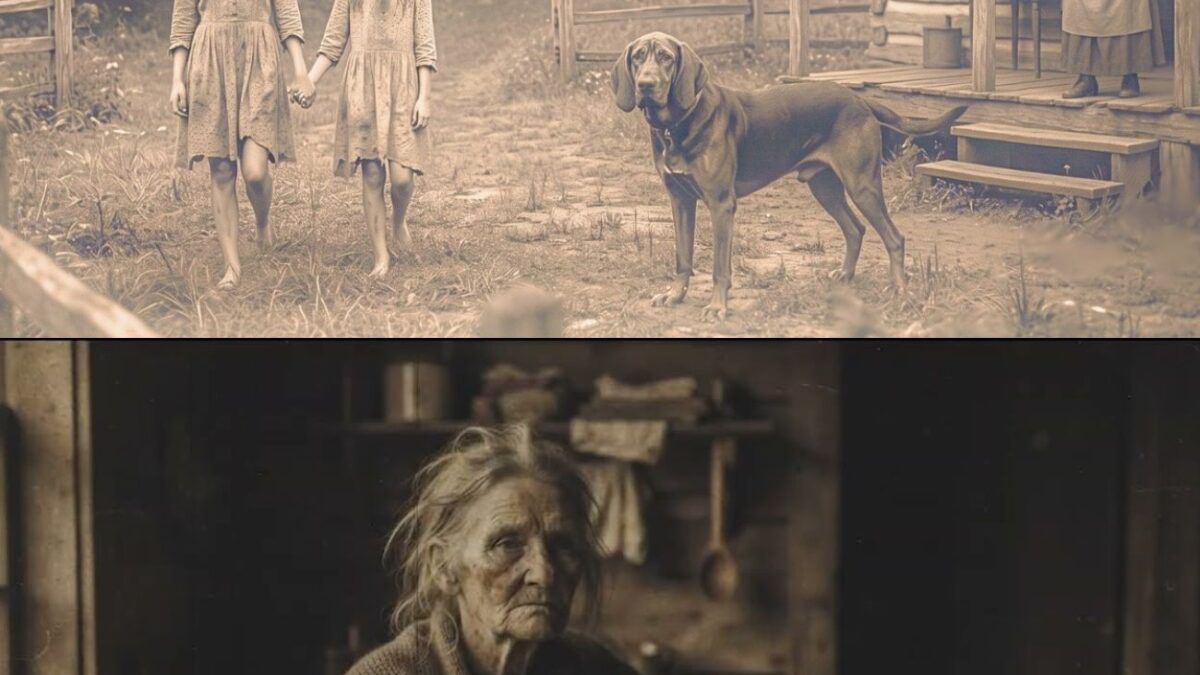
The Gault Sisters Disappeared for Nine Days in 1904 — When They Returned, Only One Would Speak
On the 7th of October, 1904, two sisters walked out of the tree line behind their family homestead in the hollow country of Eastern Kentucky. They had been missing for 9 days. Their mother had not slept in 9 days. The search parties had given up on the 3rd, and when the girls came back through the ridge line at dusk, barefoot and hollow-eyed, wearing clothes that no longer fit them and holding hands so tightly the skin had gone white, their mother did not run to them. She stood on the porch and she screamed. Because the older sister, Corrine Gault, was speaking in a voice that did not belong to her, and the younger sister, Effie Gault, was not speaking at all. She would never speak again for the rest of her natural life. And what Corrine began to say in the days that followed would be transcribed into a small leather notebook by the county sheriff, sealed by the family lawyer, and then quietly disappeared from every record it ever touched.
The Gault family had lived on that ridge since before the state of Kentucky had a name. Their great-grandfather had cleared the first patch of ground in the 1780s, back when the whole of the Appalachian shelf was still called by names the new settlers could not pronounce. By the time Corrine and Effie were born in 1889 and 1892, the homestead had grown into a modest working farm. Their father, Ellis Gault, was a timber man. Their mother, Hannah, kept the house and taught the girls their letters. There were three older brothers, all working the far pastures, and a black dog named Warden that slept under the porch. It was, by every account that survives, an ordinary life. Hard, yes. Quiet, yes. But ordinary.
Corrine was 15 when it happened. Effie was 12. Neighbors who knew them described the older sister as sharp-minded and stubborn. The sort of girl who read the family Bible not for comfort, but for argument. The younger one was said to be softer, dreamier, given to sitting by the water and speaking to things that were not there. This last detail is noted in three separate accounts. Effie spoke to things that were not there, and her mother had learned over the years to leave the child to it.
The morning of the 28th of September, 1904, was warm for the season. Hannah Gault sent her daughters up the ridge to gather ginseng and wild sassafras. It was a route the girls had taken maybe a hundred times before. There was a game trail that ran up the north slope, wound around a limestone shelf the family called the broken table, and came out at a small clearing where the ginseng grew thick beneath the hemlocks. The girls left after breakfast with a basket, a canteen of well water, and a paring knife wrapped in cloth. They were expected back before supper.
They did not come back before supper. They did not come back that night, and by the following morning, when Ellis Gault rode down into the settlement to gather men for a search, the whole hollow understood that something had gone very wrong.
The search lasted three days. Men from four families combed the ridge from the low creek to the shale outcrop at the top. They called the girls names until their voices gave out. They found the basket upturned at the edge of the clearing. The paring knife was still inside it. The canteen was gone. There were footprints leading away from the clearing, two sets of them, small and unhurried, walking east into a stretch of forest so old and so tangled that no logger had ever bothered with it. The prints continued for perhaps 40 yards, then they simply stopped, not turned back, not scattered, stopped, as though the ground itself had lifted the girls up and taken them somewhere else.
On the third day, the sheriff called the search off. He did not say the girls were dead. He said, in the careful language of a man who knew what he was looking at, that the ridge had taken them, and the ridge would decide when to give them back. This is a phrase that appears more than once in the folk record of the region. It was not, in that place and in that year, considered a superstition. It was considered a report.
Six more days passed. Hannah Gault did not eat. She sat on the porch through every one of those nights with an oil lamp burning, and the black dog Warden at her feet, and she watched the tree line. On the sixth night, according to a statement given later by one of the older brothers, the dog began to whine, not bark, whine. A low, continuous sound aimed at the ridge. It went on for hours.
And then, at first light on the seventh morning, the girls walked out of the trees.
They were changed. This is the word every witness used, changed. Their clothes did not fit them. The hem of Corrine’s dress rode above her knees in a way it had not before, and the sleeves reached only to her forearms. Effie’s dress was so short it looked as though she had grown 3 inches in a week. Their hair was longer, their skin was darker in patches, as if sunburned in places that had been covered. And their eyes, both witnesses insisted, had gone a slightly different color. Corrine’s eyes had been gray, now they were nearly black. Effie’s eyes had been blue, now they held no color at all, just a kind of flat pale that reflected the porch light without absorbing it.
They walked directly to their mother. They did not run. They did not cry. Corrine opened her mouth and began to speak, and this is where the record becomes strange, because what she said, in that first hour on the porch, was not English.
Hannah Gault, who could read the Bible in three languages and knew the Cherokee names for every plant on the ridge, later told the sheriff that her daughter had been speaking a tongue she did not recognize at all. It had, she said, a rhythm to it, a structure. It was not gibberish. It was a language, just not one that belonged to this century, or she suspected, to this continent.
Corinne spoke for perhaps two full minutes in that unknown tongue. Then she stopped, blinked slowly, and said, in perfect English, “Mother, the city was still burning. The city was still burning after all that time.” And she said it the way you would report the weather.
Effie said nothing. Effie would say nothing for the next 61 years of her life.
The sheriff arrived that afternoon. His name was Josiah Rael. And he was a man of 39 who had come up through the mines before he took the badge. He had seen dead bodies. He had seen men do terrible things to each other in the deep hollows. He was not a man given to what he called nervous talk. But his transcription of Corinne Gault’s testimony, taken over the following 3 days in the front room of the Gault homestead, would be sealed under the county private judicial record, and would not be spoken of publicly again in his lifetime.
Some of what Corinne said, however, has survived. It’s survived because the family lawyer, a man named Whitfield, made a private copy in longhand and passed it to his son, who passed it to his son, who eventually, in 1971, allowed a folklorist from the University of Kentucky to examine it under supervised conditions. The folklorist made notes. Those notes are what we still have.
And what those notes describe, in the plain voice of a 15-year-old farm girl from a Kentucky hollow, is a story that has no place in the accepted history of the American continent.
Corinne said that on the afternoon of the 28th of September, she and Effie had walked past the broken table and into the clearing where the ginseng grew. She said that Effie had stopped at the edge of the clearing and pointed at something behind a stand of hemlocks that had not been there before. Corinne turned to look, and what she described, in the sheriff’s front room 3 days later, was a doorway. A doorway cut into the side of the ridge, made of a stone she did not know, framed with carved figures she did not recognize, standing open. She said the doorway was old. She said it looked as old as anything she had ever seen. And she said the air coming out of it was warm and smelled like a market she had never visited, full of spices and something sweeter, something like resin.
She said Effie walked toward it without speaking. And Corrine, who was the older sister and knew better, followed her in.
What she described next takes up nine pages of the folklorist’s notes. I will summarize it as faithfully as I can. She said the doorway opened onto a set of stairs cut into the living rock. The stairs went down. They went down farther than she could count. And at the bottom of the stairs, she said, was a road, a wide, flat, paved road running through the inside of the mountain. On either side of the road were buildings, tall buildings, taller than anything she had seen in Louisville or Lexington, made of a pale stone that seemed to glow slightly from within.
And the road was lit, she said, but not by torches, not by lamps. It was lit by long strips of something white that ran along the ceiling of the tunnel, giving off a cold, steady light that made no shadow. She said there were people, not many, perhaps a dozen. They wore clothing she could not describe well, some kind of woven fabric that changed color as they moved. She said their faces were long and their eyes were larger than a normal face allowed for, and their skin was very pale, the color of a river stone that has never been touched by sun.
They did not seem surprised to see the two sisters. They spoke to Corrine and Effie in a language the girls did not understand. And then, after a moment, one of them, an older one, a woman, stepped forward and touched Corrine’s forehead very gently with two fingers. And after that, Corrine could understand them perfectly. She said Effie did not need to be touched. Effie already understood. Effie had, Corrine said, understood since the moment they walked through the door.
They were, she said, the last of them. That was the phrase she used, the last of them. She said they had lived in that place for a very long time. She said the world above had been theirs once. She said there had been a great fire and then a great cold and then a great forgetting. And she said the people who lived above now, meaning us, meaning her family and her neighbors and the sheriff and everyone she had ever known, were not the first. We were the second. Or perhaps the third.
She said the city was still burning. She meant a city she had been shown, not by walking through it, but by being taken to see it in some other way she could not describe. A city on a plain with towers taller than the mountain she was standing under, and the towers were on fire, and the fire had been burning for what she was told was thousands of years. She said the people underground kept a watch on it. She said it was their duty to remember.
Sheriff Rael wrote in the margin of his own notes—the words the family lawyer copied and passed down—the following observation. He wrote, “The girl is not lying. The girl believes what she is saying. The girl has seen something that this office was not built to hear, and she has come back changed.” He also wrote, and this is the part that has troubled every reader of the document since, one line at the very bottom of the third page. He wrote, “I have been up the ridge. I have seen the door.” That single sentence has never been publicly explained by anyone.
In the weeks after the sisters’ return, several things happened in rapid sequence. A team of men from a company that was not local, wearing suits that were not local, arrived in the hollow. They spoke to Ellis Gault. Money changed hands. Ellis Gault, who had never left the county in his life, moved his family within the year to a farm in central Ohio. The Gault homestead was abandoned. Then it was burned. Not by anyone in the family, but by persons unknown.
The ridge where the doorway had stood was purchased by a mining concern that never mined it. A road was built to the base of it. The road was gated. The gate is still there.
Sheriff Josiah Rael resigned his post in December of 1904. He moved to Pittsburgh. He died two years later of what was recorded as heart failure at the age of 41 in a hotel room he had rented for one night under a name that was not his own.
The sealed transcript of Corinne Gault’s testimony was, according to the county records office, destroyed in a fire in 1912. This fire consumed exactly one filing cabinet in a records office of some 400 cabinets. The rest of the building was untouched.
Corinne Gault lived to the age of 91. She married a salesman, raised four children, and in her old age gave one interview to a small historical society in Ohio. In that interview, she was asked about her missing sister. She said only this. She said, “Effie saw more than I did. Effie went further in, and Effie could not carry it and speak at the same time. So, she chose. She chose to keep it. She kept it for the both of us.”
Effie Gault lived to the age of 73. She did not marry. She lived with Corrine’s family in a back room and worked in the garden. She wrote on scraps of paper, never forming sentences. Her writings, of which several dozen scraps survive in a private archive, consist entirely of the same three shapes drawn over and over again: a doorway, a staircase, and a circle with a smaller circle inside it.
The folklorist who examined the papers in 1971 identified the third symbol as consistent with a marking found on certain pre-Columbian stones in the American Southwest, and also on certain stones in the Anatolian Highlands, and also on a small carved bone dug up from a bog in northern Denmark. The symbol appears in places that had no contact with one another. It is, in the language of the historians who will admit it exists at all, a survival, a piece of something older than the story we have been given.
Effie died in the winter of 1965. Her last act, according to Corrine’s family, was to raise her hand and point at a place on the wall of her back room. There was nothing on the wall. She held her hand there for perhaps a full minute, and then she died.
Now, here is what makes the Gault case matter, and here is what has been circling since we began. Because the story of two sisters lost in the woods and returned changed is, on its own, an old story. It is a story told in every culture that has forests or mountains or deep water. Children go into the wild, time behaves strangely. They come back wearing clothes that no longer fit. In every version of that story, from the changeling stories of Ireland to the mountain lore of the Ozarks, the returned child speaks of a place beneath the world, a place with towers, a place with lights that are not fire, a place with people who remember what we have been made to forget.
We have been told those stories are folklore, that they are the way our ancestors explained wolves or fevers or the ordinary tragedy of a child who wandered off and did not come back. But the accounts do not describe wolves. They describe cities. They describe stone. They describe writing on the walls that the returned children cannot read, but can draw. And the drawings, wherever they surface, match: a doorway, a staircase, a circle within a circle.
You are meant to believe that our civilization is the first that ever mattered, that the great works of stone in every corner of the world were raised by primitive men with rope and bronze and time, that the sudden gaps in the historical record—the mud that buried the first floors of buildings across three continents in the 18th century, the maps that showed vast nations and then vanished from every school text within a generation—are simply the mess of history, not evidence of anything hidden, not evidence of anything erased.
But the Gault sisters walked into a doorway on a ridge in Kentucky in the autumn of 1904, and they saw a road and buildings and a light that made no shadow, and people who told them that we were the second, or perhaps the third, and one of them came back speaking a language nobody could place, and the other came back silent and stayed silent and drew the same three shapes for the rest of her life. And the sheriff who took her testimony wrote in the margin that he had gone up the ridge himself and had seen the door, and within eight years every physical record of what she said had been burned.
That is not the shape of folklore. That is the shape of a deliberate cover.
The ridge is still there. The gated road is still there. The mining concern that owned it changed hands 11 times and is now, on paper, the property of a shell company registered in Delaware whose stated business is agricultural research. There has been no agriculture on the ridge in 120 years. There has been no mining either. There is only a fence and a locked gate and, according to a hunter who spoke on record to a small podcast in 2019, a low humming sound that comes from the ridge on certain nights of the year. He said it sounded, he did not know how else to put it, like a city underneath.
Corrine Gault, near the end of her life, was asked by her granddaughter what she thought had happened to her and her sister in those nine days. She thought about it for a long time, and then she said, “We did not lose nine days. We gained them. We were given nine days that did not belong to the world above. We were shown a place that was here first, and they let us come back because they wanted someone up here to know. Not everyone, just someone.”
She said, and this is the last thing on the record from her, “They told us it would not be long now. They told us the ground would move again. They told us the second forgetting would come and after it the third. And when I asked them, ‘Why show us this?’ they said, ‘Because you will be the ones telling the story when it begins, Effie and me.’ And the ones like us.”
The Gault sisters’ file was closed in 1904. It has never been reopened. The homestead site was, in the 1980s, briefly investigated by a private group of amateur historians who tried to walk the ridge without permission. They were turned back by armed men who did not identify themselves. The men were, according to the account, wearing no insignia of any government agency the historians could name.
You are told that the world above is all there is. You are told that the record is complete. You are told that if there were a doorway in the side of a mountain in Kentucky and a road under it and a light that made no shadow, someone would know. Someone would have said. Someone would have written it down.
Someone did. Her name was Corinne Gault. Her sister’s name was Effie. The sheriff’s name was Josiah Rael. The folklorist made notes in 1971 and those notes are held today in a private collection in Lexington. And the family that owns them has, for four generations, quietly refused every request to publish them.
The story survives. It survives the way these stories always survive: in the margin, in the copy of the copy of the copy, in the hand of a country lawyer who did not trust his own sheriff, in the drawings of a mute girl who lived out her days in a back room in Ohio, in the single line at the bottom of a page, “I have been up the ridge. I have seen the door.”
That is where the public record ends, but the true trail does not stop there. Decades after Effie’s passing, in a forgotten cedar box tucked beneath the floorboards of that Ohio back room, a final, uncatalogued scrap of paper was found. It bore no drawings of doorways or stairs. Instead, written in a cramped, trembling hand that bore the clear marks of Corinne’s later years matching Effie’s ink, it contained a sequence of precise geographical coordinates deep within the heart of the Appalachian range, accompanied by a single, chilling sentence in English:
“They have finished waiting; the seals are open, the lights beneath the soil are turning green once more, and when the mountain finally breathes out, nothing left upon the surface will ever be the same.”

