The Fortune Tellers Who Robbed the Richest Families of the Gilded Age
The Fortune Tellers Who Robbed the Richest Families of the Gilded Age
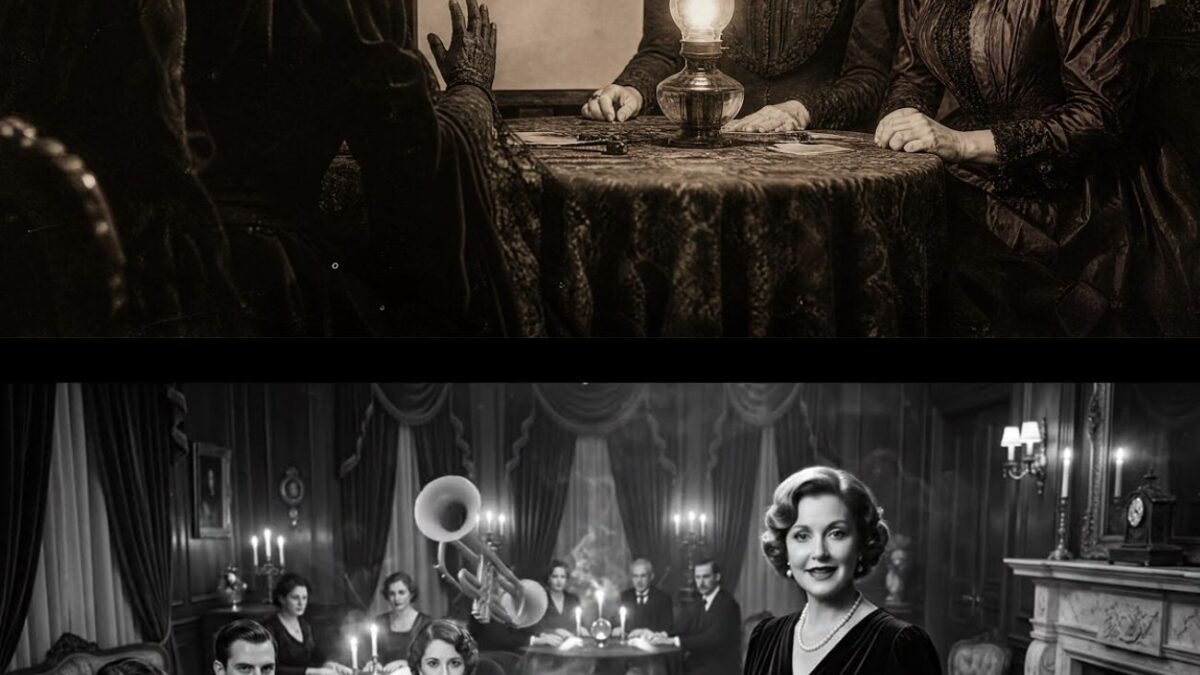
In a curtained room in Chicago, a millionaire watched a blank canvas fill stroke by stroke with the face of his dead mother. And when the two sisters at the table told him she wished him to marry the younger of them, he did as the dead instructed. Inside two years, the money was gone, and so was the marriage. He was not the only one. Before him, two farm girls had made the dead knock on a bedroom wall and turned the sound into a religion. A Boston engraver had learned to sell grieving families a photograph of the very loved one they had just buried. A slate writer had convinced the finest scientists in Europe that the dead were writing in his hands. Behind every one of these fortunes stood an open grave and someone waiting beside it with a bill. Who grew rich when the richest families in America could not buy back the one thing they had lost? If you love the Gilded Age the way I do, its silk and its seances both, then subscribe and stay close because I am about to walk you past four seance tables and show you the hands that worked them.
The door a death leaves open. Every fortune in this story began with a grave. And every grave for a certain kind of person was a business opportunity. That is the uncomfortable truth this film is built on. And it is worth saying plainly at the start because the century that follows dressed it in candlelight and hymns and the language of comfort. And the dressing was the whole trick. The Gilded Age is usually remembered for what it built. The railroads and the marble palaces and the universities with a single family name carved over the door. This is the story of its shadow trade. The men and women who built their own fortunes out of other people’s dead and who found to their lasting profit that the richest families in America grieved exactly as the poorest did, and had so much more to give.
To see how the trade grew so large, you have to see how much death there was to work with. The war that had lately torn the country in two had killed more than 600,000 young men, and later counts pushed the number higher still toward three-quarters of a million out of a country a fraction of the size it is now. Whole towns had sent their sons away and buried empty coffins. Mothers kept a folded uniform in a drawer and a lock of hair in a locket and no grave they could visit because the body had gone into the ground somewhere in Virginia or Tennessee under a board with the wrong name on it or no name at all.
Beneath that visible slaughter ran the ordinary dying of the age, the fever that took a child in a week, the consumption that hollowed out a husband over one long winter, the infant gone before its name had been worn smooth by use. Almost every household in the land had a small grave in it somewhere. This was a country soaked in loss, and it had no comfort equal to the size of the wound. The churches offered heaven, a reunion deferred to the far side of death, patience without end.
Into that vast silence, a new faith began to speak, and it offers something the churches did not. Not that the dead were at peace, and not merely that you would see them again someday, but that you could reach them now, this evening, in a rented room for the price of a sitting. That was the genius of it and it fell on ground that could not have been better prepared. The new belief called itself spiritualism and it spread through a grieving country like water finding cracks. It gave the bereaved a task where the church had given them only waiting and it gave one group in particular a voice they had almost nowhere else. In an age when a respectable woman was not to speak in public, to preach, to hold a room, the seance table let her do all three, so long as the words were said to be coming through her from someone else. A great many of the mediums in this film are women for exactly that reason. The trade offered them the one stage the century allowed them, and some of them, as we will see, worked it with a ruthlessness that had nothing to do with the spirits at all.
Think of the thing they were selling as a door. The image will follow us through every story here, so hold it now. Grief is a door that no amount of money can close. You may own a railroad and a name that stops traffic on Fifth Avenue, and there will still be a room in the house of your life whose door will not shut. And behind it stands the person you have lost. The people in this film were the figures who learned to appear in that doorway, holding a candle, promising a single glimpse of what lay beyond, and asking very gently for a fee. They did not force the door. They never needed to. A death had already left it open, and they simply learned to be standing in it when the grieving turned around.
The sound that opened the trade was a knock. Remember that too because it comes back at the end. It began with two children rapping on a wall and it ended 60 years later with the same cheap trick being performed under the noses of professors of physics who wrote it up as proof of another world. In between, the knock became a photograph you could frame and the photograph became a portrait that seemed to paint itself and the portrait became a marriage and a signature on a fortune, and at every step the price went up and the marks grew richer.
The tools of the trade were humble and they hardly changed across 60 years. A rap under a table, a trumpet that floated in the dark, a slate that wrote by itself, a canvas that filled with a face, a photographic plate exposed twice. What changed was who was sitting on the other side of the table. The con climbed from the farmhouse to the mansion to the laboratory, and it climbed on grief the whole way.
Now, some of the greatest predators of this world are not in this film, and you should know why, because their absence is part of the argument. Two sisters worked the richest man in America in his old age and his widowhood, took his backing on what looked like guidance from the beyond, and opened the first women’s brokerage on Wall Street. Another woman talked a distinguished New York lawyer out of his marble mansion by claiming the old masters were painting canvases for him from beyond the grave. And he went on believing in her even after a court had convicted her. Those are the famous cases, the ones you may have heard of, and they have their own stories told elsewhere. This is the film about the operators who are usually left out. The two girls who started the whole thing. The engraver who learned to sell the dead by the print. The sisters who turned it into a machine. And the man who carried it all the way to a university bench. It starts as it must with the two girls and a knock in the dark.
Two girls and a knock. It began, as these things so often do, with two children and a lie they could not take back. In 1847, a Methodist farming family named Fox moved into a small rented house at Hidesville in the flat country of upstate New York, an ordinary house on an ordinary road, the kind of place nothing is ever supposed to happen in. In the following spring, the two youngest daughters, Kate, who was about 11, and Margaret, who was about 14 and went by Maggie, began to report a strange knocking in the walls of their bedroom at night.
At first, it frightened the whole household. The parents searched the walls and the cellar and found nothing. And then, on the last night of March in 1848, the thing turned from a terror into a game. Kate, the younger girl, is said to have called out to whatever was making the sound, challenging it to repeat the snapping of her fingers, and the sound answered her, snap for snap, as if something on the other side of the plaster were listening and willing to play.
From there, the girls built a code. One rap for yes, silence for no. A slow march through the alphabet for anything longer. And the thing in the wall, the raps eventually spelled out, was the spirit of a peddler who had been murdered in that very house and buried somewhere beneath it. That last part was never proven in their lifetimes. And you should hear it for what it is, a story, the kind of story a frightened and imaginative child tells in the dark and then cannot climb back down from once the grown-ups start to believe it.
There was no missing peddler on any record, no body the neighbors could produce, only the name the raps had spelled, and a growing crowd in the yard come to hear the dead man knock. Much later, long after the sisters were gone, there would be a report of a skeleton and a peddler’s tin box found in a wall of the old house, endlessly repeated by believers as proof at last. Though the provenance of that discovery is thin and disputed and best left where it belongs, at the edge of the story, neither confirmed nor quite let go.
What matters is that in 1848 it should have died where it started, a prank in a country farmhouse, forgotten by summer. Instead, it caught like fire in dry grass. The reason it spread lay partly in who took it up. The girls had an elder sister, Leah, a grown woman with a hard, practical mind and a sharp eye for a chance. And Leah saw at once what her little sisters had and what it might be worth. It was Leah who moved the sisters to Rochester. Leah, who arranged the first public demonstrations before paying crowds. Leah, who booked the halls and handled the money and shaped two frightened children into an act. In time she married well, a successful Wall Street banker, and lived comfortably on the far side of the phenomenon she had managed.
If Kate and Maggie were the instrument, Leah was the one who learned to play it and to charge admission. This is the pattern in miniature that the whole film will enlarge. A real human need, a cheap trick that seems to meet it, and behind the trick, a cooler mind doing the sums. Within a year of that first night, the sisters were filling halls. The newspapers called it the Rochester rappings, and the country leaned in to listen.
Then came the cover of respectability, which every operation in this film would need, and which the Foxes got early and almost for free. The most powerful editor in America, Horace Greeley of the New York Tribune, took the sisters up, invited them into his home, and lent them the shelter of his name at the moment they most needed it. And once Greeley had opened his door, the rest of society came through it behind him.
At sittings in New York in 1850, the people who came to sit in the dark and hear the dead knock included the poet William Cullen Bryant, the historian George Bancroft, the novelist James Fenimore Cooper, the writer Nathaniel Parker Willis, the reformer William Lloyd Garrison, and Sojourer Truth herself. Radical Quakers named Amy and Isaac Post, good and serious people, sheltered and promoted the sisters in Rochester and helped carry the new belief across the country on the strength of their own good name.
Understand what that guest list means. This was not a sideshow on the edge of town, a hustle fleecing the ignorant. This was the finest company in the republic. Its poets and its historians and its reformers seated at a table in the dark, waiting for a little girl’s toe to tell them the dead were near. If they could be brought to believe, anyone could. That was the discovery the whole trade was built on.
The money came in the way it would come for most of the mediums who followed, not in one great theft, but in a steady stream, sittings and tours, and the patronage of the wealthy who liked to have a famous medium to hand. When Kate crossed the Atlantic in 1871, a rich New York banker paid her way. And when a Boston newspaper offered a prize of $500 back in 1857 to anyone who could demonstrate a genuine spirit power under proper watch, the sisters did not step forward to claim it. They did not need to. And more to the point, they did not dare. They had already learned the first law of the trade, the law every operator in this film would live by. A believer never asks for proof because proof is the last thing a grieving heart wants to risk. And a skeptic, a man with a prize and a set of controls, can simply be avoided. You work the mourner, and you stay well clear of the tester.
Sixty years of fraud ran on those two rules. What the Fox sisters had truly created was larger than any fee they ever collected, larger than they could have imagined. On that first night, they had made a marketplace. Out of a knock on a bedroom wall grew a faith that would within a few decades be counted by some at eight million followers on both sides of the ocean. A religion with no church and no scripture, and no God, but memory, held together by a single promise that the dead were only a room away, and the door could be opened for a fee.
Every seance table in this film, every spirit trumpet and slate and photographic plate and painted canvas that follows traces back to that farmhouse and those two frightened girls. They lit the fire that warmed a whole industry. What they never managed, as we will see, was to warm themselves at it.
The founder who cracked her own toes. Forty years after the first knock, the woman who had started it all stood on a lit stage and showed 2,000 people how the trick was done. It was the night of October 21st in 1888 at the Academy of Music in New York, a great hall packed to the walls. And the woman who walked out onto that stage was Margaret Fox, the girl from the Hidesville bedroom, grown old before her time, worn down by drink and by poverty, and by four decades of a lie she had never once been allowed to step away from. She had come to confess.
She took off her shoe. She placed her stockinged foot on a small wooden stool set out for the purpose. And in the hush of that enormous room, she cracked the joints of her toes, one deliberate snap after another, and the wraps that had founded a religion rang out across the hall loud and clear, loud enough that the doctors on the stage bent down to her foot and confirmed with their own hands where the sound was coming from. The dead had never spoken, not once. Not in Hidesville, and not in any darkened parlor in the 40 years since. It had always been a girl cracking her own bones beneath a table, and a room full of people who needed so badly to believe that they had turned a snapping joint into the voice of God.
She told them how it had been done from the very beginning, and the plainness of it was the cruelty of it. In her own account of those first deceptions, she remembered making the spirit wrap on a chair and one of the ladies present crying out that she felt the spirit tapping her on the shoulder. Of course, Margaret said, that was pure imagination. Hold on to that sentence because it is the truest thing anyone in this film ever said about the trade, and it comes from the one person with the most right to say it. The whole engine of the con is in it. A small real sound and a grieving mind that rushes to fill the space around it with meaning until the meaning is more real than the sound. The medium supplies the knock. The mourner supplies the miracle. Everything that follows in this story, every photograph and painted canvas and slate and seance is only that one sentence written larger and sold at a higher price.
The New York World had paid her something like $1,500 for the confession, and the money is the reason she gave it, because by that autumn, Margaret and her sister Kate had almost nothing left. The two younger Fox girls, the ones who had actually made the raps while Leah counted the receipts, had both fallen hard into drink across the long years. And the movement that had made them famous had grown enormous and moved on without them, crowded now with slicker performers and younger faces, its founders left behind like the first cheap tools of a trade that had gone industrial.
Margaret’s life had held its glamour once. She had married the celebrated Arctic explorer Elisha Kent Kane back in 1852, a famous and dashing man who privately regarded her raps as fakery and who died young in 1857, leaving her a widow still in her 20s. Kate, too, had married and been widowed by her husband, a London barrister named Jencken, and had come home with two young sons and a thirst that was swallowing her. By the 1880s, the two women who had lit the fire of American spiritualism were closer to charity cases than to the queens of a faith, and there was a bitterness in it, too, for they had turned on their elder sister Leah, the one who had managed and profited and married well while they came apart. The confession when it came was aimed as much at Leah and at the believers who had grown rich on the sister’s trick as it was at the truth.
And then within a year Margaret took it all back. In 1889 she recanted the confession, and her words are worth hearing in full because they show a soul turning on a rack. She said she wished God could undo the injustice she had done to the cause of spiritism. That under the strong influence of its enemies, she had uttered words that had no foundation in the truth. Which was the lie then, the confession or the taking back of it? The record leaves the question open, and honest people can read it either way. But the likeliest answer is the saddest one. She had confessed for the money the newspaper offered and then discovered that the confession had slammed shut the only door still open to her. The believers who might have paid for her sittings and kept her from the poorhouse would not feed a woman who had stood on a stage and called their faith a fraud. So she unsaid it and hoped they would take her back, and gave the world the spectacle of the founder of spiritualism first exposing it for money and then recanting the exposure for the same reason.
They did not take her back, not really. And the end came fast and it came poor. Kate died first in the summer of 1892 at an address on Columbus Avenue in New York, worn out at 55. Margaret followed less than a year later in the spring of 1893 in a bare room in Brooklyn, kept alive at the very last by the charity of others, dead at 59 in what one account called extreme destitution. The two women who had founded a faith that counted its followers in the millions died with almost nothing, cast out by the very believers they had made, their names a scandal to the movement they had begun.
Here is the shape of the whole story in that one life. So take it with you into the chapters ahead. The trick itself cost nothing. A cracked toe joint, a moment’s nerve, a willingness to lie to the grieving. What it unleashed was worth more than its makers could ever have counted, and it went on earning long after they were gone for hands cleverer and colder than theirs. The Fox sisters had proven the one thing every operator after them would need to know. They had proven that grief would pay and pay again for the sound of a door opening. What they had failed to do was make it pay for very long or for very much for themselves.
That refinement was left to the men and women who came after. And the first of them understood something the Foxes never had. A knock dies in the air the moment it is made, and you have to be in the room to sell it. But a picture—a picture can be sold and framed and hung on a wall and carried home in a widow’s bag, and it will draw the grieving back to look at it for as long as the paper holds. In a studio in Boston, a quiet engraver was about to put the dead where they could be kept.
The man who photographed the dead. In a Boston studio, grieving families paid $10 a dozen for the chance that a lost face might appear beside their own. That price was five times the going rate for an ordinary photograph, and it bought no guarantee at all. The spirit might come or it might not. And if it did not, you were welcome to pay again and sit again in your black mourning clothes in front of the same lens, hoping that this time the husband, the child, the mother you had buried would consent to stand behind your shoulder in the finished print. Come back often enough, and eventually the dead obliged.
The man who ran that studio was named William Mumler. And where the Fox sisters had sold a sound that faded in the air the instant it was made, Mumler sold something far more dangerous to the wounded heart. He sold the dead in a form you could take home and keep and look at every day for the rest of your life. He had not set out to, or so he always claimed. Mumler was a jewelry engraver by trade, a careful and unremarkable craftsman in the years around the Civil War when photography was still young and its chemistry still full of surprises.
The story he told on himself was that he had once developed a portrait of himself and found a faint second figure standing at his side, an extra that no one had posed and no one could account for. What had almost certainly happened was the plainest accident in early photography: a double exposure. A single glass plate used twice so that a faint earlier image bled up through the new one like something surfacing in water. It happened in studios all the time, and any working photographer knew exactly what it was. But Mumler was married to a woman named Hannah who worked as a healing medium in her own right, and between them, husband and wife, they understood at once what such a picture might be worth to the right customer at the right moment of grief. The accident became a business. The faint second figure, the shadow that bled through the plate, stopped being a flaw to be thrown away. It became a visitor from the other side, and it went up for sale.
Consider what he was actually selling, because in one way it is colder than anything the Fox sisters ever did. The knock in the dark had asked the grieving only to believe there in the room for as long as the sitting lasted. The photograph asked them to pay and then handed them what looked like proof, an object they could carry out of the studio in their own two hands. A widow could keep the print in her bag and take it out on the train. She could set it on the mantelpiece and look at it every evening, the living face and the pale one behind it. And every single time she looked, she was looking at the $10 she had paid and the promise it had bought renewed and renewed. The Foxes had needed their customers to come back to the table for each fresh thrill. Mumler had improved on that. He had sold them a machine for grieving that ran by itself on a loop in the front parlor forever.
The market for it was as wide as the country’s sorrow. And in the wake of the war, the country’s sorrow had no bottom. Hundreds of thousands of families had a son or a husband in a grave they could not visit, and a face they were already starting to forget. And here was a man who promised to give that face back to them one more time standing at their shoulder. Spirit photography became a small industry of its own, and Mumler its most famous practitioner precisely because he landed the one testimonial no rival could match.
His masterpiece, the picture that made his name and survives to this day, was of the most famous widow in the country. Mary Todd Lincoln, whose husband had been shot dead at her side while the war was barely won, came to Mumler veiled and in her mourning and under a false name, and sat for him. The exact date is disputed, and this story will not pretend otherwise. Some accounts placed the sitting around 1869 and others in the early 1870s, and Mumler himself later claimed it was the late winter of 1872. She gave her name as Mrs. Lindall or perhaps Mrs. Tundle, and even that the record cannot quite agree on, which is fitting for a woman who came in disguise to buy a ghost.
What is not in dispute is the image that came back: the former first lady of the United States, seated, grave, exhausted, and rising behind her out of the shadow, hands laid gently upon her shoulders, the pale, translucent figure of the murdered president. It is one of the most reproduced photographs in the whole history of American fraud, and it worked on precisely the principle the entire trade ran on. Here was a woman who had lost the most public man in the world in the most public way it was possible to lose a person. And here, for the price of a sitting, was his hand upon her shoulder again. Gentle, forgiving, home.
That was the height of it. The widow of Abraham Lincoln paying a Boston engraver to set her husband’s ghost behind her chair. And for a while it looked like a miracle with a receipt. But the trouble with selling the dead as a keepsake is that a keepsake is also evidence. It can be shown to other people. It can be studied at leisure in good light by someone who is not weeping. And some of the people who studied William Mumler’s photographs had begun to notice a very awkward thing about the spirits in them.
The ghosts who were still alive. The trouble began when Bostonians started recognizing the spirits in the photographs as people who were not yet dead. It was the one flaw the trade could not survive, and it grew directly out of Mumler’s own method, the way a crack grows out of the mold in casting. To make a ghost, he needed a second faint image to bleed through the plate. And the easiest second images to lay hands on were photographs of living people, ordinary sitters whose portraits happened to be lying about the studio. So the pale spirit hovering behind a grieving customer was sometimes not a departed loved one at all, but some Bostonian who was at that very moment walking around the city in perfect health, entirely unaware that he had been drafted into the afterlife to console a stranger.
And the people best placed to notice were the believers themselves. Prominent spiritualists, the very customers who should have been Mumler’s staunchest defenders, were reported to have been stunned to recognize living neighbors among his phantoms. And letters began to appear in the Boston papers naming the problem out loud. The dead in the photographs were embarrassingly and repeatedly the not-yet-dead.
The scandal followed him when he moved his operation to New York. And there, in April of 1869, it stopped being gossip and became a criminal matter. Mumler was charged with fraud and larceny, hauled into a courtroom, and made the centerpiece of one of the most closely watched trials of its kind the country had seen. The prosecution set out to prove the simple thing: that he was cheating the bereaved with a darkroom trick and taking their money for it. And the most damaging witness to walk into that courtroom was a man who understood profitable humbug better than almost anyone alive. Phineas Taylor Barnum, the great showman, took the stand against him.
It is a strange and revealing detail that the age’s most famous seller of spectacle should be the one to turn on Mumler. And it tells you where even Barnum drew his line. Barnum had built a fortune on cheerful, knowing deception—on humbug the customer was half in on and enjoyed. He seems to have had no patience at all for a man who used the same conjurer’s tools on the freshly bereaved and dressed the result in the language of heaven. To show the court how easily the miracle was manufactured, Barnum had a respected New York photographer named Abraham Bogardus produce a spoof spirit photograph to order: a portrait of Barnum himself with the ghostly figure of the murdered President Lincoln looming obligingly behind his shoulder, run up in a few minutes as a demonstration. If a plate like Mumler’s could be knocked together as a joke between lunch and dinner, the argument ran, then it proved nothing about the next world and everything about the chemistry of this one.
And yet Mumler walked free. The judge, a man named Dowling, was blunt about what he privately believed. He announced from the bench that he was morally convinced Mumler had been practicing fraud and deception upon his customers—a remarkable thing for a judge to say about a man he was about to release. But being morally convinced was not the same as proving it to the standard the law demanded. And the prosecution, for all its witnesses and its spoof photographs and its recognized living faces, had never quite pinned down the exact mechanism Mumbler used or caught his hands in the act. On that narrow ground, and only that ground, the judge discharged him.
The verdict satisfied no one. It branded Mumbler a fraud in open court and then opened the door and let him out. And he left New York almost the moment that door swung wide, a free man with a ruined name. The freedom did him little good in the end. The trial had been a public unmasking, even in acquittal, and the recognition of living faces among his ghosts had eaten straight through the one thing his whole product depended on, which was the customer’s faith that the second figure had come from somewhere beyond the reach of a Boston photographer. A keepsake you suspect is a fake is not a comfort. It is an accusation.
Mumler’s business declined from there, and he died in 1884 on the 16th of May, his passing marked by an obituary that noted with careful distance that he had at one time gained considerable notoriety in connection with spirit photographs. The man went into the ground and the images stayed above it. The widow of Abraham Lincoln, veiled in her mourning, still sits in that famous plate beneath the double-exposed hands of a husband who was really a trick of the light—a woman who paid a stranger $10 a dozen to give her back a ghost and got instead a photograph of her own longing.
Mumler had refined the Fox sisters’ business in one crucial way. He had turned a sound that died in the air into an object that lasted, and he had charged a premium for the difference. But he was still, when you stand back from him, a small operator selling a small keepsake, $10 at a time, to one grieving customer after another. He took the mourner’s money and sent the mourner home.
Out in Chicago, two sisters were preparing to take the very same grief and the very same trust and run them through a machine that did not stop at selling a photograph. It sold the bereaved their whole future, their fortunes, and in the worst case, a man’s sanity. All of it handed over willingly on the instruction of the dead.
The portrait that painted itself. In Chicago, a blank canvas would be set in the light, and hours later, a dead face would be looking out of it. That was the signature miracle of the Bang sisters. And of all the tricks in this story, it may be the one that best explains why intelligent, wealthy, grieving people handed over so much and defended the givers so fiercely.
Picture the sitting as the customer experienced it. You brought a photograph of the person you had lost sealed in an envelope you had chosen and closed yourself, and you kept your eyes on it, or thought you did. You watched two ordinarily looking women set a plain empty canvas upright in full view, nothing behind it, nothing on it. And then you waited and talked and watched as the light shifted through the long hours, seeing faint outlines take shape upon the blank cloth until a recognizable likeness emerged, glowing and complete, ready to be framed and carried home.
It felt like magic because the human eye, anchored to its grief, saw only what it needed to see. The sisters worked behind screens and panels, handling the hidden materials with practiced stealth, while the sitters stared in mesmerized anticipation at the empty space. They extracted fortunes from families desperate for a final connection, rewriting wills and guiding life choices under the quiet dictation of spirits painted by living hands.
In the end, the canvas was never empty, and neither were the hands that held the brush. The dead remained silent in their graves, but the living walked away with a painted illusion, leaving behind everything they owned to pay for a ghost that never truly arrived.

