The Exorcist Priest of 1923 Who Left the Church After One Final Confession
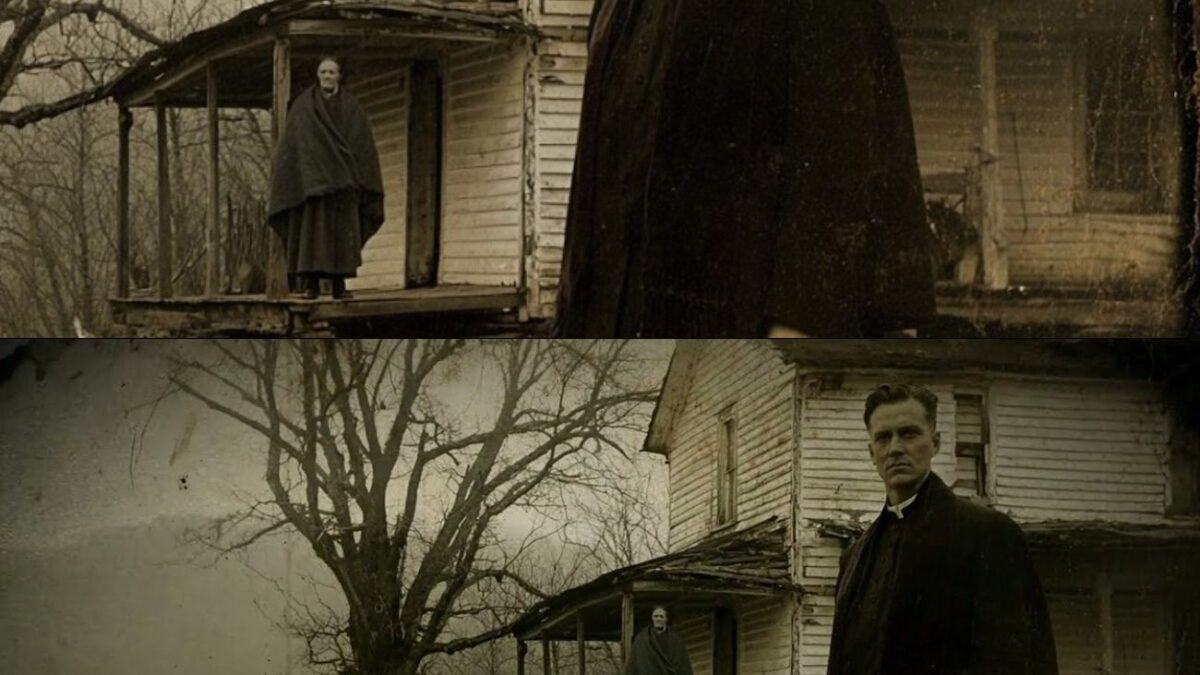
The Exorcist Priest of 1923 Who Left the Church After One Final Confession
There is a kind of silence a man learns to listen for. Not the silence of an empty church. Not the silence after a bell has finished ringing. A different one. The kind that leans against the walls of a room and asks very politely to come in. Father Emmerick Vandelure had heard that silence twice in his life before the winter of 1923. On the third time, he stopped being a priest.
I want you to picture him first. Father Vandelure was 47 years old that winter, not a tall man, not short either. Broad in the shoulders in the way farm boys get broad, which is what he had been before the seminary took him. His hair had gone gray early at the temples, the way ash goes gray at the edges of a fire, before the middle knows what has happened. His eyes were pale, almost colorless, and he was aware of what those eyes did to people. He had learned over the years to soften them. He kept a small parish outside of Wheeling in those days, St. Ottolo of the meadow, a brick church with a slate roof and a bell that had cracked twice and been recast twice. He said his masses. He heard his confessions. He buried his dead. Nothing about him would have told you what else the diocese asked him to do. The bishop had asked and Father Vandelure had said yes. That was all. He had studied the right in Rome. He had assisted, then led, and then been trusted. By the winter of 1923, he had performed the greater rite of exorcism 11 times. Once in Philadelphia, twice in Pittsburgh, three times in the coal region, and the rest in places most people can’t find on a map because the roads that went to them stopped going to them a long time ago.
He kept a small ledger. He wrote each one down. He did not put the details in the ledger. He put the names. He put the dates. He put a small mark next to each one in his own private shorthand. A cross if the person had come through it and lived. A circle if the person had not. A dash if the case had never truly ended. He had six crosses. He had four circles. He had one dash. And on a Tuesday in early December of 1923, a letter came for him that would give him his second dash.
It came in a hand he did not know. The paper was cheap and brown and folded twice. The postmark said Verer Hollow, West Virginia, which he had never heard of. The handwriting was careful, the letters upright and even, the kind of hand a person forms when they were taught late in life and taught only once. It was two sentences long. The first sentence said, “My brother is dying.” The second sentence said, “He wants a priest who has done the rite.” There was no name. There was no signature. There was at the bottom of the page an address that turned out not to be an address in any usual sense. It was directions. Turn off the state road at the second creek, past the burnt mill. Follow the creek up to the split rock. Take the left branch of the road. Two miles. The house is the only one.
Father Vandelure took the letter to his bishop. His bishop was an old man by then, kind in the way old men get kind when they have stopped being afraid of the wrong things. He read the letter. He read it again. He set it on his desk and looked at it for a long time before he spoke. He said, “You have to go.”
Father Vandelure said, “I know.”
His bishop said, “You know something else about this, too. I can see it in you.”
Father Vandelure did not answer. He was not sure yet what he knew. He was only sure that the letter had come and that the letter was for him, and that the third silence he had spent his life listening for was on the far end of those two sentences, waiting.
He left three days later. The train took him as far as Wheeling. From Wheeling he took another train to a town whose name I will keep out of this, out of an old habit that isn’t mine to break. From that town he hired a horse and cart and a driver, a lean man of maybe 35 named Wendell Krider, who did not ask what business the priest had going up into Verer Hollow, and did not talk much on the way.
The road was iron that morning. That is the word Vandelure used later when he wrote it down. Iron. The ground had frozen hard, and the ruts in the road had frozen hard inside their own shapes, and the cart made a sound going over them like a hammer at the far end of a long hall. They rode most of the morning. They stopped once at a stream that had ice at the edges, but water still running in the middle, and the horse drank, and Wendell Krider stood beside the horse, and said without turning around, “You’re the priest they sent for old Silas.”
Father Vandelure said, “I did not know his name until now.”
Wendell Krider said, “Well, now you do.”
Father Vandelure said, “You know him?”
Wendell Krider took a long time to answer. He put his hand on the horse’s flank and left it there. Finally, he said, “I’ve known his sister my whole life. I don’t know him. Nobody does. I don’t think he knows him either.”
That was all he would say. They went on. The hollow was the kind of place a person could pass twice in a day and not see. The mountains around it were low, but they were folded strangely, folded on top of themselves, the way a piece of paper folds when a nervous person can’t stop touching it. The road went in through a gap between two ridges, and after that the sky got smaller. The trees on either side were mostly oak and hickory, and the leaves that were left on them were the color of old copper. The rest of the leaves were down. The rest of the leaves were on the road, and they made no sound. That is what Vandelure noticed first. He had walked through fallen leaves his whole life. Leaves make a sound. These did not. He asked Wendell about it. Wendell said, “Yeah, that’s how it is up here.” He didn’t offer more.
The house appeared where the directions said it would. It was a two-story frame house painted white a long time ago and now more gray than white with a wide front porch and a tin roof and a small stone chimney at each end. There was a barn off to one side and a well and a stone springhouse and a field beyond the barn that had been let go for a year or two, the tall dead stalks of last summer’s corn still standing in it, brittle in the wind. There were no other houses in sight. There was no other sound but the wind and the horse.
A woman was standing on the porch. She was a tall woman. That was the first thing you noticed about her. Tall in the way certain older women are tall, as if their spine had never learned to be sorry about anything. She was wrapped in a dark gray shawl and her hair was white and pulled back and her face was the color of paper that has been out in the sun. She watched them come up the road without moving. She did not wave. Wendell stopped the cart at the foot of the porch steps. He did not get down. Father Vandelure got down. He looked up at her. He said, “I am Father Emerick Vandelure.”
She said, “I know.”
He said, “You wrote to me.”
She said, “I did.”
He said, “May I know your name?”
She said, “Ruth Ottinger. My brother is Silas. He’s inside. He’s not well. He hasn’t been well for a long time. He wants to make his confession. He wants it heard by a priest who has done the rite.”
Father Vandelure said, “Why?”
Ruth said, “You’ll have to ask him that. I don’t ask him things. I haven’t asked him things in nearly 40 years.” She stepped aside. She held the door open.
The inside of the house was warm. A wood stove was burning in the front room, and the windows had heavy curtains drawn over them. And there was a smell in the air that was not any one thing, but seemed to be several things put together: beeswax, wet wool, an old broth, and something under all of it, something that Vandelure could not place, that reminded him faintly of the smell inside an old stone church that has not been aired out in a very long time. Not unpleasant, not clean either.
Ruth Ottinger led him through the front room, past a straight-backed chair with a book of hymns on it, past a mantel with three photographs on it that he did not look at closely, and down a narrow hall to a door at the back of the house. She stopped at the door. She did not open it. She said, “He has good hours and bad hours. This is a good hour. You should go in. If he tires, come out. If I knock on the door, come out. Do not stay past dark tonight. Not for the confession. Tomorrow in daylight is when he wants to say it. Tonight is only to meet you.” She looked at him, then really looked at him. Her eyes were the same pale color as his own, which he had not expected. She said, “Father, one thing.”
He said, “Yes.”
She said, “When he says it, you must not answer him. You must not tell him what he already knows. You must not say the words of the absolution until he has finished. Do you understand me?”
He said, “I understand.”
She said, “I don’t think you do, but you will.” She turned and went back down the hall.
He opened the door. The room was small. A single bed, a chair by the bed, a small table with a cup of water on it, a window with a curtain half open. A man was in the bed. Silas Ottinger was 74 years old that winter. He had been in his working life a lay preacher in a small independent chapel two ridges over and before that a surveyor for the railroad and before that a soldier for a short time in a war that had ended before he was old enough to understand what he had gone off to do. He had never married. He had lived in this house with his sister Ruth for most of his adult life. He had not been seen by anyone from the county in nearly four years. That is what Father Vandelure learned later. That is not what he saw when he walked into the room.
What he saw was an old man in a bed, small, wasted, the skin drawn tight against the bones of the skull, the hair thin and white and slightly damp at the temples. The hands folded on top of the quilt, and the hands were the strangest part. The hands were not the hands of a man of 74. The hands were smooth. The skin on the backs of the hands was smooth in a way that the skin of the face was not, as if the hands had been kept out of the years, as if the years had gone around them.
Silas Ottinger opened his eyes. The eyes were clear, gray, fully aware. He said, “Father.”
Father Vandelure said, “Mr. Ottinger.”
Silas Ottinger said, “Sit.”
Father Vandelure sat. They looked at each other for a long time, long enough that if there had been a clock in the room, the clock would have gone through a full minute of ticking and started on the second. There was no clock in the room. Vandelure noticed that, too. In a house that old, in a room used by a man who could no longer get out of bed, there was no clock.
Finally, Silas Ottinger said, “You’ve done the rite.”
Father Vandelure said, “11 times.”
Silas Ottinger said, “How many of them worked?”
Father Vandelure said, “I don’t answer that question. I’ve never answered it.”
Silas Ottinger smiled. It was a small smile. It was not unkind. He said, “You will.”
Father Vandelure said, “Not tonight.”
Silas Ottinger said, “No, not tonight. Tomorrow in the light, when I can see your face and you can see mine, tonight only sit. I want to know what you sound like when you are not saying anything.”
They sat. Ruth Ottinger did not come to the door. The light in the window went slowly from gray to a paler gray to almost nothing. Father Vandelure, who had sat with dying people for 20 years, understood that this was not the sitting of a dying man. This was something else. This was a man taking his measure. This was a man who had waited a long time for a certain kind of listener and was making sure before he began that the listener could bear it.
At some point Silas Ottinger closed his eyes. At some point after that Vandelure understood he had been dismissed. He stood up. He walked to the door. He put his hand on the doorknob.
Silas Ottinger said without opening his eyes, “Father.”
Vandelure said yes.
Silas Ottinger said, “When you leave this room tonight, walk straight out. Do not stop in the hall. Do not look at the pictures on the mantel. My sister will feed you. Sleep in the room she gives you. If you hear something in the night, do not get up. That is important. Do not get up.”
Vandelure said, “All right.”
Silas Ottinger said, “Good night, father.”
Vandelure stepped into the hall. He closed the door behind him. He walked down the hall. He did not look at the pictures on the mantel. He walked out to the front room where Ruth Ottinger was standing at the stove with her back to him, stirring something in a black pot. She did not turn around. She said, “Wash up. There’s water in the basin in the back room. Supper is in a few minutes.”
He washed. He ate. The food was plain and good: a stew of some kind, dark bread, a small piece of cheese, hot cider. They ate at a small table in the front room. She did not talk. He did not ask her to talk.
After supper, she said, “You’ll sleep upstairs. First door on the left. There’s a lamp. Blow it out before you sleep. Do not sleep with a lamp burning in this house.”
He said, “Why not?”
She looked at him. She said, “You’ve come this far, father. Trust me on the small ones.”
He said, “All right.”
He went upstairs. The room was small and clean and cold, a narrow bed, a washstand, a crucifix on the wall above the bed, which surprised him. A chair with his valise on it, which he did not remember bringing up. Someone had brought it up while he was eating. He undressed slowly. He knelt beside the bed. He said his usual prayers. He got into the bed. He blew out the lamp. He listened.
For a long time he heard only the wind and the beams of the old house settling and once far off a dog. Then he heard from downstairs from the back of the house the sound of Silas Ottinger’s door opening. Then the sound of it closing. Then footsteps in the hall. Then footsteps on the stairs. Then footsteps in the hall upstairs coming toward his room. Then the footsteps stopped outside his door.
He did not get up. He remembered what Silas had said. He did not get up.
He heard breathing on the other side of the door. He heard the doorknob turn very slowly, not hard, not testing, just turning it all the way and holding it there as if the person on the other side was waiting to see whether he would react. He did not react. The doorknob turned back to its resting position. The footsteps went away down the hall. The footsteps went back down the stairs. The door at the back of the house opened and closed, and then there was quiet, and Father Vandelure, who had done the rite 11 times and had heard the third silence twice before in his life, understood that he was hearing it now for the third. He did not sleep, but he did not get up.
In the morning at breakfast, Ruth Ottinger poured him coffee and did not mention the night. He did not mention it either. He said, “Your brother said he wanted a confession in daylight. What hour does he mean by daylight?”
She said, “10. When the sun comes over the ridge and gets in his window, he’ll ring the small bell by the bed when he’s ready. Go in when you hear it.” She paused, then said, “Father, may I ask you a question?”
He said, “You may ask. I may not answer.”
He said, “Last night, there were footsteps in the hall.”
She looked at him. She did not answer at once. She stirred her coffee, though she took it black. She said, “My brother has not been out of that bed in three years, father.”
He said, “I know.”
She said, “So no. There were no footsteps in the hall last night.”
He said, “All right.”
She said, “Eat.”
The sun came over the ridge a little after 10:00. Vandelure heard the small bell. He had spent the two hours before that in the front room with his breviary open on his knee, though he was not reading it. He was preparing himself. That is what he told himself. In truth, he was doing what he always did before the rite. He was making himself very small. He was making himself very still. He was reminding himself of the one thing he believed above everything else, which was that the priest is not the strength in the room. The priest is only the doorway. Whatever comes through him comes from the other side of him. His job is to keep the doorway open. His job is not to speak.
He walked down the hall. He did not look at the pictures on the mantel this time either. He opened the door of the room at the back. Silas Ottinger was sitting up in the bed. The sun was on his face, coming in through the window, as Ruth had said it would. He looked in that light both worse and better than he had looked the night before: worse, because the sun made no allowance for the sunken places in his face; better, because his eyes were the eyes of a man who had made up his mind.
He said, “Father.”
Vandelure said, “Mr. Ottinger.”
Silas said, “You had a visitor last night.”
Vandelure said, “I did.”
Silas said, “You did not get up.”
Vandelure said, “I did not get up.”
Silas said, “Good. That was the test. If you had gotten up, I would have sent you home this morning. There is no confession for a man who gets up. You will hear me because you did not get up.” He motioned to the chair. Vandelure sat.
Silas said, “Do you know why my sister told you not to look at the pictures on the mantel?”
Vandelure said, “No.”
Silas said, “Because two of them are not who she says they are, and I don’t want you distracted. Not by that. Not before.”
Vandelure said, “All right.”
Silas said, “Put your stole on, father.”
Vandelure took the violet stole from his valise. He kissed the small embroidered cross at its center. He put it around his neck. He crossed himself. He said, “In the name of the Father and of the Son and of the Holy Spirit.”
Silas said, “Amen.”
Silas said, “Father, my last confession was in the year of our Lord 1886, in a chapel that is not there anymore, made to a preacher who is not alive anymore. I have not confessed in 37 years. There are reasons for that. I will tell you the reasons. When I have finished, you will do what you were sent to do or you will not. I will not hold it against you either way.”
Vandelure said, “Say what you need to say.”
Silas closed his eyes. He said, “In the summer of 1884, in my second year, I had a farm of my own. The corn burned in the field. It burned twice: in June from the sun, in August from a fire that started I don’t know how, though I have thought about it every day since. I had a mortgage. I had a note at the bank in town. I had a sister who was living with me because our parents were dead by then and there was no one else. If I lost the farm, we would have gone on the county. Do you know what the county was in 1884?”
Father Vandelure said, “I have some idea.”
Silas said, “You have some idea. Yes. So, there was a man in the hollow in those days, not in this hollow, in the next one. His name I will not say. His name was not a name people like to say. And I have not said it out loud in almost 40 years, and I am not going to say it now because if I say it in this room, the room will hear me. Do you understand?”
Vandelure said, “I understand.”
Silas said, “I went to him not for money, not for gold, nothing like that. I went to him because there was a thing he could do that people who had been to him could do afterwards. He could put a small thing into the ground of a farm. He could put it under the corner post of the barn or under the sill of the front door or into the mouth of the well. And when the small thing was in the ground, the farm did not fail. Not that year, not the year after, not ever until the man of the farm was ready to give it up.”
Vandelure did not speak. This is the thing to remember about him in this moment: he did not speak. Ruth had told him not to speak. Silas had told him not to speak. He did not speak.
Silas said, “I gave him what he asked. It was not a large thing. It was not a soul. Father, I want to say that plain. Nothing so big. It was a smaller thing. It was a piece of the smaller life a man lives inside the bigger one. A piece of the time you spend on the porch in the last hour of the day. A piece of the quiet in your own kitchen when no one is talking. A piece of the sleep of a man who is not afraid. He took that from me. He put the small thing under the sill of my door. And my farm did not fail.”
Silas opened his eyes. He looked at Vandelure. He said, “That is the first thing I have to confess. That is the small thing. That is the thing I could have confessed to any preacher. That is not why you are here.”
Vandelure still did not speak.
Silas said, “When I was 41 years old in 1890, I was called to a house four ridges from here, a cousin of mine on my mother’s side, a woman named Alfield Roberg. She had married a man from up there. Her husband had died in the spring. Since his death, she had been troubled. Not sick. Troubled. The kind of trouble a preacher can smell before he can name. The chapel had no one to send. They sent me because I was a lay preacher then, and because I was blood. I did not do the rite, Father. I did not know the rite. But I did what I had learned from other men, from what I had read of other men. I prayed over her. I read the Psalms over her. I laid my hand on her forehead and I called on the name that is supposed to make these things go. And it worked, Father. I want to tell you it worked. She sat up. She looked at me clear. She said, ‘Thank you.’ She lived another 22 years. She died in bed of a bad heart. Ordinary, a death like most deaths.”
Silas swallowed. He said, “I went home that night. I slept a good sleep. In the morning, I went out to the barn to feed the horse, and there was something in the barn. Not a shape, not a figure, something in the corner of my eye, in the corner of the barn, in the place where the two beams meet the loft, something waiting, something that was pleased to see me, not glad, pleased, like a guest at a door.”
Vandelure, who understood now what he was hearing, held very still.
Silas said, “I did not think that first day about the small thing under the sill of my door. I did not connect them. Why would I? One was in 1884 and the other was in 1890. But over that year and the year after I began to notice anywhere I had prayed a bad thing out of a person, the bad thing came home with me. And where did it go, father? Where do you think it went? It went under the sill of my door. It went to the small thing that was already there. And the small thing kept them. The small thing was a house for them. My farm did not fail because my farm was a house for them.”
Silas opened his hands on the quilt. The smooth backs of the hands were turned up. The palms were up. The palms were rough. He said, “For 33 years, Father, I have been the doorway, not the priest at the door, the door itself. Every time I went out to a house where there was trouble, and I did what I had learned to do, the trouble came home with me. And under the sill of my door, there is a small thing that is not small anymore.”
Vandelure still did not speak.
Silas said, “That is not the confession, Father. That is only the outside of it. That is the part I could have told a man who was a stranger to what I am telling you. Now I am going to tell you the inside of it. I am going to tell you the part that is for you. Because you are here because you have done the rite 11 times, because you are the one my sister wrote for.”
Silas leaned forward. It cost him. The bones of him moved under the loose skin. He said, “Father, I will tell you what the man in the next hollow told me in the summer of 1884 when I asked him what the small thing was that he was going to put under the sill of my door. He said, ‘It is a listener.’ He said, ‘It listens for a name.’ He said, ‘You will not know the name, but the small thing will know it. And when the small thing hears the name spoken over your roof, the small thing will open. And what is on the other side of the name will come and it will stay.’ He said, ‘You will not have to feed it. It will feed on the fact of you. And after you, it will feed on the fact of the next.'”
Silas paused. He was struggling for breath. Vandelure reached for the water on the small table and held it to his lips. Silas drank.
Silas said, “Thank you, Father.” Then he continued, “The name, Father, the name it listens for. I did not know it in 1884. I did not know it in 1890 when I first prayed over my cousin. I know it now. It has been 33 years, and I know it now. And I know it because the small thing under my sill has been saying it quietly every night for 33 years, and eventually a man learns to hear.”
Silas smiled. He said, “The name is the name of the rite you have done, Father. The name is the Latin word your bishop taught you. The name is the name that means in your church to cast out.”
Silas closed his hand around Vandelure’s wrist. The hand was very cold. Vandelure did not pull away.
Silas said, “Every time you have done the rite, Father, you have not cast anything out. There is no out. You have opened a door and on the other side of that door there is a small thing under the sill of a house. And the small thing knows your name now. And the small thing has kept the thing you thought you cast out. And the small thing is not under a sill in this hollow only. Father, do you understand me? There is a small thing under a sill in 11 houses, in 11 towns, in 11 counties, in 11 states, wherever you have said the words. And they are all keeping. And what they are keeping is not gone. It is only kept.”
Silas let go of his wrist. He said, “That is my confession, Father. I did not know when I began. I know now. I have kept it here for the last four years because I did not know who to give it to. My sister wrote to your bishop because I told her to. Your bishop sent you because he did not know any of this and because he thought this was a dying old man asking for a priest who could handle the smell of the room. And he was right about the smell of the room, father, and he was wrong about the rest.”
Silas said, “Now say the absolution or do not. I will not hold it against you either way. I am tired. I am going to sleep. When I wake up, if I wake up, my sister will tell me what you said.” He closed his eyes.
Father Emerick Vandelure sat in the chair with his violet stole around his neck for a very long time. He did not say the absolution. He did not say anything at all.
After some length of time that he did not measure, he stood up. He folded his stole. He put it back into the valise. He walked to the door. He walked down the hall.
This time on the way out he did look at the pictures on the mantel. There were three pictures. The one in the middle was Ruth Ottinger and Silas Ottinger standing together in front of the house in what looked like the summer of maybe 1892, both of them young, Ruth’s hair not white yet, Silas standing straight and the hands of him at his sides, and the hands of him already, in that picture already, smooth in a way the rest of him was not. The picture on the left was a man in a soldier’s coat. The picture on the right was also a man in a soldier’s coat, but it was a different soldier’s coat, and it was not a war from a time he could name.
Ruth was standing in the front room when he came out. She had her back to the stove and her hands folded in front of her. She looked at him and saw whatever she needed to see and nodded once.
She said, “You didn’t say it.”
He said, “No.”
She said, “Good.”
He said, “Miss Ottinger, the two pictures on the mantel, the soldiers.”
She said, “One of them is our older brother. He went to the war in 1862 and did not come back. The other one—” She did not look at him now, only at her own hands. “The other one is not our brother. It has been on the mantel since the summer of 1891. I did not put it there. Silas did not put it there. It came in the night. I have taken it down 11 times. It comes back. I stopped taking it down.”
He said, “11.”
She said, “Yes.”
He said, “When was the last time?”
She said, “The morning of the day your letter reached us saying you were coming.”
He said, “All right.” He said nothing else.
He picked up his coat from the peg by the door. He put it on. He picked up his valise. He looked at her one more time.
She said, “Do not come back, father. You do not owe us a return.”
He said, “I know.”
She said, “And do not please do the rite again. Not one more time. If you do it once more, we will feel it, my brother and I, under our sill. That is how we will know you have done it. That is how we will know what house it has gone to.”
He said, “I will not do the rite again.”
She said, “Thank you.”
He went out. Wendell Krider was waiting at the foot of the porch steps with the cart. He did not ask what had happened inside. He waited for Vandelure to climb up. He clucked to the horse. They went down the road.
At the split rock, Wendell said without turning, “He told you then.”
Vandelure said, “Yes.”
Wendell said, “Every 10 years or so, somebody comes up out of that hollow with that look on them. My father brought a man out of there in 1911 with that same look. Never asked him what it was. Not once. My father died two years later in his sleep in his own bed, and I like to think it was on account of him not asking.”
Vandelure said, “That is probably wise.”
Wendell said, “Yes, sir. I thought so.”
They rode. Father Vandelure was gone from that hollow by dark. He was back in Wheeling within the week. He said Mass on the Sunday. He said the mass carefully and slowly, and he did not, at the elevation, look up at the wooden crucifix above the altar. He could not have said why. He only knew he could not.
He kept his parish through the winter and into the spring. He did not tell his bishop what Silas had said. He did not know how to tell it. He did not know honestly whether he believed it. He knew only two things. He knew that he had not said the absolution over a dying man for the first time in his life, and he knew that he had made a promise to Ruth Ottinger, and that of the two things he was more afraid of breaking, the promise was the one that held him anchored to the earth.
As spring deepened into summer, the letters from the diocese stopped asking about new assignments, and the ledger remained locked inside his desk drawer, untouched and gathering dust. Father Vandelure lived out his days in quiet isolation within the parish bounds, tending to the routine needs of his flock, never lifting his voice in the ancient Latin of expulsion again. He passed away quietly in his sleep many years later, an old man whose hands, unlike Silas’s, bore the honest wrinkles and stains of time, carrying his secret silently to the grave, while out across the distant hills and counties, eleven separate houses stood silently under the sun, each guarding beneath its threshold a small, unmoving thing that waited patiently in the dark, listening for a name that would never be spoken again.

