The Doyle Family of Ravens Bend 1885 NC Neighbors Called Thm Cursed the Court Called them Dangerous
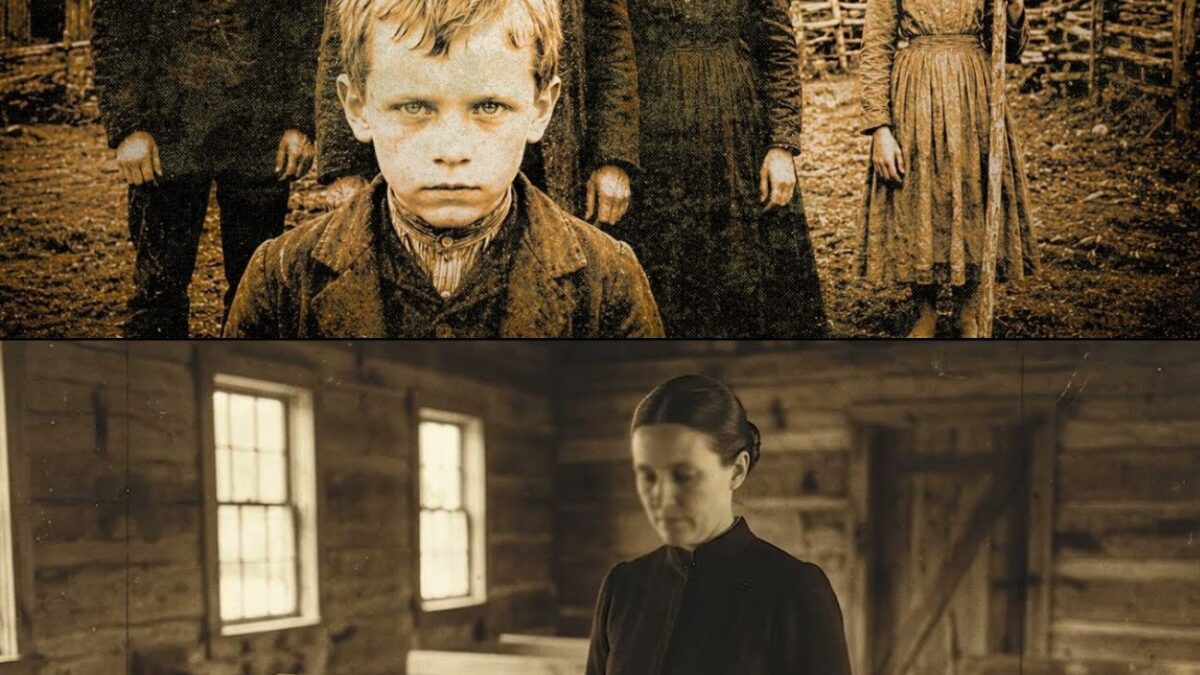
The Doyle Family of Ravens Bend 1885 NC Neighbors Called Thm Cursed the Court Called them Dangerous
The sheriff of Raven’s Bend rode out on the morning of October 9th, 1885, with three deputies and a warrant folded inside his coat pocket. He had signed the paper himself the night before, and he had not slept since. The Doyle farm sat two miles up the ridge, past the old iron bridge, past the burned church, past the boundary line the county had drawn in blue ink on a map nobody outside the courthouse had ever seen. When the sheriff reached the gate, he found it standing open. He found the front door standing open. He found the kitchen table set for seven, the food still warm, the chairs pushed back as if the family had risen mid-meal. But the Doyles were gone, every last one of them.
Raven’s Bend was not a town in 1885. It was a scatter of tobacco farms and split-rail fences pinned to the western slope of Buckhorn Ridge in what the mapmakers of the day called Caldwell County, North Carolina. The nearest railhead was thirty-one miles down the mountain at Hickory Station, and the road that connected them was a wagon track that turned to red clay soup between the first frost and the last thaw. The people who lived on that ridge counted themselves in three ways. They counted themselves as Baptist or Methodist. They counted themselves as descended from the Ulster men who came over the Blue Ridge in 1760-something. And they counted themselves as either Doyle or not Doyle.
Because for as long as anyone on that ridge could remember, the Doyle family had lived at the top end of the hollow in a two-story timber house with a slate roof that no other family in the county could afford, on land that had been surveyed in the 1790s by a man whose signature nobody could quite read. The deed itself was strange. It named the grantor as the crown, not the state of North Carolina, and it predated the county by forty-one years. When the Doyles were asked how their people had come to hold crown land after the revolution, they gave an answer that never varied. They said the land had been given, not sold, and that the giving had been recorded in a book that was not kept at the courthouse. Nobody pressed the point. The Doyles paid their taxes in silver coin every January, and the coins were not United States mint. They were older; some bore the profile of a queen the assessor had never heard of. The county took them anyway, because silver was silver, and because nobody on the ridge wanted to be the one to knock on the Doyle door and ask questions the family did not care to answer.
The father was named Ephraim Doyle, and in the fall of 1885, he was fifty-three years old. The mother was named Cass, short for a longer name that appeared in the family Bible in a script so ornate the census taker had simply written down what he heard. There were five children. The eldest, a daughter named Bess, was twenty-two and unmarried, which itself was cause for gossip in a county where most girls were wed by seventeen. Then came the twin boys, Elder and Mercer, both nineteen, both taller than any man in the valley below. Then a middle daughter, Rue, who was fourteen and rarely seen off the property. And finally the youngest, a boy of seven named Ansel, who had never, so far as any neighbor could recall, spoken a single word in the presence of another human being. Seven mouths at the table when the sheriff arrived. Empty chairs pushed back. Seven plates of biscuits and salt pork left cooling in the October air.
The rumors about the Doyles were the kind that a mountain community grows the way a chestnut grows burrs, slowly and thickly and without any single person planting them. One rumor said the family did not cast reflections in the still pool below the mill dam. A boy named Oliver Weeks swore in the spring of 1883 that he had seen Vestal bend over the water to fill a bucket and had seen the bucket fill and had seen no face looking back up out of the surface. He told his mother and his mother told the preacher and the preacher told him to stop drinking his uncle’s cider. But the boy stuck to his story until he died of pneumonia the following winter, still swearing on his last breath that the pool had shown him nothing where a face should have been.
Another rumor said that the Doyle livestock never sickened, never. Not in the barren year of 1879 when half the county lost its cattle. Not in the wolf winter of 1882 when farmers below the ridge were shooting their own hogs to keep them from starving. The Doyle cows stayed fat, the Doyle horses stayed sound, the Doyle chickens laid through December. And a third rumor, the one that traveled the furthest and the fastest, said that the Doyle house had rooms in it that were not on any surveyor’s plat. Men who had gone up there to trade for silver or to buy a bull calf reported the same thing when they came back down. They said the front hall was longer than the house was wide. They said the stairs turned in a direction the outside of the building did not permit. They said the little boy Ansel would stand at the top of those stairs and watch them and that when they left, the boy would still be watching and the door would close on its own behind them.
The man the county sent to look inside that long hallway for himself was a tax assessor named Palmer Hoke. He was forty-six, a widower, a Union veteran who had lost two fingers at Cold Harbor, and by every account he was the least superstitious man in the county. Palmer Hoke did not believe in ghosts. He did not believe in curses. He believed in the ledger, in the survey chain, and in the sworn deposition. In August of 1885, the county commissioners voted quietly in closed session to reassess the Doyle property. The vote was three to two. The reasons given in the minute book were dry and administrative. The Doyle acreage on the tax rolls did not match the acreage described in the deed. The deed said 160 acres. The rolls said 160 acres. But when the county surveyor had ridden the property line the previous May, chain by chain, marker stone by marker stone, he had come up with 241 acres. Eighty-one acres more than the deed described. Eighty-one acres that did not appear on any older map, and that could not, by the geometry of the ridge itself, actually fit inside the boundary the deed set out. The commissioners wanted Palmer Hoke to go up there and figure out where those eighty-one acres had come from, and to bill the family for the back taxes owed on them.
Hoke rode up on a Tuesday morning. He was received at the front porch by Ephraim Doyle himself, who offered him coffee and did not seem surprised to see him. Hoke laid out the survey figures on the porch table. Ephraim listened without interrupting. When Hoke was finished, Ephraim said only that the assessor was welcome to walk the line himself right that morning, and that a Doyle would go with him to keep him from getting turned around. The Doyle who went with him was the middle daughter, Rue, the fourteen-year-old girl who was almost never seen off the property. She wore a gray dress and no shoes, and she carried a walking stick that was taller than she was.
Palmer Hoke wrote a report about that walk. He filed the report with the county on August the 29th. The report was seven pages long. The first five pages were ordinary. Compass bearings, tree blazes, creek crossings, the usual language of a county survey. It was the sixth page where the assessor’s handwriting began to change. It grew tighter, more cramped, as if he had been writing faster and with less confidence. On the sixth page, Hoke described crossing a stone wall he had not seen from the outside of the property. He described walking along that wall for what his pocket watch told him was fifty-two minutes. He described the wall ending at a set of stone steps that led downward into the hillside. And he described the girl Rue stopping at the top of those steps and telling him, in a perfectly polite voice, that this was as far as the assessor’s authority extended. On the seventh page, Hoke wrote a single paragraph. He wrote that when he turned back from the stone steps to return to the house, the walk that had taken him nearly two hours to complete on the way out took him eleven minutes on the way back. He wrote that the sun was in the same position when he reached the porch as it had been when he left it. He wrote that his pocket watch, which had been running fine that morning, was now stopped at seven minutes past ten, and that it never ran again for the remainder of his life.
Palmer Hoke did not go back up the ridge. He submitted his report, collected his fee, and requested reassignment to the assessment district on the far side of the county. The commissioners read the report in closed session. They did not enter it into the public record. They did, however, on September the 4th of 1885, request that the county attorney, a man named Byron Latch, draw up papers to condemn the Doyle property under the doctrine of public nuisance. The papers cited three grounds. The first was tax fraud. The second was the harboring of unregistered structures. The third, and this was the grounds that would follow the Doyle family into every telling of the story that came after, was the one the attorney phrased in careful Latin so that the newspaper would not print it plainly. He wrote that the property constituted a locus alienus, a foreign place, a place that was, in the eyes of the court, not properly part of the county at all.
Word of the condemnation papers reached the ridge before the sheriff did. That much is certain, because on September the 22nd, three weeks before the raid, a farmer named Cletus Sample came down off the mountain with a story he could not stop telling. Sample had been up on the high pasture rounding strays. He had passed within sight of the Doyle house at dusk. He said the windows were all lit, every window on both floors, and that the light coming out of them was not the color of lamp oil. It was, he said, the color of a winter moon seen through river ice, pale and cold and moving. He said he heard singing, not him singing, not English. He said the voices were high and low at the same time, the way a hive of bees sounds if you press your ear to the wood. And he said that when he looked at the house too long, the roof line seemed to bend, the way heat bends the air over a stove in July. But the day was cold, and there was no fire, and no reason for the air to bend at all.
The sheriff of Caldwell County that October was a man named Barnabas Rill, elected the previous November on a platform of restoring order to the high hollows. Rill knew about the condemnation papers. He had known since Byron Latch drew them up. He had not been eager to serve them and he had told the commissioners as much in a private meeting on the evening of October 7th. What changed his mind was a letter. The letter arrived at the sheriff’s office on the morning of October 8th, delivered by hand by a boy from the ridge who would not give his name. The letter was addressed to Sheriff Rill personally. It was written in a hand the sheriff did not recognize, on paper his deputies later described as thicker and softer than any they had ever handled, almost like fine kidskin.
The letter contained four sentences. It said that the family at the top of the hollow would be leaving on the morning of the 10th. It said that the house and all its contents would be left as they stood. It said that any man who entered the house before the 10th would be welcome and any man who entered after the 10th would find nothing to enter. It said that Sheriff Rill was invited to bring the condemnation papers if he wished, but that he should understand the papers would have no force on the property after sundown of the 9th. The letter was signed with a single initial, a capital D drawn in ink that the sheriff’s clerk examining it later under a lamp would swear was not quite black and not quite any other color he could name.
Sheriff Rill signed the warrant that night. He rode out at dawn on the 9th with three deputies. He wanted to arrive before the family could leave. He wanted, in his own later testimony to the commissioners, to see for himself whatever there was to see. The ride up took an hour and forty minutes. The morning was cold and still. The horses were skittish for the last mile, and one of the deputies later said that the birds had stopped singing when they crossed the iron bridge and that the woods on either side of the wagon track had gone as quiet as a tomb. When they reached the gate, the gate was open. When they reached the door, the door was open. Then they reached the kitchen. The fire in the stove was still burning low, and the food on the table was still warm to the touch. Seven plates, empty cups, seven chairs pushed back at angles, as if the people who had been sitting in them had stood up all at once and walked out together. There was no sign of struggle. There was no sign of packing.
In the bedrooms upstairs, the beds were made. The clothes were folded in the trunks. The children’s shoes were lined up beside the door. The family Bible was open on the parlor table, open to a page in the book of Second Kings, and someone had underlined a single verse in what looked like fresh ink. The verse was the twenty-second verse of the sixth chapter: “And the chariot of fire, and the horses of fire, and they went up by a whirlwind into heaven.”
Sheriff Rill and his deputies searched the house room by room. They counted the rooms as they went. Downstairs, they found the kitchen, the parlor, a pantry, a small back room used as a workshop, and the long hall that ran from the front door to the back. Upstairs, they found four bedrooms and a linen closet. That was nine rooms in total, not counting the hall. Nine rooms for a two-story timber house on a stone foundation. The sheriff went outside and walked the perimeter of the house and counted the windows. He counted twenty-two windows. The rooms he had walked through inside should have accounted for sixteen. That left six windows on the outside of the house that did not open into any room he had been able to find.
He went back inside. He measured the front hall with the length of his own boot, heel to toe, the way a countryman measures a length of rope. The hall came out to fifty-one boot lengths. He went back outside and measured the front of the house the same way: thirty-eight boot lengths. The hall inside the house was thirteen boot lengths longer than the house was wide, and the house was not deep enough to account for the difference. One of the deputies, a young man named Ford Whitaker, went back into the hall and began knocking on the wall panels. On the fourth panel from the back, the sound changed. It went from the solid thump of wood over stud to the hollow report of something empty behind. Whitaker got a pry bar from his saddlebag and worked the panel loose.
Behind it was a door. The door was made of a wood none of the men could identify, dark and close-grained, and it had no hinges on the outside and no handle. It had, instead, a single circular disc of what looked like polished brass set at eye level, with markings around its edge that Sheriff Rill later described in his report as being neither letters nor numbers, but something in between. The deputies wanted to open the door. Sheriff Rill did not let them. He would say afterward, in the closed session of the commissioners on October the 14th, that he had stood in that hallway looking at that brass disc and had felt for the first time in his life that he was being watched from a place he could not see. He ordered the deputies out of the house. He ordered the panel replaced. He ordered the front door closed and the gate closed behind them, and he rode back down the ridge with the warrant still folded in his coat pocket, unserved, because there was nobody left on the property to serve it to.
That night, the 10th of October, at some point between sundown and sunrise, the Doyle house burned to the foundation. There was no wind that night. There was no lightning. The nearest neighbor, a widow named Elma Church, who lived a mile and a half down the ridge, said she woke sometime after midnight to a light so bright coming through her window that she thought the sun had come up wrong. She went to the window and looked out. The light was not coming from the sky. It was coming from the direction of the Doyle place, straight up, a column of pale blue that stood as high as she could see and did not flicker. It lasted, by her count, the length of time it took her to say the Lord’s Prayer through twice. Then it was gone, and the sky was dark again.
And in the morning, the Doyle house was a foundation of black stone and a chimney standing alone against the hill. The county investigation lasted three months. It concluded on the 15th of January, 1886. The commissioners ruled the fire was of unknown origin. They ruled the Doyle family legally absent and that the property, having no living claimant and no valid deed any American court could enforce, would revert to the county in one calendar year. The foundation was left where it stood. The chimney was left where it stood. No one went up to walk the property line again. The eighty-one anomalous acres were quietly dropped from the tax rolls the following summer, and the map that had shown them was, per a note in the register’s office, misplaced during a routine reorganization of the files.
And that would be the end if this were only a story about a family that vanished from a mountain in 1885, but it is not. Because in the archive of the North Carolina Genealogical Society, in a folder marked only with the number 412, there is a photograph. It is dated 1897, twelve years after the raid. It was taken at a train station in St. Louis by a photographer named Aldus Sperry. In the background, standing on the platform, is a family of seven. A tall father with a beard gone gray, a mother in a plain dark dress, two identical young men, a daughter in her thirties, a younger woman in her twenties, and a boy of perhaps seven looking directly into the lens with an expression Sperry described as unsettlingly aware. The family does not appear in any manifest or passenger list that week. But the photograph exists, and the little boy in it is a dead match, feature for feature, to a sketch of Ansel Doyle drawn by a school teacher in Caldwell County in the spring of 1885, when the boy was seven years old. Twelve years earlier. Twelve years, and the boy had not aged a day.
Raven’s Bend is not on any map now. The post office closed in 1914. The last farm was abandoned in 1931. If you drive up what used to be the wagon track today, and you know where to look, you can still find the stone foundation. The chimney is still standing. The property line the county surveyed is still there, marked by the old blaze trees, and the ground inside that line is quiet in a way the ground outside it is not. No birds nest in it, no deer beds down in it. And on certain nights in October, according to the two or three families that still live within earshot of the ridge, you can hear something moving up there. Not footsteps, no voices. Something that sounds, if you listen long enough, like a chair being pushed back from a table. Seven chairs pushed back, one after another, by hands that left the table a long time ago, and never quite arrived anywhere else.
Decades passed, swallowing the remaining traces of the old path until the briars and the mountain laurel claimed the clearing entirely. Yet, every autumn on the ninth day of October, the local folklore records that the temperature at the peak drops sharply by ten degrees, and a faint, sweet smell of woodsmoke and old cedar drifts down the hollow where no hearth has burned for over a century. Those who stumble upon the charred clearing by accident report that their compasses spin wildly out of control, pointing toward a void in the timber line that is neither north nor south, but deep into a quiet, forgotten territory that time itself forgot to close behind them.

