The Deranged Story of the Weepers (1890, Ozarks) — They Set a Chair Out Every Evening
The Deranged Story of the Weepers (1890, Ozarks) — They Set a Chair Out Every Evening
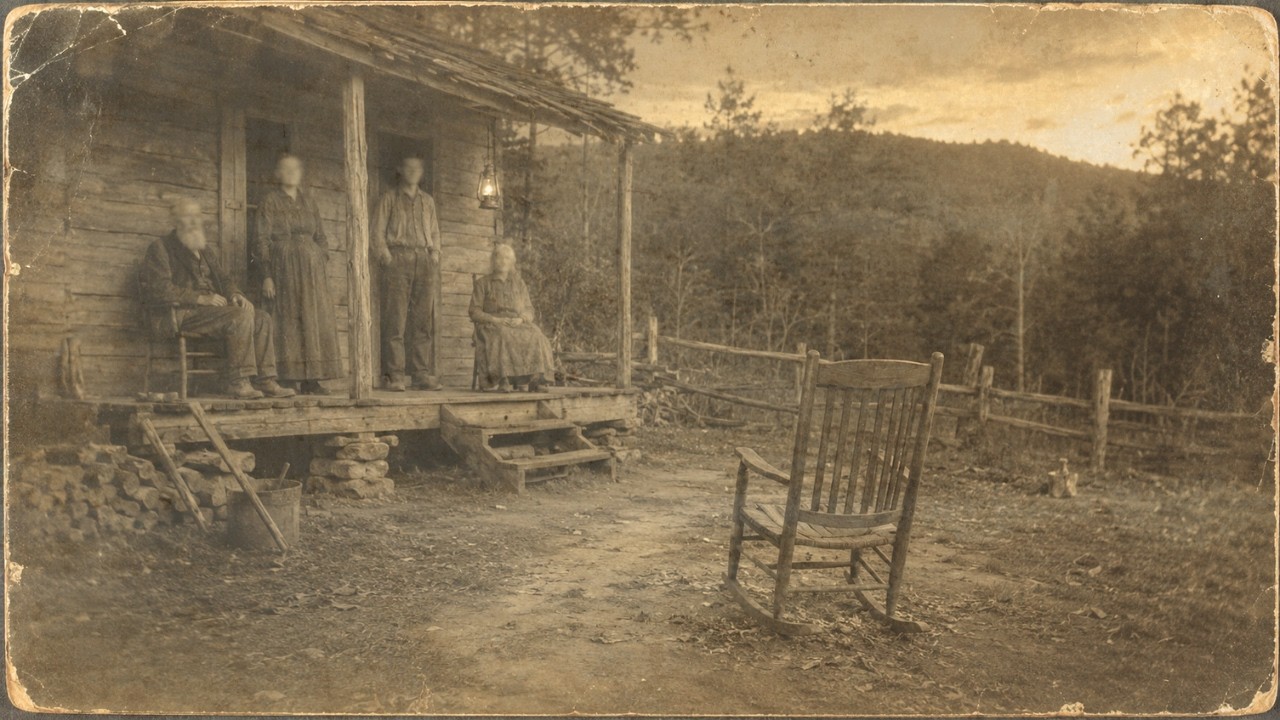
Have you ever fed a stranger at your table and felt, somewhere beneath the ordinary business of passing bread and filling a cup, that the act of feeding was doing something you did not intend? Not generosity going out of you, but something coming in. As though the hunger at your table were not only in the body of the person you had invited, but in the walls of the room itself, in the grain of the wood and the stone of the hearth, and that what you had really done by opening the door and setting down the plate was to make an agreement you had not yet read.
Have you ever watched someone eat at your table and understood very slowly across the course of a long meal that they were not eating the food? There is a hollow in the western reach of Harlan County, Kentucky, where they still do not leave food on the table after dark—not covered, not locked away, gone, off the table, off the boards, out of the room before the sun is down. The oldest people there will tell you it is habit. They will tell you their mothers did it and their mother’s mothers did it, and they do not know why. But if you ask the right person on the right evening when the dark is coming down the ridge and the fire has burned to red and there is nobody else in the room, they will lean forward and they will say one name to you, and then they will say it is a long story. I am going to tell you the long version.
Settle in, get comfortable, get warm, get something to eat if you are hungry, and eat it before we go too far, because by the time we are done tonight, you may not want to eat at a table in the dark. This is the story of the Soul family of Trace Creek Hollow, Harlan County, Kentucky. It begins in the winter of 1877, which is how they reckon it, though the thing that started in that winter had roots that went down into the ground of that hollow considerably longer than anyone in the family understood at the time. It ends in 1921 when a woman named Leora Soul, the last of that line to live in the hollow, packed what she could carry in a flour sack and walked out of that place on a February morning without looking back, and never told her children why, only that the house had been given away. That is her word for it, found in a letter she wrote to her sister in 1944 when her sister asked after all those years what had really happened. The house was given away. That is all she would say.
Between those two dates there are 44 years, four generations of a family, and a record that should not exist but does: assembled from a county death book, three church ledgers, one family Bible with notations in four different hands, a statement given to a circuit-writing minister in 1883, a schoolteacher’s diary from 1891 to 1897, and a set of 17 letters written by a woman named Kora Soil between 1902 and 1919. I am going to tell you what is in all of them. Everything I say comes out of one of those sources or out of the land records and court files of Harlan County, Kentucky, which are held in the basement of the courthouse in Harlan, and which I have spent considerable time in. When I am speculating, I will say so. When two sources disagree, I will tell you both versions and let you sit with the difference, because in a case like this, the disagreements are not problems to be smoothed over; the disagreements are the case.
Let me give you the place first before I go on. Harlan County sits in the far southeastern corner of Kentucky, pushed up against the Virginia line in the last fold of the Cumberland Mountains before they run out of room. It is coal country now and was timber country then, and before that it was hunting ground that three nations of people had kept deliberately empty of settlement for a very long time. Not because there was nothing there worth settling on, but because there was something there that made settlement unwise. The old accounts used different words for it. The Cherokee had a word. The Shawnee had a different word. The first white settlers who came up the Cumberland River Road in the 1790s had no word for it at all, only a feeling that the ground in certain hollows was looking back at them, and most of them moved on. The ones who stayed built in the open on the ridges, on the valley floor, along the rivers where the light came in even and all day. They built their churches on high ground. They left the deep hollows alone. But people come; they always come. Land is land, and hunger has no long memory for warnings. And by 1860, the deep hollows of Harlan County had families in them, and by 1870, most of those families had been there long enough to have stopped asking why their grandparents had chosen the high ground instead.
Trace Creek Hollow runs northeast off the main stem of Clover Fork for about two and a half miles before it closes at the headwall. It is narrow, no more than 200 yards wide at the mouth and pinching down to perhaps 80 at the back, with walls that go up steep enough that the sun only hits the floor of it directly for about four hours in midsummer, and in December not at all. The creek that runs through it, Trace Creek, comes out of the headwall over a shelf of sandstone and runs down the middle of the hollow in a channel it cut a long time ago, and it is cold even in August—cold enough to ache your hand, cold enough that the cress growing along its banks stays green in winter when everything else is gray.
There is a spring on the east wall of the hollow about three-quarters of a mile in. It seeps out of a crack in the rock at about four feet off the ground and runs down the face in a dark stain and collects in a stone basin that somebody cut before the county existed. That basin is the reason the Souls built where they built, because a spring at four feet is a spring you do not have to dig for, and a spring that has been there long enough for someone to cut a basin is a spring that has never gone dry. I want you to remember that spring. It comes back in this story several times, and each time it comes back, what is in the basin is different from what should be there.
The Soul family arrived in Trace Creek Hollow in the spring of 1851. The head of the family was a man named Gideon Soul, 43 years old, born in Bledsoe County, Tennessee, son of a tanner who had come up from the Carolinas a generation before. He was a large, deliberate, God-fearing man who had made a decision to follow a cousin’s report of good bottomland in Kentucky and had gotten instead two and a half miles of shadowed hollow with 70-odd acres of flat ground at the base of a headwall. He was not a man who turned around; he built. His wife was a woman named Patience Soul, née Combs, 39 years old, born in Letcher County, which is the next county over, which meant she was mountain-born and knew what a hollow meant, and said so. She said so more than once, according to the family Bible, which contains not only the births and deaths of the Soul line but a set of marginal notations in a woman’s hand that are not scripture and are not exactly history, but are something between the two, written across 50 years in the same careful hand, growing smaller and closer as it went, as though the writer were trying to fit more truth into the same amount of space.
The first notation in the margin beside the record of Gideon Soul’s death in 1863 reads that he should have listened the first winter. I will tell you what happened the first winter in a moment, but I want to give you the rest of the family first because you need to know who is in this house before the first winter comes. Gideon and Patience Soul had six children. The first, a boy named Abijah, was 21 when they came to the hollow. The second, a girl named Dorcas, was 18. The third, a boy named Luther, was 15. The fourth, a girl named Sula, was 11. The fifth, a boy named Reuben, was 7. And the sixth, the youngest, was a girl named Willa, who was 3 years old in the spring of 1851, and who is in a way, I will explain, the most important person in this entire account, though she was too small when it started to understand what she was part of, and had died long before anyone else understood it either. Six children ranging from 3 to 21, one father, one mother, two and a half miles up a dark hollow in the spring of 1851, and a spring in the east wall that somebody had already cut a basin for.
Gideon built the cabin that summer and into the fall. It was a log house, one room and a loft, set on the flat ground about 30 feet from the east wall, which put it perhaps 40 feet from the spring. He built it that close to the spring on purpose, because water, and he built it that close to the wall on purpose, because wind—mountain logic. The wall broke the northwest wind, and the spring was right there. He finished the main walls in August, got the roof on in September, and chinked the gaps with clay and moss through October. The children cleared ground for a garden. Abijah, the oldest boy, was already logging on the Clover Fork for a timber outfit that had come into the county that year, walking out every Monday morning and walking back every Saturday night, which meant that most of the work of finishing the place fell to Luther, who was 15 and capable, and to Patience, who was always capable. By the 1st of November, they were in, and by the middle of November, the hollow was closed in for winter.
And here is where the first winter begins, and here is what Patience Soul meant by that marginal notation, and here is the thing that a careful man who was not given to turning around should have listened to. It was Reuben who told it in the statement to the circuit minister in 1883. Reuben was 7 years old in the first winter. He was 39 when he gave the statement, and he gave it in the careful, plain language of a man who has decided to say a thing straight because he is tired of carrying it.
He said, “In the first week of December 1851, my mother put a plate of food outside the door—not on the step, not on the porch, outside the door, sat down on the ground three feet from the threshold, covered with a cloth.” Reuben asked her why, the way a seven-year-old asks why about everything, and she told him it was for the poor. He accepted that because it was the kind of thing adults said and children did not question. But he noticed that she did it again the next night and the night after that, and that she always did it after dark, and always covered it with the same cloth, and always went out for the plate in the morning herself before anyone else was up, and that she never said what she found on it, whether it was empty or full or touched at all.
He said she did it every night that winter, every night until the snow went. “My father did not know. I am sure of that. She did it after he was asleep. I saw her go out two times when I was supposed to be asleep in the loft, and both times she went quiet with no lamp, and she was out no more than a minute, and she came back in and put the bar on the door and went to bed as if nothing.”
He said, “In the spring, when she put the garden in, I saw her take the clay off the window that faces the spring and put fresh clay in, thicker, like she was making it harder to see through.”
And then he said the thing that the minister wrote down with, according to his own notation, a hand that he had to steady on the page. He said, “The spring was right. I mean what came out of it was right, the color and the temperature. But when I was eight or nine years old, I used to put my ear against the wall of the house, the east wall, the one closest to the spring, and I could hear something I cannot describe to you as anything other than the sound of something very large being very still. Not sleeping still, waiting still—the way a dog waits at a rabbit hole. Patient, just patient. And I never told my father because I did not have words for it and because I was afraid of being told I was foolish. And now I am 39 years old, and I am telling a minister of God instead of a doctor, because a doctor would say foolish and you might not.”
The minister wrote: I did not say foolish. I wrote it down instead.
That is the first winter. That is where this starts. Now I am going to tell you something about what Patience Soul knew, because she clearly knew something, and the question of how she knew it is the question underneath all of this—the question that does not get answered until we find the letter in the church ledger in 1881, and when we find it, it changes the shape of everything that came before. But not yet. I am going to make you wait on that, because Patience waited on it in that hollow for 30 years, and it seems right to give you some of that waiting.
Gideon Soul died in the spring of 1863, 12 years after he built that house, of a chest wound taken at the Battle of Stones River the previous December. He did not die at Stones River; he died of it in March at home in his own bed, which was a mercy of the particular kind that leaves the person who witnesses it worse off than a clean death would have. He had come home in January, unable to breathe full and getting worse, and Patience kept him three months before he went. He was 55 years old. He had lived in Trace Creek Hollow for 12 years, and in those 12 years he had never once, according to every account that survives him, shown any sign that he understood what his wife was doing at the door every night in winter, or why the east wall of his own house was the thickest wall in it, or why his youngest child, Willa, who had grown from 3 to 15 in that hollow, would not go to the spring alone.
Patience outlived him by 22 years. She died in 1885 in the same house, in the same bed, at 73 years old. She kept the notations in the family Bible until about a year before her death, when her handwriting went too small to read without a glass. The last notation is dated October 1884 and reads only: 20 miles is not far enough. I have been wrong about that all my life.
I do not know what she meant. I have thought about it for a long time, and I do not know. And that is the kind of sentence that sits in a person.
Here is what I can tell you about the 12 years Gideon was alive in that hollow, which is not nothing: The garden did well. That is the first fact. In a hollow that got four hours of direct sun in summer and none in winter, on ground that had never been broken before, the Soul garden did well from the first year—better than well. Reuben says in his statement that his mother attributed it to the spring water, which they used on the garden, and that she was very particular about using that spring water and no other, drawing it herself in a particular clay jar, and that she told the children the jar was for the garden and they were not to drink from it. Reuben says he did drink from it once when he was about 10 on a hot day when it was the nearest water, and that it tasted wrong. He said, “It tasted the way old copper smells, and my tongue went numb, and I did not do it again.”
The animals did less well. The Souls’ animals from the beginning did not thrive in Trace Creek Hollow—not the chickens, not the pigs, not the two milk cows they brought in the first year. The animals were not sick in any way a person could name; they just diminished. They ate and they did not fill out; they were thin and they were quiet, quieter than animals ought to be, and they gave less milk and laid fewer eggs and put on less weight than their feed accounted for. Gideon noted it in a farm log that survived to 1902, when Kora Soul found it in the loft and transcribed parts of it into her letters. He wrote in the fall of 1853 that the stock wants for nothing he can name and lacks for something he cannot. He had increased the feed; no improvement. Patience says leave it.
That is the kind of entry a man makes when he has had an argument and lost it and is writing down the loss for his own record. He wrote a similar entry in the fall of 1857 and again in the spring of 1860, and each time: Patience says leave it.
What Patience was leaving, and why she was leaving it, and what she knew that Gideon did not is the question I promised you the answer to. And the answer comes from the church ledger of the Clover Fork Baptist Church, which still exists, which I have held, which is stored in a tin box in a woman’s hall closet in Harlan, and which she let me spend two afternoons with.
The Clover Fork Baptist Church was the Souls’ congregation. They walked out of the hollow every Sunday except in the worst of winter, three miles down the Clover Fork Road to the church. Patience Soul was a pillar of that congregation for 30 years. She taught Sunday school. She cleaned the building. She did the flowers for the weddings and laid out the dead for the funerals. And in the summer of 1861, 10 years after she came to the hollow, she wrote a letter to the minister of that church, a man named Elbert Frasier, and she gave it to him in person, and she asked him to read it privately, and she asked him to keep it. And she said she would tell him in person whether to burn it or preserve it, and that if she died without telling him, he should preserve it. She died in 1885. She never told him to burn it. He preserved it. When he died in 1893, the letter was in the church ledger, tucked into the back under the membership roles for 1863. It stayed there through three more ministers and 80 years until I found it.
The letter is four pages in Patience Soul’s same careful hand. I am going to read you all of it that matters.
She begins with an apology for troubling him, and she says she has thought about writing for 10 years and has decided she must because she is not certain she will always know enough to write it plainly, and she would rather write it while her mind is clear and her reasons are clear and she can still be accountable for what she says.
She says, “I need to tell you what my grandmother told me and what her mother told her and what I believe to be true from my own experience, which is now 10 years long in this place. My grandmother was a woman named Harney Combs who was born in Letcher County in 1778 and died there in 1844. Her mother before her was named Paul Combs, and Paul Combs was one of the first white women in Letcher County, coming there from North Carolina with her husband in the 1790s. And Paul Combs told my grandmother, and my grandmother told my mother, and my mother told me on the night before I was married as a gift, as she thought of it, though I have thought about whether it was a gift ever since. And here is what she told me and what I know to be true:
“There are places in these mountains where the ground is hungry. Not the way ground is usually hungry, the way it eats the dead and makes them soil—a different hunger, a patient one. These places were known to the people who were here before us, and the reason they were known is that those people had learned at great cost not to stay in them long. They came to hunt and came to gather and came to pray in certain of these places, but they did not build there, and they did not eat there, and they did not say their own names there out loud. And the reason for all of those rules is the same reason, and it is this:
“The hungry places feed on what is offered freely—on the food set out, the prayer said aloud, the name given in good faith, not taken, never taken. That is the rule of it: it will not take, it will only receive. But what is given freely in one of these places becomes the ground, and the ground, once it has tasted what you have given, will want more of the same kind. And if you have given food, it will come to your table and it will sit there and eat, and it will look like whoever you fed it with, and it will be to any eye ordinary.
“My mother told me this on the night before my wedding as a warning and as a guide, and the guide is this: Never feed a stranger in a hungry place. Eat nothing that grows in one. And if something comes to your table that you did not invite, and it eats, and you let it eat, and it finishes, you have made the second offering. And after the second offering, it does not leave.
“I knew this when I came to Trace Creek Hollow. I knew what the spring meant and I knew what the hollow meant. My husband did not know, and I could not tell him, because the knowing was given to the women of my line, daughter to mother, and I could not give it to a man without giving it wrong, and a wrong telling is worse than no telling.
“And so I have fed it every winter the way my mother’s line has fed such things for as long as the line goes back, because the feeding is the oldest agreement. You feed it, and in return it feeds your ground, and it does not come to your table. You keep it outside, and it keeps outside, and for 10 years this has held.
“I am writing to you now because I need a witness who will outlast me, and because I am not certain any longer that I have not made a mistake, and the nature of the mistake I may have made is this: My husband built closer to the spring than I told him to. I said 30 feet would hold it. I am no longer certain 30 feet holds it. Last winter in January, I found the cloth on the plate folded inside the door. I put it outside the door; I always put it outside the door. In January, I found the cloth folded inside the door on the floor of my own kitchen, and the plate was clean, and the door was barred, and I had barred it myself.
“I do not know if this means it has come inside or only that it is telling me it could. I do not know which of those is worse. I am keeping the feeding the same. I am keeping the clay thick on the east window. I am not telling my children more than I have to. But I am telling you in case I am wrong about the 30 feet, in case the line is not enough, and I am asking you to pray over this letter and keep it, because a thing that has been witnessed by a man of God is harder to lose than a thing that only a woman knows.”
That is the end of the part that matters. That is what Patience Soul wrote in 1861, 10 years in, a year and a half before her husband died.
Sit with that for a moment, because I want you to feel the full weight of what this woman was doing. She came to a hollow she recognized as dangerous. She did not turn around, because you do not tell a man like Gideon Soul to turn around. She made the oldest agreement she knew how to make. She fed the thing every winter, every night in the dark after her husband was asleep, for 30 years, to keep it outside and keep it small and keep it fed enough that it did not come to the table. For 30 years she managed it alone. She made the garden work. She let the animals be thin. She kept the east wall thick. She kept the children back from the spring. She wrote one letter to one minister and gave it to him in person and told him to preserve it. And then she went back to the hollow, and she kept feeding for 30 more years.
And the question that sits at the center of this whole case, the question that everything else is trying to answer, is this: Was she wrong about the 30 feet before she wrote the letter, or was she wrong after? Because the cloth folded inside the door might be a first crossing, or it might be a message, and those are not the same thing. And which one it was determines everything that came after, and no one in that family knew the answer until it was too late to use it.
Now let me give you the generation that came after Gideon, because the story does not become fully visible until we are in the next generation—which is the generation of Reuben and Willa, and then the generation after that, which is where the real damage begins.
Abijah Soul, the oldest son, left Trace Creek Hollow in 1858, married a woman in Whitley County, and did not come back. He gets one sentence in this account because he had the sense to go, and in a story full of people who stayed when they should have left, a person who left deserves a kind of silence that passes for respect.
Dorcas married a man named Goins in 1855 and went to Bell County and also does not come back, though she comes back in the letter writing, and one of her granddaughters will matter to us later.
Luther stayed. Luther is the one you need to watch. Luther Soul was born in 1836 in Bledsoe County, Tennessee, and he was 15 when the family came to the hollow, and he was the one who did the building alongside his father, and he was the one who knew the hollow the way a boy who has worked every inch of ground knows it bone-deep without having thought about what the knowing means. He was the one who re-chinked the east wall in the fall of 1854 thicker on his mother’s instruction without asking why. He was the one who cut the new clay for the east window in 1857. He was the one who, in 1863 when his father was dying, took over the farm log and began keeping it in his own hand.
He married a woman named Bess Fry in 1866, three years after his father died, and she came to live in the hollow, and she is the first person in this account who came in from outside without being born to it, and she is the first person in this account who left a record in her own hand of what it felt like to come to that spring for the first time. Her record is the schoolteacher’s diary, which I will explain when we get to it. She did not write it herself; she told it to a schoolteacher named Ottoine Pratt, who was in the hollow from 1891 to 1897 and who wrote everything down and who died in 1943 having never said a word of it to anybody but the paper.
What Bess Fry said about coming to Trace Creek Hollow for the first time, as Ottoine recorded it, was this: She said it was a June day, warm. She and Luther had been married at the Clover Fork Church that morning, and they walked in from the Clover Fork Road together. The hollow was green, as hollows are in June, and the creek was running full, and Luther showed her the garden and the house and the spring, and she put her hand in the spring basin to feel the water. She said the water was the right temperature; everything about it was right—the color, the clearness, the feel of it. But when she took her hand out, the water stayed.
That is how she said it, and Ottoine wrote it down the same way. She said, “I put my hand in and took my hand out, and the water stayed around where my hand had been, like a mold, like there was still a hand in it, and I watched it for a full minute before it smoothed back over, and I never put my hand in that spring again.”
Luther saw her watching it and said nothing. He had seen it himself many times. He was 19 years old the first time he saw it working at the east wall, and he had decided what his father had decided and what, in a different way, his mother had decided differently: which is that some things you decide not to know, and the decision holds you up better than the knowing would. He was in that way his father’s son rather than his mother’s, and the decision cost him accordingly.
Now, Reuben Soul, the fifth child, who gave the statement in 1883, he stayed in the hollow until 1868 when he was 24, and then he left and went to work in the coal mines at Cranks Creek and then the lead mines in Missouri, and then came back to Harlan County in 1878 and settled in Evarts, four miles from the mouth of Clover Fork. He never went back into the hollow. He said in his statement that he went back once in the fall of 1870 to help Luther with a fence, and he walked in and helped with the fence and walked back out the same day, and had not been back in 12 years and did not intend to go. “Not because I am afraid of the dark or the hollow or the quiet. Because I know what I heard in that east wall. And I know that Luther has built onto the house, and the addition is against the east wall. And a man who puts a room against that wall either does not know what is in it or has made a peace with it that I am not willing to make.”
Luther had built on in 1865, the year after his father died: a second room against the east wall, which is where the spring was, which is where his mother had kept the clay thickest and the window smallest. He put a full room there with a fireplace, with windows that faced the spring from 8 feet instead of 40. Patience Soul’s marginal notation for that year reads: He will not be told. Lord, he will not be told. And then below that, in slightly smaller letters: I have moved the feeding to the spring itself. I do not know if that helps. I do not know if that helps.
That is the sentence of a woman who has maintained a system for 14 years and is watching the system be changed around her by a man who does not know the system exists. The question is whether it worked, and the answer depends on which year you are looking at. In 1866, the year Bess arrived, it seems to have held. In 1868, the year Reuben left, it seems to have held. In 1870, the year Reuben came back for one day to help with the fence and walked out and never came back, it seems to have been holding, or Reuben might not have been able to leave.
But in the winter of 1877, something changed. And here is where the case truly begins, and here is where I am going to ask you to hold two things at once, because the events of the winter of 1877 are told to us from two directions, and the two directions do not fully agree, and I think both of them are telling the truth about different parts of the same thing. The first direction is Luther’s farm log, as transcribed by Kora Soul in 1902. The second direction is the family Bible, in the notations Patience made in the margins, which by 1877 had gotten smaller and closer and harder to read.
Luther’s farm log for December 1877 begins normally: accounts of wood cut, of a cow that was off her feed, of a repair to the roof of the second room. Then on the 12th of December 1877, this entry, he writes: A man came to the door this evening after dark. Did not know him. He was cold and he said he was turned around in the dark coming from the Clover Fork Road and had seen our light. Bess fed him at the table. I gave him the barn for the night. That is the whole entry for December 12th.
On December 13th, he writes: Man in the barn this morning, still there. Said he would be glad to work for his keep another day. I said all right. He helped me with the fence posts on the north end. He is a big man and useful. Does not say much.
On December 14th: Man still here. Did not ask to stay. Just did not leave when the work was done. Sat by the fire in the new room. Bess gave him supper at the table again.
And then in the margin beside that entry, in a different hand—not Luther’s, but Patience’s, written so small the ink has bled into the grain of the paper—these words: It has eaten twice. It is inside the board. God have mercy on us all.
From that night forward, the stranger did not leave, nor did he ever speak his name. He sat by the hearth in the room built against the east wall, staring into the red coals while the winter wind howled down the narrow gut of Trace Creek Hollow. Month by month, the family dwindled in spirit; Bess grew hollow-eyed and silent, and Luther walked with the stiff, mechanical gait of a man carrying a weight he could no longer set down. The food vanished from the boards almost before it could be chewed, yet the stranger remained as gaunt and insatiable as the mountain itself.
By the winter of 1921, only Leora Soul—Luther and Bess’s youngest daughter—remained in the house. She had spent her entire life listening to the faint, rhythmic shifting of the earth against the east wall, a sound that no longer stopped at the timber, but seemed to resonate directly inside the bones of anyone who stayed too long after dark. When she finally packed what she could carry in a single flour sack on that freezing February morning, she did not look back at the cabin, nor did she ever explain to her children why the rooms felt so agonizingly light, as if they were entirely empty of air. She simply walked out down the frozen creek bed toward Clover Fork, leaving the door wide open to the empty hills, and took the final secret of the hollow with her to the grave.

