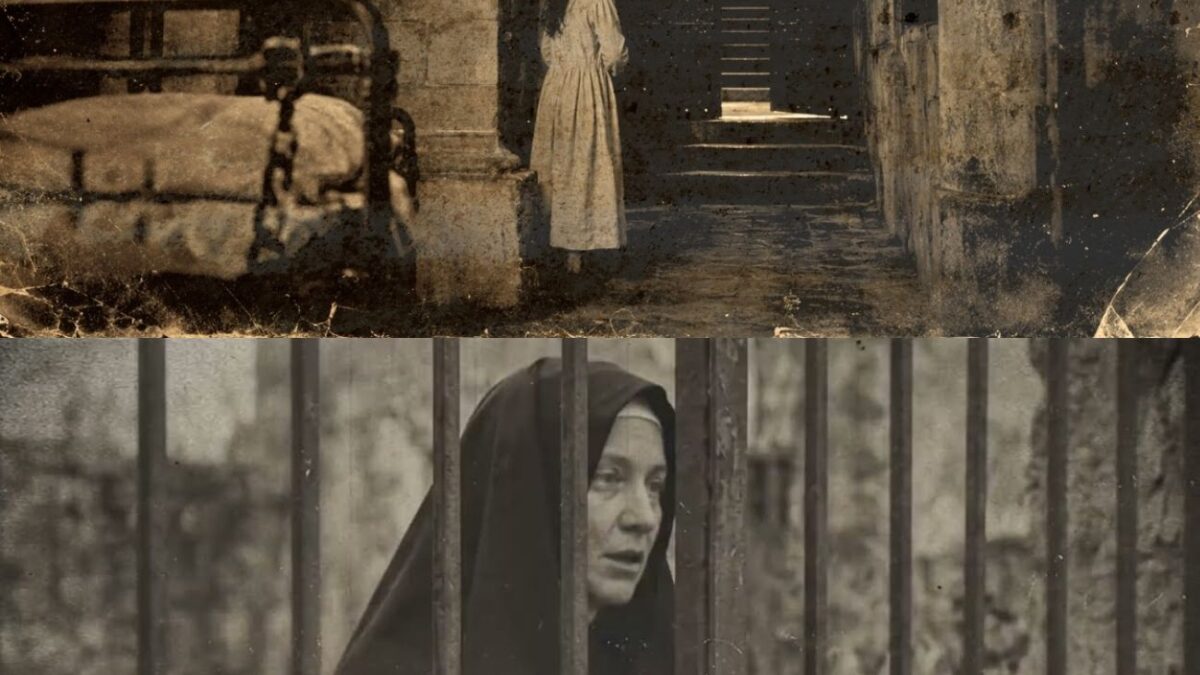
On the morning of October 9, 1871, two men rode out of the market town of Halbeck and up the old carriage road toward Redmarch Convent, a building that, according to every map printed after that winter, does not officially exist. Their names were Edmund Ror, a clerk for the county board of guardians, and Thomas Ferrell, a parish surgeon who had been asked to accompany him because nobody had heard from the convent in eleven weeks, and the last letter that arrived was written in a hand that shook so badly the words tore the paper. They expected to find sickness, perhaps fever, or the quiet neglect that crept into remote institutions when funds ran thin and winters dragged on, but they did not expect to find the front doors bolted from the outside.
When the heavy bolts finally gave way, they were met by a complete silence, one so profound that Ferrell later wrote he could hear his own pulse in his ears before anything else. In the east dormitory at the top of a staircase that should not have been able to hold the weight of the building above it, they found forty-one iron beds, and on nearly every one of them, a child was chained at the wrist and ankle to the frame. Some had been there so long that the metal had worn deep grooves into the wood, some could not speak, and others repeated the same phrase endlessly in an unrecognized language. The sisters who ran the convent—the women who had collected the board payments and written to the county for eleven years assuring them everything was well—were completely gone, having vanished without a trace as if they had walked off the edge of the world.
As Ror later investigated the founding paperwork in the county archives, he discovered that the ledger containing the Redmarch entries had a run of leaves cleanly cut out close to the spine, with surrounding entries renumbered in a different ink to hide the gap. The cover-up had not begun when the children were found; it had been prepared long before the crime was ever discovered, suggesting that the institution itself was built upon layers of hidden history. The building was too fine and too old for its official eleven-year history, featuring stonework, worn steps, a great vaulted hall, and rows of chimneys that suggested it had not been built so much as uncovered.
The women who ran the place called themselves the Sisters of the Sixth Mercy, an order completely absent from traditional historical records, wearing gray habits and veils that concealed their faces. Visitors noted that they moved in eerie silence, never aged across the years, and followed a rule belonging to an older, unnamable tradition. They collected children whom nobody else wanted—specifically those considered incurables, sleepwalkers, and those who spoke in unknown tongues during the night. For eleven years, Redmarch never returned a child and never reported a death, making it appear to the county boards as the most successful institution in the region, fueled by a bureaucratic convenience that preferred not to ask difficult questions.
The spell of silence was finally broken by a twelve-year-old girl named Alice Marin, who had been sent to the convent in the spring of 1870. Realizing that children taken down to the room below the chapel never returned, and knowing she was next on the list, Alice managed to smuggle a letter out through a passing carter, pleading for rescue before it was her turn. When Ror and Ferrell finally arrived and explored the convent, they found a circular stone chamber beneath the chapel—an architectural impossibility beneath a rectangular building—lined with mysterious markings and featuring a central basin surrounded by child-sized iron fittings, used not for care, but as an instrument for listening to whatever spoke through the children in the dark.
Following the discovery, the surviving children were removed and the convent was swiftly condemned, pulled down, and its lower levels permanently sealed with rubble and earth under official orders to bury the mystery. Ferrell retired to the coast in unhappiness, speaking no more of what he saw, while Ror’s inquiries were suppressed, his ledgers removed, and his career threatened into silence. Alice Marin herself was placed in a private asylum under a mysterious signature and vanished from the records entirely, leaving behind only the terrifying certainty that Redmarch was merely one of many hidden nodes in a vast, erased network, and that the bolts had been put back in place to keep something out there safely locked away forever.