The Dark Case of Amelia Dyer
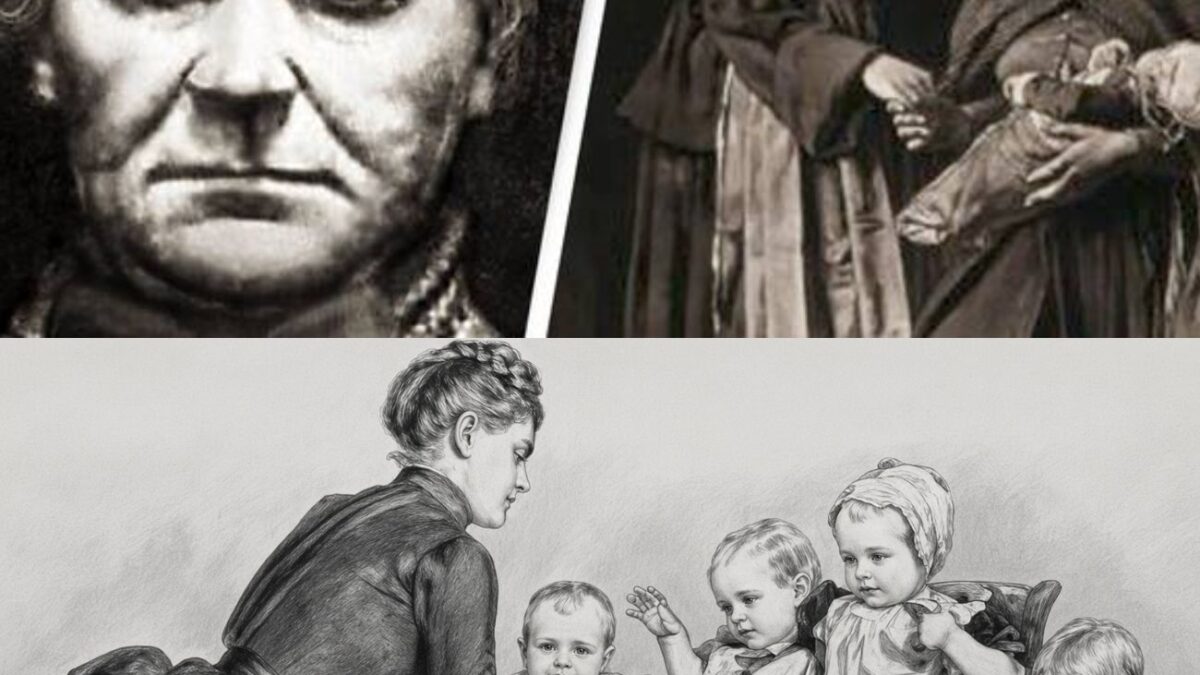
The Dark Case of Amelia Dyer
Amelia was born in 1838 in the small village of Ppy Marsh, just east of Bristol. Bristol, for those of you unfamiliar with England, is on the River Severn, which separates England from Wales, and is about 120 miles from London. Amelia was the youngest child of Samuel and Sarah Hobley and had three brothers and a sister. Her father worked as a master shoemaker. In her early years, she was a good student and very much liked literature and poetry.
Sadly, during this time, her mother suffered mental illness caused by typhus. Amelia witnessed her mother’s violent fits, and she cared for her mother until her mother’s death in 1848. After her mother’s death, Amelia went to live with an aunt in Bristol for a while and found work as a corset maker. Her father died in 1859, and her eldest brother, Thomas, inherited the family shoe business. In 1861, at the age of 24, Amelia became permanently estranged from at least one of her brothers, James, and moved into lodgings in Trinity Street, Bristol. There, she married George Thomas. George was 59, so 35 years her senior, and they lied about their ages on their marriage certificates to reduce the age gap. George deducted 11 years from his age, and Amelia added 6 to hers.
After her marriage, Amelia trained as a nurse. In Victorian Britain, this was considered a respectable occupation and enabled her to acquire useful skills. Life as a nurse, however, was hard. Through a contact with a midwife named Ellen Dane, Amelia learned an easier way to earn a living. Amelia started using her own home to provide shelter for young unmarried women who were pregnant illegitimately, and then farming off the babies for adoption or allowing them to die of neglect and malnutrition. Ellen Dane was forced to decamp to the USA shortly after meeting Amelia to escape the attention of the British authorities.
In 1834, the Poor Law Amendment Act was passed, which meant that the fathers of illegitimate children no longer had any financial obligation to provide for the mother of the child. This made life very difficult for young unmarried mothers and helped the growth of the practice known as baby farming, in which people such as Amelia Dyer acted as adoption or fostering agents in return for regular payment or a single upfront fee from the babies’ mothers. Many of these institutions took in young women and cared for them until they gave birth. The mothers subsequently left the unwanted babies to be looked after as nurse children. The predicament of the parents involved was often exploited for financial gain. If a baby had well-off parents who were simply anxious to keep the birth a secret, the single fee might be as much as 80 pounds; 50 pounds might be negotiated if the father of the child wanted to keep his identity safe.
Sadly, the majority of the young women were from poor backgrounds. These women were charged a lot less, such as 10 pounds. In 1870, 10 pounds would be about 850 pounds in today’s money. Some carers resorted to starving the farmed-out babies. They did this to save money and even to hasten death. Many babies were noisy, so they were sedated with alcohol or opiates. Godfrey’s Cordial, better known by its common name Mother’s Friend, was a syrup containing opium which would be given to babies. Many children died as a result of these medicines, and in Victorian times, opium killed far more infants through starvation than directly through overdose. This was because when a baby is continually fed opium, they would not want to eat and would die from malnutrition. This meant that when a coroner would produce a death certificate, they were most likely to record a death as debility from birth, lack of breast milk, or simply starvation.
Mothers who wanted to see their babies or whose circumstances had changed and wanted to reclaim their child could often encounter difficulties, and many would be too frightened or ashamed to tell the police about any suspected wrongdoing. Even the authorities often had problems tracing any children that were reported missing. This was the world opened up to Amelia. She had to leave nursing due to the birth of her daughter, Ellen Thomas. Then, in 1869, her husband George Thomas died, and Amelia needed an income. Amelia decided that baby farming could help her make money, especially as she had trained as a nurse. So she advertised to nurse and adopt babies in return for a substantial one-off payment and adequate clothing for the child. In her advertisements and meetings with clients, she assured them that she was respectable, married, and that she would provide a safe and loving home for the child. At some point in her baby farming career, Amelia was prepared to forego the expense and inconvenience of letting the children die of neglect and starvation, and soon after receipt of each child, she murdered them, thus allowing her to pocket most or all of the entire fee.
Amelia Dyer evaded any police investigation for a long time until she was eventually caught in 1879 after a doctor was suspicious about the number of child deaths he had been called to certify in her care. Strangely though, she was not convicted of murder or manslaughter, but instead sentenced to six months’ hard labor for neglect. After serving her six-month sentence, she had spells in mental hospitals due to her alleged mental instability. These always, however, coincided with times when it was convenient for her to disappear. Being a former asylum nurse, Amelia knew how to behave to ensure a relatively comfortable existence in an asylum. It appears that Amelia began abusing alcohol and opium-based products early in her killing career; her mental instability could have been related to her substance abuse.
In 1890, Amelia cared for the illegitimate baby of a governess. When the governess returned to visit her baby, she became suspicious and stripped the baby to see if a birthmark was present on its hips. It wasn’t. The governess reported this to the authorities, and when the authorities started to investigate, Amelia drank two bottles of laudanum in a serious suicide attempt, but her long-term abuse had built up a tolerance to opium products, so she survived and was not prosecuted due to lack of evidence. Of course, she returned to baby farming and murder. Amelia decided that she did not want to involve doctors to issue death certificates and began disposing of the bodies herself. The precarious nature and extent of her activities again prompted undesirable attention. She was alert to the attentions of the police and of parents seeking to reclaim their children. She and her family frequently relocated to different towns and cities to escape suspicion, regain immunity, and acquire new business. Over the years, Amelia used many different identities.
In 1895, Amelia moved to Caversham, Berkshire, accompanied by an unsuspecting associate, Jane “Granny” Smith—whom Amelia had recruited from a brief spell in a workhouse—along with Amelia’s daughter Marianne (also known as Polly) and her son-in-law Arthur Palmer. This was followed by a move to Kensington Road, Reading, Berkshire, later the same year. Smith was persuaded by Amelia to be referred to as “mother” in front of innocent women handing over their children. This was an effort to present a caring mother-daughter image.
In January 1896, a 25-year-old barmaid named Evelina Marmon gave birth to an illegitimate daughter, Doris, in a boarding house in Cheltenham. She was unable to raise the child alone, so she sought offers of adoption and placed an advertisement in the miscellaneous section of the Bristol Times and Mirror newspaper. It simply read: “Wanted, respectable woman to take a young child.” Evelina intended to go back to work and hoped eventually to reclaim her child. The advertisement next to her own was one placed by Amelia Dyer, which read: “Married couple with no family would adopt healthy child, nice country home, terms 10 pounds.” Evelina responded to a Mrs. Harding, and a few days later she received a reply from Amelia from Oxford Road in Reading.
Mrs. Harding wrote: “I should be glad to have a dear little baby girl, one I could bring up and call my own.” She continued: “We are a plain, homely people, in fairly good circumstances. I don’t want a child for money’s sake, but for company and home comfort. Myself and my husband are dearly fond of children. I have no child of my own. A child with me will have a good home and a mother’s love.” Evelina Marmon wanted to pay a more affordable weekly fee for the care of her daughter, but Mrs. Harding insisted on being given the one-off payment in advance. Evelina was not in a very good social or economic position, so she reluctantly agreed to pay the 10 pounds, and a week later Mrs. Harding arrived in Cheltenham. Evelina was surprised by Amelia’s advanced age and appearance. Amelia seemed affectionate toward Doris. Evelina handed over her daughter together with a cardboard box of clothes and the 10 pounds. She was very upset at having to give up care of her daughter and accompanied Amelia to Cheltenham station. She returned to her lodgings very emotional at having to give up her baby daughter.
A few days later, she received a letter from Mrs. Harding saying all was well. Evelina wrote back but received no reply. However, Amelia Dyer had not traveled where she had told Evelina she was going. Instead, she had gone to 76 Mayo Road, Willesden, London, where her 23-year-old daughter Polly was staying. There, Amelia found some white edging tape used in dressmaking, wound it twice around the baby’s neck, tied a knot, and murdered her. Amelia and her daughter Polly allegedly helped to wrap the body in a napkin. They kept some of the clothes Evelina had packed and sold the rest to the local pawnbroker. Amelia paid the rent to her landlady and gave her a pair of child’s boots as a present for her little girl.
The following day, Wednesday, the 1st of April 1896, another child named Harry Simmons was taken to Mayo Road. However, with no spare white edging tape available, the tape around Doris’s corpse was removed and used to strangle the 13-month-old boy. On April 2nd, both bodies were stacked into a carpet bag along with bricks for added weight. Amelia then headed for Reading. At a selected spot she knew well near Caversham Lock, she forced her carpet bag through railings into the River Thames.
Three days before, on the 30th of March 1896, a package was retrieved from the Thames at Reading by a bargeman. It contained the body of a baby later identified as Helena Fry. The package was given to Reading Borough Police, who found a label from the Temple Meads station, Bristol, with microscopic analysis of the wrapping paper deciphering a faintly legible name, “Mrs. Thomas,” and an address. The evidence led police to Amelia Dyer, but they still had no strong evidence to connect her directly with any involvement with the baby in the river. The police decided to put Amelia under surveillance.
The police used a young woman as a decoy, hoping she would be able to secure a meeting with Amelia to discuss her services. A meeting was arranged for April 3rd, Good Friday, but instead of the decoy turning up, it was the Reading police who arrived at Amelia’s house. When searching her home, they were apparently struck by the stench of human decomposition, although no human remains were found in the house. Plenty of other related evidence was found, including white edging tape, telegrams regarding adoption arrangements, pawn tickets for children’s clothing, receipts for advertisements, and letters from mothers inquiring about the well-being of their children. In the previous few months alone, at least 20 children had been placed in the care of Mrs. Thomas, now revealed to be Amelia Dyer. It also appeared that she was about to move home again, this time to Somerset. This rate of murder has led some to estimate that Mrs. Dyer may, over the course of decades, have killed over 400 babies and children, making her one of the most prolific murderers ever.
It is believed that Amelia arrived home carrying a brown paper parcel. She hid the package in the house, but after three weeks, odor and decomposition prompted her to dump the dead baby in the river; as it was not weighed adequately, it had been easily spotted. Amelia was arrested on April 4th and charged with murder. Her son-in-law Arthur Palmer was charged as an accessory. During April, the Thames was dredged, and six more bodies were discovered, including Doris Marmon and Harry Simmons, each baby having been strangled with white tape.
Eleven days after handing her daughter to Amelia Dyer, Evelina Marmon—whose name had emerged in items kept by Amelia—identified her daughter’s remains at the inquest into the deaths in early May. No evidence was found that Marianne or Arthur Palmer had acted as Amelia Dyer’s accomplices. Arthur Palmer was discharged as a result of a confession written by Amelia Dyer. On the 22nd of May 1896, Amelia Dyer appeared at the Old Bailey and pleaded guilty to one murder, that of Doris Marmon. Her family and associates testified at her trial that they had been growing suspicious and uneasy about her activities, and it emerged that she had narrowly escaped discovery on several occasions. Evidence from a man who had seen and spoken to her when she had disposed of two bodies in Caversham Lock also proved significant. Also, her own daughter had given graphic evidence that ensured Amelia Dyer’s conviction.
The only defense Amelia Dyer offered was insanity; she had been twice committed to asylums in Bristol. However, the prosecution argued successfully that her mental instability had been a ploy to avoid suspicion, noting that her commitments had always coincided with times when Amelia was concerned her crimes might have been exposed. It took the jury only four and a half minutes to find her guilty. In her three weeks in a condemned cell, she filled five exercise books with her last true and only confession. She was visited the night before her execution by a chaplain and asked if she had anything to confess; she offered him her exercise books, saying, “Isn’t this enough?”
Amelia Dyer was hanged at Newgate Prison on Wednesday, the 10th of June 1896. Asked on the scaffold if she had anything to say, she said, “I have nothing to say.” It is uncertain how many more children Amelia Dyer murdered, however, inquiries from mothers, evidence of other witnesses, and material found in Amelia’s homes—including letters and many babies’ clothes—pointed to many more. The Amelia Dyer case caused a scandal in Victorian Britain, and she became known as the Ogress of Reading. Subsequently, adoption laws in Britain were made stricter, giving local authorities the power to police baby farms in the hope of stamping out abuse.
Despite this and the scrutinizing of newspapers and personal ads, the trafficking and abuse of infants did not stop. Two years after Amelia Dyer’s execution, railway workers inspecting carriages at Newton Abbot, Devon, found a parcel inside. Inside was a three-week-old girl; she was cold and wet, but she was alive. A lady named Jane Hill had given the baby to a Mrs. Stuart for 12 pounds. Mrs. Stuart had picked up the baby in Plymouth and apparently dumped her on the next train; it is claimed that Mrs. Stuart was Polly, the daughter of Amelia Dyer.
Though Amelia Dyer met her end on the gallows, her dark legacy served as a permanent, chilling reminder of the shadows cast by the Victorian era—a stark warning that greed and cruelty could hide behind the most respectable of facades, forever altering how society viewed the safety of its most vulnerable innocents.

