The Crimes of Mary Bateman | The Yorkshire Witch
The Crimes of Mary Bateman | The Yorkshire Witch
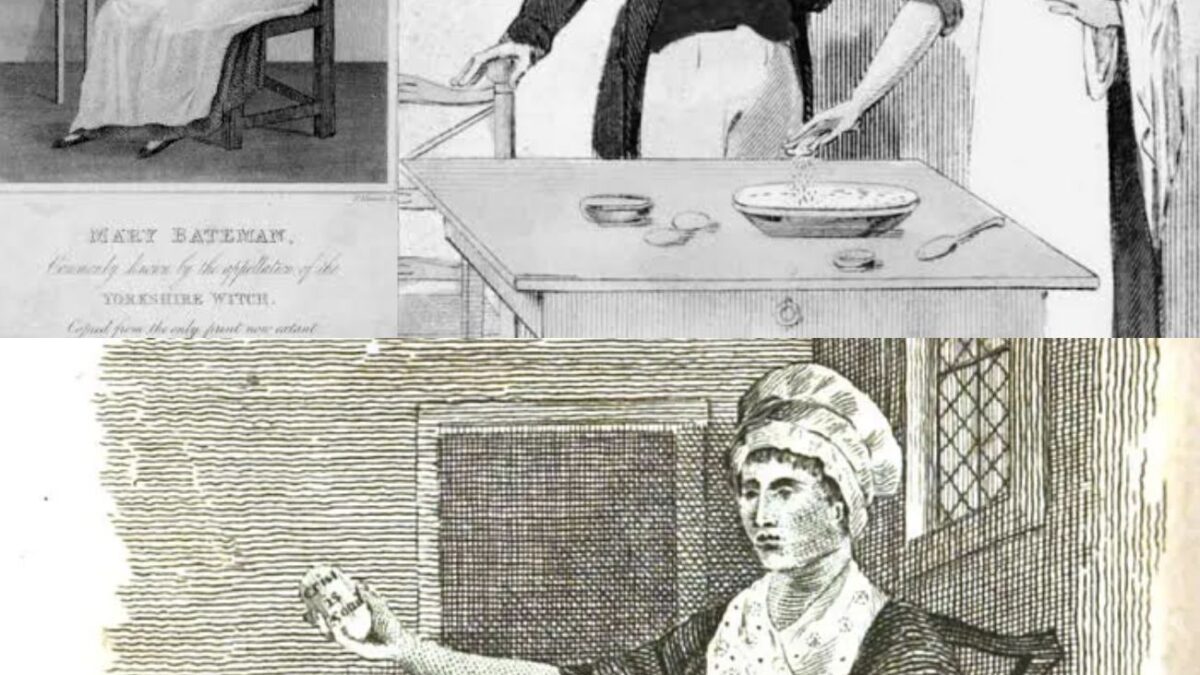
Mary Bateman was born at Topcliffe in Yorkshire, England, in 1768. Her father was a farmer, and both her parents were well-respected. From a very young age, Mary stole things wherever she went, even things she didn’t really need. This stealing habit didn’t stop. As an attempt to put Mary on a more law-abiding path, when she was 13, her parents sent her to work as a domestic servant in a large house. She started her work quite well, but soon started stealing from her employer and was dismissed. She was then dismissed from her next employer, and her reputation started to spread so no one wanted to employ her.
Out of necessity, Mary moved to the city of Leeds. Here, she soon found work as a dressmaker, and she was quite good at her role. The pay, however, was quite low, so resourceful Mary supplemented her income by becoming a soothsayer. Sooth is an old English word which means truth, and a soothsayer is what we would probably refer to today as a fortune-teller. When Mary was 24 years old, she met John Bateman, who was a wheelwright, and after a quick three-week courtship, they married. They had four children, including a son also christened John. Within two months of her marriage, Mary was again on the wrong side of the law for the many crimes she had committed. However, she was always one step ahead of them and always managed to escape arrest and prosecution by persuading her husband to move frequently from place to place.
Her husband John, however, tired of his wife’s constant tricks and schemes, joined the supplementary militia. This meant that he worked away from his Leeds home for months on end, and that Mary was reliant on herself to generate the income she needed to live on and bring up four children. By 1799, Mary was living in Marsh Lane, Leeds, and without any real trade, she started to focus on her fortune-telling, claiming that she had supernatural powers. She made and sold potions that were supposed to cure various illnesses and ward off evil spirits. In the late 1700s and early 1800s, there was still a popular belief in the power of witchcraft, and quick-thinking Mary found she could cash in on it. It was a far more profitable and certainly less dangerous way of making money than stealing, as at the time stealing was punished by hanging. It might seem incredible to us today that a relatively uneducated woman who was a career criminal had successfully convinced a large number of people that she possessed supernatural powers and healing abilities, but Mary certainly succeeded in doing so.
In 1803, Mary sold medicines to two sisters who lived above their draper’s shop with their mother in St Peter’s Square. Mary sold the medicines, which were in fact a mixture of poisons. When the three of them died, Mary calmly robbed their house and shop. When the neighbors asked why the women had died, she told them that they had caught the bubonic plague. Amazingly, there was no inquest and no suspicion fell on Mary, so she just walked away from the crime with everything she had stolen from the house. After this crime, Mary decided that it would be good to use an alias for all her scams, so she invented a character named Mrs. Moore. This non-existent lady was always consulted on behalf of Mary’s clients. All clients were told that the money she took from them was to go to Mrs. Moore. By 1806, clients thought it strange that no one had ever seen Mrs. Moore, so Mary had to invent a new alias and named her Mrs. Blythe.
By this time, she had moved to the Bramley area of Leeds, where she met a wealthy, childless, middle-aged couple named William and Rebecca Perrigo. Rebecca was apparently suffering from dizziness whenever she laid down and was also having psychological problems, claiming to be haunted by a black dog and other spirits. She was told by her doctor that she was under a spell and that he was unable to help her. In about June 1806, the Perrigos were visited by their niece, who suggested that they employ help from Mary, who she said would be able to assist her aunt to get rid of the spirits that were possessing her. As a result, a meeting was arranged between the Perrigos and Mary outside the ironically named Black Dog pub. Of course, Mary saw this as a very big money-making opportunity.
Mary listened to Mrs. Perrigo’s problems and explained that she was just a messenger for Mrs. Blythe. She told the unsuspecting couple that she would need an item of underclothing from Mrs. Perrigo, which she would send to Mrs. Blythe in Scarborough, who would be able to connect with Mrs. Perrigo through the clothing to find a solution, stop the dizziness, and end the black dog haunting. William Perrigo took the petticoat to Mary, who promised to send it to Mrs. Blythe and told William to come and see her the following week.
The following week, William arrived as promised, and Mary showed him a letter from Mrs. Blythe. The imaginary Mrs. Blythe had instructed that Mary should go to the Perrigos’ house and sew one-guinea notes and some gold coins, which she had sent, into each corner of Rebecca’s bed, where they were to be left for 18 months. A guinea is about 1 pound 10 pence. William was to give Mary four guinea notes in exchange to return to Mrs. Blythe. Mary then went to the Perrigos’ house, and remember she had worked as a dressmaker so it was very good at sewing, and the notes were sewn into the bed. William was instructed to visit Mary regularly to receive further instructions from Mrs. Blythe.
The next instruction was that William should nail two horseshoes to the door. William was soon to receive a letter from Mrs. Blythe instructing him to take Mary a further two guinea notes and to purchase cheese to be sent to her by Mary. The letter was to be burnt after he had read it. The next request was for a small quantity of china and silverware to be sent to Mrs. Blythe, together with some tea and sugar. Again, the letter was to be burnt. The next request was for a bed and bedclothes, as Mrs. Blythe was unable to sleep in her own bed due to the problems she was having with the spirits that had taken over Mrs. Perrigo again. The letter would be immediately burnt after all this had been actioned.
The letters continued. The following one predicted an illness in the Perrigos’ house affecting one or both of them. It instructed Mrs. Perrigo to take half a pound of honey to Mary, who would mix it with some special medicine that Mrs. Blythe had made. The letter also stated that the Perrigos were to eat puddings for six days and they were to mix into each of the puddings a packet of powder that Mary would give them. The Perrigos began eating the puddings. Interestingly, the letter said that only one pudding was to be made each day, nobody else was to be allowed to eat any of it, and that if there was any left over it must be immediately destroyed. It also said that should William or Rebecca become ill, they were not to go to the doctor because he would be unable to help. Unsurprisingly, this letter like its predecessors was to be burnt.
So Mary’s plan was that the Perrigos would poison themselves and destroy all the evidence of Mary’s involvement. You may wonder how an adult couple could be so naive in the early 1800s, but Mr. Perrigo just wanted his wife to be cured, and his doctor had already informed him that his wife was possessed and was unable to cure her. The couple began eating the puddings with no ill effects, but on the sixth day, they tasted a little different, and it caused William and Rebecca Perrigo to have severe stomach cramps and vomiting. As directed, a doctor was not consulted, and Rebecca died a horrible death on the 24th of May, 1807. Her husband William, however, did consult a doctor who suspected that Rebecca could have been poisoned, but no post-mortem was carried out. William Perrigo stopped eating the puddings and started to recover.
Mary had been very clever up to this time. Through Mrs. Blythe, she continued to demand items of value from the Perrigos, no more than she assessed that they could afford in view of William’s successful business. William Perrigo decided to examine the little silk purses that contained the guinea notes and gold coins that Mrs. Blythe had asked to have sewn into Rebecca’s bed. Would they still contain notes and coins that had been placed in them? He looked, but instead they contained cabbage leaves and copper coins. William finally started to realize that he had been deceived by Mary.
William then arranged a meeting with Mary, saying he wanted to purchase another bottle of medicine, but he also went to see the local constable. At the meeting, Mary brought a little bottle of liquid containing oatmeal and arsenic. Mary had a problem as William had lived rather than died as she had planned, but with the oatmeal and arsenic, she would now be able to finish him off. The constable, however, very quickly saw what Mary was doing and took Mary into custody, and followed this by searching her house, where he found many of the items that the Perrigos had given to Mary to be sent to the imaginary Mrs. Blythe.
The constable was not a naive man, and Mary appeared before the magistrates the following day charged with Rebecca’s murder. They committed her for trial, and on Friday, 17th of March, 1809, at York Castle, she came before the judge, Sir Simon LeBlanc. Evidence of the handwriting was submitted, which showed Mrs. Blythe’s letters were identical to Mary’s. Forensic evidence was provided which analyzed the remains of the honey and found that it contained mercuric chloride, which was extremely poisonous and was consistent with the symptoms displayed by the Perrigos. Mary’s defense was very simple; she just denied any involvement with Mrs. Perrigo’s death.
Sir Simon LeBlanc summed up and told the jury that to bring in a guilty verdict, they had to satisfy themselves on three points: these were that Rebecca Perrigo had died from poisoning, that the poison had been administered with the knowledge of Mary, and that it had been done with the aim of causing Rebecca Perrigo’s death. He went on to remind the jury that although there was a strong case against Mary for having systematically defrauded the Perrigos, this did not make her automatically guilty of murder.
The evidence of criminality and murder was so overwhelming that it did not take the jury long to deliver its verdict of guilty. In accordance with the usual procedure, Mary was asked if she had anything to say as to why sentence of death should not be pronounced on her. With teary eyes, she told the judge that she was pregnant. As a result, the judge ordered the court doors to be locked and got a doctor to examine her. Mary was found not to be pregnant, and the judge proceeded to sentence her to be hanged and afterwards dissected on the following Monday.
Mary was aged 41 at the time and had an infant child with her in prison up till the time she was condemned. Over the weekend, Mary wrote a letter to her husband in which she enclosed her wedding ring and asked him to give it to their daughter. She admitted some of her crimes but continued to deny the murders. It was reported in a Leeds newspaper that she continued her criminal habits even in the condemned cell, telling the fortune of other inmates for a guinea.
Mary was executed on Monday, the 20th of March, 1809, in front of a very large crowd who had gathered to see her. Many still believed she had supernatural powers, and there was some sympathy for her. Many also believed that she would be saved from death by some divine intervention, but this was not to be. Mary continued to deny any involvement in the murder and her other criminal activities to the end.
After execution, Mary’s body was sent to the Leeds Royal Infirmary for dissection and afterwards put on display. The public paid three pence each to view her body, and 30 pounds was raised for the hospital. Her skeleton, together with a plaster cast of her death mask, were put on display and can be seen today at the Thackeray Museum in Leeds, serving as a permanent, chilling reminder of the Yorkshire Witch who manipulated human credulity to its absolute, devastating limit.

