The Bible Story Churches Never Teach: Rizpah’s Vigil
The Bible Story Churches Never Teach: Rizpah’s Vigil
There is a woman in the Bible who never preached a sermon, never led an army, and never wrote a single word of scripture. She spoke only once in the entire biblical record, and even then, her words were not preserved. And yet, this woman, armed with nothing but a piece of rough cloth and a mother’s broken heart, did something almost no one else in the Old Testament ever accomplished. She changed the mind of a king, not through violence, not through political maneuvering, not even through petition. She did it by refusing to move. Her name was Rizpah. And for roughly six months, through the scorching heat of a Judean summer, through nights filled with the sounds of prowling predators, in the presence of a horror most of us cannot even imagine, she kept a vigil on a lonely rock in Gibeah. What she was guarding and why is one of the most haunting stories in all of scripture. It is a story most churches never teach, most sermons never touch, and most Christians have never heard.
But when King David learned what this woman was doing on that hillside, the Bible tells us he was moved to act, and her silent protest ended one of the darkest chapters in Israel’s history. How did a concubine, a woman near the bottom of the social ladder in ancient Israel, accomplish what prophets and priests could not? To answer that, we have to walk into one of the most difficult and mysterious passages in the Old Testament: the famine, the Gibeonites, and the seven men hanged on a hill before the Lord.
Our story begins not with Rizpah, but with a crisis. 2 Samuel chapter 21 opens with these words: Now there was a famine in the days of David for three years, year after year. And David sought the face of the Lord (2 Samuel 21:1 ESV). Three years in an agricultural society like ancient Israel—a single failed harvest was a hardship, two was a disaster. Three consecutive years of famine was a national catastrophe, the kind of event that emptied villages, killed the elderly and the very young first, and drove families to sell their land, their livestock, and sometimes even themselves into servitude just to survive.
Notice what David does. He does not immediately blame the weather; he does not simply organize grain imports from Egypt as rulers in the ancient Near East often did during famine. After three years, he sought the face of the Lord. In the Hebrew mindset, a sustained famine in the covenant land was never merely a meteorological event. The book of Deuteronomy had explicitly tied the fruitfulness of the land to the faithfulness of the nation: rain in its season was a covenant blessing, while the heavens shutting up like bronze was a covenant warning. So when the rains failed year after year after year, David finally asked the question an Israelite king was supposed to ask: Lord, what is wrong between us?
The answer he received was startling: And the Lord said, “There is bloodguilt on Saul and on his house, because he put the Gibeonites to death” (2 Samuel 21:1 ESV). To understand the weight of this answer, we need to travel back nearly 400 years to the days of Joshua and the conquest of Canaan. The Gibeonites were not Israelites at all; they were Amorites, a remnant of the original inhabitants of the land. In Joshua chapter 9, when Israel entered Canaan, the people of Gibeon realized they could not survive a military confrontation. So they resorted to an elaborate deception: they dressed in worn-out clothes, loaded their donkeys with dry, crumbling bread and cracked wineskins, and presented themselves to Joshua as travelers from a distant country, asking for a treaty.
Joshua and the leaders of Israel, the text tells us pointedly, did not ask counsel from the Lord (Joshua 9:14 ESV). They made a covenant of peace with the Gibeonites and sealed it with an oath in the name of the Lord, the God of Israel. Three days later, the deception was exposed: the Gibeonites were not distant foreigners, but neighbors living just a few miles away. The people of Israel grumbled and wanted the treaty annulled, but the leaders refused, saying, “We have sworn to them by the Lord, the God of Israel, and now we may not touch them” (Joshua 9:19 ESV). An oath sworn in God’s name was inviolable, even an oath obtained by fraud. The Gibeonites became woodcutters and water carriers for the house of God, and Israel became their sworn protector.
That covenant, sealed around 1,400 BC by conservative dating, was still legally and spiritually binding centuries later. In the ancient Near East, treaties did not expire; they bound not only the men who swore them, but their descendants generation after generation. And this is where King Saul enters the story and where the trouble begins. The text of 2 Samuel 21 tells us that Saul had sought to strike them down in his zeal for the people of Israel and Judah (2 Samuel 21:2 ESV). Somewhere during his reign, Saul carried out a campaign of killing against the Gibeonites. Scripture gives us no chapter narrating this massacre; we learn of it only here after the fact, the way an old crime surfaces in a courtroom years later.
Notice the word the text uses: zeal. Saul’s motive may even have looked pious on the surface, perhaps a desire to purify the land, to finish what Joshua’s generation had left undone, or to reclaim Gibeonite territory for his own tribe of Benjamin, since Gibeon sat squarely within Benjaminite land. But zeal without faithfulness is not obedience. Saul, the king who had failed to destroy the Amalekites when God commanded it, took it upon himself to destroy a people God had sworn to protect. He broke a 400-year-old oath made in the name of the Lord, and heaven took note.
The theology here is sobering, and it is one of the reasons this passage is so rarely preached: God did not forget. Years, perhaps decades, passed between Saul’s massacre and the famine in David’s reign. Saul himself was already dead, fallen on Mount Gilboa. And yet, the bloodguilt remained, hanging over the land like an unpaid debt. The Hebrew concept at work here is damim, literally “bloods”—innocent blood shed that cries out from the ground just as Abel’s blood cried out in Genesis. Numbers 35:33 states the principle plainly: “Blood pollutes the land, and no atonement can be made for the land for the blood shed in it, except by the blood of the one who shed it.” A broken covenant oath sworn in the name of the Lord was not a private sin; it was a national wound, and the land itself in the covenant worldview of Israel groaned under it.
So David summoned the Gibeonites, this small marginalized remnant still living among Israel, and asked them a question that no king had ever bothered to ask them: What shall I do for you? And how shall I make atonement, that you may bless the heritage of the Lord? (2 Samuel 21:3 ESV). Consider the reversal in that moment. The descendants of the deceivers of Joshua’s day now stood before the throne of Israel as the wronged party, and the king of Israel stood before them as the representative of the guilty house.
The Gibeonites’ answer was careful, almost legally precise: It is not a matter of silver or gold between us and Saul or his house (2 Samuel 21:4 ESV). They refused monetary compensation, what the ancient world called blood money. In their understanding and in the understanding of that entire age, blood required blood. What they asked for next is what makes this chapter so difficult for modern readers: they requested seven men from Saul’s descendants to be hanged. The Hebrew suggests a public exposure of the bodies, likely impalement or hanging after execution, before the Lord at Gibeah of Saul (2 Samuel 21:6 ESV). Seven—the number of completeness, signifying that the debt would be paid in full at Gibeah, Saul’s own hometown, his royal seat, the very capital from which the massacre had likely been ordered. It was done before the Lord because this was not framed as private revenge, but as a judicial act of atonement carried out in the sight of the God whose name had been profaned by the broken oath.
And David said yes. He spared Mephibosheth, Jonathan’s son, because of his own sworn oath to Jonathan—one oath honored in the very act of atoning for another oath broken, a detail the narrator surely intends us to notice. But he took the two sons of Rizpah, Armoni and Mephibosheth (a different Mephibosheth, named perhaps after the same family tradition), and the five sons of Merab, Saul’s daughter, and delivered them to the Gibeonites. The text records the execution with terrible brevity: They hanged them on the mountain before the Lord, and the seven of them perished together (2 Samuel 21:9 ESV). Then the narrator adds a time marker that will matter enormously for our story: They were put to death in the first days of harvest, at the beginning of barley harvest (2 Samuel 21:9 ESV). In the Judean calendar, barley harvest begins in April.
Now, before we go on, we must be honest about the moral difficulty here, because your Bible reading instincts are probably raising an objection—and they should. Deuteronomy 24:16 commands that fathers shall not be put to death because of their children, nor children because of their fathers. How then could seven descendants die for Saul’s crime? Scholars have wrestled with this for centuries. Some note that the seven may not have been innocent bystanders at all; as members of Saul’s house, grown men of the royal clan, they may have participated in or benefited directly from the massacre and the seizure of Gibeonite land. The text calls the guilt “bloodguilt on Saul and on his house,” and the house included them. Others observe that David was navigating between two binding realities: the covenant with the Gibeonites, which predated the Mosaic monarchy, and the international treaty law of the ancient Near East, in which a dynasty bore corporate responsibility for its crimes.
What the text itself emphasizes is the outcome: After this act, and after one more thing we will see shortly, God responded to the plea for the land (2 Samuel 21:14 ESV). The narrator does not pause to justify every actor; scripture often records the hard edges of history without smoothing them, and that unflinching honesty is itself a mark of its authenticity.
But there is one person in this story for whom the theological debates and the royal calculations meant nothing at all. For her, the seven bodies on that hill were not legal instruments of atonement—two of them were her boys. She had carried them, nursed them, raised them in the shadow of a doomed royal house, and now she watched them die for a crime committed by their father, a man who had used her and left her defenseless in the political wreckage he created.
Her name, Rizpah, means “glowing coal,” and no name in scripture ever fit its bearer more perfectly, because what this woman did next burned slowly, silently, and relentlessly until it scorched the conscience of the most powerful man in Israel. To understand what Rizpah did and how staggering it truly was, we first need to understand who she was and what it meant to be a concubine of a fallen king in the brutal politics of the ancient world.
Rizpah appears for the first time in scripture in 2 Samuel 3 in a scene that tells us everything about her vulnerability. She was the daughter of a man named Aiah, and she had been the concubine of King Saul. A concubine in ancient Israel was a wife of secondary rank, a woman legally bound to a man bearing his legitimate children, yet without the status, the dowry protections, or the family alliances of a full wife. Concubines of kings occupied an even stranger position: they were symbols of royal power. To possess the concubine of a king was, in the political language of the ancient Near East, to claim his throne. This is why, after Saul’s death, a single accusation nearly tore his surviving kingdom apart. Abner, the general who had propped up Saul’s son Ish-bosheth as a rival king, was accused by Ish-bosheth of going into Rizpah. Abner’s furious response and his immediate defection to David set in motion the collapse of Saul’s dynasty.
Notice what the text does not record in that scene: Rizpah’s voice. Whether the accusation was true or false, no one asked her. She was discussed, contested, weaponized—a piece on the board of men’s ambitions. That is the position from which this woman came: no husband to protect her (Saul was dead), no powerful family (her father Aiah is otherwise unknown). Her security and old age rested entirely on her two sons, Armoni and Mephibosheth. And in a single April morning at Gibeah, both were taken from her at once.
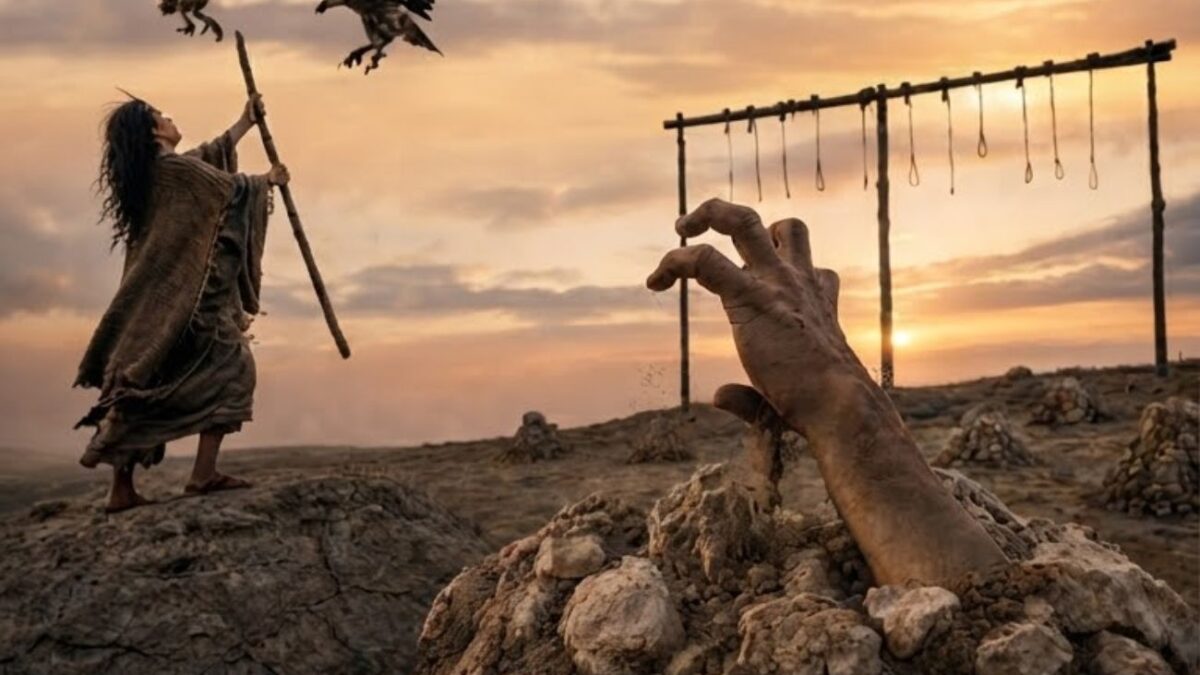
What happened next is recorded in a single verse, and it is one of the most extraordinary verses in the Old Testament: Then Rizpah the daughter of Aiah took sackcloth and spread it for herself on the rock, from the beginning of harvest until rain fell upon them from the heavens. And she did not allow the birds of the air to come upon them by day or the beasts of the field by night (2 Samuel 21:10 ESV). Read that again slowly and let the timeline sink in. The beginning of barley harvest is April. In the land of Israel, the rains cease in spring and do not return until October. The early rain, the yoreh, was the autumn rain that softened the ground for plowing. When the text says Rizpah stayed until rain fell upon them from the heavens, it is describing a vigil of roughly six months through the entire rainless Judean summer, through May’s heat, through the furnace of July and August when temperatures on an exposed hillside can exceed 100°F. This woman stayed on a rock beside the decomposing bodies of her sons and their five kinsmen.
We must not sanitize what this means. The bodies were left unburied deliberately; that was the point of the public exposure. In the ancient world, to leave a body unburied was the ultimate degradation, a fate worse than death itself. Deuteronomy 21:23 declared that a hanged man is cursed by God and that his body must not remain overnight on the tree. The Gibeonites, who were not bound by Israelite burial law, left the seven exposed indefinitely, and in that climate, exposed remains would draw scavengers within hours. Griffon vultures, common in the hill country, can spot carrion from miles away. At night would come the jackals, the striped hyenas, the feral dogs that roam the edges of every ancient settlement. Against all of this stood one aging woman with no weapon—scripture records most likely a staff, stones, and her own voice—day after day, night after night, for half a year.
Think about the practical reality of that vigil. When did she sleep? Vultures hunt by day; the predators of the hill country hunt by night. Her watch could never truly pause. She spread sackcloth on the rock, the coarse goat-hair fabric of mourning, not as a tent for comfort, but as a public declaration that this was a mourning that would not end until justice was done. The rock itself likely gave her a raised vantage point over the execution site. Local tradition has long associated the place with the high ground near Gibeah, just a few miles north of Jerusalem, close enough to the roads of Benjamin that travelers would see her.
And that detail may be the key to everything, because a vigil no one saw would have changed nothing. But people did see. They saw a solitary figure on a rock through the shimmering heat of an entire summer. They saw her rise again and again to drive off the birds. They heard her voice at night, answering the howls in the dark, and they talked. The report traveled the way everything travels in a small country: from the roads of Benjamin to the markets, from the markets to the court. When David was told what Rizpah the daughter of Aiah, the concubine of Saul, had done (2 Samuel 21:11 ESV), that is the hinge of the entire chapter. Rizpah never went to Jerusalem; she never petitioned the throne; she never spoke a recorded word. She simply made her grief so visible, so relentless, so impossible to ignore that the king could no longer look away.
Her sackcloth on that rock became a question posed to the conscience of the nation: The debt to the Gibeonites has been paid, but what about the debt to these dead? How long will the anointed of Israel leave the sons of a king and the grandsons of a king to lie under the open sky like carcasses? And David, the king who had authorized the execution, the king who had every political reason to let the house of Saul rot into oblivion, was moved.
What he did in response is one of the most quietly beautiful acts of his entire reign, and it reaches back to a debt of honor that was by then decades old. When David heard what Rizpah was doing on that rock, he did not send soldiers to remove her; he did not issue a decree defending his handling of the Gibeonite affair. Instead, the news seems to have awakened something in him: a memory, and with it an old unpaid debt of his own. The text tells us that David went and took the bones of Saul and the bones of his son Jonathan from the men of Jabesh-gilead (2 Samuel 21:12 ESV).
To understand why that sentence carries such weight, we need to remember how Saul’s story had ended. Some 40 years earlier, after the catastrophic battle of Mount Gilboa, the Philistines had found the bodies of Saul and his sons among the fallen. They cut off Saul’s head, stripped his armor, and fastened his body and the bodies of his sons, including Jonathan, to the wall of Beth-shan, a fortified city overlooking the Jordan Valley. It was the ancient equivalent of a trophy display: the first king of Israel exhibited as carrion for the birds.
But one town remembered what Saul had done for them. Decades earlier, at the very beginning of his reign, Saul’s first act as king had been to rescue the town of Jabesh-gilead from the Ammonite warlord Nahash, who had threatened to gouge out the right eye of every man in the city. Jabesh-gilead never forgot. When they heard what the Philistines had done to Saul’s body, all the valiant men arose and went all night (1 Samuel 31:12 ESV)—a march of perhaps 10 miles through hostile territory in darkness—took the bodies down from the wall of Beth-shan, carried them home, burned away the desecrated flesh, and buried the bones under a tamarisk tree, fasting seven days in mourning.
It was an act of breathtaking courage and loyalty, but it was also, by the standards of Israel, incomplete. Saul and Jonathan lay in an improvised grave in Transjordan, far from the land of Benjamin, outside the tomb of their fathers. In the ancient Israelite understanding, to be “gathered to one’s fathers” was not a mere figure of speech; burial in the ancestral tomb was the final act of belonging, the seal of an honored life. For four decades, the founder of Israel’s monarchy and his heroic son had lain outside that circle. David knew it; David had even praised the men of Jabesh-gilead for their loyalty at the time. And yet, through all the years of his reign, the bones had remained where they were, a loose thread in the fabric of the kingdom, quietly ignored.
It took Rizpah’s vigil to pull that thread. Here is the connection the narrator wants us to see: A woman’s faithfulness to the dead reminded the king of his own unfinished faithfulness to the dead. Her sackcloth on the rock at Gibeah reached across the Jordan to a tamarisk tree in Jabesh-gilead. David sent for the bones of Saul and Jonathan. And then the text says, “They gathered the bones of those who were hanged” (2 Samuel 21:13 ESV)—the seven from the hill at Gibeah, the two sons of Rizpah among them—were finally taken down. And in one solemn procession, the remains of the fallen house of Saul were carried into the land of Benjamin and buried together in the tomb of Kish, his father, at Zela (2 Samuel 21:14 ESV). The royal house that had been shattered at Gilboa, disgraced at Beth-shan, and decimated at Gibeah was at last gathered home, reunited in death with the honor that politics had stripped from it in life.
And then comes the verse that closes the entire episode, the verse the whole chapter has been straining toward: And after that, God responded to the plea for the land (2 Samuel 21:14 ESV). The rains came, the famine broke. But notice the sequence with care, because it is the quiet theological thunderclap of this story: The Gibeonites had been given their justice back in April, the executions complete, the legal debt paid. Yet, the text does not say God answered after the hangings. It says God responded after that—after the burial, after the honoring of the dead, after the king was moved by a grieving mother to an act of covenant kindness that no law required of him. Heaven’s answer waited, it seems, not only for justice to be satisfied, but for mercy to have its say. The famine that began with a broken oath ended with an honored grave. And standing between those two points, between the wrath and the rain, is Rizpah, the woman on the rock.
It is worth pausing to ask what this vigil cost her, because scripture’s silence about her suffering can make it easy to miss. Six months of exposure meant six months of scavenged food, of water carried up from a spring or brought by sympathetic villagers, of heat by day and cold by night—for even in summer, the hill country of Benjamin, sitting at over 2,000 feet of elevation, grows sharply cold after dark. It meant enduring the unendurable, remaining present hour after hour to sights and smells from which every human instinct recoils, because the alternative was to let her sons be torn apart and scattered. Mothers in the ancient world washed bodies, wrapped them, anointed them, closed the eyes of their dead. Rizpah was denied every one of those mercies. The only act of love left to her was refusal: the refusal to let the degradation be completed, the refusal to let Israel forget, the refusal to leave. And she performed that refusal with such unbreakable constancy that 3,000 years later we are still speaking her name.
There is also a detail in the Hebrew text that deserves our attention. The verse says, “She did not allow the birds of the air to rest on them by day or the beasts of the field by night.” The language echoes almost word for word the covenant curses of Deuteronomy 28:26: “And your dead body shall be food for all birds of the air and for the beasts of the earth, and there shall be no one to frighten them away” (ESV). That curse was the fate of a nation that broke covenant with God: unburied dead and no one to drive the scavengers off. Rizpah, whether she knew the text or not, stood in the exact breach that curse describes. Where the curse said “no one to frighten them away,” she became the someone—one woman standing against the full weight of a covenant curse with nothing but sackcloth and stubborn love. And the curse did not prevail. It is hard to find anywhere in scripture a more vivid picture of intercession embodied: a person placing herself physically between the judgment and the judged, refusing to yield until mercy answered.
And so we come to the question that lingers over this whole account: Why did God allow Rizpah’s story to be recorded at all? The chapter could have ended with the executions and the rain; the narrator could have moved from the Gibeonites’ justice straight to heaven’s answer without ever mentioning a concubine on a rock. Ancient historians routinely omitted women like her. Yet, the inspired text pauses, names her twice, names her father, and describes her vigil in careful, deliberate detail. Scripture, which is so often economical to the point of silence, chose to preserve her. And when the Bible preserves what the world would have discarded, it is telling us something about the heart of God.
Consider what Rizpah’s presence in this chapter accomplishes. Without her, 2 Samuel 21 is a story about royal guilt and legal atonement—a transaction between a king, a wronged people, and a holy God. With her, it becomes something more: it becomes a story about what grief is permitted to do, and what love owes the dead, and how the powerless can move the powerful without ever raising a hand. The Gibeonites received justice through the machinery of the state; Rizpah obtained mercy through no machinery at all, only persistence made visible. In a chapter filled with kings, generals, executioners, and the weight of national politics, the moral center of gravity is a woman whom no one consulted about anything, sitting on a piece of sackcloth.
Her story also speaks a hard and healing word about the questions we carry to God when his justice bewilders us. Rizpah never receives an explanation; the text records no oracle sent to comfort her, no prophet dispatched to her rock, no voice from heaven interpreting her loss. Her sons died in an act of national atonement she did not choose and could not prevent, caught as so many are in the wreckage of sins committed before them and above them. Scripture does not pretend her situation was fair, and it does not rush to resolve the tension. What it shows us instead is what she did with her unanswered questions: she stayed. She did not curse God and abandon the dead; she did not accept the degradation as final. She took her stand in the space between what was and what ought to be, and she remained there until something changed.
There is a name for that posture in the life of faith: it is called hope. Not the shallow optimism that denies the darkness, but the iron hope that keeps watch inside it. And her watch bore fruit she never could have orchestrated. Because of Rizpah, seven men received honorable burial. Because of Rizpah, the bones of Saul and Jonathan came home after 40 years of exile under a tamarisk tree. Because of Rizpah, the house of Saul—the house that had persecuted David, the house whose politics had destroyed her own life—was gathered with dignity into the tomb of its fathers.
Notice that last point, because it is easy to miss: the primary beneficiaries of her vigil were the family of the man whose sin had killed her sons. Her love did not calculate; it overflowed the boundaries of her own grief and washed even over the memory of Saul himself. If you have ever wondered what it looks like to honor those who have wounded you, there may be no more concrete picture in the Old Testament than the ossuary procession that ended at Zela, a funeral that happened because a wronged woman refused to stop loving.
The rabbis of later centuries saw this clearly. Jewish tradition preserved in the Talmud reflects on this passage and asks how the exposure of the seven could be justified at all given the Torah’s command to bury the dead before nightfall. The answer the sages gave is striking: the public nature of the atonement and the extraordinary spectacle of Rizpah’s vigil caused the name of God to be magnified among the nations. For all who passed by learned how seriously Israel’s God took a covenant sworn in his name, even one made with foreigners, even one obtained by deception, even one four centuries old. In other words, in the rabbinic reading, Rizpah’s faithfulness became a public sermon that no prophet preached: the God of Israel keeps his word, and he honors those who keep theirs.
For the believer today, Rizpah’s rock still stands as a summons. There are wrongs in this world that we have no power to reverse and no authority to adjudicate. There are griefs that no court will hear. Rizpah shows us that even then, especially then, faithful presence is not nothing; it is sometimes everything. The mother who will not stop praying for a wandering child, the widow who tends a memory the world has moved past, the believer who stands quietly against an injustice year after year while others look away—all of them keep vigil on Rizpah’s rock. And her story whispers what they need to hear: The king sees. It may take a season—it took her half a year of scorching days and howling nights—but the report of faithful love has a way of traveling from the roads of Benjamin to the throne. And the true king, the son of David, misses nothing done in love for the least and the lost.
Perhaps that is the final resonance of this ancient story, the one that reaches all the way to the gospel. Centuries after Rizpah, another descendant of the tribe of Judah would hang publicly on a hill under a curse pronounced in Deuteronomy: “Cursed is everyone who is hanged on a tree” (Galatians 3:13 ESV, citing Deuteronomy 21:23). And near that cross too stood women who refused to leave, watching through the hours of horror, following to see where the body was laid, coming back at dawn with spices to honor the dead. The vigil of faithful women at the place of execution did not begin at Calvary; Rizpah kept it first a thousand years earlier on a rock in Gibeah. And just as her watch ended with rain from heaven and the dead gathered home, theirs ended with something greater still: an empty tomb, and the news that the curse itself had been broken forever.
A famine that began with a broken promise, a king moved by a mother who would not move, bones gathered home after 40 years, and rain at last on a healed land—that is the story of Rizpah, the glowing coal that would not go out. She never wrote a word, never held an office, never raised a sword. She simply loved faithfully in the darkest place imaginable, and in doing so, she changed the heart of a king, restored the honor of a dynasty, and left the people of God a portrait of intercession that still burns 3,000 years later. Standing there in the quiet aftermath of the storm, as the fresh smell of damp earth rose toward the hills of Benjamin, she finally closed her weary eyes, knowing that love had had the final word. May her name never again be forgotten among those who love the scriptures.

