The Bald Knobbers of the Ozarks — The Masked Vigilantes Who Ruled the Hills in the 1880s
The Bald Knobbers of the Ozarks — The Masked Vigilantes Who Ruled the Hills in the 1880s
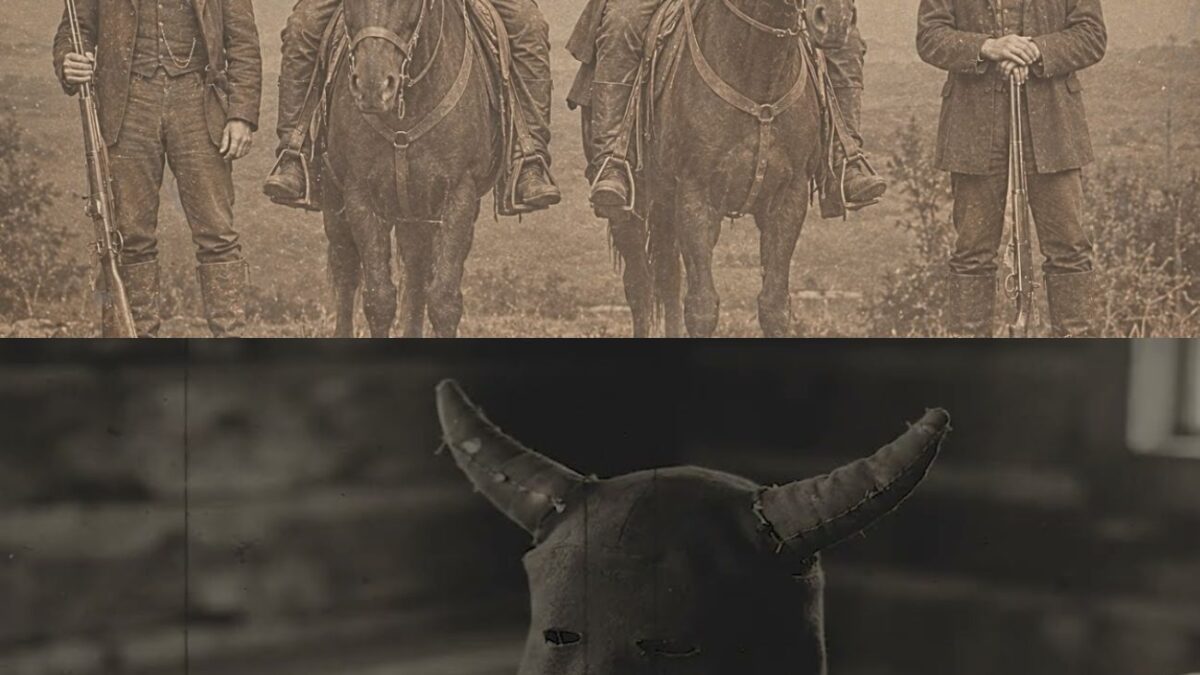
In April of 1887, two men were found on the south slope of a hilltop in Taney County, Missouri, in a position that the county sheriff would spend the rest of his career refusing to describe in writing. They were kneeling side by side at the base of a pile of stones. Their foreheads were pressed against the same single flat stone at the base of the cairn. Their hands were folded in their laps. They were cold through. There was no wound on either body. Their names were Charles Green and William Edens. And the men who had done this to them were their neighbors, wearing hoods of black cloth with horns sewn into the crown and calling themselves the Bald Knobbers.
The surface story is the one the schoolbooks kept: that in the years after the Civil War, the hill country of southwest Missouri had no law worth the name, and a merchant named Nathaniel Kinney gathered a hundred men on the top of a bare hilltop called Snaps Bald, and they swore an oath to clean the country of horse thieves and violent men, and for three years they rode at night in their horned hoods, until the state hanged three of them for the killings above, and the movement fell apart. That is the story that is told.
The story underneath is that the hoods were not disguises, that the bald hilltops were not chosen for the view, that the position in which William Edens and Charles Green were found was the position in which certain men had been found on certain hilltops in that country since long before the county had a name, and that the men in the hoods knew this. The reason Nat Kinney gathered a hundred men on the top of Snaps Bald in the spring of 1885 was not to enforce the law of the state of Missouri. It was to resume a duty that had lapsed for seven years, and the duty was older than the state and older than the county. And what the men in the horned hoods were reading by lantern light on the wall of a chamber inside the hill was not any law that had ever been written in English.
Understanding what the Bald Knobbers required understanding what the country was, and the country was ruined. The southern part of Missouri in the years after the war between the states had been fought over from both sides by regular armies and by irregular bands who wore no uniform and answered to no flag. The Bushwhackers had come out of the woods for four years and taken what they wanted. The Jayhawkers had come out of Kansas and done the same. Families had been burned out. Farms had been walked away from when the war ended. The country did not settle. The men who had ridden with Quantrill and the men who had ridden against him were still on the same roads and still knew each other’s faces. And the roads had no sheriffs on them worth mentioning. And the towns, meant to be county seats, had one store and one church and a courthouse where the records had been used to feed a fire during the winter of 1863.
Taney County and the counties north and west of it in the spring of 1885 were what the papers called lawless. What they were, more accurately, was underattended. The soil was thin over limestone. The hollows were deep and narrow. A man on a horse who did not want to be found could stay out of sight for a week without trying. The county histories written a generation later would say that horse thieves and cattle rustlers operated in the country with impunity. That was true, and it was also the smallest part of what was operating in the country with impunity, and the men who founded the Bald Knobbers knew the difference and the men who wrote the county histories did not.
Nathaniel Kinney was six feet six inches tall. He had come to Taney County from Springfield in 1883 at the age of forty-seven and had opened a saloon and a general store in Forsyth on the White River. He had been a Union soldier. He was a Sunday school teacher. He carried two revolvers on his hips at all times, and it was said he had killed men before coming to Taney. He was, by every account of every person who met him, a man who filled the room he was in, and the room was often quieter than it would have been otherwise.
On the evening of April 5, 1885, Kinney climbed the wagon track to the top of a hill in northern Taney County that the country people called Snaps Bald. It was called that because the crown of the hill was bare of trees for a distance of about two acres, and the country people had never known it to grow trees, though the slopes below were thickly forested with oak and hickory. Bare hilltops of this kind were called balds. No accepted explanation for them existed then, and none exists now. The soil on the balds is thin over stone. The stone under the balds, where anyone has ever looked, is not entirely the stone the geologist would expect for that formation.
One hundred and three men, according to the count recorded by county schoolteacher Pearlene Vestal in her diary three days later, climbed the wagon track to the top of Snaps Bald on the evening of April 5. Kinney addressed them for approximately forty minutes. The oath they swore was to protect the country from thieves and violent men and to answer to no court but their own. The oath they swore was in English. What was not written in Pearlene Vestal’s diary because she was not there to see it was what four of those 103 men did after the others had gone back down the wagon track. And what they did was open a fitted stone panel in the ground at the exact center of the bald crown and go down.
The masks are the part of the story that even the schoolbooks kept because the masks are what got the movement into the newspapers. They were black cloth cut and sewn to fit closely over the head and shoulders with eyeholes and a mouth slit. The crown of each mask carried a pair of sewn horns made variously of cloth stuffed with cotton or of stitched leather or, in a few of the surviving examples, of stiffened rope wound with black yarn. The horns projected forward and up six to eight inches from a point roughly above the forehead. In photographs of surviving Bald Knobber masks taken in the 1930s by folklorist Vance Randolph and in the two originals held by the Missouri State Historical Society, the horns are always paired and always the same length and always positioned above the forehead in the same location. There is no variation in the placement across the several dozen surviving examples.
The historians who wrote about the Bald Knobbers in the 1920s and 1930s treated the horns as theater, as frontier melodrama, as an attempt to frighten cattle rustlers by resembling devils in the lantern light. This explanation was passed down through the county histories and into the schoolbooks, and it is repeated in every serious academic account of the movement to this day. It is not the explanation that Pearlene Vestal wrote in the margin of her diary in the winter of 1887 after her cousin’s husband, who was a Bald Knobber, was killed. Her marginal note reads in full that the horns were not meant to be seen from the outside, that the horns pointed forward and up because that was the direction the mask needed to point when the wearer’s forehead was against the wall, that the mask was a reading position, and that the horns were the reading instrument. And what her cousin’s husband had told her on his last visit was that he had been taught to hold his head at a specific angle against a specific stone, and that when he held his head at that angle for long enough, the marks on the stone would start to make sense.
The chamber under Snaps Bald was described in a document that survives in the private papers of a Springfield attorney named Albian Wheeler Coons by a Bald Knobber named Merritt Tras in the summer of 1888 in the weeks after Nathaniel Kinney’s death. Tras was under criminal indictment at the time. He believed he was going to hang. He gave the document to Coons in exchange for a promise that Coons would not open it until Tras was in the ground. Tras did not hang. He was acquitted and left the state. Coons kept it sealed in his safe for the rest of his life. It was found by his grandson, an Ozark history graduate student at the University of Missouri named Hosford Coons, in 1962.
The chamber, according to Tras, was reached by a fitted stone panel at the exact center of the crown of Snaps Bald. The panel was pale gray limestone, cut and dressed to a joint so close that a folding knife could not be worked into it at any point along its edge. It was seven feet long and three feet wide and lay flush with the surface. A wooden staff which the founders kept in a lockbox in Kinney’s saloon was used to depress a point on the north edge of the panel, and the panel rose along a stone hinge that Tras did not attempt to describe further. Beneath it, a stair of the same pale gray limestone descended forty-two steps dressed to the same close joint as the panel.
The chamber at the foot of the stair was fourteen feet north to south, ten feet east to west, and eight feet high at the crown of a gently arched ceiling. The walls, ceiling, and floor were faced in the same pale gray limestone, joined so closely that Tras, who had worked in the trades before the war, wrote that no man he knew of could have laid the stone in that pattern. The floor sloped from all four walls toward a shallow circular depression at the center, about eighteen inches across and four inches deep. The stone of the depression and the stone of the floor within two feet of it was measurably warmer than the stone of the rest of the chamber. Tras wrote only that when he had knelt at it in the fourth week of his instruction and put his palm flat against the floor at the edge of the depression, his palm came away with the warmth a stove leaves on a cast-iron kettle an hour after the fire has gone out.
On the walls of the chamber at shoulder height ran a continuous carved band. It ran around all four walls and across the doorposts of the stair. The marks in it were not any alphabet Tras had ever seen, and Tras had been to school in Kentucky and could read Latin. He counted them three times over three nights of instruction. There were, he wrote, 471 distinct marks in the band before the sequence began again, and the sequence began again exactly, and no mark in the second run of the sequence differed from its counterpart in the first run by any amount he could see with a lantern held six inches from the wall.
The instruction Tras received consisted of being brought down to the chamber by an older Bald Knobber whose name he did not commit to paper, and being taught to kneel with his forehead against a specific stone on the east wall, at a specific angle set by the horns of his mask, and to hold that position silently for no less than one hour and no more than three. The horns fit into two small notches carved in the wall stone above the reading position, and when they were seated in the notches, the wearer’s forehead sat against the wall at the correct angle, and when the forehead was at the correct angle for long enough, a change began to occur that Tras found difficult to describe in ordinary English. He wrote that the marks in the band began to speak to him, not in words, in a quality he compared to the sensation of understanding a spoken language you have heard from birth without having ever studied its grammar.
What the marks were describing was the state of the ground below the chamber. The ground below the chamber held something. The something held in the ground was contained by the maintenance of the reading, and the maintenance had lapsed for seven years between the death of the last reader of the previous group in 1878 and the founding of the Bald Knobbers by Nat Kinney in 1885. And in those seven years, the state of the ground had changed.
On the night of March 11, 1887, a party of Bald Knobbers rode to the cabin of James Edens, south of Chadwick in Christian County, Missouri, and called Edens and his son William out to the yard. What happened in the yard is a matter of court record. It involved the discharge of firearms. William Edens and his cousin Charles Green were killed, and James Edens survived a wound to the head and identified four of the men in the Bald Knobber party by voice and by build, and the four were later charged and tried. That is the account that went into the newspapers and led to the movement’s collapse.
It is not the account that the four Bald Knobbers gave to Merritt Tras, who was told about it in the chamber under Snaps Bald in April of 1887 by the older reader instructing him. According to Tras’s document, William Edens and Charles Green were not killed in the yard. They were wounded in the yard and then carried by the Bald Knobber party approximately three-quarters of a mile east through the timber to a small stone cairn at the base of an unnamed knob and there arranged. Their bodies were placed kneeling at the base of the cairn. Their foreheads were pressed against a single flat stone at the base. Their hands were folded in their laps. They were left in that position, and the bodies were found by Edens’s surviving brother the next morning, and the brother, who was not a Bald Knobber, moved the bodies back to the cabin before the sheriff arrived. When the sheriff arrived, the bodies were on the porch. The position at the cairn was not entered into any record that survives except for one line in the memorandum book of the Christian County deputy who was the first officer on the scene, and that line reads in full that the mud on the dead men’s knees was fresh in a way it should not have been if they had been shot in the yard where the elder Edens said they had been shot.
The anti-Bald Knobbers were formed in Christian County in the spring of 1886, and their surface story is that they were the neighbors and kin of men whom the Bald Knobbers had beaten or driven off. This is true, and it is again the smallest part. The larger part is that the anti-Bald Knobbers had a leadership of their own, and that leadership included at least three men who had been Bald Knobbers under Kinney and had left the movement. Tras names two of them. The first is Wy Matthews. The second is Milton Miles. The reason the three left, according to Tras, was not that they disagreed with the vigilantism, though they said so in public. The reason was that they disagreed with the reading.
Tras’s document is not clear on what the disagreement was because Tras himself did not fully understand it. What he wrote was that Matthews and Miles and the third man whom he did not name believed Kinney’s group was reading the marks on the east wall of the Snaps Bald chamber incorrectly, that there was a second reading position on the west wall that Kinney’s group had chosen not to use, and the second reading position gave a different account of what was in the ground, and the anti-Bald Knobbers had gone to a different chamber, under a different bald in Christian County, and were reading that one instead.
There were, according to Tras, six chambers of this kind that his instructor knew of, and Tras believed there were more. They sat under six of the bald hilltops in the Ozark country, placed there by people who had never lived there in living memory. The purpose of the six chambers, according to Tras’s instructor, was not the same. Each read a different aspect of the state of the ground. Together, when all six were being read at once, they gave what the instructor called a complete report. When only one or two were being read, the report was partial. In the spring of 1887, three of the six chambers were being actively read. In 1890, after the collapse of the movement, none of them were.
Nathaniel Kinney was killed on August 20, 1888, in the doorway of a grocery store in Forsyth. The man who shot him was a Bald Knobber named Billy Miles, a cousin of the Milton Miles who had gone over to the anti-Bald Knobbers, and the killing was ruled self-defense at trial. Kinney died on the floor of the store. His body was carried back to his house by four men, all of whom had been sworn on Snaps Bald in April of 1885. None of the four ever spoke publicly about the killing.
The four men charged in the Edens-Green killings were tried in the winter of 1887 and 1888 in Ozark County on a change of venue. Three were convicted of first-degree murder and sentenced to hang. Their names were William Walker, John Matthews, and Wool Hensley. The fourth, David Walker, was William Walker’s father. He was also convicted, but his sentence was commuted on the grounds of his age. The three were hanged on May 10, 1889, in the yard of the Christian County Jail in Ozark, Missouri. The rope on William Walker broke on the first drop. He was hoisted back up and hanged a second time. On the second drop, the rope held. His last words, as recorded by the county newspaper editor who stood on the platform, were that he was not afraid to die, and that the country would remember what had been asked of him and what he had answered, and that he had kept his mask in the box under the floor of his cabin where his son could find it, if his son was ever called.
The son was never called. The mask was found by the son’s grandson in 1947 when the cabin was being torn down. And the grandson, who did not know what it was, sold it for two dollars to a man from Springfield who was buying up frontier artifacts for a museum that never opened. Where it went is not known. It is not among the surviving Bald Knobber masks in any known collection.
The movement was gone by the end of 1889. The anti-Bald Knobbers dissolved within a year. The country returned to what county historians called ordinary life. And the schoolbooks began to be written. And the schoolbooks called the movement a chapter of frontier vigilantism. And the horns on the masks became a piece of frontier melodrama. And the balds were classified as an anomaly of forest ecology that a good agricultural extension officer would eventually explain.
Snaps Bald was purchased in 1923 by Vaughn Prey, who ran cattle on the surrounding country for thirty-one years. He did not run cattle on the bald itself. He wrote in his farm ledger in 1931 that his dogs would not go up onto the bald and would sit at the treeline and refuse to be called. He did not himself go up to the crown often. The ledger does not say why.
The fitted stone panel at the center of the crown is still there. It is grown over with lichen. The grass at the crown of Snaps Bald grows short and fine in the pattern that grew there in the 1880s. And the bald has not grown a tree in the century and a half since anyone began keeping records of it. In 2011, an amateur geologist from Springfield named Ordana Reeves took a rock hammer to the crown and reported to a small caving journal that the surface stone did not match under a hand lens the country limestone of the Springfield Plateau. It matched, she wrote, a pale gray limestone found in a specific formation in southern Indiana, 430 miles east.
The chamber under Snaps Bald has not been read since 1889. The stone in the shallow depression at the center of its floor is, if Tras’s account is accurate, still warm. The band of 471 marks on its walls is still there. Whether the state of the ground below the chamber is currently maintained by any reader at any of the other five balds is a question that no one alive is known to be able to answer.
The surface story of the Bald Knobbers is finished: the three men hanged in Ozark, Missouri, in the spring of 1889, the masks going into museums or into attics or under floorboards where they were forgotten, the country getting its sheriffs. That is the story that ends. The other story does not end. The other story is that six chambers sit under six hilltops in the Ozark country, and none of them are being read, and no one currently living has the instruction the Bald Knobbers had. And the man who wrote it down in the summer of 1888 left the state and died in Oregon in 1914 without ever telling another person what was in his document. And the document itself, after Hosford Coons found it in his grandfather’s safe in 1962, was donated to the University of Missouri special collections in 1971, where it has been read in the decades since by only a handful of people.
To this day, the deep silence of the Ozarks holds its hidden architectural secrets undisturbed beneath the brush and limestone. While the modern world races forward, completely unaware of what rests beneath those ancient elevations, the stones remain warm in the dark, waiting for a frequency that no human voice remembers how to speak anymore, keeping a permanent watch over a subterranean threshold that time itself has chosen to forget.

