The Amalekites: The Bible’s Cursed Nation God Ordered to Be Erased From History
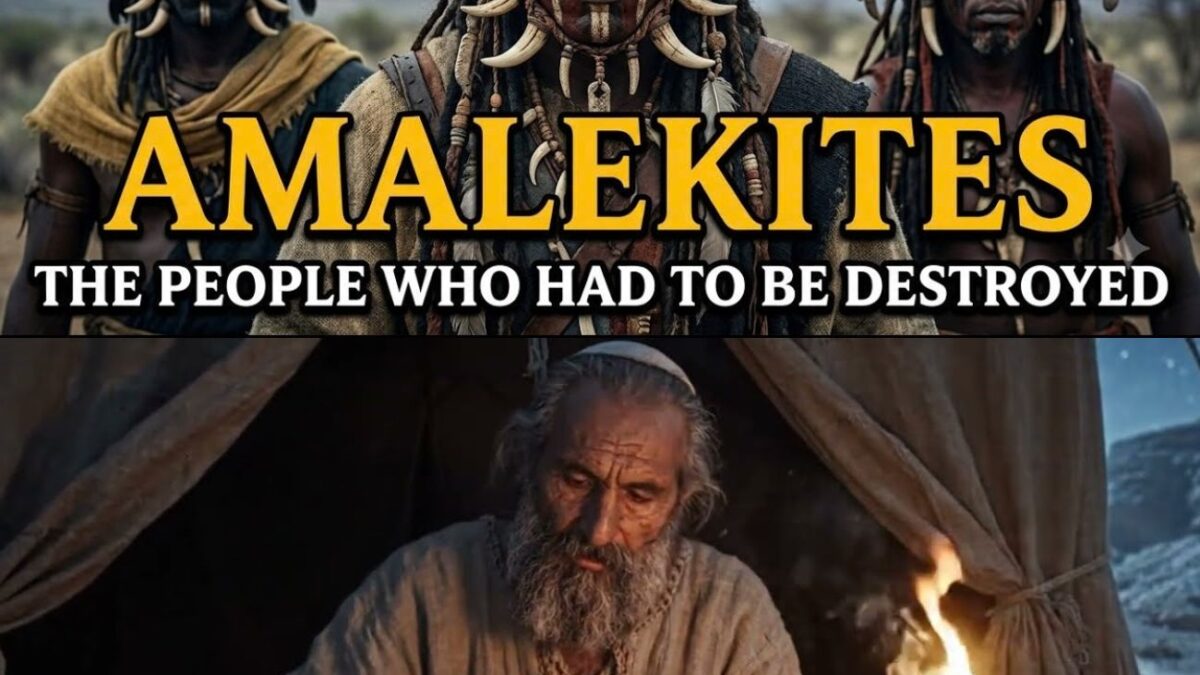
The Amalekites: The Bible’s Cursed Nation God Ordered to Be Erased From Histor
There is a name in the scriptures that makes the foundations of good and evil tremble. A people who awoke the eternal wrath of the Almighty with a single act of cowardice. God pronounced against them a sentence that he had never before declared: I will completely blot out their memory from under heaven. What crime could be so atrocious as to receive such a prophetic curse? The Amalekites attacked when Israel was most vulnerable, killing those who lagged behind. The elderly, pregnant women, exhausted children. That day, an enmity was born that would span generations. Prophets announced their end. Kings received the divine command to execute judgment. And every encounter with Israel brought the fulfillment of the prophecy closer. From the raised staff of Moses in battle to the sword of Samuel, executing the last Amalekite king. This is a story where the supernatural and the earthly intertwine. Today we will unravel the mystery of this cursed people, their genealogical origin, their unforgivable crimes, and how the divine prophecy was fulfilled letter by letter until their name was erased forever. The story of Amalek is proof that not a single word of God falls to the ground.
To understand who the Amalekites were, we need to return to the beginning of their family history. It all started with Esau, Jacob’s twin brother. Esau was the eldest son of Isaac and Rebecca, but he sold his birthright for a bowl of lentil stew when he grew up. He took several wives, and one of them was named Adah. From this marriage, a son named Eliphaz was born. Eliphaz had several sons, but he also had a concubine named Timna. The Bible records this important detail in the book of Genesis 36:12 where it says, “And Timna was a concubine of Eliphaz, son of Esau, and she bore him Amalek.” Thus, Amalek was born, the grandson of Esau and great-grandson of the patriarch Isaac. This origin is crucial because it means the Amalekites were distant relatives of the Israelites. Both peoples descended from Isaac; Israel came from Jacob and Amalek came from Esau. They were family, although separated by different decisions and paths. This family connection makes their future enmity even more significant. They were not complete strangers, but relatives who became mortal enemies. The name Amalek would become synonymous with hostility against Israel, but at this point in history, he was simply a child born into Esau’s family, with no one knowing the role his descendants would play in biblical history.
Esau’s descendants did not stay in Canaan with Isaac’s family. They moved south to a mountainous and rocky region. The book of Genesis 36:8 tells us, “Thus Esau dwelt in Mount Seir. Esau is Edom.” This land of Seir, also known as Edom, was south of the Dead Sea. It was a difficult territory with red mountains and deep valleys. The Amalekites, as descendants of this clan, developed their own territory. They did not stay only in the mountains of Edom; they expanded toward the Negev desert, that arid zone south of Canaan, and they also occupied parts of the Sinai Peninsula. It was dry land with little water and a lot of sun. This harsh environment made them a resistant people accustomed to the difficult life of the desert.
The location of the Amalekites was strategic. They lived on the routes connecting Egypt to Canaan. Any commercial caravan or group of travelers passing through that area had to cross their territories. This gave them constant opportunities for plundering and attack. The book of 1st Samuel 15:7 describes the extent of their territory from Havilah all the way to Shur, which is east of Egypt. It was a wide area covering much of the desert between Egypt and Canaan. The Amalekites knew every valley, every water well, every hiding place in those arid lands. This advantage made them dangerous for anyone crossing their territory.
The Amalekites did not build large walled cities like other peoples of the region. Their way of life was different. They were nomads, living in tents that they could dismantle and move quickly. This mobility made them difficult to locate and even harder to fight. They would attack suddenly and disappear into the desert before anyone could respond. Their economy depended mainly on two things: herding sheep and goats, and plundering other peoples. They did not plant fields or cultivate the land permanently. Instead, they moved with their flocks looking for pastures and supplemented their needs by attacking vulnerable caravans and settlements.
The Amalekites developed a reputation for cruelty. They were not warriors who fought honorable battles between armies. They preferred surprise attacks against weak targets. They attacked tired travelers, small groups that could not defend themselves well, and those lagging behind in the caravans. This way of waging war made them particularly feared and hated enemies. They had no respect for the most vulnerable. While other ancient peoples had certain codes of war, the Amalekites seemed to enjoy attacking precisely the most defenseless. This characteristic would become evident in their first encounter with Israel and would be the main reason for the divine sentence against them. They lived for war and plunder. They did not seek to establish lasting alliances or build a permanent civilization. Their culture revolved around brute force and the ability to take what others had worked to achieve.
Before the first battle between Israel and Amalek took place, something extraordinary happened. A prophet named Balaam pronounced words about this people that would reveal their final destiny. The story of Balaam is fascinating. He was a pagan seer whom the king of Moab hired to curse Israel, but God forced him to bless the Hebrew people instead. During these prophecies, Balaam also spoke about other nations. The book of Numbers, chapter 24, verse 20 records what he said about Amalek: “And when he looked on Amalek, he took up his discourse and said, ‘Amalek was the first among the nations, but his end shall be destruction forever.'”
This declaration is mysterious and powerful at the same time. What does it mean that Amalek was first among the nations? Some scholars believe it refers to the fact that they were the first people to directly attack Israel after their liberation from Egypt. Others think it speaks of their antiquity or importance among the peoples of that region. But what remains absolutely clear is the second part of the prophecy: their end would be total destruction. This prophecy was pronounced before any major conflict between the two peoples. It was as if God were announcing in advance the destiny of Amalek. It was not simply a prediction of military defeat, but the announcement of a complete disappearance—that they should perish forever. Prophetic words carry weight in the Bible. When a true prophet speaks under the inspiration of God, his words are inevitably fulfilled. This prophecy about Amalek would be no exception. But to understand why they deserved such a destiny, we need to see what they did.
The people of Israel had left Egypt after 400 years of slavery. God had liberated them with powerful signs: the ten plagues, the parting of the Red Sea, the destruction of the Egyptian army. Now they were walking through the desert toward the promised land. They were a huge multitude—men, women, children, the elderly, with their flocks and all their possessions. The journey through the desert was exhausting. The sun burned during the day, and it was cold at night. There was little water and limited food. The weakest, the elderly, and small children walked slower than the rest. Naturally, they stayed behind the main group, forming a vulnerable rear guard of tired and exhausted people. It was at this moment of weakness that the Amalekites decided to attack.
They did not challenge the Israeli army head-on. They did not send messengers declaring war. There was no previous conflict between them; Israel had not invaded their territory or threatened their cities. They were simply passing through the desert. The book of Deuteronomy 25:17-18 describes exactly what happened: “Remember what Amalek did to you on the way as you were coming out of Egypt, how he met you on the way and attacked your rear guard, all the stragglers at your rear when you were tired and weary, and he did not fear God.”
They attacked from behind. They killed the weak, the tired, the ones who could not defend themselves. While Israel’s main army was ahead, the Amalekites took advantage of the elderly, pregnant women, and small children walking slower. It was an act of pure cowardice. And the Bible adds an important detail: he did not fear God. The Amalekites had seen or heard about what God had done in Egypt. Everyone knew about the plagues, the parting of the sea, the destruction of the most powerful army in the world. But they did not care. They had no respect for God or his people. This contempt for the divine and this cruelty against the defenseless sealed their destiny.
When news of the Amalekite attack arrived, Moses acted quickly. The place where they camped was called Rephidim, somewhere in the Sinai desert. Moses called Joshua, a young warrior who would become his successor later. The book of Exodus, chapter 17, verse 9 records the instructions: “And Moses said to Joshua, ‘Choose us some men and go out, fight with Amalek. Tomorrow I will stand on the top of the hill with the rod of God in my hand.'” The battle would be planned for the next day. Joshua was to select men able to fight and organize a defense. But the most important thing was the second part of the plan: Moses would climb a hill with the rod of God in his hand. This was the same rod with which he had performed miracles in Egypt, the same one with which he had struck the Red Sea.
The next day, everything happened as planned. Joshua went down with his men to face the Amalekite army. Moses climbed to the top of a nearby hill, accompanied by Aaron, his brother, and Hur. From there, they could see the entire battlefield. Then something extraordinary began to happen. The book of Exodus 17:11 describes it: “And so it was, when Moses held up his hand, that Israel prevailed; and when he let down his hand, Amalek prevailed.” The connection was direct and immediate. When Moses lifted his hands with the rod, the Israeli soldiers gained ground. When he lowered his hands out of fatigue, the Amalekites began to win. This revealed a fundamental truth: victory did not depend on Israel’s military strength. It was not a question of who had more soldiers or better weapons. The battle was won on the spiritual plane. Moses’ raised hands represented dependence on God, prayer, and faith in divine power.
But Moses was human. His arms grew tired. Verse 12 says: “But Moses’ hands became heavy; so they took a stone and put it under him, and he sat on it. And Aaron and Hur supported his hands, one on one side, and the other on the other side. And his hands were steady until the going down of the sun.” Aaron and Hur stood one on each side holding Moses’ arms up. This image is powerful. The leader needed support, and his companions were there to give it. With Moses’ hands held high until sunset, the battle was decided. Verse 13 concludes: “So Joshua defeated Amalek and his people with the edge of the sword.” It was a complete victory, but everyone knew it had not been by their own power.
Immediately after the victory, God spoke with Moses. It was not a simple congratulation for winning the battle; it was a solemn declaration that would change the destiny of Amalek forever. The book of Exodus 17:14 records: “Then the Lord said to Moses, ‘Write this for a memorial in the book and recount it in the hearing of Joshua, that I will utterly blot out the remembrance of Amalek from under heaven.'” This command had two parts. First, write this in a book so it would be permanently recorded. Second, tell Joshua specifically that God would completely erase the memory of Amalek. Why mention Joshua? Because he would eventually lead the conquest of Canaan. He needed to know that this people was under divine sentence. The word blot out is strong. It does not simply mean to defeat or conquer. It means to erase, to eliminate completely, to make it disappear without leaving a trace. God was not ordering one more battle, but the total extinction of this people.
Verse 16 adds more details: “And he said, ‘Because the Lord has sworn: the Lord will have war with Amalek from generation to generation.'” Here God explains the motive. Amalek had raised his hand against the divine throne by cowardly attacking God’s people, by having no fear of him, by killing the defenseless. They had declared war against God himself. And the divine response would be perpetual war, not for a single generation, but from generation to generation. This meant that the enmity would not end with a single battle. Each generation of Israelites would have to remember and act against Amalek until the decree of extermination was completely fulfilled. This judgment may seem extreme, but it reflects the seriousness with which God views cruelty against the defenseless. The Amalekites had not attacked soldiers in battle; they had murdered exhausted elderly people, weak women, and small children, and they had done it without provocation, without fear of God, simply because they could. This level of gratuitous evil could not go without consequences.
After receiving these divine instructions, Moses did something symbolic. The book of Exodus 17:15 tells us: “And Moses built an altar and called its name, The-Lord-Is-My-Banner.” The name means the Lord is my banner or the Lord is my standard. It was a permanent reminder that God had fought for them. This altar served as a physical memorial of the battle. Anyone passing by there in the future would see that altar and ask what it meant, and the story would be told once more: how Amalek attacked cowardly, how God gave the victory, and how he had declared eternal war against that people.
But the memorial was not just a stone. There was a deeper obligation that Israel had to remember. Years later, when Moses was preparing the people to enter the promised land, he reminded them specifically about Amalek. The book of Deuteronomy, chapter 25, verses 18-19 says: “How he met you on the way and attacked your rear guard, all the stragglers at your rear when you were tired and weary, and he did not fear God. Therefore it shall be, when the Lord your God has given you rest from your enemies all around, in the land which the Lord your God is giving you to possess as an inheritance, that you will blot out the remembrance of Amalek from under heaven. You shall not forget.”
The order was clear. Do not forget what Amalek had done. And when they were established in the promised land, when they had peace and security, then they were to fulfill the divine decree and erase the memory of Amalek completely. This was a responsibility that would pass from generation to generation. Parents were to tell their children; grandparents were to remind their grandchildren. No one could forget. The memory of what Amalek had done had to remain alive until the divine judgment was fully executed. It was a sacred obligation that would eventually fall upon the kings of Israel.
After Joshua conquered the land of Canaan and died, Israel entered a chaotic period known as the era of the judges. It was a time without a king where each person did what seemed right in their own eyes. Israel repeatedly fell into idolatry. God allowed enemies to oppress them, the people cried out for help, and God raised up a judge to liberate them. This cycle repeated over and over for centuries. The Amalekites took advantage of this instability. They were no longer just desert raiders; now they formed strategic alliances with other enemies of Israel to cause as much damage as possible.
One of these alliances is recorded in the book of Judges 3:12-13: “And the children of Israel again did evil in the sight of the Lord. So the Lord strengthened Eglon king of Moab against Israel, because they had done evil in the sight of the Lord. Then he gathered to himself the people of Ammon and Amalek, went and defeated Israel, and took possession of the city of palms.” Eglon, the king of Moab, did not act alone. He gathered the Ammonites and the Amalekites to attack Israel. Together, they formed a powerful coalition that managed to defeat the Hebrew people and capture Jericho, known as the city of palms. This was not a simple raiding incursion; it was an occupation that lasted eighteen years. For almost two decades, Israel lived under the dominion of this alliance. The Amalekites actively participated in keeping God’s people subjugated. It was a dark period where Israel paid tribute to their oppressors and lived in constant humiliation. The presence of the Amalekites in this coalition showed that their enmity against Israel had not diminished over time. They kept looking for opportunities to harm and weaken the people God had chosen. Finally, God raised up a judge named Ehud, who freed Israel from this oppression through a bold act. But the lesson was clear: the Amalekites were not just enemies of the past, but a constant threat that took advantage of any moment of Israel’s spiritual weakness to attack.
Years later, Israel fell into sin again, and God allowed another foreign oppression. This time, it was even more devastating. The Midianites, along with the Amalekites and other peoples of the east, formed an alliance that plunged Israel into absolute misery for seven consecutive years. The book of Judges 6:3-5 describes the situation: “So it was, whenever Israel had sown, that Midianites would come up, and Amalekites, and the children of the east would come up against them. Then they would encamp against them and destroy the produce of the earth as far as Gaza, and leave no sustenance for Israel, neither sheep nor ox nor donkey. For they would come up with their livestock and their tents, coming in as numerous as locusts; both they and their camels were without number; and they would enter the land to destroy it.”
This oppression was systematic and calculated. Every year when the Israelites planted their fields and waited for the harvest, these invading peoples arrived like a plague. They did not settle for stealing part of the harvest; they destroyed everything as far as Gaza, which was in the extreme south of the territory. They left nothing—no food, no animals, nothing to survive with. The description is shocking. They came in quantities so large they looked like locusts covering the land. They brought their own livestock and tents, camped in Israeli territory, and consumed or destroyed absolutely everything. The camels were innumerable, which meant they had great mobility and carrying capacity to take away the loot. The Amalekites were an integral part of this destructive coalition. Their knowledge of the desert and experience in quick incursions made them valuable for this scorched earth strategy. For seven years, Israel lived in caves and mountain hideouts trying to protect some of their crops. Verse 6 of the same chapter says: “So Israel was greatly impoverished because of the Midianites, and the children of Israel cried out to the Lord.” The situation became so desperate that the people finally cried out to God for help. God responded by raising up Gideon, who with only 300 men defeated this huge coalition in a miraculous battle. But once again, the Amalekites had shown their nature, always ready to join anyone who wanted to oppress and destroy Israel.
Centuries later, during the reign of King Saul, a young man named David had been anointed as the next king of Israel. But Saul, consumed by jealousy, pursued David to kill him. David had to flee and live as a fugitive for years. In his desperation, David did something risky: he sought refuge among the Philistines, Israel’s traditional enemies. The Philistine king Achish gave David a city named Ziklag so he could live there with his men. It was a small city, but it became the temporary home of David, his 600 warriors, and all their families. For sixteen months, David lived there, occasionally going out on military expeditions.
One day, David and all his men had to accompany the Philistine army north. They left Ziklag completely unprotected with only the women, children, and the elderly. The Amalekites, who were always watching for opportunities, discovered this vulnerability. The book of 1st Samuel 30:1-2 relates what happened: “Now it happened, when David and his men came to Ziklag on the third day, that the Amalekites had invaded the South and Ziklag, attacked Ziklag and burned it with fire, and had taken captive the women and those who were there, from small to great; they did not kill anyone, but carried them away and went their way.”
The Amalekites attacked not only Ziklag but the entire Negev region. They burned the city to the foundations. But there was something different about this attack: they did not kill anyone. They took all the people as prisoners, including David’s two wives, Ahinoam and Abigail. They took everything of value and disappeared into the desert. When David and his men returned on the third day and saw what had happened, their reaction was one of complete despair. Verse 4 says: “Then David and the people who were with him lifted up their voices and wept, until they had no more power to weep.” It was not just material loss; their wives, their children, their families had been captured. They did not know if they were alive or dead, if they would see them again, or if they would be sold as slaves.
The situation got even worse. Verse 6 records: “Now David was greatly distressed, for the people spoke of stoning him, because the soul of all the people was grieved, every man for his sons and his daughters.” David’s own men, blinded by pain and anger, wanted to kill him. They blamed him for leaving their families unprotected. David was on the verge of losing everything: his city, his family, his men, his life. In the middle of this devastating crisis, David did the only thing he could do. The end of 1st Samuel 30:6 says: “But David strengthened himself in the Lord his God.”
He did not let himself be consumed by despair; he sought strength in God. David called the priest Abiathar and asked him to bring the ephod, a sacred object used to consult the will of God. David asked directly: “Shall I pursue this troop? Shall I overtake them?” The divine response was clear and full of hope. Verse 8 records: “And he answered him, ‘Pursue, for you shall surely overtake them and without fail recover all.'” With this divine promise, David quickly organized the pursuit. The 600 men prepared to leave immediately. There was no time to lose; every passing hour, the Amalekites were getting farther away in the desert with their captive families. They ran south following the trail of the plunderers.
They reached the brook Besor, and something unexpected happened there. Two hundred men were so exhausted they could not continue. Verse 10 says: “But David pursued, he and 400 men; for 200 stayed behind, who were so weary that they could not cross the brook Besor.” The pursuit was so intense that a third of the army could not keep up. But David could not stop. He left the 200 resting by the brook with the baggage and continued with the 400 remaining. They still did not know exactly where the Amalekites were. The desert was vast, and the enemy group could be in any direction, but God was guiding every step. Soon they would find the help they needed to locate their enemies precisely.
While David and his men advanced through the desert following the trail, they found something unexpected in the middle of a field: a young man lying on the ground, evidently sick and abandoned. The book of 1st Samuel 30:11-13 says: “Then they found an Egyptian in the field, and brought him to David; and they gave him bread and he ate, and they let him drink water. And they gave him a piece of a cake of figs and two clusters of raisins. So when he had eaten, his spirit returned to him, for he had eaten no bread nor drunk water for three days and three nights. And David said to him, ‘To whom do you belong, and where are you from?’ And he said, ‘I am a young man from Egypt, servant of an Amalekite; and my master left me behind, because three days ago I fell sick.'”
The young man’s story was revealing. He was an Egyptian slave belonging to one of the Amalekites who had attacked Ziklag. He had fallen sick three days ago, and his master simply abandoned him in the desert to die. This cruelty was typical of the Amalekites; they had no compassion even for their own servants. But this cruel abandonment would become the downfall of the Amalekites. The Egyptian youth, grateful for the water and food David had given him, began to reveal crucial information. Verse 14 records: “We made an invasion of the southern area of the Cherethites, which belongs to Judah, and of the southern area of Caleb; and we burned Ziklag with fire.” The Egyptian confirmed what David already knew—that they had burned Ziklag—but he also revealed that they had attacked other areas, showing the magnitude of the Amalekite incursion. It had not been just an attack against David, but a broader plundering campaign against the entire southern region.
David asked him a direct and vital question. Verse 15 says: “And David said to him, ‘Can you take me down to this troop?’ So he said, ‘Swear to me by God that you will neither kill me nor deliver me into the hands of my master, and I will take you down to this troop.'” The Egyptian youth knew exactly where the Amalekites were; he had been with them until three days ago. He knew their location, their camp, everything. David swore not to kill him or hand him over to his former master. With this promise, the Egyptian agreed to guide them directly to where the plunderers were. It was providential. Without this encounter, David could have searched for days in the vast desert without finding the Amalekites. But God had prepared this seemingly casual encounter that would change everything.
Guided by the Egyptian youth, David and his 400 men finally located the Amalekite camp. What they saw filled them with fury and determination. The book of 1st Samuel 30:16 describes the scene: “And when he had brought him down, there they were, spread all over the earth, eating and drinking and dancing, because of all the great spoil which they had taken from the land of the Philistines and from the land of Judah.” The Amalekites were celebrating. They felt safe; they thought no one would pursue them. They were dispersed all over the area, eating, drinking, and partying with everything they had stolen. They had no guards, and they were not expecting any attack. It was the perfect time to strike.
David did not wait. Verse 17 says: “Then David attacked them from twilight until the evening of the next day. Not a man of them escaped, except 400 young men who rode on camels and fled.” The attack lasted from dawn until the evening of the next day. It was an intense and complete defeat of the Amalekites. Only 400 young men managed to escape riding fast camels. The result was total and absolute. Verse 18 records: “So David recovered all that the Amalekites had carried away, and David rescued his two wives.” Verse 19 adds: “And nothing of theirs was lacking, small or great, sons or daughters, spoil or anything which they had taken from them; David recovered all.” It was a perfect victory. They did not lose a single person. All the children, all the women, and all the elderly who had been captured were rescued safe and sound. And not only that, they recovered absolutely everything the Amalekites had stolen from them. But there was more. Verse 20 says: “Then David took all the flocks and herds they had driven before those other livestock, and said, ‘This is David’s spoil.'” The Amalekites had with them not only what was stolen from Ziklag, but the accumulated spoil of multiple incursions. All that livestock and wealth now belonged to David and his men.
When they returned to the brook Besor where they had left the 200 tired men, a problem arose. Some of the warriors who had fought did not want to share the spoil with those who stayed behind. Verse 22 records their words: “Then all the wicked and worthless men of those who had gone with David answered and said, ‘Because they did not go with us, we will not give them any of the spoil that we have recovered, except for every man’s wife and children, that they may lead them away and depart.'” It was a selfish and unfair attitude. They wanted to keep everything for themselves because they were the ones who fought. But David, as a good leader, established a principle of justice. Verses 23-24 record his response: “And David said, ‘My brethren, you shall not do so with what the Lord has given us, who has preserved us and delivered into our hand the troop that came against us. For who will heed you in this matter? But as his part is who goes down to the battle, so shall his part be who stays by the supplies; they shall share alike.'”
David recognized the fundamental truth: the victory had come from God, not from their own strength. And he established a fair principle. Everyone would share equally, regardless of whether they had been in battle or guarding the baggage. Verse 25 concludes: “So it was, from that day forward, that he made it a statute and an ordinance for Israel to this day.” This decision by David became a permanent law for Israel.
While David celebrated his victory over the Amalekites in the south, a tragedy was occurring in the north. King Saul had led the Israeli army into battle against the Philistines on Mount Gilboa. The battle was disastrous. The Philistines completely defeated Israel, and Saul’s three sons died that day: Jonathan, Abinadab, and Malchishua. The army fled, and Saul was seriously wounded. Saul, seeing that he was lost, asked his armor-bearer to kill him so he would not fall alive into the hands of the Philistines. But his armor-bearer, terrified, did not dare touch the Lord’s anointed. Then Saul took his own sword and fell on it. When his armor-bearer saw that he was dead, he also killed himself. Thus ended the reign of Israel’s first king.
Three days later, David was in Ziklag when a messenger arrived. The book of 2nd Samuel, chapter 1, verses 2-3 describes his arrival: “Now it happened on the third day, that a man came from Saul’s camp with his clothes torn and dust on his head. So it was, when he came to David, that he fell to the ground and prostrated himself. And David said to him, ‘Where have you come from?’ And he said to him, ‘From the camp of Israel I have escaped.'” The messenger brought torn clothes and dust on his head, traditional signs of mourning. David immediately asked what had happened, listening as the bearer of bad news confirmed the catastrophic defeat on the mountain.
In the final reckoning of history, the divine decree pronounced centuries earlier in the desert was ultimately carried out. Although individual remnants of Amalek surfaced through the generations—such as Haman the Agagite, a descendant of Agag the Amalekite king whom Saul had unlawfully spared—even his desperate plot to annihilate the Jewish people was completely overturned. The relentless justice of heaven ensured that every trace of their national identity was utterly swept away, sealing the absolute fulfillment of the prophecy that their name would be erased from under heaven forever.

