Something Followed This Family Through the Ozarks for 6 Nights — Until the Granny Witch.. Folk Story
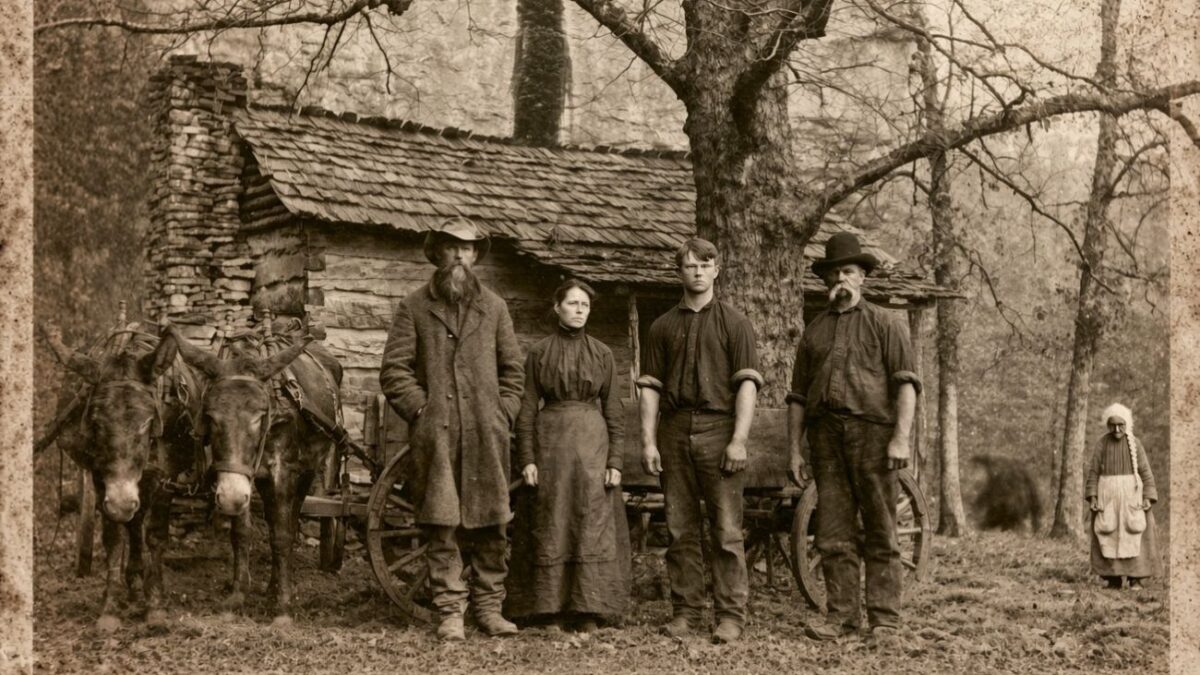
Something Followed This Family Through the Ozarks for 6 Nights — Until the Granny Witch.. Folk Story
There is a stretch of country in the northwest of Arkansas where the ridges don’t quite line up with the maps and the roads that were cut through them in the 1880s still run more or less where they were laid, only narrower now and grown over in places by things that shouldn’t have grown that fast. If you have ever been in country like that, if you have ever walked into a hollow at dusk and felt the air change on your face, then you will know the kind of place I am telling you about tonight.
This one is called Something Followed This Family Through the Ozarks for Six Nights Until the Granny Witch. Newton County, Arkansas, 1907, Betto Hollow. A husband, a wife, her brother, and a teamster they hired at the last crossroads before the wagon road ran out. Six nights, one cabin, and a woman with red thread in her apron pocket who knew what was standing at the edge of the yard and knew the word for it and would not say the word out loud until she had to.
Halbert Yokum was 34 years old that autumn, a timber cruiser out of Fort Smith. He had spent the better part of the last 12 years walking through country most men found reasons not to walk through, marking trees for the companies and coming back down with a notebook full of numbers. He was tall, near enough to 6’2″, and thin in the way that a man gets when he has been eating from a saddlebag for weeks at a time. His hands were a mess, split at the knuckles, calloused at the palms, one thumbnail black from where a mule had stepped on it two summers before. He had a low voice, and he was not a talker. His wife did most of the talking for both of them, and she had always done it, and he was grateful for it.
Verly Yokum, born a Kretic, was 31 that fall, and she carried herself like a woman 10 years older, which is what happens to certain women who grow up in a house full of men and learn early that if you do not steer the room, the room will run over you. She worked on a floor loom in the winters and helped her mother-in-law tend women in labor in the springs, and she had a plain, watchful face with a mouth that pulled to one side when she was thinking. She and Halbert had been married eight years and had stopped talking about what they did not have.
Her brother, Ansel Kretic, was 28, a blacksmith at a small forge outside of Ozark, and he had come with them because their mother had made him promise, and because the inheritance they were going up into the hollow to see had been left to the three of them together, not to Halbert alone. Ansel was a big man in the shoulders and small in the belly, with pale eyes and a habit of laughing at the wrong moment, which had gotten him into fights more than once.
And there was Otis Renfro. And I want you to keep an eye on Otis Renfro because Otis Renfro is the one it took first. Otis was 52, a widower, and he drove teams for a living out of Jasper. They had hired him for the last stretch of the trip because the wagon road into Betto Hollow was not a road anymore in any sense the word normally means, and they needed a man who knew mules the way most men know their own hands. He came recommended by the postmaster, and he came cheap, and he was quiet, and he had a wool hat he wore even when the sun was full on him. His face was long, his eyes were set close together, and he had a mustache the color of old iron. When he shook Halbert’s hand at the crossroads outside of Panka, Halbert said later that the palm was too cold for the day, and that he had put it out of his mind at the time, because a man’s palm is his own business.
The property they were going up to had belonged to Verly’s great-uncle, Cletus Kretic, a man none of them had ever laid eyes on, who had died at 81 that August of what the county coroner called failure of the heart. He had lived in Betto Hollow alone since before the war, and he had left in his will a cabin, 240 acres of hardwood and rock, one bald pasture, and a locked cedar chest at the foot of the bed, which the letter from the lawyer said the family was to open together. The lawyer had also written at the bottom of the last page in a smaller hand that the neighbors he had spoken to had asked him to pass along one particular piece of advice: Do not stay past a week. He had written it out that plainly. Not a warning, not a threat, just a piece of advice from people who had known Cletus Kretic. Halbert read it aloud at the kitchen table in Fort Smith the night before they left, and Verly laughed a little, and Ansel said the neighbors were probably worried about the roof, and Halbert folded the letter and put it in his coat pocket and did not talk about it again.
They came into the hollow on the afternoon of October the 7th. The road down was the kind of road you’d drive with your foot on the brake all the way, with the wagon leaning first one way and then the other, and the mules blowing hard on the switchbacks, and Otis standing up in the box now and then to see what was ahead. The cabin came into view around the last bend. It was smaller than Verly had pictured, and older, and set back against the base of a limestone bluff that rose up behind it, maybe 200 feet, all in one raw gray face, with a wet streak of moss running down the middle of it like something had spilled from the top years ago and never been cleaned up. There was one big walnut tree in the yard, and the yard was more moss than grass, and the rest of the hollow ran off to the east in a long fold of timber that was already going brown at the top.
It was quiet. That was the first thing Verly said out loud when they got down from the wagon: It is quiet. And it was. There were no crows, and there were no jays, and there was no wind in the walnut tree, and Halbert said later that he had noticed it too and that he had made a note of it the way he made notes of everything and then set it aside.
They spent the rest of that day carrying things in. The cabin had two rooms: a front room with a stone hearth and a plank floor worn dark at the door, and a back room with a rope bed and the cedar chest at its foot. The chest was locked. The lawyer had sent the key with the letter on a bit of leather cord, and Verly had it around her neck. She said she wanted to wait until they had eaten and washed before they opened it. She said it in the tone she used when she had already decided a thing, and neither man argued. Otis slept in the wagon that night out under the walnut tree wrapped in a horse blanket with the mules tied close and a small fire in a ring of rocks he had built himself without being asked. He said he preferred the open. He said it more than once. Halbert would remember that later.
The first night was cold for the season, and the moon was three days short of full and rode up early. They ate cornbread and beans and drank coffee that Verly made on the hearth, and they sat for a while without much to say. And then Ansel went out to check on Otis, and came back and said Otis was asleep already, and the mules were quiet. Halbert read a little from the last newspaper they had brought, dated the 6th of October, four days old already, and Verly unrolled a piece of weaving she had brought to work on and did not work on. She sat with it across her lap and looked at the fire. She said later that she had felt something like a hand pass across the back of her neck once gently at about a quarter to nine that first evening, and that she had turned her head and seen nothing, and that Halbert had been looking straight at her when she turned and had not seen anything either, but that his face had gone still in a way she did not like.
He did not remember that. He remembered other things. He remembered the breathing. He remembered that at about half-past ten, when Verly had gone to the back room, and Ansel had gone to lay down on a pallet by the fire, and he was sitting with the lamp low and the door barred, he heard out past the walnut tree, past the yard, out at the edge of the hollow where the timber started, something breathing. Not a horse, not a bear, not anything he had ever heard a name for in 12 years of walking timber. It was slow. It was slow the way a man breathes who is holding still on purpose so as not to be heard and failing at the second half. It went in and it went out and it went in again, and Halbert stood up from the table without meaning to and stood there with his hand on the back of the chair and listened to it for what he later said was near enough three full minutes. Then it stopped. He waited another minute. He heard the mules shift under the tree, and he heard Ansel cough once in his sleep, and he heard the fire in the hearth crack and settle. He went to bed. He did not tell Verly. He said later that he did not want her to lie awake, and that he had told himself it was a deer in rut, or a black bear passing through, or an old man’s imagination on a first night in a strange house. He said all of that to himself in bed with his eyes open for a long time before he went to sleep.
The second day was warm and gray. They walked the property. Ansel said the timber was better than he had hoped, and Halbert in his notebook wrote down black walnut and white oak and shagbark hickory and made a rough count of the acres in each and made his marks with a stub of pencil, wetting it on his tongue between numbers. Verly stayed at the cabin and swept and washed the plank floor with lye water she boiled on the hearth and beat the dust out of two horse blankets they had found in a wooden trunk in the front room. Otis fed and watered the mules and then walked alone out to the edge of the timber on the east side of the yard and stood there for a long time with his hat in his hand. Verly saw him from the window. She said he stood there with his lips moving, not praying, not the shape of any prayer she knew, just moving. When he came back in for the noon meal, she asked him if he was feeling all right. He said the water in the spring behind the cabin tasted like iron. That was all he said.
That afternoon, Halbert found the first sign. It was on the far side of the walnut tree, on the ground in the moss. A patch of moss the size of a dinner plate had been pressed down cleanly into the shape of something. He crouched over it for a while and he called Ansel over, and Ansel crouched over it too. It was not a bootprint. It was not a hoof. It was not a bear paw. It was oval, and it had four points at the front end, not five, and it was pressed in evenly at all four points, which is not how a foot presses when it walks. A foot presses harder at the heel and lighter at the toes, or the other way around, depending on the animal. This one was even. Halbert measured it against his hand; it was slightly longer than his hand and slightly wider, and it was one single depression. There was no other. He walked in circles for a hundred feet around it and found nothing else. Ansel said, standing up, that it had to be a fresh dig from a hog, that the shape was accidental, that the ground remembered wrong sometimes. Halbert did not answer. He went back into the cabin and got the axe from where it was hung by the door and set it against the wall by his side of the bed. He did not tell Verly about the print either, but that night he barred the door, and he set the axe in the corner, and he lay awake most of the night listening. He heard nothing that night. Not one breath, not one branch, not one owl. He heard, if anything, less than a night in Betto Hollow should have. That was the thing he wrote about later, and underlined twice in his notebook: not what he heard, but what he didn’t.
The third day was when things stopped feeling accidental. Verly went to the spring behind the cabin in the morning to fill the bucket, and when she came back, she was walking a little too fast, and she set the bucket down harder than she meant to, and some of the water sloshed out onto the plank floor. She said—and I want you to hear how she said it, calm, like a woman reading a receipt out loud—that there was a bundle on the spring stone. A bundle, she said it that way. Halbert went out with her. Ansel followed. They stood at the spring, which was a natural rock basin about the size of a laundry tub, set into the base of the bluff and shaded by a leaning ironwood tree. On the flat stone at the near edge of the basin, where a person kneels to dip a bucket, someone had set a small bundle no bigger than an apple, tied up in what looked like a piece of blue and white ticking cloth. It was tied with three loops of a hair, a single long gray hair wound three times around and knotted.
Halbert bent to look at it without touching it. He said later he could tell from a foot away that it did not smell right. He said it smelled the way a wet dog smells and the way a jar of pickled onion smells, and something else under those which he could not name. Ansel reached to pick it up, and Halbert said without turning, “Don’t.” Ansel did not. They left it where it was. They went back inside and sat around the table and did not eat the breakfast Verly had put on it. Otis came in from the yard and asked what was wrong, and Verly told him. Otis went out to the spring by himself and stood there for a while. When he came back, he was pale. He said he had not touched it. He said whoever had left it had left it in the night and had come and gone without waking the mules, and the mules woke for anything, and that was not a thing a person could easily do. Then he sat down at the table, and he ate. He ate the cornbread, and he ate a plate of beans, and he drank a whole tin cup of coffee, and none of them had ever seen him eat like that; he always ate small. Verly said later that watching him eat that morning was the first moment she was afraid, really afraid—the fear that gets in low and stays.
That afternoon, Halbert walked back out to the edge of the timber and found Otis standing there with his hat in his hand, lips moving. Verly watched him from the window and asked Halbert to bring him in. Halbert went out. He came up on Otis from behind quietly in the way he had learned to come up on deer, and he heard before Otis heard him what Otis was saying under his breath. Otis was saying over and over in the same tone that he was sorry, that he had not meant to, that he did not know it would follow him this far. Halbert put his hand on Otis’s shoulder, and Otis jumped like a man who has been shot. He looked at Halbert, and for the first two seconds, he did not know who Halbert was; then he did. He came back into the cabin without saying another word. He ate again that night. He ate more than he should have. He slept in the wagon again, and he refused, this time gently but firmly, to sleep inside.
That was the third night, October 25th, 1907. This is the night Halbert put a mark in the margin of his notebook, a small cross, which he later told Nanny Bell Tree he did not remember drawing. On the third night, the thing came into the yard. Ansel saw it. He was up because he could not sleep, and he was standing at the front room window with the shutter cracked an inch, looking out at the walnut tree and the wagon under it, and at Otis rolled up in his horse blanket with his back to the cabin. The moon was full that night, or one night short of it, and the yard was the pale color that moss goes under a full moon, which is almost white. Ansel said the tree threw a shadow across the yard the way a tree always does, and then a second shadow came into the yard. That was how he described it later when asked: a second shadow, not a body, not a shape, not an animal, a shadow. It came in from the east edge, from where the timber started, and it walked the way a shadow walks when the thing making it moves across the yard, and it stopped by the walnut tree, and it stood there for what Ansel said was two minutes at the least. He did not scream. He did not wake Halbert. He said he could not; he said his throat had closed up on him and his knees were not obeying him, and the only thing he could do was stand at the shutter with his eye pressed to the crack. The shadow moved. It went around the walnut tree. It went to the wagon. It stopped beside the wagon on the side where Otis was sleeping, and it bent down slowly in the way that a person bends down to look at a face on a pillow. Ansel saw the shadow of the bend; he did not see what bent. He said the moon was full on the yard and there was nothing to cast the shadow—there was nothing there. And then the shadow straightened up, and it went back the way it had come, and it went across the yard, and it went into the timber, and the yard was one shadow again, the walnuts and only the walnuts. And Ansel stood at the window with his hand pressed against the plank wall to keep from falling. He woke Halbert in the morning and told him. Halbert listened. He did not interrupt. He asked at the end only two questions: he asked if Ansel had been drinking, which Ansel had not, and he asked if Otis had woken up. He had not. Otis was at that moment out at the wagon brushing down the mules, humming a tune Halbert did not recognize under his breath. The humming was the first thing that morning that made Verly put down what she was holding and go still.
Halbert and Ansel walked out to the neighbors on the fourth day. They left at first light, and they took the axe and Halbert’s rifle, and they left Verly in the cabin with Otis, which Verly did not want, but agreed to because she said one of them needed to be with the wagon, and she was the one who could handle Otis if he needed handling. She did not say why she thought Otis might need handling; she said it in a plain voice. Halbert kissed the side of her head at the door and told her they would be back by nightfall. He was not back by nightfall, but he was back.
The neighbors were the Fanchers: old Mrs. Rowena Fancher, near 80 by then, and her son Emmett Fancher in his 50s, unmarried, sharing a small farm on the far side of the ridge with a milk cow and 20 chickens and a good spring. Halbert did not have to explain who he was. Rowena Fancher opened the door and looked at him and said without any surprise that they had come sooner than she thought. She took them inside. She made coffee. She sat them down at the table. Emmett stayed by the door with a shotgun broken open across his arm. Halbert would remember later that Emmett did not put the shotgun down the whole time they were in the house.
Rowena Fancher told them at that table on the fourth morning of what would be six nights what Betto Hollow was, and what Cletus Kretic had done to it, and what had followed him for the last 40 years of his life, which was the same thing that had followed him into and out of the hollow every year since 1867, and which he had kept in that hollow the way a farmer keeps a cow in a fenced pasture—only he was not the farmer and it was not a cow, and the fence, whatever it was, had come down when he died. She told them that in 1867, Cletus Kretic had been a young man of 21 that spring, and he had walked out of the war a year and a half late, and he had come home to find his mother dead of the pox and his younger sister gone to Texas with a man neither of them approved of. He was alone and he was angry, and he had inherited the hollow from his mother’s people, and he had gone up into it that spring with nothing but a rifle and a bag of seed corn, and he had spent the summer alone. Rowena Fancher said her own mother had known Cletus Kretic in that summer and had said he was a hard man and he had gotten harder. That fall, at the end of the harvest, something had happened in the hollow. She said no one knew exactly what; she said the only thing they knew was that Cletus Kretic had walked down to the Fancher place one November morning in 1867 and had asked to speak to her father, and he had told her father that he had made a bargain, and he had told her father the name of the thing he had made the bargain with. And her father had shut the door in his face and stood behind it with the bar drawn and told his own family that Cletus Kretic was never to be let in the house again. He was not. For 40 years he was not. And in those 40 years, Rowena Fancher said plainly, looking Halbert in the face, three men went up into Betto Hollow at different times to see Cletus Kretic on business or to hunt or to serve papers, and only two came out. The third was a tax collector in 1882, and his horse came back without him, and his hat was found the following spring at the top of the bluff behind Cletus Kretic’s cabin, and there was nothing else of him ever found. The county called it a fall; the county said the horse must have thrown him, but Rowena Fancher’s father, who had been alive then, had said something else. Her father had said that whatever Cletus Kretic had bargained with was the one who ate, and Cletus had provided.
Rowena Fancher told them that when Cletus Kretic died—and she had heard he was dead the day after it happened because word ran fast in the hollows—she had known immediately that the thing in Betto Hollow no longer had a keeper. She had told her son to keep the shotgun broken open by the door. She had told Emmett to keep the lantern lit on the porch at night. She had gone herself to see the granny witch and had asked her whether they were in danger. And the granny witch had said, “No, not yet.” The granny witch had said the thing in Betto Hollow would not travel four miles for a Fancher; it would stay in the hollow, and it would wait, and it would test whoever came into it, and it would take whoever was easiest to take. That was what the granny witch had said. That was in September, six weeks before Halbert and Verly and Ansel and Otis came down the road into the hollow with a wagon and a locked cedar chest.
Halbert asked her the granny witch’s name. She said the name plainly: Nanny Bell Tree. She said the granny witch lived alone in a cabin on Peavey Ridge about six miles north as the crow flies, but a good deal further as a man walked, and she said if they had any sense at all, they would leave the hollow that day and come back for the chest with a wagon and a preacher in the spring. And if they would not leave, they should go immediately to Peavey Ridge and put themselves under Nanny Bell Tree’s roof for one night at the least, and do whatever she told them to do, and pay her whatever she asked, and not argue about any of it.
Halbert asked her what would happen if they did not. Rowena Fancher looked at him for a while before she answered, and she answered in six words: “One of you will be next.”
Halbert asked her who she thought would be next. She said, “The one who is already hearing it.”
He knew. He had known since Ansel’s shadow story, and he had known even before that, since the morning at the spring, and he had known before that, in a place under his knowing, since the first night with the breathing in the timber: it was Otis. It had been Otis from the start. Otis had brought it with him, or Otis had drawn it to him, or Otis had once in some year Halbert did not know done something in the hollow, or near the hollow, or to a man from the hollow, and the thing in the hollow had a memory, and the thing in the hollow had recognized him, or had recognized what he owed.
Halbert did not tell any of this to Rowena Fancher. He drank his coffee. He thanked her. He and Ansel walked back over the ridge with the axe and the rifle, and they did not talk the whole way, and they came into the yard at Betto Hollow just as the sun was going behind the bluff. And Otis was sitting on the porch with a piece of harness in his lap and a needle and thread in his hand, and Otis was mending. He was mending well in even stitches in a light so low a man his age should not have been able to see, and he was humming the same tune he had hummed that morning, and Verly was standing in the doorway with her arms crossed watching him, and had been standing there she said later for near an hour without moving.
That was the fourth night. That was the night they did not sleep. Halbert put his side of the cabin that night, not in the wagon; he would not take no for an answer, and Otis did not fight him, which was itself a bad sign. Halbert laid a pallet by the hearth and put Otis on it. He barred the door. He set the axe by the door. He set the rifle across his own knees at the table with the lamp low. Verly sat opposite him with her weaving in her lap that she was not working on, and Ansel sat on the floor with his back to the wall between the door and the window, and none of them slept.
Otis slept. Otis slept the way a man sleeps who has taken laudanum deep on his back with his hands folded on his stomach and his mouth open a little and his breath coming even and slow. And at about two in the morning, by Halbert’s pocket watch, Otis began to speak in his sleep. He did not speak English; he did not speak anything Halbert or Verly or Ansel had ever heard. He spoke for perhaps a minute and a half in a low voice, in a rhythm like a man reciting something he had learned by heart, and then he stopped, and he lay still, and he did not speak again the rest of the night. And outside on the far side of the door, from about the time Otis started speaking to about the time he stopped, something walked slowly back and forth across the porch. Slow, deliberate steps. Not a raccoon, not a possum, not the wind. Steps.
Verly and Ansel and Halbert sat in that room and listened to the steps for a minute and a half without speaking, without moving. And then the steps went off the porch and around the corner of the cabin and away, and they did not come back that night.
At dawn, Halbert went out and looked at the porch. There was nothing. No mark, no dust disturbed, no smell. The moss under the bottom step, however, was pressed in cleanly in one oval, four points at the front, no other, just the one—and the porch was seven feet up from the ground.
The fifth day was a running day. They did not sleep, and they moved fast. Verly packed food for one day, wrapped in oiled cloth, and she filled two canteens from the spring after standing at the edge of it for a long minute looking at the flat stone, which was clean now, the bundle gone, taken by something or by no one, she could not tell. Halbert and Ansel hitched the mules to the wagon. Otis, when they told him what they meant to do, said he would stay with the cabin. He said it flatly. He said the mules did not need him for a walk. He said he had things to mend. Halbert told him plainly that they were not leaving him. He said it in a voice that Verly had never heard him use with a man before. Otis looked at him for a long time, and then Otis nodded once, and he climbed into the wagon, and he sat on the bench, and he put his hands on his knees, and he did not speak the whole drive out.
The drive to Peavey Ridge was six miles as the crow flies and near 16 the way the wagon had to go up out of Betto Hollow and along the crest of the ridge road, which was passable that time of year for a small wagon if the driver was careful. Halbert drove. Ansel walked ahead with the rifle to watch the ruts. Verly sat in the box beside Halbert and held the reins loose across her knees when he needed both hands for the brake. Otis sat in the back on the pile of blankets and looked at the timber going by and did not blink for what Verly later said was nearly the whole first hour.
They arrived at Nanny Bell Tree’s cabin at about two in the afternoon, and they did not have to knock. She was standing in the yard. She was not what any of them had pictured. She was small, five foot even if that. She was thin the way a fence post is thin. She had white hair braided in a single braid over one shoulder down to her hip, and she wore a long gray dress with a white apron over it, and the apron had two large pockets, and in the right pocket she was carrying visibly a bundle of red thread wound around a wooden bobbin. She had blue eyes, pale and clear, and she was, Verly said, the oldest-looking human being any of them had ever seen, and at the same time she moved without hesitation like a woman half her age. She was somewhere past 70 and short of 90, and she did not wait for Halbert to step down from the wagon before she spoke.
She looked past Halbert, past Verly, past Ansel, straight into the back of the wagon where Otis sat with his hands on his knees.
“You brought the stray,” Nanny Bell Tree said. Her voice was thin as dry grass, but it carried across the yard without a quaver. “You shouldn’t have brought him near a house, but you’re here now.”
She turned and walked toward the cabin door without looking back to see if they were following. Halbert tied the mules to the fence rail and helped Verly down. Ansel climbed out of the wagon bed first, his hand tight on the barrel of the rifle, and Halbert told him quietly to leave it by the gate. Ansel left it.
They went inside the cabin. It was dark and smelled of dried pennyroyal and tallow and wood smoke that had settled deep into the logs over fifty winters. There was no furniture to speak of—just a low table, three split-oak chairs, and a bed in the corner covered with a quilt made of scraps of dark wool. Nanny Bell Tree stood by the hearth where a small fire burned low, though the day was warm. She reached into her apron pocket and pulled out the wooden bobbin with the red thread wound tight around it, and she set it down on the center of the table with a dry click.
“The thing in Betto Hollow doesn’t care about your timber,” she said, looking at Halbert. “And it doesn’t care about your dead uncle’s iron chest. It cares about accounts. And Mr. Renfro here has kept an open account since the winter of ninety-eight, when he took a stray calf that didn’t belong to him out of a pen that wasn’t his, and left a man dead in the creek bed behind the mill at Jasper so nobody would talk.”
Otis did not move. He sat on the wooden chair nearest the door, his hands still flat on his knees, his head tilted down so only the brim of his wool hat showed.
“I was wondering when it would find him,” Otis said. His voice was quite normal, perfectly steady, like a man talking about the price of corn. “I heard it outside the first night. I knew the step.”
“Of course you knew the step,” Nanny Bell Tree said, taking a step toward him with the red thread in her palm. “You made it. Every time a man takes a life to cover a theft in these hills, he leaves a track behind him that something else moves into. Your uncle Cletus spent forty years feeding it scraps so it wouldn’t come looking at the house. When he died, the pantry was empty, so it looked for the nearest name on the list.”
Verly reached out and caught Halbert’s sleeve. “Can we go back?” she asked, her voice dropping low. “Can we get the wagon and go back to Fort Smith tonight?”
“You can go,” Nanny Bell Tree said, “and the woods will walk with you all the way to the county line. But the man stays.”
She walked over to Otis and stood right in front of him. She pulled a length of the red thread from the wooden bobbin, maybe two yards of it, snapping it with her thumbnail with a sharp little pop. She did not ask his permission. She laid the thread across his shoulders in a cross, right over the wool coat he wore, and tied the ends together under his chin with a knot so small it looked like a red beetle against his throat.
“Get out of the chair, Otis,” she said.
Otis stood up. He did not look at Halbert or Verly or Ansel. He looked straight at the small fire on the hearth.
“Go on out the back,” Nanny Bell Tree told him, pointing to a low batten door at the rear of the cabin that led out toward the steep slope of Peavey Ridge where the cedar brakes grew thick and gray. “Don’t look at the trees. If you hear someone calling your name from the brush, don’t answer it twice. Walk until the ground gets soft under your boots, and then sit down and wait.”
Otis turned without a word and walked to the back door. He lifted the wooden latch, pushed it open, and stepped out into the bright afternoon light. The door swung shut behind him with a heavy, final thud. Nobody ran to look after him. They stood in the dim room and listened through the logs as his boots crunched once, twice, three times on the dry limestone gravel, and then the sound stopped, swallowed entirely by the cedar brush outside.
Nanny Bell Tree walked back to the table, picked up her bobbin, and dropped it into her white apron pocket. She pulled out a small stone jug and three clay cups, setting them down on the wood without a sound.
“Sit down,” she said to the three of them. “You’ve got three miles of daylight left before you reach the ridge road, and you’re going to need every inch of it inside you to get back down to the river before dark. Don’t go back for the chest. Let the county keep what’s in it. Some things are heavier than silver, and once you open the lid, you’ve signed the name at the bottom of the page whether you meant to or not.”
Halbert sat down because his legs had gone light, and Verly sat beside him, her hand still cold in his. Ansel stayed by the door, looking out the small grease-paper window toward the back where the ridge ran off into the blue distance.
They did not speak for a long time. They drank the bitter tea Nanny Bell Tree poured into the clay cups—it tasted of wild cherry bark and river water—and when they got back into the wagon to turn the mules around toward Fort Smith, none of them looked back toward the ridge. They reached the crossroads outside of Panka just as the sun went down behind the western hills, and the night came down fast over the wagon road, quiet and narrow and growing over with things that had no business growing that fast, leaving behind them a hollow in the dark where the mountain kept its own accounts, and the law signed off with the wrong word for the last time.

