Scandalous Women From History Who Ruined Their Lives
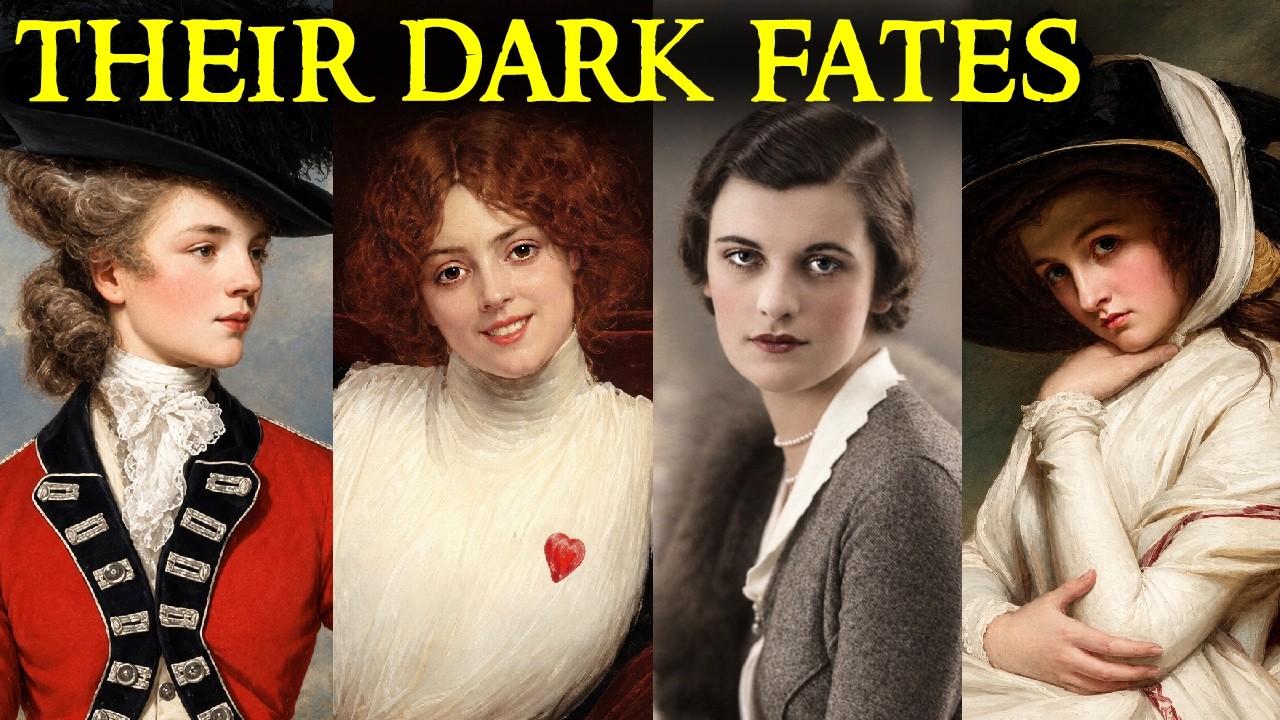
Today we’ll be looking into various women from history whose names became forever linked to scandal, controversy, and shocking secrets. From aristocratic bedrooms and forbidden affairs to jewels, murder, and courtroom drama, these women lived extraordinary lives that captivated their contemporaries and continue to fascinate us today. So, join me as we explore all of this and much more. Just quickly before we begin, I want to announce that I now have Spotify. So, if you’re interested in listening to my content or watching it on Spotify, check that out. And I have Spotify exclusives coming up in the following months. So, if you are interested, please give me a follow and check me out on Spotify. Thanks.
Margaret Campbell, the Duchess of Argyle, had it all: beauty, wealth, and a place at the heart of Britain’s elite. But she was hiding a dark secret that could destroy everything. Suspicious of his wife, her husband broke into a locked drawer and made a discovery that shocked him to his core. What he found would ignite one of Britain’s most notorious scandals—a scandal that would follow Margaret to her grave.
The woman who would one day become the Duchess of Argyle was born as Ethel Margaret Whigham on the 1st of December 1912 in Newton Mearns, a small town in Renfrewshire in western Scotland. Her father was George Hay Whigham, a successful businessman who for many years was the chairman of the Celanese Corporation, a dual British and North American company that specialized at the time in the production of synthetic materials out of substances like cellulose. The family was well-connected and wealthy as a result, though not staggeringly rich by contemporary standards. Margaret’s mother was Helen Mann Hannay.
Growing up, Margaret attended a series of private and boarding schools in both New York and in Scotland, in line with the family’s business interests being in both the United States and Britain. These included around 14 years at the elite Hewitt School on the Upper East Side of Manhattan. Her family traveled a good amount and they enjoyed holidaying in France and in places like the Isle of Wight. It was a cosmopolitan upbringing, though not an entirely happy one. Her parents’ marriage was strained as a result of George’s many affairs, and Margaret’s mother often used her to try and mediate in their marital rows. The chaos of her parents’ marriage left a mark on Margaret that would shape the rest of her life. Years later, biographers would draw a direct line between her fractured childhood and the scandals that made her infamous.
But Margaret’s descent into controversy didn’t begin as a duchess. It began as a teenager with a forbidden romance and a closely guarded secret. Even before her debutante years, Margaret’s beauty and charm attracted a succession of wealthy and well-connected admirers. But behind the glamour was a growing appetite for risk, and one teenage romance would change her life forever. In 1928, while on one of her family’s holidays to the Isle of Wight, she began a relationship with David Niven, a figure who would go on to become a famous actor who won an Academy Award for his role in the film Separate Tables in 1958. At the time, Niven was 18 and Margaret was 15.
But what began as a summer romance quickly spiraled into crisis when Margaret became pregnant. When Margaret’s parents learned of the pregnancy, they were appalled. One maid later recalled that all hell broke loose. For a wealthy upper-class family in 1928, an unmarried teenage daughter expecting a child threatened not only disgrace, but social ruin. Determined to avoid a scandal at any cost, her parents acted swiftly. Margaret was taken to London and subjected to a secret abortion at a time when the procedure was still illegal in Britain. Just 15 years old, she found herself caught in a nightmare that had to remain hidden from the world. The experience must have been traumatic, and it was so deeply buried that Margaret would later omit it entirely from her memoirs. Yet remarkably, she never lost her affection for David Niven, remaining on good terms with him for decades and even attending his funeral in 1983, 55 years after their brief fling on the Isle of Wight.
But if her family hoped this painful episode would teach Margaret caution, they were mistaken, for greater scandals and far more dangerous romances still lay ahead. In 1930, when Margaret was 18, she made her debut at the royal court in London and was titled as debutante of the year. Thereafter, she became one of the most talked-about socialites of the 1930s by employing clever manipulation of the tabloid newspapers and also harnessing her good looks. For instance, she regularly appeared in magazines and was often commented on for her dress sense and hairstyle. As her fame grew, so did the number of wealthy and influential men vying for her attention. Among them was Charles Greville, the seventh Earl of Warwick, who became so infatuated that he proposed marriage. Margaret accepted, and for a time it seemed that she was destined to become Countess of Warwick. Yet when the moment came, she abruptly called off the wedding, leaving society gossip columns in a frenzy. It was an early sign that Margaret had little intent of following convention. At the same time, she was also romantically linked to Prince George, Duke of Kent, a younger son of King George V of Britain and one of the most eligible bachelors in the country.
But Margaret was not a woman who remained unattached for long. The collapse of her engagement to Warwick did little to slow her rise through high society; if anything, it only added to her allure. Just a year after she broke things off with Warwick, Margaret married for the first time. This was to Charles Sweeney, an amateur golfer and stockbroker who hailed from a very rich Irish-American family, one that had made a lot of money in mining during the Gilded Age of late 19th-century America. She even converted to Roman Catholicism to facilitate the marriage, and the ceremony became one of the most talked-about social events of 1933. It literally stopped traffic in the streets surrounding the Brompton Oratory in Kensington in London, where it was held. Particular attention focused on Margaret herself. Her wedding dress, designed by Norman Hartnell, a fashion designer who had produced dresses for the women of the British royal family, was widely admired and remains on display at London’s Victoria and Albert Museum today. It marked the beginning of a lifelong association with glamour and high fashion.
To outsiders, the marriage appeared to have it all: wealth, status, and sophistication. Behind closed doors, however, the relationship was steadily falling apart. The union would last more than 14 years, but by Margaret’s own account, it was deeply unhappy. All Charlie wanted in a wife was a pretty, brainless doll, she later complained. They were both unfaithful and engaged in numerous affairs. Then, in 1943, Margaret came terrifyingly close to death. In an incident that briefly captured newspaper attention, she plunged 40 feet or 12 meters down a lift shaft. The fall was so violent that she narrowly avoided being killed. Recalling the ordeal years later, she stated, “The only thing that saved me was the lift cable, which broke my fall. I must have clutched at it, for it was later found that all of my fingernails were torn off. I apparently fell onto my knees and cracked the back of my head against the wall.” Though it appears to have been nothing more than a freak accident, Margaret was lucky to survive.
The marriage eventually ended in divorce in 1947. It was not without complications, though, as she and Charles had had three children by then, though the first of these in 1933 was a stillborn. A daughter, Frances Helen, and a son, Brian Charles, followed in 1937 and 1940, both of whom lived long lives. Margaret’s natal history was otherwise very complicated, with her suffering numerous miscarriages as well as the stillbirth before Frances was born, possibly a consequence of the manner in which the abortion she underwent as a teenager was carried out.
Following the collapse of her marriage to Sweeney, Margaret soon became engaged to Joseph Thomas, a Texan-born banker of Lehman Brothers. Yet the relationship proved short-lived; before they could marry, Thomas fell in love with another woman, and the engagement was called off. Margaret then began a brief relationship with Theodore Rousseau, the curator at the time of the Metropolitan Museum of Art in New York. Not long after that, she met Ian Douglas Campbell, the 12th Duke of Argyll, one of the most senior aristocrats in Scotland, while on a train journey. They soon began a relationship that just as quickly turned into her second marriage when they wed one another on the 22nd of March 1951. She was 38, he was 47.
On the surface of it, Margaret’s marriage to Argyll and her ascent as the Duchess of Argyll seemed to be a move up the social ladder, the attractive socialite of the 1930s finally finding happiness after her first failed marriage. But as we will soon see, her second marriage was even more tumultuous. While Campbell was a scion of a very prestigious aristocratic family and they owned extensive lands around Inveraray Castle in western Scotland, in reality the Duke was in severe financial straits. The British government had taken it upon itself to heavily tax the aristocracy after the Second World War as part of its efforts to rebuild Britain. This, combined with Argyll’s alcoholism, gambling, and addiction to prescription drugs, had created major financial difficulties. And while Margaret was theoretically marrying up the social ladder, it was Whigham family money which saved Argyll from having to sell his ancestral castle.
Sadly, marital bliss was not on the cards for Margaret, and as the years passed, the marriage soon descended into bitterness and hostility. Argyll was also physically and psychologically abusive, something which was later corroborated by his first two ex-wives. Then, during their vicious marital war, he made a discovery that would detonate one of the most sensational scandals in modern British history and destroy Margaret’s reputation forever. By the early 1960s, Margaret’s marriage existed in name only, and both were considering divorce. Convinced that the Duchess was being unfaithful, Argyll took matters into his own hands. While Margaret was in New York, he hired a locksmith to force open a locked cupboard in their Mayfair home. Once inside, he discovered a collection of photographs that shocked him and confirmed everything he feared about his wife. He then proceeded to apply for a divorce based on her infidelity, hoping that he would also win a financial settlement as part of the proceedings.
When the case came to trial in 1963, it generated a lot of press attention—how could it not when it involved one of Scotland’s leading aristocrats and his wife, a woman who had been one of England’s most notable socialites for decades? However, as sensational as the case already was, the real explosion came when Argyll unveiled the photographs he had obtained. Overnight, what had been a high-profile aristocratic divorce became a national obsession. Among the images were Polaroids showing the duchess posing nude, except for her trademark three-strand pearl necklace, in the company of an unidentified man. Another photograph captured her engaged in a sexual act with a lover whose identity could not be determined. In an age when divorce was still controversial enough in and of itself, this was highly incendiary.
The case descended into a media circus thereafter, one in which all of the salacious details of the Argylls’ chaotic marriage were aired in public. The allegations then grew even more sensational. The Duke accused Margaret of having affairs with no fewer than 88 men. The figure was almost certainly exaggerated, but that hardly mattered to a press already intoxicated by the scandal. Rumors spread around a remarkable cast of alleged lovers, including members of the British royal family, senior aristocrats, and government ministers. Among those named was Duncan Sandys, the minister for defense and son-in-law of Sir Winston Churchill. Each new allegation poured fuel on the fire, and soon Margaret was being dubbed the Dirty Duchess.
When the case finally concluded on May 8th, 1963, the judgment proved devastating for Margaret. Granting the divorce, the judge declared that the evidence showed the Duchess to be a completely promiscuous woman whose sexual appetite could only be satisfied with a number of men, and condemned her attitude towards marriage as wholly immoral. The remarks were widely reported on and ensured that the scandal would follow her long after courtroom doors had closed. After months of relentless publicity and public humiliation, the finalization of the divorce must have come as an immense relief. Margaret then fled into seclusion, taking refuge for a time in a remote village on the English-Scottish border.
Perhaps the worst element of the divorce and scandal was the rift it caused between Margaret and her daughter Frances. In 1958, Frances had married Charles Manners, 10th Duke of Rutland. Margaret had already frayed the relationship years earlier by trying to insist that Frances raise her own children as Roman Catholics, and this rift intensified during the divorce period. They would not talk for over two decades, a sad affair in which mother and daughter would often show up to the same social event in London and refused to even say hello to one another.
As mentioned, Margaret’s life was ravaged by the press attention and scandal surrounding her divorce. She attempted several libel suits against newspapers and other outlets for the manner in which they had covered the case and portrayed her. These were unsuccessful and only damaged her financially in the long run. Other efforts at rehabilitating herself included writing a memoir called Forget Not and even a book on entertaining, but they did not do well, her name still tainted by the events of 1963.
By the late 1970s, Margaret was facing serious financial difficulties. In a desperate attempt to maintain her lavish lifestyle, she opened her famous Mayfair home at 48 Upper Grosvenor Street to paying visitors. But the income was not enough. Years of extravagant spending and ill-judged investments had steadily eroded her fortune, and in 1978, she was forced to sell the house that had been her home for more than four decades. She then moved into a fancy hotel and lived like this for many years, but she was unable to pay her mounting bills and was ultimately evicted. In 1991, not long before she died, Margaret finally reconciled with her daughter Frances after a decades-long rift. Just two years later, in 1993, she suffered a bad fall and died not long after on the 25th of July at 80 years of age. She was penniless at the time and in a nursing home, her reputation having never recovered from the battering inflicted on it 30 years earlier at the time of her infamous divorce. Interestingly, she was later buried in Brookwood Cemetery in Woking, Surrey, alongside her first husband, Charles Sweeney, who had died just four months before her.
The Duchess’s story generated no shortage of newspaper articles and other media coverage in her own time, and that infamy continued to result in discussions and treatments of her life in the years after 1963. Retrospective looks at the trial appeared in newspapers and magazines for years to come. And in 1995, a chamber opera covering the trial and other events of the Duchess’s life appeared at the Cheltenham Music Festival. The most widely known version of her story, though, is the 2021 historical drama series, A Very British Scandal, which received a decent critical reception and starred Claire Foy as the duchess. Thus, Margaret’s story continues to interest the public over six decades after her scandalous divorce occurred.
On the 21st of February 1782, one of Britain’s most scandalous trials began at Westminster Hall. An enraged aristocrat, Sir Richard Worsley, accused his close friend, Captain George Bissett, of engaging in criminal conversation with his wife and demanded 20,000 pounds in damages. For years, his wife and close friend had been secret lovers, and this, as well as other shocking revelations, would turn Lady Worsley into the most scandalous figure in Georgian Britain. But what exactly was criminal conversation? And who was the woman at the center of the scandal that all of Britain could not stop talking about?
The woman who became infamously known as Lady Worsley was born on the 5th of October 1758 in Middlesex, England. Oddly, she was christened with a male-sounding name, Seymour Dorothy Fleming. But there was a good reason for this: she was the daughter of Sir John Fleming, an Irish-born landowner who had relocated to Brompton Park in Middlesex, in what is now South Kensington in London. Seymour’s mother was Jane Coleman, a wealthy heiress. John and Jane’s unusual choice of name honored Seymour’s maternal grandmother, who came from the influential Seymour family—the same family that had produced Jane Seymour, the third wife of Henry VIII in the 1530s. Seymour and her older sister, Jane, were largely raised by their mother on her own. A few weeks after Seymour turned five years old in 1763, her father tragically died at around 33. After seven years of grief, her mother Jane was finally ready to remarry, and in 1770 she wed Edwin Lascelles, first Baron Harewood, a wealthy man whose family owned a sugarcane plantation in the Caribbean. Back in the 1760s, Edwin was building Harewood House near Leeds, one of the great country houses of the era. A famous portrait of Lady Worsley by Joshua Reynolds hangs there to this day. After her mother remarried, Seymour and Jane moved with her to live at Harewood. They had several other siblings, too, but they had all died in childhood.
As she grew into her teenage years, it became clear that Seymour was a headstrong young woman with a fondness for horse riding, cards, and dancing. This contrasted with her sister Jane, who was described as being more reserved. As one of her deceased father’s only two surviving daughters, Seymour would bring a large dowry to any potential marriage—this would run into tens of thousands of pounds, millions of dollars in today’s money—and before long, wealthy and powerful men were lining up to win her hand. Seymour’s entire life would be shaped by her marriage at a young age and the unhappiness of her relationship.
Her future husband was Sir Richard Worsley. He was seven years older than her and was born back in 1751 on the Isle of Wight, where the Worsley family had been prominent landowners since the High Middle Ages. Sir Richard had inherited a baronetcy when he was 17 years old. He was later a member of Parliament and a comptroller of the household of King George III. The Worsleys, like the Flemings and the Lascelles, were a wealthy family in an age when money was flooding into England as the British Empire rose to become the world’s superpower. Interestingly, Worsley had originally been courting Seymour’s older sister, Jane, but in 1772 she turned him down in favor of a match with the Earl of Harrington. Later he switched his attention to Seymour after they met at the York races in the summer of 1775. In a whirlwind romance that shocked polite society, he proposed in less than a week, and by the 20th of September 1775, the pair were married. Seymour was 17 years old while Sir Richard was 24.
Unfortunately for Seymour, though, the marriage contract was heavily stacked in her husband’s favor. While a vast fortune was handed over to Worsley, she was left with only a 400-pound annual allowance, effectively giving him control of the wealth she had brought into the marriage. Initially, the marriage appeared fairly conventional. Lady Worsley was pregnant within a few months of the wedding and gave birth to their first child in August 1776, a son named Robert. He would, however, be their only legitimate child. Behind the grand facade of aristocratic marriage, tensions were already beginning to simmer. Seymour would later describe her husband as cold, rigid, and painfully dull, while she herself was spirited, flirtatious, and irresistibly drawn to the glamorous inner circle of Georgiana Cavendish. And before long, whispers were spreading through high society, and Lady Worsley’s marriage was heading towards scandal.
It wasn’t long before accusations of infidelity arose within the Worsley marriage. Many sources suggest that Sir Richard was astonishingly indifferent to his wife’s affairs. On one infamous occasion, he reportedly discovered one of Lady Worsley’s lovers inside the house in the middle of the night; yet instead of confronting him, he simply let the man go, fueling rumors that their marriage concealed far darker secrets than anyone realized. The newspapers would later claim that Seymour had dozens of lovers, though the evidence indicates a smaller number. Of all of the men that Lady Worsley had affairs with, none would become more scandalous than Maurice George Bissett. He hailed from a noble family that had lands on the Isle of Wight, although the clan Bissett were Scottish originally. His residence on the Isle of Wight was only four years away—or rather, four miles away—from the Worsleys’ home, and Bissett was no outsider as he was one of Sir Richard’s close friends. What followed was not simply an affair, but a humiliating stab in the back that turned friendship into betrayal and sent shockwaves through Georgian high society.
Yet, this scandalous affair might never have been discovered at all were it not for the outbreak of the American Revolutionary War. After France entered the war on the side of the rebels in North America, Lord Worsley was responsible for drilling militias in southern England in the event of a French attack on the coastal region. Bissett was involved in these military drills. And when Worsley rented a home at Maidstone in Kent while he was overseeing these drills, he invited Bissett to lodge there. It was during this time that the affair between Lady Worsley and Captain Bissett became common knowledge. In August 1781, Seymour gave birth to a daughter named Jane, but whispers spread almost immediately that the child was not Sir Richard’s at all. Desperate to avoid an even greater public scandal, he acknowledged the baby as his own, despite widespread rumors that the true father was Bissett. What’s clear is that Sir Richard was fairly unbothered by his wife’s infidelity at the time. One infamous story which emerged soon afterwards was that in September 1781, he had joked about the relationship between Bissett and his wife when the trio were visiting a bathhouse in Maidstone.
But while Sir Richard seemed willing to endure the humiliation of being publicly cuckolded, Seymour had grown tired of the marriage altogether. In November 1781, she took the scandal to an entirely new level, fleeing with Bissett from Kent to London, where the pair brazingly checked into the Royal Hotel together as lovers. Seymour then wrote to her maid, Mary Softley, and instructed her to send baby Jane to them in the capital along with extra clothes. Seymour appears to have believed that her dramatic elopement would finally force her husband to agree to a divorce, clearing the way for her to marry Bissett. But while Sir Richard had long tolerated her affairs, he had no intention of surrendering the fortune and status tied to their marriage. What followed was a vicious separation, a sensational courtroom battle, and a scandal that would captivate all of Britain.
Lord Worsley now moved to prosecute Bissett for what was termed criminal conversion at the time—a specific charge that was leveled where a man accused a close friend of seducing his wife. Crucially, the charge excluded the wife from being able to testify, as she was not a party to the suit. Instead, in this case, Sir Richard was suing Bissett, not Lady Worsley. Richard sought 20,000 pounds in damages, a sum that would have ruined Bissett if Lord Worsley won the case. To put this into perspective, that would be nearly 3 million pounds in today’s money. The case convened at Westminster in February 1782. Instead of denying the affair, Bissett’s legal team argued that Lady Worsley had multiple lovers before him, meaning that he had hardly stained her honor in the first place. Moreover, they also claimed that Sir Richard had been well aware of his wife’s unfaithfulness and had even seemingly encouraged it in some cases.
Then various of her former lovers were called to testify under oath. Viscount Deerhurst, who was clearly embarrassed by the turn of events, admitted that Sir Richard had once known that he and his wife had spent three days together in London and Southampton and had done nothing to stop them. As the trial went on, it became all the more scandalous, and Lady Worsley’s reputation was quickly going downhill. For instance, one of her doctors, William Osborne, appeared to testify that he had treated her for venereal diseases that she had probably contracted from the Marquess of Graham. It was unheard of for medical issues like this to be publicly discussed in court in the 18th century. Meanwhile, newspapers, cartoons, and pamphlets were published in London outlining the salacious revelations in the trial.
In the end, the court ruled in Sir Richard’s favor. There was no doubt that Lady Worsley and Bissett were having an affair. Yet, the jury awarded Sir Richard just one shilling in damages, the smallest possible sum. It was a devastating public humiliation. The verdict effectively declared that while his wife had been unfaithful, Sir Richard himself had openly tolerated, even encouraged, her affairs. As the scandal continued to spread across Britain, the lives of all three would never be the same again. The 1782 trial was a disaster for everyone involved. Sir Richard’s political career never recovered. A transcript of the entire trial was on sale in London within a few days of the whole thing ending and became a bestseller, with George Washington even owning a copy on the other side of the Atlantic. This meant that Lady Worsley’s reputation was also destroyed by the trial, and soon there were bold pamphlets circulating, too, with titles like The Genuine Anecdotes and Amorous Adventures of Sir Richard Easy and Lady Wagtail.
Also, the conclusion of the trial didn’t mean that the Worsleys could divorce so that Seymour and Bissett could live happily ever after. In fact, Sir Richard refused to agree to a divorce, as he stood to lose financially if he did, and Seymour would acquire control of the dowry she’d brought to the marriage. In a dramatic turn of events, Bissett then left Lady Worsley. Thus, she ended up in the worst of all worlds: her reputation was destroyed, her lover and the father of her daughter left her, and her husband refused to grant her a divorce, meaning that she was also left destitute, especially so because her own wider family disowned her as well. Not only this, but she was also pregnant with another of Bissett’s children. After giving birth in 1783, she became a courtesan to survive, relying on the money and patronage of wealthy men.
In the period that followed, Seymour became a member of the New Female Coterie, a group of women who met in a brothel run by Sarah Prendergast. It was basically a kind of support network for women of the nobility whose reputations had been destroyed in one way or another and who were living in precarious circumstances. Its members included Lady Ancram and Lady Derby, while the founder of the coterie, Caroline Stanhope, was the mother-in-law of Seymour’s own sister, Jane. Caroline, like Seymour, had become notorious years earlier for her adultery. As part of the coterie in the mid-1780s, Lady Worsley had numerous further lovers, but yet again, her life was about to take an even darker turn.
As much as she tried to maintain herself, Lady Worsley’s debts began to mount in the years following her separation, and eventually she left London to go and live in Paris, where there was a greater tolerance of women who had been publicly accused of extramarital affairs. She then became a fixture at the French court at Versailles and gave birth to another daughter named Charlotte, who was sent away to be raised by another family. One of her lovers here was Joseph Bologne, Chevalier de Saint-Georges, a biracial composer and champion fencer. The time she decided to join the French court, though, was not ideal, and in 1789 the French Revolution began. The years of the revolution were not easy for her, and she was arrested by the revolutionary government during the Reign of Terror in 1793 on account of her noble status and ties to the royal court. This eventually led to her being imprisoned, and during this dark period of her life, her son with Worsley also passed away.
Finally, in 1797, she escaped back to England. At this juncture, she reconciled with her family and began to live quietly at her childhood home, Brompton Park, as she entered her 40s. While his wife moved around, Sir Richard continued to have a mixed career. In the period prior to the French Revolution, he lived on the Isle of Wight with his mistress Sarah Smith. During the French Revolutionary Wars, he was appointed as the British envoy to the Venetian Republic. He died back in Britain in 1805, aged 54, at which time his estate was saddled with heavy debts—an all-too-common feature of life for the British aristocracy in an era of excessive drinking, gambling, and the wasting of vast fortunes on elaborate home building.
Despite her estranged husband’s financial illiteracy, after his death Seymour was finally able to regain control of the 70,000 pounds she had brought into the marriage. For more than two decades, the fortune had been tied up in legal disputes. Suddenly restored to immense wealth, she was able to leave behind the years of precarious living she’d endured in both England and France. The former Lady Worsley was also able to finally remarry. On the 12th of September 1805, little more than a month after the death of her first husband, she married John Lewis Cuchet, a 26-year-old musician. She retook her Fleming surname, which, in an unusual development for the time, Cuchet also took as well. Her remarriage right before her 47th birthday was a more peaceful affair; most accounts agree that it was a happy relationship, and they lived a quiet life by comparison with the drama of her first marriage.
After the French Revolutionary and Napoleonic Wars ended in 1814 and 1815, the couple moved to Paris and lived in the French capital for the remainder of Seymour’s life. She died there on the 9th of September 1818 at 59 years of age from an unspecified illness. The woman who had once become notorious in the British public eye was buried in the famous Père Lachaise Cemetery in Paris, where she lies today amongst the graves of people like Jim Morrison, Oscar Wilde, Édith Piaf, and Frédéric Chopin—a fitting end to a scandalous life that ultimately found peace and quiet in its closing chapter.
Known most famously as Julie d’Aubigny, she was born around the year 1673 in Paris. Julie came from a middle-class background as her father, Gaston d’Aubigny, worked as a secretary to one of France’s most important men, Louis de Lorraine, Count of Armagnac, the master of the horse for King Louis XIV. Meanwhile, information regarding her mother is completely unknown, leading many to speculate that she likely died soon after giving birth to Julie. Growing up around the royal court through her father’s position, Julie received an unconventional upbringing that set the stage for her legendary and rebellious life, learning fencing, horsemanship, and swordplay alongside the young nobles, and ultimately cementing her place as one of history’s most fearless and flamboyant figures.

