It Looks Like a Photo Of a Regular Asylum Ward in 1911 — Until You Look at Patients’ Necks
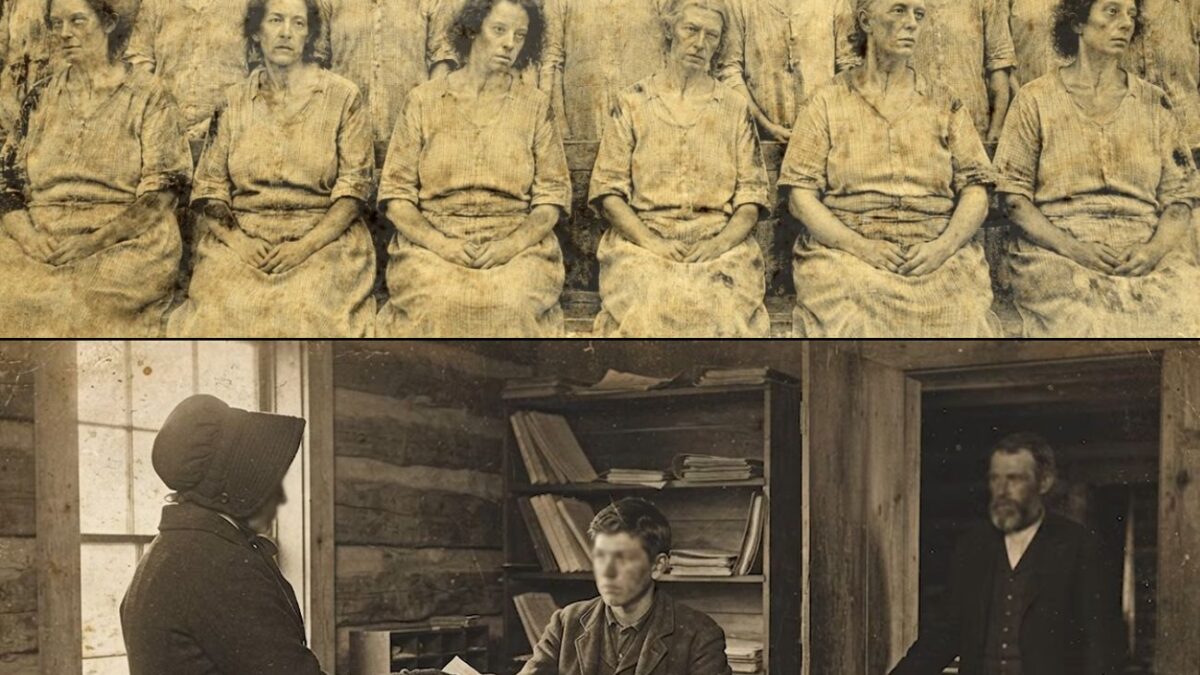
It Looks Like a Photo Of a Regular Asylum Ward in 1911 — Until You Look at Patients’ Necks
In 1911, a staff photographer at the Elmore County Home for the Incurable took a group portrait on the south lawn of the West Wing: forty-seven patients in identical gray ticking gowns, three attendants in white aprons, and the assistant superintendent standing behind them with his hands folded. It is the kind of institutional photograph that survives by the thousands from that era, filed away, forgotten, and occasionally reprinted in a local history book as a curiosity from the age of the great asylums. And for 104 years, that is exactly what this one was.
Until the winter of 2015, when a genealogist scanning the plate at high resolution for a family history project noticed that every single patient in the front row had the same mark on the left side of the neck. Not similar, but identical: a pale raised line roughly two inches long, curved slightly downward, sitting just above the collarbone in the exact same position on every one of them. She thought at first it was a defect in the emulsion. Then she checked the back row. Same mark, same size, same position. She counted forty-seven patients and forty-seven identical scars.
She sent the scan to a colleague at the state historical society, who sent it to a friend at the medical archives in the capital. Within a week, the image was on the desk of a retired forensic pathologist who spent three days looking at it before he made a phone call and used a word he had been trying to avoid using: surgical. The marks were surgical. Made with a blade, deliberately made on all forty-seven of them in the same place at what appeared to be roughly the same age. And nowhere in the surviving records of the Elmore County home was there any mention, any log, any physician’s note, any admission entry, any procedure order, any consent form, or any explanation of what had been cut into the necks of every incurable patient on that lawn on that afternoon in the autumn of 1911.
What you are about to hear is not a ghost story. It is what happens when you start pulling on the loose thread of an institutional photograph and the entire wall comes down. Before we go any further, do me a small favor. In the comments below, type the name of the state you are watching from right now and the year your grandparents or great-grandparents were born. That is it. Just the state and the year. I read every one of them, and I promise you by the end of this story, you are going to understand exactly why I am asking. So go do that now and then come back, because what I am about to show you only works if you are actually paying attention.
The Elmore County Home for the Incurable sat on a low ridge above the confluence of two creeks in the eastern part of the state, six miles from the nearest town, on land that had been deeded to the county in 1861 by a man named Silas Elmore, who had made his money in the timber trade before the war and who died childless and by most accounts alone. The deed stipulated that the land be used for the care of persons of unsound mind and no other purpose in perpetuity, and that any structure built upon it must be constructed of stone quarried from within a two-mile radius of the property line.
That second stipulation, the stone stipulation, is the sort of detail that historians tend to file under the eccentricities of the wealthy and move on from. It is also the first thread, because the stone that was quarried from within that two-mile radius, according to the county geological survey of 1894, was a specific type of banded quartz interlaced with veins of a mineral the surveyors could not identify, and which, when they sent samples to the state assay office, came back with the annotation not consistent with any known regional formation. The surveyors made a note of it, filed the report, and moved on. Someone else did not.
The home was constructed between 1863 and 1867, featuring four wings arranged around a central rotunda, each wing three stories tall, and each floor divided into wards of twelve beds. The east wing housed men, the west wing housed women, the north wing housed what the intake ledgers called children of defective birth, and the south wing, according to every architectural drawing that survives, did not exist. There is a foundation, there are load-bearing walls, and there is a roofline visible in the aerial photograph the county commissioned in 1922. But there is no floor plan, no door schedule, no ward numbering, and no patient assignment. The south wing appears on the outside of the building and it does not appear on the inside of any document produced by the institution that operated the building for seventy-one years. That is the second thread. Hold on to it. We are going to come back to it, and when we do, I want you to remember that I told you about it here in the beginning before anyone had a reason to lie to you about what was in it.
The first superintendent of the Elmore County home was a physician named Dr. Erasmus Wickham, who arrived from Philadelphia in the spring of 1867 with a wife, three trunks, and, according to the boarding house register at the depot, a small locked cedar box that he carried personally and would not allow the porters to touch. Wickham was forty-one years old, had trained under the alienists of the eastern schools, and had published two monographs on what he called the derangement of the ancestral memory—a phrase which does not appear in any medical vocabulary before or after him, and which nobody in the profession seems to have found worth commenting on at the time. He was hired at a salary of $1,800 a year, given full authority over admissions, treatment, and discharge, and answered only to a board of three men who lived elsewhere and who visited the property on average twice a decade.
The intake ledgers for Wickham’s first three years survive and are unremarkable: farmers whose wives had ceased to speak, old men seeing their dead brothers in the corners of the barn, a schoolteacher who could no longer remember the names of her own students. Wickham’s notes on each case are brief: admitted, treated, discharged, or died. There is nothing that would cause anyone to look twice at him, which is the point I want you to sit with, because everything that made this place what it became does not begin with Wickham. It begins with a patient who arrived in the summer of 1870, walked into the intake office on her own two feet, and asked by name for Dr. Wickham.
Her name was Bertha Luella Kettering, twenty-six years old, unmarried, from a farm ninety miles to the west. She had traveled alone with no letter of referral and no visible sign of the sort of distress that would ordinarily bring a person to such a place. The clerk on duty, a young man named Josiah Boon, wrote in the intake register that Miss Kettering was well-dressed, calm, and articulate, and that she had produced from her handbag a folded piece of paper which she asked him to give to Dr. Wickham personally. Wickham came out of his office within two minutes and escorted her personally upstairs. She was given a private cell on the third floor of the West Wing and was recorded under the diagnosis melancholia of long duration—a catch-all term that meant nothing and could not be challenged.
Bertha Luella Kettering never left the home. She was recorded in the census returns of 1880, 1890, 1900, and 1910, and would have been sixty-six years old at the time of the photograph. And I want you to hold that name in your mind, because you are going to understand why she was there, what she brought with her, and what the piece of paper said. But we are still in the 1870s, and I have not yet told you about the second patient: the one who arrived alone, unaccompanied, well-dressed, calm, and articulate, and asked for Dr. Wickham by name six months after Bertha did.
Her name was Harmony Reverend, twenty-two, from a farm 140 miles to the north. She produced a folded paper, was escorted upstairs by Wickham personally, and was given a private cell on the third floor of the West Wing, one door down from Bertha Kettering. She also never left. By the end of 1875, there were seven of them. By the end of the decade, fourteen—all women, all between twenty and thirty on arrival, all having traveled alone from farms in different counties, all producing the paper, all housed on the third floor of the West Wing, and none ever discharged.
The board of trustees, on the rare occasions when they visited, appear to have been satisfied. There is a note in the board minutes for 1878 in the handwriting of the chairman, a Colonel Ambrose Fenway of the state capital, which reads only: W’s project proceeding as understood, expenses justified, discretion continued. That is the entire entry. W’s project. Whatever it was, the board knew about it, approved of it, and had agreed in advance not to speak of it in writing, and they never did. In seventy-one years of board minutes, W’s project is mentioned once in that single line in 1878. Every other reference to whatever was happening on the third floor of the West Wing is, in the surviving documentation, an absence—a hole in the paperwork where a hole should not be. And you learn when you spend enough time in old institutional records that the holes in the paperwork are not the absence of the story; they are the story.
By 1890, the population of women on the third floor of the West Wing had stabilized at thirty-one. From that point forward, the number never changes. If one dies, another arrives within weeks, unaccompanied, producing the folded paper, asking for the superintendent by name. Wickham died in 1893 of what the coroner ruled a cerebral apoplexy, though the coroner also noted in a private letter to his son that surfaced in a family archive in the 1980s that Wickham had complained in his last weeks of hearing the war between the second and third floors of the West Wing speaking to him in what he called the old tongue.
His successor, Dr. William Alloys Krun, was appointed within a week, carried the same cedar box, and continued the project without visible interruption. Nobody outside the walls of the home appears to have asked a single question about any of it for another twenty-two years. Before we move on to the next passage of this record, stop for a second. What you just heard about Dr. Wickham, the folded papers, the thirty-one women, and the sealed south wing is the part that changes everything. But it only makes sense when you see it written out next to the original 1911 photograph and the county coroner’s private letter, the identical scars, and the stone stipulation. It’s all in the document linked below. Take five seconds right now, grab it, and then come back, because what comes next builds directly on it.
The photograph that started all of this was taken on the afternoon of October 16, 1911, by a commercial photographer from the county seat named Adler Rouge, who had been hired by the assistant superintendent, a man named Dr. Frank Cornelius Krun, to produce a formal group portrait for the institution’s fiftieth anniversary album. Rouge was thirty-eight years old, had operated a studio in town for eleven years, and by all accounts was a competent, unremarkable practitioner of the trade. He arrived at the home in the mid-morning with a large folding wooden view camera, a set of glass plates, a black cloth, and a wagon driver named Ephraim Wilbur Austin. He was met at the gate by Dr. Krun and escorted to the south lawn of the west wing, where the patients and staff had already been arranged in three rows in front of the exterior wall.
The photograph took approximately four hours to complete. Rouge made six exposures on six separate plates from slightly different angles, using different lengths of exposure to compensate for the shifting autumn light. Five of the plates survive; the sixth does not, and I will get to the sixth in a moment. Rouge was paid $12 for the sitting, given a small meal in the staff dining room, and sent home with his plates in his wagon at approximately 5:00 in the afternoon. He developed them in his studio over the following three days, printed one contact print of each exposure, and delivered the prints to Dr. Krun on October 20. He was paid an additional $8 for the prints. He kept the original glass plates in his studio archive as was standard practice in case additional prints were ever ordered.
They were not. In fact, according to Rouge’s business ledgers, which survive in the county historical society, no additional prints of the 1911 Elmore home portrait were ever ordered from him or from anyone else for the remainder of his working life—which is unusual. Institutional group portraits of that scale were expensive to produce and were routinely reprinted for distribution to staff, board members, and prominent donors. The fact that not a single reprint was ever ordered suggests one of two things: either the institution had no intention of ever showing the photograph to anyone, or something happened between October 20, 1911, when Rouge delivered the prints, and the moment when someone in a position of authority looked at them for the first time in good light and decided that the photograph should be quietly filed and never spoken of again.
I lean toward the second explanation, and so I think would you if you had seen what Rouge saw when he was developing the third of the six plates in his darkroom on October 18 and made a note in the margin of his working ledger in a hurried pencil—which the historical society photographed and archived in the 1960s—which reads in full: marks on necks of subjects uniform was told not for reproduction will not print sixth plate have destroyed same God forgive me.
He destroyed the sixth plate. The five that survived are the ones he made from angles that concealed the necks of the patients behind the shoulders of the staff standing in front of them, or that were exposed too briefly to bring out fine detail. The sixth plate, based on the notation and the angle of the tripod holes visible in the surviving contemporaneous photographs of the chute itself, was a close-in, well-lit exposure of the front row taken from slightly above and to the left, in which the marks on the necks of every patient in that row would have been rendered in sharp, undeniable detail.
That plate never left Rouge’s darkroom. He broke it on October 18, 1911, two days before he delivered the prints of the other five to Dr. Krun. He had been told, he wrote, not for reproduction. He had been told, in other words, that whatever he saw on those plates, he was not to reproduce. And Rouge, who was a competent, unremarkable, God-fearing man from a small county town in the first decade of the last century, had done what he was told. And then, in the privacy of his own darkroom, he had done a little bit more: he had eliminated the evidence, and then he had asked God to forgive him.
What did he see? What was on the necks of those forty-seven patients that a professional photographer hired for a routine institutional portrait would break a plate rather than allow to be printed? That is the question the genealogist Mrs. Callis Adelind Renick was asking herself in the winter of 2015 when she zoomed in on the surviving fifth plate—the one taken from the widest angle in which the marks are visible but small—and began the process of documenting every one of them patient by patient, cross-referencing what she saw with the surviving intake ledgers of the Elmore County home for the year 1911.
She spent four months on the cross-reference, and what she found at the end of those four months was not what she had been looking for. She had been looking for her great-grandmother who, according to family tradition, had been committed to the home in 1908 and who had died there in the influenza epidemic of 1919. Her great-grandmother was not in the photograph. Her great-grandmother, in fact, was not in the intake ledgers at all. There was no Effie Marlo Renick recorded as admitted to the Elmore County home in 1908, 1909, or any other year. There was no discharge, no death record, no burial in the institutional cemetery. According to the paperwork of the home, Effie Marlo Renick had never existed.
But Mrs. Callis Renick had her great-grandmother’s obituary. She had her great-grandmother’s letters. She had a photograph—a small tintype from about 1895 of a young woman standing on the porch of the farmhouse where the family had lived, holding a baby who would grow up to be Callis’s grandmother. And when she held that tintype up next to the fifth plate from the Elmore home and used a magnifying loupe to compare the features of the face in the tintype with the faces in the group portrait, she found her great-grandmother: third row, seventh from the left, wearing the gray ticking gown of an incurable, fifty-two years old, alive in the photograph in the year 1911, three years after she had, according to the family, been buried in the churchyard behind the farm.
Which meant one of two things: either the family had been lied to, or the woman in the photograph was not her great-grandmother. And Callis, who had been a professional genealogist for twenty-two years and who knew what her own great-grandmother’s face looked like better than she knew her own, was certain of what she was seeing. Which left her with the first possibility, and with the question that follows from it—the question that pulled her down the hole, and then pulled a retired pathologist down after her, and then pulled the rest of us down after him: How many other families have been told their daughter, their mother, their sister had died? And how many of those daughters, mothers, and sisters were at the moment of the supposed funeral alive in the Elmore County home with a fresh two-inch surgical scar on the left side of the neck above the collarbone, waiting for whatever it was that Dr. Wickham, Dr. Krun, and W’s project had planned for them next?
The retired pathologist was a man named Dr. Rutherford Elias Peabody, seventy-nine years old, thirty-one years on the state medical examiner staff, and another sixteen consulting on cold cases for three separate law enforcement agencies. He had been sent the scan of the fifth plate by the archivist at the state medical archive, a woman named Ms. Odalis Bramwell Wickham, who had been sent it by the historical society, who had been sent it by Mrs. Renick. Peabody looked at the scan for three days before he called Ms. Wickham back. When he did, he asked her three questions. He asked her whether the photograph was authenticated; she said it was, and that the provenance from Rouge’s studio to the home to the county archive was unbroken. He asked her whether the intake ledgers of the home listed any surgical procedures performed on the patients pictured; she said they did not, and that she had checked and found no mention of any surgery performed on any incurable patient of the home at any point in the institution’s seventy-one-year operational history. He asked her finally whether she was sitting down; she said she was, and he told her what he had spent three days working out.
The mark visible on the neck of every patient in the front row of the photograph—and on closer examination, on the neck of every patient in the middle row and the back row—was a surgical scar of a type that Peabody had encountered exactly twice before in his career: once in a case from 1963 involving the remains of a woman who had been found buried in a shallow grave in a wooded area of the adjacent state, and once in a case from 1981 involving the remains of a man who had been found in a similar circumstance in a rural part of a state four hundred miles to the south. In both of those cases, Peabody said the scar had been identified eventually by consultation with a specialist in the history of medicine as consistent with an operation known in the nineteenth century by several different names, but most commonly referred to in the German literature as the suboccipital insertion.
It was a procedure that had been described in exactly one published paper in an obscure journal of experimental neurology in Vienna in 1881 by an author who signed himself only with initials. It had never, as far as Peabody could determine, been performed in any legitimate medical setting in the United States, and it involved the insertion—through a small incision made in the exact location of the mark visible in the photograph—of a foreign object into the soft tissue at the base of the skull immediately below the point at which the spinal column meets the cranium.
What foreign object? Ms. Wickham had asked.
The paper in Vienna, Peabody said, described the object as a piece of the appropriate metal shaped to specification, of a length not to exceed 19 mm and a width not to exceed 4 mm. The paper did not say what the appropriate metal was, it did not say what the specification for the shape was, and it did not say what the purpose of the insertion was, giving as its only justification the phrase for the correction of the ancestral disturbance—which Peabody said was not a phrase used in medical literature before, during, or after 1881 by any other author in any language that he had been able to locate through six months of subsequent inquiry.
It was the same phrase, Ms. Wickham would later realize when she went back and reread the archived monographs of Dr. Erasmus Wickham, that Wickham had used in his own writings three years before the Vienna paper was published to describe the condition he claimed to be treating: the derangement of the ancestral memory, the ancestral disturbance. The same idea in two different translations appearing in two different medical documents on two different continents, published by two anonymous or effectively anonymous men within three years of each other, and connected by the fact that a rural county asylum in the eastern United States run by the American of the two appears to have been the operational site at which the procedure described by the Austrian was performed without record on at least forty-seven human beings in the year 1911.
Peabody did not say all of that in his first phone call to Ms. Wickham. What he said was, in effect, “We need to exhume the cemetery.” And Ms. Wickham, who was fifty-three years old and had been an archivist for twenty-nine years and who had never in her career been party to a conversation involving the word exhume, said she would need to think about it and hung up. She thought about it for eleven days, then called Peabody back and said she agreed.
The problem was that the institutional cemetery of the Elmore County home, which sat on a small hill approximately a quarter mile behind the main building, had been officially closed in 1938 when the home itself was decommissioned and the surviving patients were transferred to the new state hospital in the capital. The cemetery had been maintained in a nominal sense by the county parks department, but no burials had been made in it for seventy-seven years, and no one currently living had any legal or personal connection to any of the persons interred there. Which meant from a legal standpoint that permission to exhume any of the graves would have to come from the state historical preservation office, from the county board of commissioners, and—if the graves contained human remains that had been buried within the last one hundred years—from the state coroner’s office.
Ms. Wickham filed the paperwork in April of 2016. It was approved in June, and in the last week of July of that year, a team consisting of Peabody, two forensic anthropologists from the state university, a representative of the coroner’s office, and three graduate students arrived at the cemetery with permits, ground-penetrating radar, and the expectation that they would spend perhaps a week confirming what they already suspected. They spent four months, and what they found in the end was not what they had gone there to confirm. It was something much worse—something that when Peabody sat down to write his final report to the coroner’s office in December of 2016, he opened with the sentence: “I have been asked to describe in professional terms what was recovered from the site. I am able to describe it. I am not able in any professional framework I possess to explain it, and I would ask that this document be sealed for a period not less than fifty years, so that others with better tools than mine may attempt to do so.”
That report was in fact sealed. It was leaked in part in the spring of 2019 by an unknown source to a small independent journal of anomalous archaeology, which published redacted excerpts from it under the title “The Elmore Cemetery Findings” and was subsequently subjected to what its editor described in a subsequent editorial as significant legal pressure to remove the article—which the editor declined to do. That article and the redacted excerpts from Peabody’s report contained within it are the primary source for everything I am about to tell you. I have cross-referenced it with the original scan of the fifth plate, with the ledgers, with the surviving intake records of the home, with the private letter of the coroner who ruled on Wickham’s death, and with three other documents which I will introduce when they become relevant.
What I am about to describe is not speculation. It is what was in the ground on the hill behind the Elmore County Home for the Incurable in the summer of 2016. The cemetery contained, according to the surviving burial register, 183 interments made between 1868 and 1938. The ground-penetrating radar on the first day of the survey identified 241 distinct grave shafts. The discrepancy was fifty-eight: fifty-eight burials that had been made in the cemetery but that did not appear in the register. The graves were arranged in the register in orderly rows, with each burial dated and identified by patient name, age, and cause of death. The graves identified by the radar included the registered graves in their expected positions and then included, in a second area on the north side of the cemetery behind a low stone wall that had been assumed to be a property boundary, an additional band of fifty-eight unmarked shafts arranged in three tight rows oriented not east to west as the registered graves were, but north to south.
Peabody made note of the orientation in his preliminary field notes, though he did not at the time know what to make of it. The team began with the registered graves, exhuming six chosen for their positions in the row and for the dates of burial which spanned the operational years of the home. In each of the six, they recovered the remains of a single adult human being positioned in a plain wooden coffin with no personal effects, in a state of preservation consistent with the age of the burial and the composition of the soil. In four of the six, the remains showed clear evidence of the suboccipital insertion. In each of those four cases, a small metallic object, oxidized to the point of being almost unrecognizable, was recovered from the soft tissue channel at the base of the skull.
The objects were sent to the state metallurgical laboratory for analysis. The report from the laboratory, which is one of the documents Ms. Wickham subsequently released to the independent journal, describes the objects as thin rectangular pieces of a copper alloy of unusual composition containing a percentage of a rare earth element inconsistent with any known nineteenth-century American metallurgy, engraved on one face with a repeating pattern of small marks that do not correspond to any script or symbolic system identifiable by our staff, and which may represent decorative or ritual markings of unknown origin. The objects, in other words, were metal plates of a composition that should not have existed in a rural asylum in 1880, engraved with writing that nobody could read, and inserted surgically into the base of the skulls of persons who had been recorded as ordinary patients dying of ordinary causes at an ordinary institution.
That was the finding from the registered graves. The team then moved on to the unregistered graves. They exhumed the first one on August 4. The shaft was shallower than the registered graves by about eighteen inches. The soil composition suggested that it had been dug in some haste. There was no coffin; the remains were placed directly in the earth, wrapped in what had been a length of the same gray ticking cloth from which the patient gowns had been made. The body was that of a young adult female, aged approximately twenty-five at death, positioned on her back with the arms crossed over the chest. Around her neck, laid across the collarbones, was an object which one of the graduate students initially took to be a piece of decayed leather, and which turned out on cleaning to be a thin band of the same copper alloy engraved with the same markings as the smaller plates—wide enough and long enough to have encircled the entire neck of the deceased at the time of burial. It had not been embedded in the tissue; it had been laid on top like a collar, like a marker, like something placed there so that whoever opened the grave at whatever future point would know what she had been.
They exumed twelve more. Every one of them was the same: a young adult female, no coffin, gray ticking, copper band around the neck. Peabody stopped the exhumation of the unregistered graves on August 14 and requested a consultation with the state coroner’s office regarding the appropriate procedure. The consultation took three weeks. The decision when it came was to complete the survey of the remaining unregistered graves using non-invasive imaging only and to leave the physical remains in place. The reasoning, as recorded in the coroner’s office memorandum, was that the remains constituted a historical burial site of undetermined but likely significant cultural or ritual character, and that further exhumation without a more complete understanding of the site’s context would be premature.
The remaining forty-five unregistered graves were surveyed with the radar and, in five cases, with small-bore camera probes lowered through narrow shafts. Every one of the forty-five contained, according to the imaging, a single human skeleton positioned as the thirteen exhumed had been, with the copper band visible at the neck. All fifty-eight of them were young adult women buried without coffins, wearing the copper collar in graves that did not appear in the institution’s own burial register, in an area of the cemetery that the institution had never officially used, behind a wall that when Peabody examined it more closely turned out not to be a property boundary at all, but a low retaining wall of the same banded quartz from which the main building had been constructed, laid without mortar and inscribed on its inner face in small chiseled marks that nobody had noticed for 150 years with more of the same script that appeared on the plates and the collars.
The inscription on the wall was photographed, mapped, and sent to three separate specialists in ancient and lost scripts. The report from the first specialist, a professor at an eastern university, described the marks as superficially resembling certain runic and pre-alphabetic writing systems of northern Europe, but not correspondent to any known example of any such system, and containing structural features—notably the repetition of certain glyphs in fixed positional relationships—that suggest either a synthetic constructed script of the nineteenth century or a genuine but hitherto unrecorded archaic human language.
As the decades passed and the transcripts of the inquiry were quietly locked away, the remaining questions hung heavily over those who dared to look into the past. No one ever truly figured out where Dr. Wickham obtained the unique copper alloy or who taught him the suboccipital technique, but the walls of the abandoned West Wing still stand on that quiet ridge, guarding secrets that time refused to fully bury.

