How Far Did People Go To Survive The Siege Of Leningrad?
In Leningrad, life under siege was far from easy, and it forced residents and defenders into survival measures that were as drastic as they were grizzly. The siege of Leningrad is one of the great underrecognized tragedies of World War II. Lasting almost two and a half years, the heroic people of the Soviet city held on against a relentless onslaught from German forces. Their survival is the stuff of legend. The Axis powers, namely Germany and Finland, carried out the siege of Leningrad against the city today known as St. Petersburg on the Eastern Front of World War II within the borders of the then Soviet Union. Leningrad was the second largest city in the USSR, and as the battle for the Eastern Front raged on, it was clear that the Axis powers were closing in on this strategically important metropolis.
Preparations for the siege began in 1941 as the Germans were barreling through Russia, leaving nothing but destruction in their wake. By August, Germany’s Army Group North had finally reached Leningrad’s suburbs. From the other side, their allies and the Finnish forces were encircling the city from the north, leaving little option for the residents but to stand and fight. The capture of Leningrad was one of the three main strategic objectives of Operation Barbarossa, the code name for the German invasion of the Soviet Union. 3.8 million Axis troops deployed for the mission, making it the largest and most costly military offensive in history.
But why was Leningrad in particular so key to Germany’s goals? For one, the city held high political status as Russia’s former capital. Furthermore, it held military and industrial importance as the main base of the Soviet Baltic Fleet and the location of several key arms factories. Most crucially, however, Leningrad had been the birthplace of the Russian Revolution and the ideological center of Bolshevism, the current of political thought that proved the biggest threat to fascism and indeed capitalism at large. It’s claimed that Hitler was excessively confident that the attack on Leningrad would be successful. So strong was his faith that he planned a victory celebration in the city’s Hotel Astoria for a specific date before the siege had even begun, and went so far as to have flyers printed.
Hitler’s intentions for Leningrad were completely insane. He wanted to level the city to the ground and wipe out its entire population. The German high command laid out the plans for their occupation, intending once they had captured the city to lead those still alive into inner Russia or into captivity, and wipe Leningrad from the face of the earth through demolitions. Unfortunately for the Germans, however, they suffered a shaky start. Field Marshal Wilhelm Ritter von Leeb led the German forces marching toward the city with the siege of Leningrad being his primary objective, but in early August, his confidence was shook. German forces found themselves seriously overextended after their eventful march through the USSR. To achieve his objectives, Leeb believed he needed 35 divisions of men; he only had 26.
Despite the Stalinist degeneration of the Soviet Union following Lenin’s death in 1924, the city legislature, the Leningrad Soviet, still enjoyed considerable influence among the city’s population. Upon learning of the German advance, their council of deputies organized civilian groups of first responders, and citizens heroically mobilized to construct fortifications. They built several lines of defense along the city’s north and south perimeters. Many fortifications, which had fallen into disrepair from misuse, were restored, and other defensive measures included timber barricades, wire entanglements, anti-tank ditches, reinforced concrete weapon emplacements, and open trenches.
The Germans, however, had their own tactics. They severed rail links to the city, crucial supply lines that connected the inhabitants with other industrial centers like Moscow. The final rail connection to Leningrad was severed on August 30, 1941. The Germans hoped this would crush the morale of the Soviet people, but they didn’t know what they were dealing with. With Soviet supply lines now hindered by early September, Leeb was confident the Red Army would surrender or abandon the city entirely. This didn’t come to pass, which made Leeb nervous.
Despite the Soviets’ refusal to capitulate, Hitler was adamant that the mission continue. Indeed, he saw Leningrad as the first significant chess piece in the larger goal of taking Russia entirely. He repeated his orders in no uncertain terms: Leningrad first, Donetsk Basin second, Moscow third. Nothing less would suffice. With those orders crystal clear, the siege finally began. The final severing of all remaining land routes took place on September 8, 1941, and the Germans proceeded to shell the city relentlessly with support from the Finns. The bombardment had begun, and the Soviet response was swift. Marshal of the Soviet Union Georgy Zhukov led the Leningrad forces and took desperate measures to halt the final German push into the city’s outskirts. They put Leningrad’s power as an industrial center to full use, with Soviet forces manning heavy tanks as they rolled off the assembly lines.
The Axis armies nevertheless laid siege to the city for a very, very long time. Most accounts lament the Axis shelling that lasted 900 days and nights. In total, the siege of Leningrad lasted from September 8, 1941 to January 27, 1944—a total of 2 years, 4 months, and 19 days. The intensity of the siege varied throughout this time, and there were some days that were far worse than others. September 19, 1941, a day relatively early in the siege, was particularly brutal for the Soviets. The Germans launched a devastating air raid, the heaviest suffered by Leningrad during all of World War II. 276 bombers hit the city, killing a thousand civilians. During the raid, the Germans deployed deplorable tactics intended to wipe out civilians. Many of those killed in the attack were recuperating from battle wounds in hospitals, which the Germans shelled indiscriminately. In total, five hospitals were hit over six air raids that day.
For the almost three years of lead-up and during the siege itself, Germany’s Finnish allies allegedly did little to contribute to the battle. Their participation largely involved recapturing lands lost in a previous conflict with the Soviets, though they also greatly assisted Hitler’s efforts by breaking Soviet military codes. German envoys pleaded with the Finns to offer aerial and ground support at Leningrad, but Finnish leaders rejected the requests. The city was simply not a strategic goal for the Finns, whose forces largely remained at the border previously established before their earlier conflict with the Soviets, although some have questioned this narrative. While most historians agree that the Finns’ participation had its limits, some have speculated that their active role in the siege of Leningrad underwent a cover-up following improved Soviet-Finnish relations after the conclusion of the war.
Commanded by Marshal Kliment Voroshilov, the Leningrad Front bravely defended the city for the seemingly never-ending duration of the siege with only minimal reinforcements at irregular intervals. Alongside defending the city from the German onslaught, the Leningrad Front assisted in the defense of civilians that the Soviets managed to evacuate from the city. It was no easy task considering the Germans had cut off most land routes, but astonishingly, the Leningrad Soviet successfully smuggled 1.7 million non-combatants out of harm’s way.
For the ones that stayed, however, it was a grim existence. Food shortages in the winter led to intense rationing before eventually the Soviets managed to deliver supplies to the city, easing the burden. The Soviets delivered these supplies via air and over Lake Ladoga. This lake in particular soon became the site of another feat of Soviet ingenuity. The Red Army desperately needed to establish a supply route for Leningrad, and they came up with an idea: they established a highway built on the frozen lake, which allowed them to get food and defensive supplies into the city. The highway became known as the Road of Life. In the warmer months, they shipped provisions by watercraft. After the initial chaos of the siege’s first winter, no further civilian evacuations were possible amid the ongoing German bombardment. The Germans completely isolated the city until November 20, when the Road of Life became operational. Finally, the Soviets could evacuate more civilians.
Meanwhile, the Germans were removing things from the city themselves. The invading forces looted many homes and museums, with valuable art collections seized and moved to Germany. As for the history that they couldn’t move, the Germans implemented a scorched earth policy. Leningrad was also home to a number of imperial palaces from Russia’s pre-Soviet era. Hitler commanded his forces to loot and destroy them along with other historic landmarks. The German onslaught was truly on all fronts with the goal of complete erasure of Leningrad physically and culturally, but the city held firm.
Despite the German siege lasting a staggering 872 days, with all the accompanying horrors inside the city, they never captured Leningrad. It was a truly heroic accomplishment, and this was no more evident than in one inspiring event. On August 9, 1942, almost one year into the siege in the face of an endless German onslaught, the Leningrad Radio Orchestra debuted Dmitri Shostakovich’s Symphony Number Seven in the besieged city. They broadcast the symphony on speakers around town, with some even aimed at enemy lines. And as if that wasn’t spirited enough, the day chosen for the performance was significant too: it was the day Hitler had planned his victory party in the Astoria Hotel.
This inspiring moment traced a direct line to the Soviets’ final push. The autumn of 1942 saw the beginning of the Sinyavino Offensive, the first major Soviet attempt to break the siege. It began with small-scale attacks on the Leningrad Front, which forced the Germans to redirect troops. The counteroffensive ended in something of a stalemate; however, it set the stage for phase two of the Red Army’s plan. The Soviets launched a full-scale offensive on January 12, 1943, known as Operation Iskra. A series of fierce battles across the USSR saw the Red Army make some significant advances, and they even managed to open a narrow land corridor to Leningrad.
After a long and arduous offensive, the siege of Leningrad finally broke on January 27, 1944. The Soviets managed to expel the German forces in the Leningrad-Novgorod Offensive with support from the Baltic Fleet, but this victory came at a great cost to the Soviets. The siege had completely devastated the city. The destruction was widespread, rendering the city unrecognizable and prompting historians to name the siege of Leningrad as the most destructive siege in history. There were nearly 2 million casualties, though some estimates—which include non-civilian casualties—put the loss of life at 3.4 million, which completely devastated a city whose pre-conflict population was 3.2 million. The occupation also cost the nation many of its most productive agricultural regions, leaving it at a disadvantage for the following decades-long conflict with the West.
By the time of the siege of Leningrad, the Russian Revolution, initially led by Lenin and Trotsky, had undergone a degeneration under the dictatorial rule of Joseph Stalin. Stalin’s unfitness for leadership was never more evident than when, during the late 1940s, he reportedly grew jealous of the praise the Leningrad leaders had rightfully received and staged show trials to prosecute them.
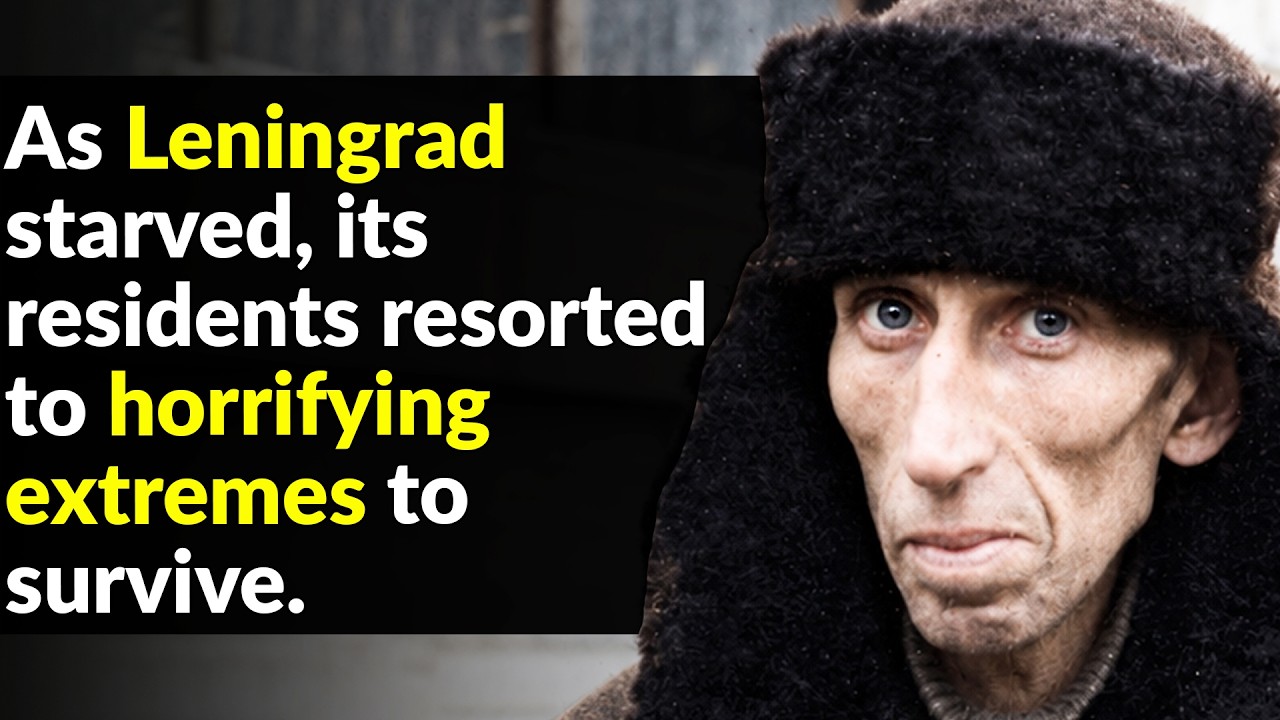
During the worst parts of the siege, life was unsurprisingly horrific, but most of the trials faced by the residents were all part of the Germans’ plan. The biggest obstacle was hunger. Because of the cutting off of supply chains, the city quickly ran out of food and rationing had to be implemented. This was completely intentional on the Germans’ part; starving the city into surrender was horrifically part of their strategy. Widespread hunger hit devastating levels during the first winter of the siege. Over the cold closing months of 1941 and early 1942, thousands of residents starved, and with rationing now at extreme levels, perhaps those that perished were the lucky ones. From November 1941 to February 1942, each resident was given just 125 grams of bread per day. As if this wasn’t bad enough, this ration consisted of 50 to 60% sawdust and other fillers.
With such grim prospects facing the residents, the horrors that followed were inevitable. With the horrific systematic starvation inflicted by the Germans, the residents of Leningrad, emaciated beyond recognition, turned to the grizzliest option imaginable. There are numerous reports from the siege of instances of cannibalism among residents, speaking to the severity of the circumstances in which the invading forces had placed the beleaguered Soviets.
Despite the murderous intent of the Germans during the siege of Leningrad, a United States court convened to prosecute German leaders after the conflict ended ruled that the siege did not constitute a war crime—perhaps an unsurprising decision given that the US was gearing up for a political conflict with communism. Many historians agree that because of the Germans’ intentional destruction of the city and systematic starvation imposed on its residents, the siege of Leningrad meets all the requirements to be classed as a genocide.
It was a genocide that the people of the city somehow endured, transforming unimaginable suffering into an enduring testament of human resilience. Though the physical scars took decades to heal and the political betrayals that followed cast a long shadow over the survivors, the spirit of Leningrad could never truly be starved out. The endurance of its people stands forever as a monumental reminder that even in the darkest abyss of human cruelty, the will to live and preserve one’s home can outlast empires.

