Hitler’s New Autopsy — The Truth Only Discovered 72 Years Later
Hitler’s New Autopsy — The Truth Only Discovered 72 Years Later
A piece of skull, some tooth fragments, and over 70 years of mystery. That was all that remained of Adolf Hitler’s mortal remains, and they were locked away under lock and key in Russia’s secret archives, far from any Western scientist, until 2018, when a group of French researchers managed to examine this material closely for the first time. Welcome to the Amazing Curiosities channel. Today I’m going to show you exactly what they found, but let’s start from the beginning.
How the mystery began. To understand why this exam, published in 2018, is so important, you need to know what happened before. Shortly after the end of the war, in 1945, Soviet troops found charred remains and two bodies in the garden of the Reich Chancellery, as well as other traces scattered throughout the area. It was a scene of total destruction. Berlin in ruins, the German army practically surrendered, and there, in a shallow, makeshift grave, lay the remains of a hastily performed cremation amidst the chaos of the war’s final days. The Soviet secret service took control of everything, collected the material, conducted its own autopsy, drafted internal reports, and kept every detail in absolute secrecy. For decades, virtually none of this came out of the Russian archives, not even to the Western allies themselves, who at the time were partners of the Soviet Union in the war. This data was not shared in its entirety. In 1946, some of the material, including skull and jaw fragments, was taken to Moscow and kept in state archives, away from the eyes of any foreign researcher. And then, silence. A silence that permeated throughout the entire Cold War.
No Western researcher has had direct access to these bones. None. Neither historians, nor doctors, nor journalists, only a very select group of Soviet and later Russian authorities who knew exactly what was being kept there. What existed on the outside were only indirect accounts, testimonies from dentists who treated Hitler during his lifetime and who were questioned by investigators years later, and old X-rays taken during the war and kept in American archives. Comparisons were made from a distance, cross-referencing documents, photographs, and testimonies, but without anyone ever having touched the original material. Every study published on the subject, over the decades, always ran into the same limitation: it spoke about bones that no one outside of Russia had ever seen in person. Over the years, this has fueled all sorts of theories because, let’s face it, when concrete proof is lacking, there’s plenty of room for speculation.
The skull fragment. Let’s start with the most impactful part of the entire exam: the piece from the back of the skull. This fragment measures just over 10 cm and corresponds to the upper part of the occipital bone, right where it meets the two parietal bones, that is, the back part, slightly lateral to the head. But then comes the most shocking detail. On the left side of this fragment, researchers found a hole, about 6 mm in diameter on the inside, which opens in a star shape on the outside, measuring 11 by 16 mm, with seven fractures spreading around it like cracks in glass. And here’s the part that really matters. This type of shape, a small hole on the inside and exploded on the outside, is exactly the pattern of an exit wound from a firearm projectile. In other words, the bullet didn’t enter through that point, it exited through that point. This is consistent with a violent death caused directly by that gunshot and not by another cause that may have occurred afterward.
But there was another hole in that same fragment. This second one, on the back side, was different, irregular, without the same fracture pattern, characteristic of damage that occurred after death, probably caused by handling, transport, or the time spent buried. And there was more. Around the fragment, there were darkened marks, as if the bone had been exposed to intense heat. This aligns with the official story that the body was burned shortly after death. And there were also brownish stains that looked like those that appear on bones that have been buried in the ground for a long time. In other words, a skull with signs of gunshot wounds, fire damage, and burial—three elements that together tell a very specific story.
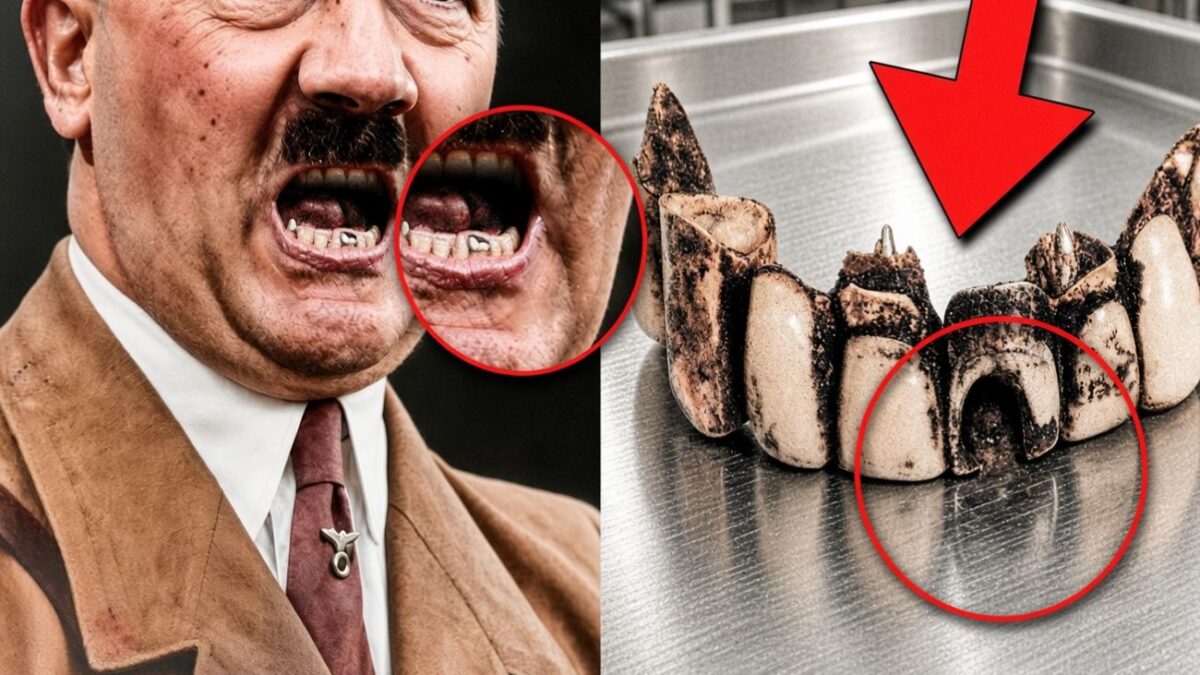
The golden bridge and the jaw fragments. Now comes the part that was even more revealing for scientists than the skull itself: the teeth. The researchers examined a fragment of the upper dental arch, just over 4 cm long, with a nine-unit dental bridge made of a yellow metal, possibly gold, ending in a premolar on the right side. They also examined three fragments of the lower jaw of varying sizes, each with its own dental prosthesis work, as well as signs of bone resorption and wear on the front teeth, specifically in the incisor region. But the most interesting thing wasn’t the material itself, it was what was embedded in it. Using ultra-high precision microscopes, scientists found tiny scratches and wear marks on the surface of the teeth and prostheses consistent with years and years of use—the type of metallic trauma that only appears after a long time chewing, talking, living with that material inside the mouth. They also found severe wear on virtually all preserved tooth surfaces and greenish tartar deposits, concentrated right at the junction between the tooth and gum on both sides, both inside and outside the dental arch.
And here’s the strangest part. Small blue deposits, 1 to 13 mm in size, were scattered on both metal prostheses and tooth enamel, including ceramic surfaces, mainly in the region of the posterior teeth, the premolars and molars. There was yet another layer of mystery. In the gaps between the teeth and in the corners where the tooth meets the prosthesis, researchers found crystalline deposits with a sandy appearance, spread throughout virtually the entire length of the jaw. And on the outskirts of the areas affected by the cremation, it was still possible to see remnants of muscle tissue, a powerful reminder that behind each of these technical analyses, there was once a living person.
Nobody knows for sure where that blue color comes from, but the researchers have put forward quite a hypothesis. Could these stains be the result of a chemical reaction between cyanide and the metal of the prostheses, such as gold, platinum, and iron, at the exact moment of death? Think about it: if Hitler really did ingest cyanide, as the official story says, it’s possible that this poison reacted chemically with the metal inside his own mouth, leaving that mark to this day, more than 70 years later. And the scientists themselves admit, it could have been at the exact moment of death, it could have been during the cremation process, or even during the period when the remains were buried. Without a more in-depth chemical analysis of these stains, it’s still not possible to definitively say which of these three explanations is correct.
What did the teeth lack? But there’s another fascinating detail to this story, and it lies in what the scientists haven’t found. By performing a much deeper microscopic analysis of dental tartar, using scanning electron microscopy—the same technology capable of magnifying a structure thousands of times—the researchers searched for muscle residue, that is, remnants of meat that remain stuck to the teeth of those who eat animal protein, even after decades, and found nothing of the sort, no trace, no muscle fiber. No traces consistent with meat were found in any of the tartar fragments examined. They did find something else: plant structures embedded within the tartar, crystalline structures, layered structures resembling clay, and even irregular, minuscule structures, a few micrometers in size, associated with the presence of nickel, possibly remnants of the fragmentation of the dental prostheses themselves over the years.
This perfectly matches one of the best-known facts about Hitler: they say that in the last years of his life he followed a vegetarian diet. And it’s important to say, the researchers were cautious because they only examined two tartar fragments, not the entirety of possible deposits. Still, it’s quite an indication—the kind of detail that, on its own, proves nothing, but fits perfectly within everything that was already known about his eating habits. And the clay-like structures found in the teeth also match another historical piece of information: that he suffered from chronic gastric pain, possibly gastritis or an ulcer, and took alginate and bile salt-based medications to treat it, according to drug lists preserved in the archives consulted by the researchers. In other words, the body, through the mouth, was unintentionally preserving clues about the routine, diet, and even the health of the person to whom he belonged—a type of record that no written document could capture with such precision.
Before we move on, we want to make sure you’ve been following and enjoying the content so far. Comment on the phrase “I want more stories”. It’s quick and easy, and this way you help our video reach more people, plus you might even get a mention in the comments to show your interest.
Theories about shooting and where the bullet actually entered. Now here is the question that has generated the most debate among historians for decades. Did Hitler pull it out of his own mouth, or did the shot come from somewhere else? The most repeated, the most popular version, so to speak, is that he put the gun in his mouth and fired the classic intraoral shot along with ingesting the poison, almost like a double suicide at the same instant, with the cyanide acting from within, ensuring there is no chance of survival. This is the version that appeared in the first Soviet reports and which, over time, has practically become common knowledge in books, documentaries, and reenactments. Almost everything repeats this same sequence of events.
However, scientists have found a detail that calls this version into question. They searched the surface of the dental tartar for traces of antimony, lead, and barium—three chemical elements that are commonly found in the mouth when a gunshot occurs very close to or directly inside the oral cavity. It’s basically the same logic used in forensic investigations to determine if a weapon was fired at close range, and they found absolutely no trace of these elements: no antimony, no lead, no barium, nothing. This could be an indication, not definitive proof, but a strong indication that the final shot was not fired into the mouth. Researchers raise the possibility that the entry point may have been in another region of the head, the right temporal region, the right frontal region, or even a posterior part under the jaw.
Think about the magnitude of this change. For over 70 years they’ve been repeating the same story, and now chemical evidence has emerged that points in a different direction. You know that with anything involving one of the most studied figures in history, any new detail turns into an entire debate. And this is exactly one of those cases. Of course, this is just one hypothesis among others. The scientists themselves are keen to say this without absolute certainty, without a complete reconstruction of the scene. This remains a possibility, not a definitive conclusion. But it is supported by a very specific absence of chemical evidence in the material that alone withstood more than 70 years, surviving war, cremation, burial, and decades locked away in a secret archive, and yet still held this type of information for anyone who knew where to look.
The most recent discovery and final analysis. And this brings us to the main point, the 2018 exam itself, the reason this story exists. After decades of refusal, the Russian secret services, the FSB, and the GARF State Archives granted direct access to the remains to an independent team of French scientists. There were two analysis campaigns, in March and July of that year—a rare, almost unprecedented opportunity, considering that until then absolutely no researcher from outside Russia had laid hands on that material. And the work was rigorous, done in several different layers. First, a visual analysis under binocular lenses, eye to eye with each fragment, looking for marks, textures, and patterns of wear. Next, scanning electron microscopy, which allows us to see microscopic structures with an impressive level of detail, magnifying each particle thousands of times. And finally, elemental analysis capable of identifying exactly which chemical substances are present in each residue, atom by atom, practically.
As a result, the scientists cross-referenced everything they found with old records, X-rays from 1944 kept in American archives, and accounts from dentists who treated Hitler during his lifetime, present in Soviet archives, including re-interrogations conducted shortly after the end of the war. And here’s the most impressive part. X-rays from 1944 show a cranial suture, the line that joins the bones of the skull, wide open, which is compatible with the pattern observed in the skull fragment examined in 2018, even decades later. And the researchers made a point of emphasizing something important: the closure pattern of these cranial sutures alone is not a very accurate indicator of age, but the compatibility between the old radiograph and the physical bone decades later is still an additional point to consider in the investigation.
And in the dental arch, the compatibility was even more precise, practically surgical. At the time of death, only four natural teeth remained, the four lower incisors with enormous wear around them, a sign of advanced periodontal disease. There was a very specific crown, partially metallic, on one of the upper incisors, the type of restoration known among dentists as a window crown. And the most peculiar detail of all, an unusual custom-made metal bar, connecting a lower right canine to a crown on one of the premolars, completely encircling the middle tooth—a solution so specific, so tailored to the anatomy of a single person, that it would be nearly impossible to find something identical in another individual. This type of dental work is extremely specialized. It’s basically a dental fingerprint, and it matched, point by point, tooth by tooth, prosthesis by prosthesis, with the official records of Hitler’s dentists, to such an extent that the researchers themselves concluded that it would be practically impossible for this set of characteristics to coincide by chance with any other person.
What does this mean? Putting everything together—the skull, the jaw, the teeth, the prostheses, the remains, the absence of certain chemical elements, the comparison with old X-rays—the researchers arrived at a straightforward conclusion. The fragments found in 1945 and 1946 are consistent with the same individual. The skull belongs to an adult and, despite limited fragmentation, shows a projectile exit wound consistent with a direct cause of death. And the dental information matches piece by piece, tooth by tooth, prosthesis by prosthesis, with the official records of Adolf Hitler, both from the Soviet side, through the official autopsy report, and from the American side, through the radiographs preserved in the United States archives. That is, for the first time, with direct access to the material and not just to third-party reports, old photographs, or secondhand testimonies, science confirms that the remains kept in Russia do indeed correspond to those of the dictator.
After more than seven decades of conflicting versions, this was the first time someone outside the Soviet and later Russian circles had the chance to look at, touch, and scientifically analyze this material. This does not definitively close all the details of the night of April 30, 1945. The scientists themselves say that future DNA analyses would still be useful to confirm, without any margin of doubt, whether the skull fragment and the jaw fragments belong to exactly the same person, since so far the compatibility has been established by morphological and odontological characteristics, not by genetic material.
But after more than 70 years of theories, contradictory versions, locked files, and nearly impossible access to the actual evidence, this was the study that came closest to putting a scientific end to this story. Not because it resolved every detail, but because, for the first time, an independent team managed to confront the myth with the bone, the account with the prosthesis, the legend with the tooth, and point by point everything fell into place. And that’s why this 2018 exam matters so much. It’s not just about confirming the death of a historical figure; it’s about showing how forensic science can reconstruct an entire scene from bone fragments and a few teeth kept for decades in a locked drawer, finally allowing history to move past speculation into verified truth.

