Hired to List a Dying Earl’s Estate, She Looked at His Hands and Said, ‘He’s Being Poisoned’
Hired to List a Dying Earl’s Estate, She Looked at His Hands and Said, ‘He’s Being Poisoned’
The ledger was still open in Minna Reich’s hands when she said the thing that would either make her or ruin her, and she had barely a heartbeat to decide which it would be before the words were already hanging in the cold air of Dunreath House like smoke that would not clear. She had arrived that grey November morning by way of a hired cart, a borrowed coat, and a letter of introduction from the solicitor Tenby, whose handwriting was as cramped and cautious as the man himself. The errand was straightforward. Lord Crispin Hull, the Earl of Dunreath, was dying, and dying men’s households required a thorough accounting of their earthly possessions before the lawyers descended.
Minna’s father, the late Emery Reich, had spent 31 years as clerk to the parish coroner, and had left her, among other things, a working knowledge of legal inventory, a neat and tireless hand, and the particular habit of noticing details that other people found distasteful to observe. She had been six years old the first time Emery brought her to an inquest. She had been 23 when she buried him. In between, she had learned more about the mechanics of death than most people ever cared to know, and had found, to her father’s quiet satisfaction and the county’s general unease, that the knowledge suited her exactly.
Dunreath House smelled of beeswax and closed windows and the specific chill of a home that has stopped expecting its master to recover. The housekeeper, a thin upright woman named Mrs. Quill, received her in the hall with a curtsey no warmer than the flagstones underfoot. She showed Minna the rooms to be inventoried, explained in precise language what was and was not to be touched, and managed, in the course of two flights of stairs, to convey, without ever quite saying it aloud, that a coroner’s clerk’s daughter cataloging the silver was a thing tolerated by necessity and not by preference.
Minna had been tolerated by necessity for most of her life. She was accustomed to making herself useful before she was welcome and letting the welcome follow at its own pace if it came at all. She had finished two rooms and half the linen inventory when she was asked as an afterthought to catalog the items in the Earl’s private sitting room adjacent to his bedchamber. She stepped in quietly. A young footman stood at the door. Through the open bedroom door she could see the great carved bed, the drawn curtains, and the shape of the man in it. She was not supposed to enter the bedchamber. She entered it anyway because her father had always said that a ledger left half finished was worse than one never begun and because something caught her eye from the threshold that she could not uncatch.
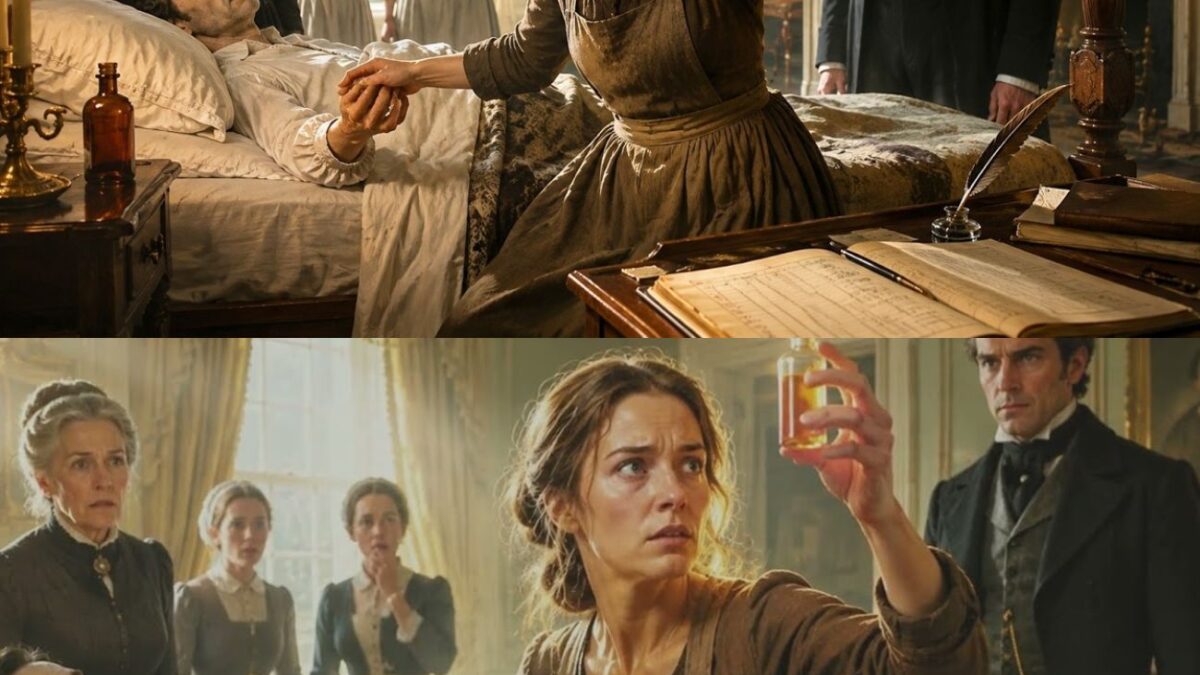
She set the ledger on the bedside table and looked at the Earl of Dunreath. Lord Crispin Hollis was perhaps 40, though the wasting had put 10 years onto him that were not truly his. His skin had the particular waxy quality she associated with a body that had been losing a long argument with itself for months. Not the gray of ordinary illness, but the strange even pallor of something more deliberate. His breathing was shallow. His hands lay open on the counterpane. Minna looked at those hands. Her father had shown her once a man brought in from the eastern parish who had died of what the doctor called a weakness of the stomach. Emery had looked at the man’s fingernails for a long time without speaking and then had said quietly in the voice he used for things worth remembering, “Look here, Minna. White bands across the nail, one for each dose if the dosing went on long enough. The body will not lie even when everyone around it does.”
Lord Crispin Hollis had white bands on his fingernails. Not one, three. She stood at that bedside rather longer than was appropriate. And when she looked up from his hands, she found the man himself watching her with eyes that were exhausted but not empty. Behind her, the Earl’s physician, Dr. Aldwin Probert, had come in from the corridor without her hearing and was watching her watch his patient with an expression of gentle, professional concern.
“The inventory does not extend to the bedchamber,” said Dr. Probert pleasantly.
Minna did not look at him. She looked at Lord Crispin. “My lord,” she said, “when did the weakness in your hands begin?”
A silence, long enough to be its own kind of answer.
“Miss Reich,” said the doctor, still warm, still measured, “his lordship is in considerable distress. Perhaps…”
“He is being poisoned,” said Minna Reich.
The room went entirely still. The footman at the door stopped breathing or seemed to. Dr. Probert’s expression did something she did not have a name for, something that crossed the face so quickly she could almost have imagined it, and resolved itself back into sorrow and composure.
“My dear girl,” he said, and his voice was everything gentle and rational, “you have lost your own father recently. You are not accustomed to vigils of this kind, and the mind in grief looks for a cause where there is only the sadness of nature. I know it well.” He took a half step toward her. “But you will kindly leave this room.”
Lord Crispin spoke. His voice was worn to a thread, but it was steady. “What,” he said, “are white bands on the nail?”
She told him. She told it precisely, the way her father had taught her to give evidence, not too fast, not embellished, every fact in its right order. She explained the chemistry of slow arsenic poisoning, the markings that appeared after repeated exposure, one line per acute dose when the dosing was careful and prolonged. She told him his own nails had three.
Dr. Probert said several things. They were reasonable things delivered in a reasonable voice. And the footman looked from the doctor to Minna and back again with the expression of a man watching a language he did not speak.
Lord Crispin let the doctor speak. Then said without particular heat, “Leave us.”
“My lord…”
“Go home, Aldwyn. You may call again Thursday.”
The doctor left. The footman left. The door closed. Minna stood with her ledger and her father’s knowledge in the bedchamber of a dying nobleman she had met 12 minutes ago and waited to find out whether she had just saved herself or ruined herself, and found to her own mild surprise that the distinction felt less urgent than whether the Earl of Dunreath would live out the month.
She did not convince him that evening. She convinced Mrs. Quill first. The housekeeper came to her after supper in the small room she had been given for the inventory work, carrying a lamp and an expression as hard as the November frost on the windows. She had heard, she said, what Minna had said to the doctor and to his lordship. She wished Minna to understand that she had served Dunreath House for 37 years, that she had attended two countesses and one previous earl, and that she did not take kindly to a stranger arriving with a ledger and a piece of her dead father’s folklore and calling the family physician a poisoner.
“Show me,” said Mrs. Quill, “on something I can see.”
Minna held a glass medicine vial from the tray Dr. Probert had left that morning over the lamp chimney until the heat drew the residue to the surface. The marks were faint but unmistakable. The uneven white clouding she had seen on glass brought to her father’s inquest 20 years ago.
Mrs. Quill looked at it for a long time. Then she looked at Minna. “Do it again,” she said.
Minna did it again. The housekeeper set down the lamp. Her jaw was tight and her eyes were bright with something that was not warmth, but was the near relation of it. The look of a woman who has been carrying a weight she did not have a name for and has just been handed the name.
“I do not like you,” said Mrs. Quill. “I want that clearly understood, but I have made that man’s broth and his beef tea and his morning posset for six months and I have watched him go smaller every week and I have believed what Probert told me because Probert has been coming through that door since before his lordship was breached. If I have been wrong in what I believed…” She stopped. “You will show me everything, every observation, every suspicion, and if you are lying to me or mistaken or playing some game I cannot see the edges of, I will have you out of this house in the cold dark. Do we understand each other?”
“Perfectly,” said Minna.
She won the rest of the household by a different means and without intending to. The under-gardener’s boy, a red-headed 14-year-old named Joss, had caught his arm on a rusted fence post during the first week of December, and by the time anyone mentioned it to Minna, she had by then acquired a reputation, unflattering but useful, for knowing things about bodies that doctors were slow to bother with. The arm had swelled to twice its size and the smell off it was the smell she had first encountered in her father’s inquest room at the age of nine. The smell that meant something had already decided the matter and was only waiting for the body to agree. The head groom wanted to send for Dr. Probert, who was three hours off in town. Joss’s mother, a laundry maid, was weeping into her apron in the kitchen corridor.
Minna rolled up her sleeves and asked for carbolic, clean linen, and the boy’s trust for the length of an hour. She cleaned the wound, she explained without sentiment, the difference between flesh that could be saved and flesh that was already beyond saving. She used what her father had kept in his cabinet for such cases because the parish poor had come to Emery Reich when they could not pay a doctor’s fee, and he had never once turned them away, and Minna had assisted him often enough to know what worked and what was merely hopeful.
Joss kept the arm. On the eighth day, he lifted it to shoulder height in front of his mother, and the household of Dunreath, which had received Minna as a necessary inconvenience and called her, in the lower regions, a coroner’s get, decided in the wordless collective way that households decide things that she was one of theirs.
It was the Earl who told her, on the evening of the ninth day, that he had been grateful to her longer than she knew. She had come to set his fire and found him sitting up in bed watching the window. And he said, without preamble, in the dry, flat voice she was learning was his truest one, “I threw away the first two bottles of tonic.”
She put the fire iron down carefully.
“I told myself it was the taste,” he said, “a sweetness underneath the bitter that has no business being there, like something is being hidden under something else. I told myself I was merely contrary or feverish, and I poured it out the window at night when Probert wasn’t watching, and told him I had taken it, and watched him return the following week with that particular expression.” He stopped. “I did not know what I was seeing. I knew I did not like it. There is a difference between knowing and knowing.”
“There is,” said Minna. “Tell me what you suspect, all of it, without managing me.”
So she told him about the inquest file her father had kept. A case from the eastern parish, a man who had died of what everyone agreed was a stomach complaint and who had lain in the ground three months before his family quarreled over his farm and applied to have him examined. He had lain in the box as though newly dead because arsenic in sufficient quantities does not merely kill, it preserves, and the dead do not rot as they ought. She had read that inquest report so many times she could have recited it by heart.
“If you die next week,” she said, and she said it the way her father taught her to speak in an inquest room, directly because softness was a kindness that served no one, “they will bury you and write wasting fever on the register. And in five years’ time when someone opens that vault, you will lie as fair and intact as a man a month dead and no one will ask why.”
A long silence. The fire had caught and was working itself into warmth.
“Who else could have access to what I eat and drink?” he said.
“Probert measures the tonic himself, but the kitchen provisions, those are Mrs. Quill’s domain, and she is not the kind of woman who…” She paused. “There is someone else in this house who might have reason: your brother. I do not know when he returns from Halifax.”
Lord Crispin was quiet. “He is expected the 12th.”
“Then we have until the 12th to get you visibly worse.”
He looked at her. “I beg your pardon.”
“The safest poisoner in the world is one who believes his work is still going according to plan. If Probert, or whoever directs him, believes you are sinking, he has no reason to hurry or change his method. If he suspects you have stopped drinking what he gives you, he may act more boldly, and boldly is harder to withstand.” She held his gaze. “You want to seem to be dying while you mend. It is a harder performance than it sounds.”
“I have been managing a version of it for six months,” he said. “I… I can continue a little longer.” And in the lean, exhausted face, there was something she had not expected to find, a dry, careful humor that the illness had not managed to reach. “You are a very unusual woman, Miss Reich.”
“I am a useful one,” she said. “It is what is left when utility is the only currency available.”
“That is not all it is,” he said quietly.
And she looked at the fire, and neither of them said the other thing that was in the room, which was that two people who keep a difficult truth together in a sickroom at midnight have already begun whatever else they are to belong to each other’s story.
Carrick Hollis arrived on the 14th, two days late, in a flurry of noise and borrowed energy, all open arms and ready tears. He was everything his brother was not: easy, extravagant in his grief, the kind of handsome that costs nothing and spends itself freely. He held Lord Crispin’s hand at the bedside and said he could not have borne to come too late, that the letters had found him barely in time, that Crispin must get well, he simply must. The Earl said from his pillows that he was trying his best.
Minna stood at the window and watched Carrick Hollis weep, and over the shaking of his shoulders, she saw his eyes come open and travel with an unhurried precision that had nothing to do with grief across the room and settle on her face for a single, assessing second before the weeping closed over them again like water over a stone. One look, half a second, gone.
She tried over the following days to believe she had imagined it. He was charming to her. That was the difficulty, the specific, deliberate difficulty she could not bring to the Earl without sounding like exactly what Carrick seemed to need her to sound like. He thanked her publicly for her devoted care of his dear Crispin. He pressed a coin on her, which she did not take. He found her alone on the gallery stairs one evening and stood beside her with his handsome grieving face and said, in the voice of a man being very kind, “I must tell you something, Minna, because someone ought to, and you deserve to know what they’re saying in the village.”
She waited.
“About your father,” he sighed, “about his inquest records. People say—and I repeat it only so you can be armed against it—that Emery Reich’s files had gaps, convenient ones. Verdicts that favored certain families. A woman already under suspicion cannot afford to have her father’s name weighed against her as well.” He shook his head. “It is monstrous, of course, but you should know what you’re walking into.”
“That is very thoughtful of you,” said Minna in the flat voice that meant the opposite of what it said, “to arm me against a rumor by delivering it personally.”
She held his eyes when she said it, and for one moment, as quick and cold as the look across the sickroom, she saw what was underneath the warmth, and it was nothing warm at all. Then he laughed and said what a plainspoken woman she was and went down the stairs, and she stood on the cold gallery and understood two things at once: that Carrick Hollis had just tried to measure her for something she was not going to fit, and that she had spent 10 uncertain days very nearly letting him talk her out of her own certainty.
She would not make that mistake again. She went that same night to her father’s writing case, the one with the coroner’s crest worn half off the brass clasp, and found, cold in her stomach before she even opened the inner pocket, what she had known on the stairs she would find. Her father’s notebook, the inquest record from the eastern parish case, the one with the white bands documented in Emery Reich’s careful hand, was gone.
She knelt in the lamplight and understood what it was going to be used for. Somewhere in Dunreath House a dead man’s handwriting was waiting in a careful hand to be turned against his daughter at the exact moment she had nothing left to counter it.
She did not go to the Earl that night. She needed something that could not be annotated in a margin or planted beneath a writing case. She needed the one kind of proof that tells the truth, however inconvenient the truth is, and cannot be coached, and does not wait to be believed.
On the 29th of December, Mrs. Quill came to her after midnight with a candle and the look of a woman who has made a decision that cost her something. She said that Carrick had arranged a county gathering for Epiphany, ostensibly to celebrate his brother’s improvement, and that she had heard through a pantry door that before the guests arrived Minna would be quietly handed to the constable. The notebook had been produced beneath Minna’s own writing case with certain margins annotated in a hand that was not Emery Reich’s, crossing out fever verdicts and penciling in what Carrick would tell the magistrate were deliberate falsifications made by Minna to build a false case against an innocent physician.
“You have nine days,” said Mrs. Quill. She opened a basket. Inside, wrapped in linen and sealed with her own thumbprint pressed into the wax, was the vial she had tested over the lamp, the residue on the medicine spoon, and a folded sheet of paper dated and witnessed in her own hand.
“It is not enough,” said Minna.
“No,” said Mrs. Quill, “it is not. But you are cleverer than me and cleverer than them, and if you cannot find a way to make it enough, at least go down making noise.” A pause. “There is one thing I have been thinking on. Lord Crispin’s father, the old Earl. He died of a wasting fever four years back. Probert attended him throughout. He is in the family vault under the chapel.” She looked at the candle. “He was not a man who aged gently. He would not lie fair…”
She left the rest of it in the cold air between them.
Minna went to Lord Crispin that same night. She told him all of it: the notebook, the annotated margins, the plan for Epiphany. She told him about his father.
“Open my father’s coffin,” he said, “before the county. If he died as Probert says, you will find four years of honest decomposition, and I will go to the constable myself. And if he did not die as Probert says, then you will have the one proof that cannot be annotated or planted. The body will say what it says. It cannot be coached, and it cannot be managed, and it cannot be made to look like anything other than what it is.”
A long silence. The hall clock tolled two from somewhere far below.
“I have told myself for three years it was simply his time,” he said quietly, “that grief was making me suspicious, that a doctor who weeps at a graveside is not a guilty man.” He looked at his hands, at the three white lines on his nails. “I have been a very stupid man in the particular way that intelligent men are stupid, which is to say I was too proud to look directly at the thing I did not wish to see.” He met her eyes. “I will not be that man again. Open the vault.”
She would not remember afterward the exact words she spoke on the morning of Epiphany, only that she spoke them into the center of a crowded hall without waiting to be asked and that her voice did not waver because the dead do not waver, and she had been schooled by the dead since childhood.
The magistrate, Sir Hadwin, a slow and careful man who had heard her father give evidence in the same inquest room for 30 years, let her speak. He had the particular stillness of a man who had learned that truth comes up in its own time, and cutting it short only buries it deeper.
Probert made his case. He was very good at it. He laid out the broth, the tending, the months of care. He produced the notebook with its annotated margins and let the word falsification do its quiet work in the room. He produced a kitchen maid, young, frightened, white as chalk, who swore she had seen Minna at the medicine tray with a paper of white powder in her hands.
“Wait,” said Minna before the girl could say it again. “Look at me, not at him. At me.” She held the girl’s gaze until she had it. “You are about to repeat something in front of Lord Hollis and Sir Hadwin and the Reverend Norris that you know in your own chest is not true. I am asking you to hold that knowledge for five minutes more and come with me to the one place where you will have to say it in front of something that cannot be managed or silenced or told what to look like.”
She turned to the room. “Lord Crispin’s father died of a wasting fever four years ago,” she said. “Dr. Probert signed a certificate. He lies in the vault beneath the chapel. My father’s inquest file, the real one before anyone else touched it, documented a case identical to what I observed in Lord Crispin: the white bands, the particular pallor, the slow systematic nature of the illness.” She paused. “Arsenic does not leave the body, not in months, not in years. It stays in the tissue and it preserves what it stays in, and a man poisoned slowly does not decay as an honest corpse decays. Open the vault. Open the old earl’s coffin. If four years in the ground have done their natural work, I will say nothing more. But if he lies there as he ought not to lie…”
Sir Hadwin said in his slow, measured voice that the vault would be opened.
They went down, all of them: the assembled county, the two magistrates, the Reverend Norris, the weeping kitchen maid, Dr. Probert, and Carrick Hollis, who went because a brother who refuses to follow his own father’s coffin has already confessed the thing he meant to deny. Lord Crispin was carried down in a chair heaped with blankets, his head lolling, a man too far gone, by every appearance, to follow the formality arranged around him. If anyone had looked closely at the line of his mouth, they would have seen it was not the slack of illness, but the precise, deliberate stillness of a man who had been counting every face in that vault and was very nearly done counting.
Minna set the bar to the coffin. She knew exactly how to set it; her father had shown her in the inquest room when she was 12 and had taught her to do it without looking away because the dead were owed the dignity of being looked at directly.
She opened it. The room made no sound.
The old Earl of Dunreath had been a heavy, red-faced man, as Mrs. Quill had said, the kind of man who does not age gently and was not expected to lie fair. He had been buried in November four years ago. He lay in his box with his color in his cheeks and the flesh on his bones and the composed, almost peaceful expression of a man four months in the ground rather than four years.
Around him, the assembled county made the collective sound of a room encountering something it cannot un-encounter. The kitchen maid put her apron over her face and began to cry before anyone asked her to. Sir Hadwin looked at the old Earl for a very long time. Then he turned his slow, careful eyes to the physician who had signed the death certificate and who stood with his folded hands and his soft doctor’s face and something behind that face no longer quite hidden.
“The arsenic stays,” said Minna quietly to the cold vault and everyone in it. “It cannot help itself. It is the one honest thing about it. It cannot lie in the ground, whatever lies were told over it.”
Carrick Hollis said something reasonable about dry vaults and the tricks of cold stone and what a dreadful coincidence this all was. He said it in his warm, easy voice, and Minna watched the room fail to believe him, and watched him watch the room fail to believe him, and watched the warmth in his face become a thing being held in place by will alone.
The kitchen maid confessed. She had been given words to say by the doctor and a coin by Mr. Hollis and a threat about her family’s tenancy that she could not repeat in front of the parson. She had never seen Minna near the medicine tray. She was terribly sorry. She would say it before any judge in England.
Sir Hadwin took Dr. Probert and Carrick Hollis before the company left the vault. What the assizes drew out of them in the weeks following closed the last dark corners of it. Carrick had lived beyond his means on the expectation of an inheritance worth nothing while his brother drew breath, and had approached Probert in a hired room in Halifax—Probert, who had already helped the old earl out of the world and understood there was money in a nobleman’s trust and a steady hand with a tonic. Carrick had never once held the spoon and had meant never to, which was the whole of his cleverness and in the end none of his defense.
Probert was tried in the spring. The evidence against him was a body that would not rot, a coroner’s daughter who could explain to the jury precisely why it would not, a sealed vial with a housekeeper’s thumbprint in the wax, and a column of dates in Lord Hollis’s own careful hand that could only add one way.
Carrick could not be directly tied to the spoon, and there are things a man will do for his own blood even after the blood has earned his contempt. Lord Crispin gave him a horse, a sum that was duty and not love, and the clear understanding that if he returned to England the entire record would go directly to the crown. Carrick took the horse and was seen on a westbound ship within the fortnight.
The household closed over the space where he had been, the way a field closes over a dug-out stone. The kitchen maid kept her place; Lord Crispin said that a girl frightened into a lie who untells it in a cold vault with four years of truth lying open in front of her has more plain courage than half the comfortable people who were watching her. Minna said the same and meant it harder.
Mrs. Quill kept the keys. She never said aloud that she had come to regard the coroner’s clerk’s daughter with something beyond grudging respect, but she pressed her thumbprint into the wax of Minna’s letters ever after with the particular satisfaction of a woman who has been right about a thing from the beginning and is content to let time be the proof.
On the last day of January, in the long gallery where Lord Crispin had begun to walk again, he stopped before the empty space on the wall where his portrait had yet to be painted and said, without looking at her, in the quietest of his voices, “I had Tenby in last week. He has drawn up a settlement.” He kept his eyes on the wall. “It is irrevocable. I had him say it to me four different ways until even I could not find the door out of it, because I know my own habits well enough to know I would otherwise have found one.” He paused. “It provides for you an income, a house in town, your independence in writing from this date forward whatever becomes of me. If I recover fully, which I intend to do, being contrary by nature and annoyed at the alternative, you are a woman of means and owe me nothing and may leave whenever the mood takes you. If something goes wrong after all, you walk out of here free, and anyone who suggests you hastened anything will have to explain why you needed to hasten a man who had already signed everything over to you while he was living.”
A long silence. The winter light came thin through the tall windows.
“That is a great many conditions,” said Minna, “for a man who claims to prefer plain speaking.”
He turned and looked at her, and the dry, careful face was doing something it had apparently not practiced: something a little off-balance and a great deal more honest than it intended. “I am giving you the means to leave me,” he said, “because I have discovered, at an age and in circumstances where I would once have called it entirely impractical, that I would very much rather you did not. And a man cannot ask that of a woman he has kept dependent on his household. He can only, in the cold gallery like a considerable fool, remove the dependents and wait.”
Minna considered him, the room, the empty frame, the long winter they had come through together in a sickroom that had tried to become a grave. “You could simply ask,” she said.
“I am asking. I am asking it the long way round because I find I am not quite able to be short about it.”
“Then be short.”
He looked at her for a moment, then said, “Stay.”
“Yes,” said Minna Reich, not because the settlement asked it, not because the house was warm or the future arranged or any practical arithmetic had been done. She said it because she had spent three months watching a man look at the sums of his own death and choose, again and again, to count straight, and she had no particular interest in spending her life anywhere near a man who would do otherwise. She said it plainly and without embarrassment, and he looked at her the way a man looks when he has been given something he was not certain he deserved and had the grace not to say so aloud.
Lord Crispin recovered fully by spring, which surprised no one who had observed him closely that winter and astonished everyone who had not. He had the particular tenacity of a man who has decided he has unfinished business with the world and who has moreover been told by a woman he respects that dying now would be, on balance, inconvenient. He ate and slept and put back the weight that six months of slow poisoning had taken. And if he was never quite the man he had been before Probert had begun his careful work, he was something adjacent to that man and in some ways, Mrs. Quill observed dryly to no one in particular, an improvement on him: less closed, less private, quicker to say a thing directly.
He married Minna in May in the chapel above the vault, and Reverend Norris, who had buried two generations of Hulls and had strong opinions about the proper order of things, performed the ceremony with the careful solemnity he brought to everything, and only Minna noticed the small, contained satisfaction in his face when he pronounced them joined, as though the vault beneath their feet had finally, after a long and unnecessary delay, been set to rights.
She put her father’s writing case in the library of Dunreath House. She kept Emery Reich’s inquest records, the real ones unmarked by anyone else’s hand, and she added to them because a record left half-finished was, as her father had always maintained, worse than one never begun. She documented the case in full: the white bands on the nail, the vial over the lamp, the vault opening, the column of dates that could only add one way. She wrote it clearly and without softness, the way her father had taught her, so that the thing done would be a thing known, set down where it could be read and not buried where it would only keep.
On an evening in late summer, with the account books closed and the window open to the last of the gold sunlight over the gardens, Lord Crispin set down his pen and looked across the library table at his wife, watching her neatly tie the ribbon around a fresh bundle of estate records before returning them to the shelf where they belonged.

