Eden Was Not a Garden: What Genesis 2 Really Describes
Eden Was Not a Garden: What Genesis 2 Really Describes
If Eden was just a beautiful garden, why does Genesis 2 spend five verses giving coordinates for rivers that still exist today? A garden doesn’t need GPS. Think about it calmly. When someone describes a garden, they talk about the flowers, the trees, the fragrance in the air. No one describes a garden by saying, “Follow this road, take this river, go around this mountain, and you will arrive at my garden.” Unless what is being described is not a leisure garden, unless what is being described is a territory with borders, with access, with its own name in the geography of the ancient world. And that’s exactly what most people never realize, because most of us read Genesis 2 backward without noticing. We start with verse 8, thinking that’s where the story begins, but the end of the account reveals the true beginning. Look at what Genesis 2, verse 15 says. The Lord God took the man and put him in the garden of Eden. He took it and put it down. In the original Hebrew, the verb carries the meaning of making something rest, of depositing, of transporting from one place to another. No one puts something in a place if that something has always been there. You can only put back what was previously in another location.
This changes the entire order of history. It means that man was not created inside the garden. He was trained outside and only then brought inside. Verse 7 tells us that God formed man from the dust of the earth, from Adamah, from common soil, that dry clay that anyone steps on without thinking twice. And verse 8 recounts that only then did God plant a garden in Eden. These are two separate moments, with a pause between them. First, man comes from the raw earth without any special privilege of address. Then, God prepares a place unlike anything that existed around it and takes this man there. This already shatters the image that most people have carried since childhood. Eden is not the starting point of human creation. This is the second address. This is where man was taken after he existed. Think about the magnitude of that shift in perspective. If man already existed before, formed from common material, from the same dust that anyone treads on their path, then Eden was not an automatic privilege of birth. It was an invitation, a promotion, a move from an ordinary place to a place of honor. It’s like comparing the courtyard of any city to the interior of a king’s palace. Being born in the city doesn’t guarantee you entry into the palace. Someone needs to take you there, choose you, open the door. And it is precisely this verb of transport, of driving, that Genesis 2 uses to describe the moment when man arrives in the garden. He wasn’t born there, he was led there. And this is where the question that underpins the entire video arises. Why bring it? Why didn’t God leave man exactly where he had been formed?
The answer lies in a small word that has been poorly translated for 2000 years. That word is gun, cataloged in Hebrew lexicons under Strong’s number 1588. In the minds of those who grew up listening to biblical stories in Portuguese, garden means leisure, it means flower, it means that square of grass with some trees that any family takes care of on the weekend. But in ancient Hebrew, Gun has no relation to that. The root of the word carries the meaning of surrounding, protecting, shielding against what is outside. Gan is a walled enclosure. It is an area of intensive cultivation, irrigated by canals, enclosed by walls or hedges so that wild animals, invaders, and the chaos of the open world could not get through. Ancient Egypt, a direct neighbor of the territory where the Bible was written, was also well acquainted with this type of construction. Pharaohs erected walled enclosures within their own temple complexes, complete with artificial water tanks, rows of trees planted, and animals brought from expeditions to the Nubian region to the south. An Israelite who had grown up in Egypt, like the Hebrew people themselves lived for generations before the exodus, would have seen this type of royal enclosure with their own eyes. He would have walked near the walls that separated the cultivated greenery from the surrounding desert. When these same people, decades later, heard the story of creation being told with the word gun, the image that came to mind was not abstract, it was concrete, it was visual, it was a type of construction that many of them had already seen up close, only now applied not to a mortal pharaoh, but to the creator of the world himself. The kings of Mesopotamia did this constantly, and archaeology has found concrete evidence of this in inscriptions and palace reliefs.
They built enclosures that the Persians later called pai daesa, a word that literally means “enclosed around” and which, after passing through Greek and Latin, gave rise to our word paradise. And what was the paradise of an ancient king? It wasn’t a place for a peaceful stroll; it was a showcase of power. The king would choose a piece of desert, a stretch of dry and hostile steppe, erect high walls, and within that enclosed space recreate the world as he thought it should be. It brought water to places where there was no water. He brought fruit trees from distant regions, sometimes conquered in war. He brought rare animals, captured in other lands, just to display them within his own enclosure. Inside the wall there was order, abundance, irrigation, and security. Outside lay the real world, dry, unpredictable, and full of risk. Archaeology has provided concrete evidence of this custom. In stone reliefs found in the palace of the Assyrian king, aurbanal, in the city of Nineveh, there is a sculpted scene showing the king himself banqueting inside a green enclosure, surrounded by trees brought from conquered lands, with a visible system of canals carrying water to each flowerbed. This type of enclosure had its own name in the administrative texts of the time and served as public proof that the king was capable of dominating even nature, bringing abundance into an enclosed space in the middle of a dry land.
Centuries later, Greeks and Romans were still talking about hanging gardens built by Babylonian kings. Such was the fame of this type of construction in the imagination of the ancient world. And there is yet another hidden clue in the word Eden itself. Some scholars link this Hebrew name to an older Sumerian term, Edin, used to describe an open plain, a fertile steppe, the type of flat, well-watered terrain that surrounded the large cities of ancient Mesopotamia. If this connection is correct, the name Eden was born carrying the meaning of a vast territory, a plain, not a simple flowerbed. Add to that the fact that the Hebrew word itself, for pleasure and delight, also sounds similar to Eden. And you have a region name that means both fertile plain and place of delight. A name for the territory, not a name for the garden. When Moses wrote that God planted a ghanam in Eden, any Hebrew who had crossed the desert, any Israelite who had lived in Egypt and seen the royal gardens of the pharaohs, understood immediately what that meant. God was acting like a king. He took an entire region called Eden and within it he built his own royal enclosure, his own protected space. Notice also that the Bible doesn’t treat this as just another detail lost in the middle of a list of instructions. The text specifically explains this word, this geography, these coordinates right in the first chapters of the first book. If the goal were simply to tell a story of moral downfall, without any concern for place or time, it would suffice to say that the man lived in a good place and then lost that place. There would be no need to name rivers, name lands, name minerals. The simple effort of providing geographical detail is in itself a sign that the author wanted to anchor that story within the real world that his first readers knew, and not leave it adrift in the realm of pure symbolism. And here comes the second discovery that almost no one notices in a quick reading. The text never says that Eden was the garden.
The text says the opposite. Genesis 2, verse 8. And the Lord God planted a garden eastward in Eden. Eden is the greater space. The garden is only one part of it. It’s like saying that someone planted a vineyard in the Serra Gaúcha region. The Serra Gaúcha is the entire region. The vineyard is just a small patch planted within it. Edenório, a vast region with its own name. And the garden was God’s enclosed space within this larger territory. Compare this with other origin stories that circulated among the neighboring peoples of Israel in antiquity. Many of them are preserved on clay tablets found by archaeologists. Ottoman. These other accounts, in general, describe the creation of the world and the first human being in loose language, full of conflict between gods, without any concern for anchoring the story in an identifiable place on the map. Genesis 2 does the opposite. He saves words precisely where other ancient texts would spend an entire page recounting battles between deities. And it focuses on detail precisely where other texts didn’t bother, on geography, rivers, and the mineral resources of a specific region. This editorial choice to prioritize concrete facts over loose mythological drama is one of the signs that Old Testament scholars use to argue that the author of Genesis was in fact trying to record historical memory within the language and literary genre available at that time. And not just composing a poem without any commitment to place or time. That’s why the text makes a point of giving you directions. Genesis 2, verses 10 to 14, are not there to embellish the narrative. A river flowed out of Eden to water the garden, and from there it divided into four branches. The author is describing the coordinates of a real watershed. He’s saying it explicitly: “Eden was so concrete, so geographical, so easily located, that I can tell you which rivers originated there.” And he cites four. Two of them we still recognize today by practically the same name: the Tigris, which in Hebrew appears as Idekel, and the Euphrates, the same river that runs through present-day Iraq. The other two, Pison and Gion, are still debated among scholars to this day, but the text doesn’t let them off the hook.
He describes where these rivers flow, what lands they bypass, and what riches exist in those lands. Gold, bidhelium, onyx stone. No one describes a simple flowerbed by saying that a river originates there, winding through the land of Ravilá, where there is good quality gold. This isn’t fairy tale language. This is the language of maps, reports, expeditions, and descriptions of a territory with cataloged natural resources, exactly as a scribe from the ancient Near East would record a region of economic and strategic value. The Jewish historian Flavius Josephus, writing in the first century AD, attempted to identify these four rivers with known waterways in the ancient world, linking Pishon to the Ganges and Gihon to the Nile, in an attempt to show that Eden, in his view, drained into the four corners of the then-known world. Josephus’s attempt may not exactly match the real geography, but it proves one important thing. Early Jewish readers did not treat Eden as a fable floating in the air. They treated it as a real place that deserved to be searched for on a map, discussed, and compared with the geography they knew. Today, scholars still debate the exact location of Eden. Some place the region in southern Mesopotamia, near where the Tigris and Euphrates rivers meet before flowing into the Persian Gulf, in an area that today corresponds to southern Iraq, near Kuwait. Others point to the Armenian highlands to the north, where both the Tigris and Euphrates rivers originate, forming precisely that pattern of a main river that divides into several branches as it descends from the mountains to the lower plains. There is also a third, more recent line of research that uses satellite imagery to try to trace the dry beds of ancient rivers beneath the sands of Arabia, proposing that the Pishon and Gihon rivers existed in that region thousands of years ago and dried up completely with climate change over the centuries. None of these proposals are unanimous, and probably never will be.
Because the region’s topography has changed dramatically over thousands of years, due to earthquakes, shifts in river courses, and the desert itself encroaching on once-fertile lands. But the mere fact that there is a serious geographical debate with maps, academic articles, excavations, and even satellite images, shows that the text was not written as a myth detached from time, without any reference to the real world. It was written as a memoir of a place. A myth doesn’t give a river its surname. It does not describe the specific ore of a specific land, a real territory. Yes. Now you understand the complete reversal that this reading provokes. For centuries, the image passed down through generations was that of a small ball, surrounded by flowers, floating alone in the middle of nowhere. But the text describes exactly the opposite of that. He describes a vast world, an open region called Eh, a word that in Hebrew carries the meaning of pleasure, delight, a fertile and well-watered plain. And within this vast world, God has enclosed only a small part of it. He erected boundaries that were perhaps not just of stone, but of divine order imposed upon that space. He planted, organized, irrigated, and transformed a section of that territory into a sacred precinct, an operational center between heaven and earth. And if it was a room, it had a clear function; it wasn’t just decoration. Gangs don’t just exist to protect what’s inside from what comes from outside. It also serves as a workspace and a surveillance area. Look again, Genesis 2, verse 15, the whole thing this time. The Lord God took the man and put him in the garden of Eden to work it and take care of it. The two words used there in the original Hebrew belong simultaneously to the vocabulary of agriculture and to the vocabulary of priestly service.
The first meaning signifies working, serving, cultivating, but it is also the term later used to describe service within the temple. The second one means to guard, watch over, protect. And it is the same word used for the Levites who stood guard at the entrance to the tabernacle, preventing any unauthorized person from entering the sacred space. It wasn’t placed in a recreational garden to pick fruit without any commitment. He was placed in a royal enclosure as a guardian priest with a dual role. To cultivate order within the wall and prevent chaos from outside from crossing the border. This pair of functions, cultivating and guarding, reappears centuries later, almost with the same words, when the Bible describes the work of the Levites inside the tabernacle, that sacred tent that accompanied the people of Israel through the desert after their exodus from Egypt. The Levites also had the function of serving within the sacred space and, at the same time, guarding its entrances against anyone who was not authorized to enter. No one, not even an ordinary priest, could simply walk into the Holy of Holies whenever they pleased. There was an entire system of protection, surveillance, and controlled access. And this system, according to the biblical text itself, was not invented out of thin air in the desert. It repeats, on a smaller scale, the original design that already existed in Eden, the first sacred space in history, the first place where heaven and earth met at a single point in geography. This helps to explain why Adam, in the very first chapters of the Bible, receives a task that sounds strangely formal to someone who imagines a simple gardener without any greater commitment. He wasn’t just choosing where to plant the next fruit tree. He was exercising a state function in an almost political and religious sense at the same time, representing God’s order within a territory that, on the other side of the wall, still lived under the weight of the original chaos. It’s a job, not a hobby.
Throughout the Bible, every position is always accompanied by responsibility, accountability, and consequences when the role is not fulfilled. Before continuing to follow the text verse by verse, it is worth pausing for a moment and talking about the book itself that we are reading, because this helps to understand why a Hebrew word can carry so much weight. Genesis is the first book of the Bible, and its name in Greek means origin, beginning. In Hebrew, the book is called by its first word, beresit, which means “in the beginning.” This difference in names already shows something important. Greeks and Jews viewed the same text from different angles, one focusing on the theme of the origin of things and the other focusing on the first word pronounced, as was the custom among the Hebrews to name their sacred books. Biblical Hebrew, the language in which Genesis was originally written, is a much more economical language than Portuguese. Few words carry much meaning, and the order of sentences, the precise choice of one verb over another—all of this communicates intention. When the text uses gan, instead of another Hebrew word that could also mean open space or loose territory, the author is making a deliberate choice. He’s saying, “Pay attention, this has limits, it has a purpose, it has guards.” And that is the beauty of studying the Bible in its original language, or at least studying what Hebraists and archaeologists have already discovered about these words. It’s not a matter of doubting the translation you grew up hearing. The Portuguese translations, whether the Almeida Revista e Atualizada, the Almeida Corrigida Fiel, or the Nova Versão Internacional, have done a serious job trying to find the closest equivalent word in our language. The problem is that no language has a word that carries exactly the same cultural baggage that Gan carried for an Israelite of the 11th or 10th century BC, someone who had already seen up close the royal gardens of Egypt, enclosed, guarded, and full of irrigation canals brought from the Nile.
Therefore, a study like this does not replace devotional reading of the text. He adds: When you read “garden” in your Portuguese Bible, your brain thinks of flowers, of a Sunday stroll. When an ancient Hebrew heard Gan, his mind would think of an agricultural fortress, a symbol of royal power, a sacred space guarded by a sentinel. Understanding this difference does not diminish the faith in the text; on the contrary, it restores to the text the concrete force it has always had, but which has been somewhat lost in translation over the centuries. This type of comparative work between ancient languages is called, in academic circles, philological study, a long word, but one that simply means the careful study of how words functioned at the time they were written. It’s not about inventing a new meaning for the text, it’s about recovering the original meaning it always had before going through almost 3,000 years of translations. First Greek, then Latin, then modern languages. It’s also worth briefly discussing the history of this text before it reached us, because that helps us trust what we’re analyzing. Jewish tradition attributes the authorship of Genesis to Moses, who is believed to have compiled and organized this account around the 11th or 10th century BC, likely drawing on memories and records that had been circulating among Hebrew families for generations. The text we have today did not come from a single manuscript scattered throughout time. It was copied by hand by dedicated scribes, generation after generation, for over 1000 years, until it became what is called the Masoretic text, the standard Hebrew version, used to this day as the basis for most translations. And here comes a discovery that reinforces confidence in this copying process. In 1947, ancient scrolls containing parts of the Hebrew Bible were found in caves near the Dead Sea. These scrolls had been copied approximately two centuries before Christ, making them nearly 1,000 years older than the manuscripts scholars had used until then.
When researchers compared these Dead Sea Scrolls with the Masoretic text copied a millennium later, they found a striking fidelity between the two versions, word for word. In the vast majority of cases, the text had been preserved with extreme care over generations of copyists. This does not, in itself, prove that every theological interpretation is correct, but it does prove that the word gan, which we are analyzing today, is with great certainty the same word that was written in the original text, without alteration from centuries of loose oral transmission. There is also the Septuagint, a translation from Hebrew to Greek made before Christ, used by Jewish communities that no longer read Hebrew fluently, scattered throughout Egypt and other regions of the Mediterranean. It is interesting to note that in the Septuagint the word Gan was translated into Greek as paradeisos, the same term which, as we have already seen, originally came from Old Persian to describe a royal enclosure. In other words, the Jewish translators themselves, centuries before Christ, chose a Greek word that carried this sense of enclosed and protected space, not a common Greek word for leisure garden. This translation choice, made by people who still had active contact with Hebrew culture and language, is further confirmation that the meaning of “enclosure” was always there, clearly understood by the ancient readers themselves, long before any modern study came to confirm the same thing through archaeology. And it is precisely this type of work, cross-referencing Hebrew with archaeological findings from Mesopotamia, with accounts from ancient historians such as Flavius Josephus, with the choice of words made by the Jewish translators themselves in the Septuagint, and with the structure of other biblical texts that we will see later, such as the tabernacle and the book of Revelation, that allows us to reconstruct a much richer and much more concrete image than that short account of a few verses was actually describing.
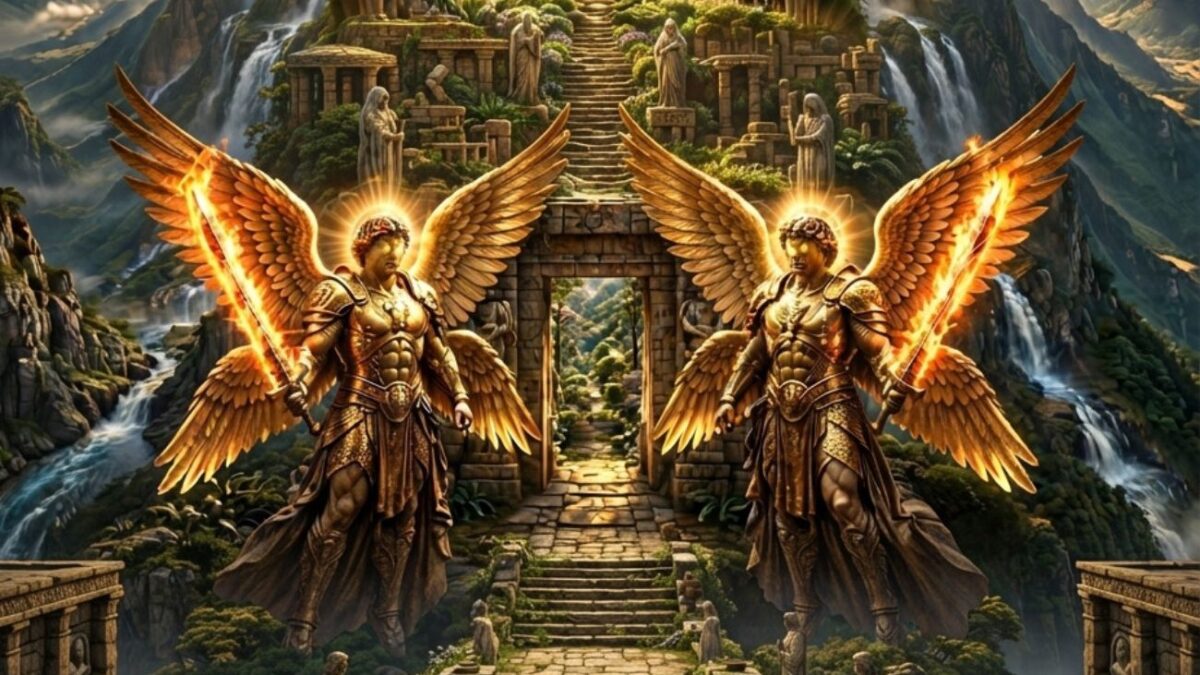
Returning to the text, this dual function, cultivating and guarding, explains why there is an entrance marked with such care. Genesis 3, verse 24 recounts that after the fall, God placed cherubim to the east of the Garden of Eden along with a flaming sword that moved by itself, to guard the path to the tree of life. No one needs to guard an entrance if there’s no wall around it. No one needs armed guards at a door if there isn’t a clearly defined inside and outside. If Eden were the entire world without any borders, where exactly would the couple have been expelled to? Expulsion only exists where there is a concrete limit to be crossed. And the text itself confirms this geography later on in a way that almost no one notices on the first reading. When Cain kills his brother, he is not thrown into a nameless void; he is expelled to the land of Nod, east of Eden. In other words, land already existed east of Eden, there was already space to escape to. And further on in that same chapter, enough space to build an entire city. How is that possible if Eden was all that existed? That’s only possible if Eden was never the entire planet. It was a region with a walled enclosure inside it. And outside that enclosure, and possibly outside the region of Eden itself, there was a larger world, not yet cultivated, not yet guarded, perhaps more hostile, but fully real. This simple observation already changes the most important question about the fall of man. The snake was inside the enclosure when it tricked the woman. How did she manage to get in? Was that space specifically designed to be protected against any intrusion? The most straightforward answer, looking at the verb itself used in Genesis 2:15, is that the guardian failed in what was his specific function. The order that existed within the enclosure was broken from the inside out, not from the outside in. And this also transforms the way we understand God’s presence in that space. The garden was not the address where God lived, as if he were trapped inside.
It was the meeting point between God and man, the place for direct conversation, for closeness, the oldest equivalent to what would later become the Holy of Holies within the tabernacle and then within the temple in Jerusalem. Throughout biblical history, all these spaces follow the same pattern. An open world outside, an intermediate courtyard, a sacred space and a most sacred space of restricted access and extreme care. The Garden of Eden was the first model of this design, the first place of intimacy between the creator and the creature, enclosed precisely to protect that intimacy. It’s also worth pausing to consider a small detail in the Hebrew text that often goes unnoticed in quicker translations. When Genesis says that the river flowed out of Eden to water the garden, the Hebrew verb used there indicates a continuous movement, a constant flow, not a single event. The text is describing a permanent, active hydraulic system that functions continuously, not just a static landscape scene. This detail reinforces once again the idea that Eden was described as a place of activity, a territory with visible water engineering, the kind that any ancient Mesopotamian civilization would take seriously, because the entire economy of that region depended directly on controlling the water coming from the rivers. And there is also the issue of the mineral resources mentioned along with the Pison River.
The text mentions high-quality gold, as well as two substances called bedelium and onyx. Bedellium was an aromatic resin used in perfumes and religious rituals by various peoples of the ancient Near East, a product with recognized commercial value. Onyx, in turn, is a semi-precious stone that reappears later in the Bible, embedded in the garments of the high priest of Israel. It’s not a meaningless coincidence. The text is, in a way, planting a seed that will only bloom chapters later. The same types of material wealth associated with Eden reappear much later, linked to the worship and priesthood of the people of Israel, as if the memory of that first sacred territory had never truly disappeared from the religious imagination of the Hebrew people. While the four rivers continued to flow, carrying gold and precious stones out of that region, man cultivated and guarded a piece of land that was, at the same time, a farm, a temple, and a border post. And it is precisely at this point, with the map drawn and man’s role defined, that the second half of this story needs to continue. What happened when the guardian failed? What does this reveal about the spiritual architecture of the entire Bible up to Revelation?
And what remains today of the question that the text itself forces you to ask? Part two. So far, the map has been drawn. There is a vast region called Eden, with rivers, rich in minerals, and a name of its own in the geography of the ancient world. And within this region there is a walled, cultivated, protected enclosure, where God placed man to work and to guard it. But a guarded enclosure only makes sense if there is something against which it needs to be guarded. And it is precisely this question that opens the second half of this story. It’s worth briefly reviewing the journey so far, because each piece fits into the next. Man was formed outside the garden, from the common dust of the earth, and only then led into the enclosure. The word used for this enclosure did not describe leisure; it described a walled, enclosed space, the kind that ancient kings erected as a demonstration of power and order over the surrounding chaos. Eden was the entire vast region, bathed by four royal rivers, rich in minerals cataloged in detail. And the garden within that region was the most protected point, closest to the presence of God, given to man with a dual purpose: to cultivate what existed within it and to guard the border against any threat that attempted to cross it. With this complete picture in mind, the natural question any attentive reader should ask is: “Guarded against what exactly?” A wall only exists because of a real or potential threat from the outside. A sentinel is only assigned to guard a gate if there is a concrete possibility of someone trying to cross it without permission. Genesis 2 doesn’t spend a single line explaining this threat before the fall. The text simply moves on to the next chapter, and it is there, right at the beginning of Genesis 3, that the answer appears without warning, without introduction.
The serpent appears inside the garden, inside the very enclosure that should be protected against any invasion. Genesis 3 begins by describing this animal as the most cunning of all the creatures God had formed. And it is already there talking to the woman, without any explanation of how it managed to cross the border that separated the garden from the rest of the world. The text doesn’t waste time explaining its origin at that moment, because the focus there is not the serpent’s biography, but the decision that will be made within the sacred enclosure. It is worth noting that the word used to describe the serpent as cunning in the original Hebrew sounds very similar to the word used a few verses earlier to describe the couple as naked, without any shame. It’s a play on words that the biblical author uses on purpose, linking the cunning of the invader to the exposed innocence of the two inhabitants of the garden. One side knew exactly what it was doing. The other side had not yet developed any distrust, no instinct to protect against manipulation.
This difference in posture already reveals, even before the serpent’s first words, the imbalance that will define the entire following scene. But the simple fact that it was there already reveals a flaw in the very function that had been given to man. Remember the two words used in Genesis 2:15: cultivate and guard. The second function, that of guardian, existed precisely to prevent this type of invasion. If something hostile managed to enter, the vigilance failed at some point even before the fruit was harvested. The fall, looking at it from this angle, does not begin the moment the fruit is bitten. It begins before, the instant when the conversation with the intruder was not interrupted when the guardian allowed the threat to remain within the space he was supposed to protect. Also note a question God asks immediately after the fall, a question often overlooked in simple translations: “Where are you?” This isn’t a question from someone who doesn’t know the answer. It’s a question inviting man to realize for himself how far he has strayed from the place of intimacy he occupied until then. The same question, in a way, runs throughout the entire Bible, asked in different ways to different characters over centuries of narrative. Where are you in relation to the place that was prepared for you to live? After the wrong decision, the text describes God’s reaction with almost surgical care, verse by verse.
Ultimately, this profound rupture led humanity out of the walled enclosure and into the vast, untamed expanse of the world, transforming human history into a long journey of longing and redemption. Yet, the blueprint of Eden was never completely erased from the human soul; it remained etched in the collective memory as a promise that the lost sanctuary would one day be restored, bridging the gap between earth and heaven once again.

