Appalachia’s Most Feared Family —The Croles of Bleak Hollow and the Records No One Was Meant to Read
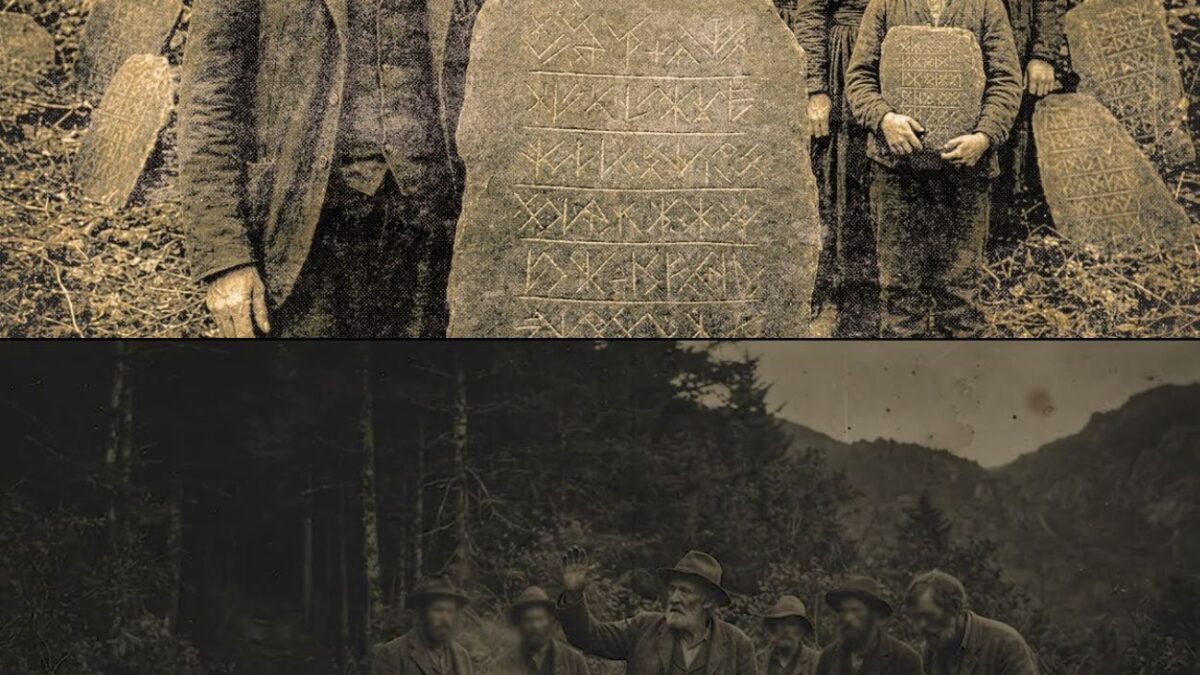
Appalachia’s Most Feared Family —The Croles of Bleak Hollow and the Records No One Was Meant to Read
In the autumn of 1903, a county clerk in southern West Virginia opened a leather folio that had been left on his desk overnight. There was no note attached, no return address, no name on the outer binding. Inside were forty full pages of cramped handwriting, and the clerk later told a colleague that by the time he reached page six, his hands were shaking so badly he had to set the folio down and walk outside into the cold air. He never filed those pages. He never cataloged them. He carried them home that evening and locked them inside a cedar chest in his attic. And when he died eleven years later, his widow found the chest but never found the key. That folio resurfaced nearly eight decades later, discovered inside a wall cavity during a renovation in Fayette County. And what it contained was a partial record of a family that the surrounding communities had spent over a century trying to forget. A family whose name appears in no published genealogy, no census index, no church baptismal role. A family that, according to the documents, occupied a stretch of hollow so remote that the closest neighbor lived more than nine miles away through unbroken forest. They were called the Crolls, and the hollow they claimed was known long before they arrived as Bleak Hollow.
The folio found inside that Fayette County wall was not the only record of the Crolls, but it was the most detailed. Other references exist in fragments scattered across the region. A deed transfer from 1847 mentions a Croll or Crawl family occupying land along an unnamed tributary. A letter from a circuit preacher dated 1861 describes passing through a hollow where he encountered a household of such strangeness and hostility that I turned my horse before reaching their door and did not look back until I had crossed the ridge. A notation in a timber company survey from 1889 simply reads crawl land. Do not enter by order of foreman. None of these fragments tell the full story, but taken together alongside the folio and the oral histories collected from surrounding communities in the 1970s, a portrait begins to form of a family that did not just live apart from their neighbors. They built an entire world inside that hollow, governed by rules that no outsider could decipher and enforced by methods that left the surrounding population in a state of permanent unease.
The earliest confirmed reference to the Crolls places them in what is now southern West Virginia around 1832. The land they occupied was not purchased. It was not granted. According to the folio, the family simply appeared. A hunter named Josiah Pembrook, whose own account survives in a letter to his brother in Richmond, described encountering a clearing in the hollow where someone had erected a structure unlike any cabin he had seen in the region. It was built not from logs, but from stacked stone with no mortar, no windows, and a single door that faced directly into the hillside rather than toward the trail. Pembrook wrote that he called out a greeting and received no answer, but he could hear movement inside, a low scraping sound, like something heavy being dragged across a dirt floor. He did not approach. He marked the location on a hand-drawn map, and noted beside it a single word that his brother later transcribed as wrong.
Pembrook returned to the area twice more over the following year, both times with a companion, a trapper named Virgil Scaggs, who knew the southern hollows better than anyone in the county. On the second visit, they found the clearing again, but noted changes. A second structure had appeared, smaller than the first, set deeper into the hillside, and half concealed by laurel thicket. Scaggs, who had trapped these mountains for over twenty years, told Pembrook that he had never encountered this hollow before, despite having worked every ridge and drainage within a day’s ride. He said the land itself felt unfamiliar, as though the topography had rearranged itself around the Croll settlement. Pembrook dismissed this as superstition, but he recorded it in his letter nonetheless, and added that even he could not explain how a stone structure of that size could have been erected without any visible trail or wagon road leading to the site. The stones themselves, Pembrook noted with some bewilderment, were not native to the hollow. They were a dark, fine-grained rock that Pembrook compared to slate, but said was harder and heavier than any slate he had handled.
What the folio reveals about the Crolls in those early decades is not a story of poverty or desperation. It is a story of deliberate separation. The family, which the folio’s author estimated at between nine and fourteen members across three generations, had constructed not just a dwelling, but an entire infrastructure within the hollow. There were animal pens built from the same unmortered stone. There were garden plots terraced into the hillside. There was a root cellar dug so deep into the mountain that the folio’s author described descending a wooden ladder for what he estimated was thirty feet before reaching the floor. But the most unsettling detail was the markings. The folio describes symbols carved into the stone walls, into the trees surrounding the clearing, and into a series of flat rocks arranged in a semicircle near the main structure.
The author, who appears to have had some education in classical languages, noted that the symbols resembled no alphabet he recognized. They were not Cherokee syllabary. They were not English or German or any European script. He described them as figures of a language that belongs to no nation I have studied, and which I believe belongs to no nation that currently exists. The author attempted to copy several of the symbols into the margins of the folio, and these crude reproductions are among the most studied portions of the document. The shapes are angular, composed of straight lines that intersect at precise intervals. Some repeat in sequences of three or five. Others appear to stand alone, larger than the rest, as though they mark the beginning or end of a passage.
A linguist who examined the photographs in 1986 noted that the symbols displayed consistent internal rules, spacing patterns, and stroke orders that suggested a genuine writing system rather than random decoration. But without a larger sample or a bilingual reference, decipherment was impossible. The linguist compared the challenge to encountering Linear A without the Rosetta Stone, a script that can be measured and cataloged but never read.
The Crolls did not welcome visitors. The oral histories collected in the 1970s from elderly residents of neighboring communities paint a consistent picture of a family that enforced its isolation through intimidation. One account from a woman who was ninety-one years old at the time of the interview described her grandmother’s warning about the hollow. She told me that the Crolls had a way of knowing when someone was on their land. You would not see them. You would not hear them, but you would know because the forest would go quiet. Every bird, every insect, every living thing would stop making sound and then you would feel it, a kind of pressure in your ears, like the air itself was pushing you back. Multiple accounts describe this same phenomenon. The silence, the pressure, and then, if the intruder did not turn back, the appearance of a Croll at the edge of the treeline, never speaking, never gesturing, simply standing and watching until the outsider retreated.
The folio’s author appears to have gained access to the Croll homestead under circumstances that are not fully explained. Several pages at the beginning of the document are damaged, and the narrative picks up midsentence, suggesting that an introduction or explanatory preface has been lost. What survives is a detailed description of the interior of the main structure, and it is here that the document becomes genuinely disturbing. The author describes a single large room with a packed earth floor. The walls were lined not with shelves or tools, but with what he calls tablets, flat pieces of shale approximately two feet wide and eighteen inches tall. Each one covered in the same unrecognizable script found on the exterior stones. There were dozens of them stacked against every wall, some propped upright, others lying flat in rows across the floor. The author counted at least sixty before he stopped counting.
In the center of the room was a stone platform roughly four feet square and two feet high, stained dark with something the author could not identify. He describes touching the surface and finding it smooth, almost polished as though it had been rubbed by hands over many years. Around the base of the platform, a shallow but precisely uniform trench had been cut into the earth floor, forming a perfect circle. The trench contained ash.
The family members present during this visit are described only in the vaguest terms. The author mentions the elder, a man of indeterminate age whose face was deeply lined, but whose body moved with the ease of someone much younger. He mentions the women, always in the plural, never individually named or described. And he mentions the child, a single reference to a young boy who sat in the corner of the room throughout the visit, and never once looked up from the stone tablet he held in his lap.
The author’s description of the elder is the most detailed and the most troubling. He writes that the man spoke in English, but with a cadence that felt foreign, as though the language was being translated in real time from some other tongue. The elder told the author that the family had been in the hollow since before the trees were tall, a phrase that the author interpreted as either metaphor or delusion, but could not dismiss entirely, given the age of the stone structures. The author noted that the elder’s eyes never settled. They moved constantly, tracking things in the room that the author could not see, pausing on corners and shadows as though monitoring presences that occupied the space alongside them.
At one point during the conversation, the elder stopped speaking midsentence and turned toward the far wall, listening. The author heard nothing, but the elder remained motionless for nearly a full minute before resuming his speech as though no interruption had occurred. The elder also made a statement that the folio’s author underlined twice, suggesting its importance. He said that the family kept records not for themselves, but for those who would come after the silence. When pressed on what this meant, the elder reportedly smiled and said nothing more.
The timber company survey of 1889 provides the next significant reference point. By this time, the forests of southern West Virginia were being systematically cataloged and claimed by industrial interests. Survey crews pushed into hollows and ridges that had been untouched for generations. But the crew that reached Bleak Hollow did not complete its work. The survey records preserved in the archives of a now-defunct lumber company contain a curt entry from the crew foreman. He reported that upon entering the hollow, his crew of seven men encountered structures of unknown origin and hostile occupants. He noted that one of his men, a sawyer named Dillard Coombs, became violently ill within minutes of entering the clearing and had to be carried back to the ridgeline. The foreman recommended that the hollow be excluded from the survey and marked as unworkable.
What happened to Dillard Coombs is described in a separate document. A letter from his wife to her sister in Kentucky written three weeks after the survey. She wrote that Dillard had returned from the expedition changed. He would not eat. He would not speak to their children. He sat on the porch from dawn until dark, staring at the treeline. At night, he drew symbols on scraps of paper, the same symbol repeated over and over, a shape his wife described as like a mouth with no face around it. After two weeks of this behavior, Dillard walked into the forest and did not return. His wife organized a search party, but the men refused to enter Bleak Hollow.
Dillard Coombs was never found. His wife kept the scraps of paper on which he had drawn the symbol, and decades later, her granddaughter showed them to one of the oral history researchers. The researcher noted that the shape bore a resemblance to the symbols described in the folio, though without seeing the original tablets, a definitive match was impossible. What struck the researcher was the compulsive nature of the drawings. Coombs had filled both sides of at least fourteen scraps, pressing so hard with his pencil that the paper had torn in places. Whatever he had seen in Bleak Hollow had lodged itself in his mind with a force that no amount of repetition could exhaust.
The timber company never sent another crew into the hollow. The foreman’s recommendation was accepted without debate, and the company’s maps from that period show Bleak Hollow as a blank space, unlabeled and unsurveyed, surrounded on all sides by parcels that had been meticulously gridded and assigned lot numbers. It is the only such gap in the entire survey.
The folio’s account of the Crolls continues into the early twentieth century, though the handwriting changes, suggesting a different author or the same author at a much later date. This section describes the family in decline. The stone structures, once meticulously maintained, are described as deteriorating. The garden terraces are overgrown. The animal pens are empty, but the tablets remain. If anything, there are more of them now, stacked not just inside the main structure, but outside, leaning against trees, half buried in leaf litter, scattered along the trail leading into the hollow.
The later author describes finding the main structure empty. The elder was gone, and so were the women and the child. But the stone platform in the center of the room still bore its dark stain, and the trench around its base still contained fresh ash. Someone had been there recently. Someone was maintaining the site even as the family itself seemed to be vanishing.
The final entry in the folio is dated 1902, one year before the document appeared on the county clerk’s desk. It is the shortest entry, only three lines. It reads, in a hand that trembles visibly across the page, that the author returned to the hollow and found it changed. The trees that had surrounded the clearing were dead, still standing upright, but stripped of bark and bleached white as bone. And in the center of the clearing where the stone structure had stood, there was nothing, no rubble, no foundation, no trace that any building had ever occupied that ground. Only the tablets remained, arranged now in a perfect spiral on the bare earth, leading inward to a point where the soil had been disturbed, as though something had been buried or unearthed.
The spiral pattern is significant because it appears nowhere else in the folio. Throughout the earlier entries, the tablets are described as stored, stacked, leaned against surfaces, treated as objects to be preserved and protected. The spiral arrangement suggests something different, a deliberate display, a message laid out for someone to find. The later author seems to have understood this. His three final lines carry a quality of recognition rather than confusion, as though he had come to the hollow expecting to find exactly what he found, and the confirmation of that expectation was what made his hand tremble on the page. The author does not say what he did next. The folio simply ends.
The oral histories add one final detail that the folio does not contain. Multiple informants from the 1970s interviews described a belief passed down through generations that the Crolls were not a family in any ordinary sense. They were keepers. The hollow was not their home, but their assignment. The tablets were not their creation, but their inheritance, passed to them by something or someone that came before. And the family’s purpose across every generation was to guard those records until the right person came to read them. One informant, a retired schoolteacher who had grown up in a community less than fifteen miles from the hollow, said that her father believed the Crolls were older than Appalachia itself, that the family had been present on that land before the mountains bore their current names, before the first European settlers pushed into the interior, before the Cherokee and Shawnee established their territories. When asked how that was possible, she said her father never explained. He simply stated it as a fact. The way one states that water runs downhill, and she never felt it was her place to question him.
No one knows whether that person ever arrived. No one knows what the tablets said. The symbols have never been deciphered. The folio itself was examined by a local historian in 1984 who photographed several pages but published nothing. When contacted by a researcher in 2003, the historian said only that he had decided the material was not appropriate for public discussion and declined to elaborate. The researcher pressed for access to the photographs, but the historian said he had destroyed them. When asked why, there was a long pause on the telephone, and then the historian said something the researcher later described as the most unsettling remark he had ever heard from an academic. He said because some records are kept for a reason and that reason is not for us to interfere with.
The historian died in 2009. His personal papers were donated to a university archive, but a preliminary catalog of the collection makes no mention of any material related to the Crolls, Bleak Hollow, or the folio. Either the material was removed before the donation, or it was never there to begin with.
Bleak Hollow still exists on topographic maps of the region, though it bears no official name. Hikers who have ventured into the area in recent years report nothing unusual. No stone structures, no tablets, no carvings, but several have noted the silence, a quality of stillness that feels, as one hiker wrote in an online trail journal, less like the absence of sound and more like the presence of listening. Another account posted in 2017 described finding a flat stone half buried in creek sediment that appeared to have markings on its surface. The hiker photographed it, but when he reviewed the images later, the markings were not visible in the photograph, though he insisted they had been clearly legible in person. He returned to the creek two months later and could not locate the stone again.
The Crolls left no graves. No descendants have come forward. No genealogical record connects them to any known family in the region or beyond. They exist only in the folio, in the fragments, in the memories of people who are now themselves gone, and in whatever was written on those tablets, in that language that belongs to no nation that currently exists, in records that someone at some point decided no one was ever meant to read. Some hollows in Appalachia are empty because the people who lived there moved on to better land or better work. Some are empty because the soil gave out or the timber was stripped or the coal companies bought everything in sight. But Bleak Hollow is a different kind of empty. It is the kind of empty that feels like something was removed from it carefully, completely, and on purpose. And the only evidence that anything was ever there are the words of people who saw it and wished they had not.
In the end, the records did not vanish with the county clerk or the hidden walls of Fayette County. Decades later, a quiet private archivist who had cataloged the clerk’s personal estate discovered a final loose slip of paper tucked deep inside the back cover of the clerk’s old ledger—written in the same trembling hand, dated the night before the clerk died. It did not speak of the Crolls or the hollow, but simply noted that the spiral had finally closed, that the language had found its reader, and that the silence had at last stopped waiting.

