A Farmer Removed His Own Skin Cancer With A Pocket Knife. This Is What Happened To His Brain.
A Farmer Removed His Own Skin Cancer With A Pocket Knife. This Is What Happened To His Brain.
A sunburned man found a lump on his arm; this is what happened to his brain.
Casey is a 45-year-old man presenting to the emergency room with a 15-minute seizure. His wife, Jennifer, tells the admitting nurse that he had been developing a weakness on the left side of his body over the last few days. You see, Casey was a farmer in rural middle America. Every year, he was sunburned for at least three months from working out in the fields, not really caring about anything for his health because he’d been okay for his whole life.
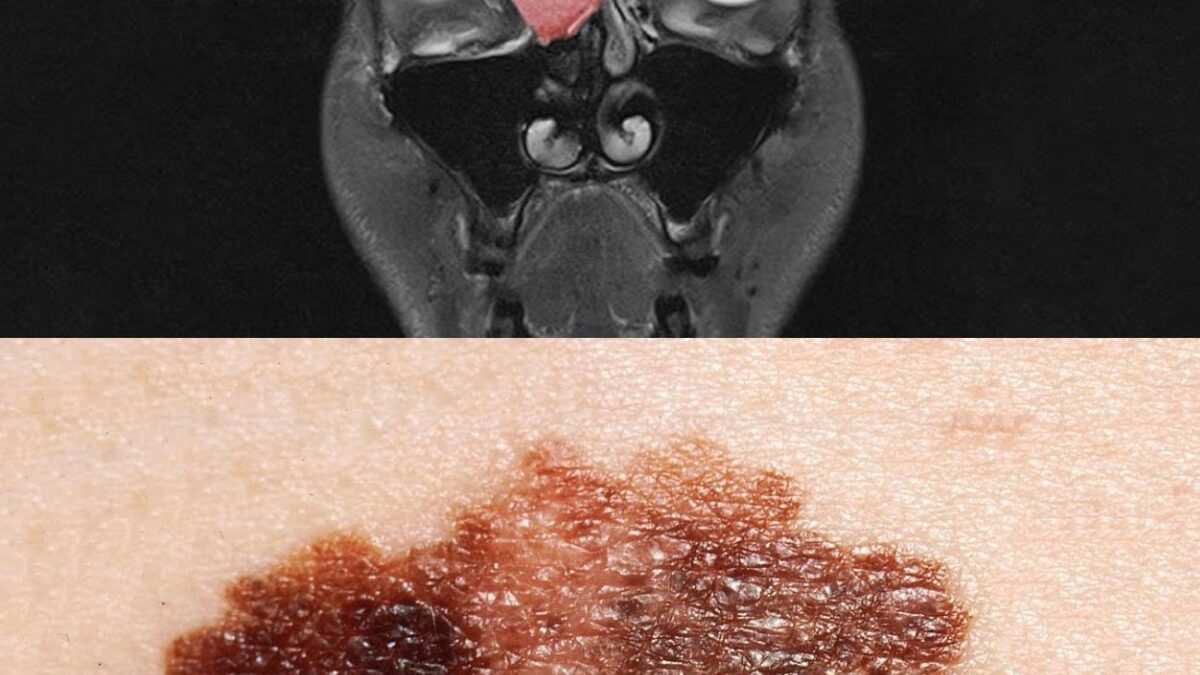
Several months ago, following a sunburn, Casey found an asymmetrical pigmented lesion with irregular borders growing rapidly on the skin of his right arm. Day after day, the lump would seem to morph into something new, grow larger, and ulcerate, but without pain. He thought it might be cancer, but a doctor’s visit was unnecessary, he thought. Most of his farmer’s life was fixing things on his own, whether it was parts of his home or his farm equipment. He lived a self-sufficient life; he always had the tools to get the job done, and in the case of his skin cancer, this was something that he could fix himself.
Immediately after removing his own skin tumor, Casey thought that the story was over, with nothing more to be done here—wrap it up with a cloth and carry on, he thought. Over the next few months, Casey felt great, but noticed that there was a lump growing inside his right armpit underneath the skin. It was warm to the touch, and sometimes he could feel a pulsating sensation coming from it. Every morning, he’d wake up and put his hand on the lump and feel his heart beat through it. His wife suggested that he see a physician, but Casey joked to his wife and said that he’s his own surgeon now, that he did it once before, and if he has to do it again for the lump in his right armpit, then he’ll have to do it.
Except a PET scan revealed hypermetabolic lymph nodes in that region—hyper meaning high, metabolic referring to cellular division, and lymph nodes denoting the structures in your body where white blood cells from your immune system accumulate and drain. The kinds of lymph nodes indicated that something was growing inside his right armpit. About a month ago, Jennifer started to notice that Casey was developing irregularities in his walk, appearing to look like a limp, which, when confronted about it, Casey would deny everything. He actually couldn’t see himself deteriorating. He started to develop a weakness on his left side and began developing headaches that were so bad he’d feel as if someone were pushing from inside his skull against his eyes. His entire family began to notice changes in his personality. A normally patient and down-to-earth man, he would now get physically angry at everything and nothing, until one day, while working out in the fields, he suddenly collapsed from a 15-minute seizure.
An MRI finds multiple lesions developing in several regions of Casey’s brain. Because there’s no indication of infection, cerebral bleeding, or signs of radiation damage to his brain, and because these tumors don’t have the characteristics of a primary tumor, it means that Casey doesn’t have brain cancer in the traditional sense, but that there are tumors in his brain that are from cancers elsewhere on his body, and that they’ve spread to his brain cells from his axillary mass. Lymph nodes were examined; it wasn’t just a swollen red lump, it was widespread cancer growth. Looking at the cells underneath a microscope, multiple markers were positive for a type of skin cancer based on the presence of the polymer that gives tissue color and pigmentation, something called melanin. Even though Casey had removed the cancer from his right arm, it appears that the cells from that primary tumor are now growing en masse in his lymph nodes and in his brain. We can conclude here that Casey is suffering from metastatic melanoma—melano referring to melanin, oma meaning tumor or irregular mass describing the type of cancer that’s growing on Casey, and metastatic meaning that even though he had originally cut out the cancer himself, it has transcended its stationary site of origin and has started spreading all throughout his body.
If in a healthy person you wouldn’t normally find skin cells growing in the brain, then how is it possible that Casey’s skin cancer has spread to the brain? Well, there’s a bit of basic cellular biology to be known here. Cancer is a genetic disease at its core, but its physical characteristics are something more. The genes in our body code for proteins, which give us our physical form, but they also signal for our cells to do things. Proteins are made of amino acids, and amino acids are sequenced together dictated by our genetic sequence. Changing that sequence, either by mistake or from environmental damage like radiation from the Sun, causes mutations. But most of those mutations are nonsense, and they happen less than 0.01 percent of the time, usually getting fixed when the cell divides.
Sometimes, however, these mutations create proteins that signal to the cell to grow with no signal to stop growing, to keep reproducing with no signal to stop reproducing, to grow their own blood supply, and to survive in the circulation and spread to distant sites of the body. Cancer is more than just a genetic disease; it’s an evolutionary step to highly successful cellular survival at the expense of its host. And Casey’s case gives us more evidence of this. A genetic test is done on his lymph node cancer cells. A single point mutation was found on chromosome number seven on the gene named BRAF at nucleotide number 1799, where there should have been an A, there was a T, meaning for the protein made by the gene BRAF, one amino acid was changed at position number 600, creating something called the V600E mutation. A normal functioning cell uses RAF, which feeds into a pathway of the cell causing it to grow with limitations. But BRAF V600E promotes unmitigated cellular growth and uninhibited cellular division, which gives us a condition necessary for it to be cancer.
There’s more. When you pee, some urethral cells will be in that pee. Physics tells us that for any flowing fluid, a shear stress will be produced along the surface on which it flows. For biological systems, it means that some of the cells can come off when you urinate, but cells can also come off when blood flows into a tissue. And as melanomas grow thicker and deeper into the skin, the chance of metastasis becomes higher and higher. We call this high-risk disease because then melanoma cells can break off from the primary tumor and float around in the blood.
The blood vessels going into the brain have a special biology called the blood-brain barrier. It prevents certain substances from going in, but allows others in. This blood-brain barrier has proteins on its surface; melanoma cells also have an overexpression of proteins on their surface, meaning that if a skin cancer cell can break off from the tumor and live within the blood circulation, then when it gets into the vasculature of the brain, it can adhere onto the proteins at the blood-brain barrier and begin to grow and multiply, forming a brain metastasis. Melanomas are the third most common cancer to spread to the brain; breast and lung cancers have a higher incidence of brain metastasis, but data shows that 40 to 50 percent of patients who have a melanoma that spreads somewhere in the body will eventually have it spread to the brain.
The massive headaches, the paralysis on one side of his body, the 15-minute seizure—if this continues unchecked, the brain mass growing inside Casey will eventually rupture the blood vessels in the brain, causing fatal damage through the cerebral cortex. Ultraviolet radiation from the Sun is known to cause cellular damage. Because the Sun doesn’t shine directly on Casey’s brain, nor did it shine on his lymph nodes, but it shined on his skin, and skin cancer is known to spread to the brain and lymph nodes, then we know where these tumors originated from. Case reports of people who for years worked in an environment where the Sun shined on one half of their face revealed the extent of damage possible to skin tissue by UV radiation. Queensland, Australia, where the UV index is often high and people with light-colored skin who are not genetically adapted to the harsh sun contribute to the melanoma capital of the world with an incidence rate of 71 cases per 100,000 people, three times that of the United States.
The metastatic propensity of malignant primary tumors is a recurring theme when it comes to causes of mortality in cancer. Colorectal and stomach cancers commonly spread to the liver first as the shared blood supply makes it one of the first organs of contact. Bone cancers typically go to the lungs first, breast cancers commonly spread to the lungs, liver, bones, and the brain, and lung cancers typically go to the brain first as the blood passes through the lungs to be oxygenated, picks up cancer cells there as the fluid produces a shear stress along its interface, and enters into the left ventricle, into the aorta, into the carotid arteries, and into the brain. Uveal melanoma, a cancer of the melanocytes in the eyes—which is a different kind of melanoma than the skin—typically spreads to the liver first, despite the eyes being right next to the brain.
For Casey, removing his own primary tumor meant very little because at some point, either before or after he removed it, the cancer had already started to spread all throughout his body. There’s a few things that can be done, but the prognosis, or the predicted outcome of his disease at this late stage, is grave. Once melanoma has metastasized to the brain and produced symptoms like a 15-minute seizure, historic data from multiple studies show that median survival—the time at which 50 percent of patients are left alive—is less than five months, and that by 18 months after diagnosis, about 10 percent of patients are still alive. Throughout any clinician’s career, over the many patients that one will see, statistically there will be those few patients who live with stable disease for a long period of time, but those patients are the exception and not the rule.
At the time Casey was diagnosed in early 2011, multiple treatment modalities were available for him. Traditional chemotherapies in metastatic melanoma had fallen by the wayside by the time he presented to the emergency room, as they were known to have little to no effect on brain metastasis. Casey was offered brain surgery in an attempt to prevent more seizures, prevent the tumor from causing a brain bleed, and minimize neurologic dysfunction, but he declined and elected for radiation therapy, which radiates the cells, thereby damaging the DNA sufficiently to prevent them from reproducing. However, it appeared that Casey presented to the emergency room too late, as additional seizures and intracerebral hemorrhage ensued before any treatment was initiated.
At autopsy, Casey’s brain masses were found to have had the same V600E mutation as the mass in his right armpit, and because it’s not likely that both of those sites each simultaneously and independently mutated the exact same gene with evidence of melanocytic immunomarkers present, this was a case of advanced melanoma with multiple metastases to the brain.
Sunscreen is a must for anyone who spends long periods of time outside; it shields one from the harmful UV radiation from the Sun that damages the DNA of the skin. Early detection along with going to a surgical oncologist for consultation instead of removing the skin tumor himself could have prevented this outcome for Casey. Prevention with sunscreen, sitting in the shade, and limiting one’s sun exposure during the summer months is still the best approach to one’s health. In this context, the ancient Chinese had a character for cancer; it’s based off of the word for rocks, implying a burden carried by one’s body. The character has a formality to indicate illness on the right as it resembles a bed turned sideways, and on the left is a symbol for a primary tumor spreading throughout the body as smaller metastasis that continue to spread to infinity.
Treatment modalities in early 2011 when Casey presented to the emergency room were better than what ancient humans had, and the treatments today improve response rates, progression-free survival, and overall survival, but they can and will be better yet with time. Even after all of these centuries, cancer is still a burden on humanity.
In his final moments, surrounded by the sterile walls of the hospital rather than the familiar soil of his farm, Casey’s journey came to a tragic close, leaving his family to grapple with the devastating reality of a silent disease that had outsmarted his lifelong self-reliance. Thank you to the Griffith family of Greenock Road in Lothian, Maryland, for allowing me to record on their farm, and thank you so much for watching. Take care of yourself and be well.

