A 150-Year-Old Wagon Train Vanished in the Blue Ridge — We Found All 62 of Them Down One Well
A 150-Year-Old Wagon Train Vanished in the Blue Ridge — We Found All 62 of Them Down One Well
There are places in these mountains where the road turns easy. And that is when a man ought to be most afraid. Have you ever driven a rise that felt too smooth or come up a trail where nothing crossed your path, no deer, no jay, no wind through the leaves, and known without a reason you could say aloud that you were being permitted? That is how country like this behaves when it is deciding. Before I begin, tell me where you are tonight. Just the town, the county, whatever you call the ground under your feet, leave it below.
It matters to me to know where these accounts go when the light is off and the room is quiet and the story is telling itself in your ear. Now, a note before this one begins in earnest. If the kind of case I tell here is one you would want more of, not one but 10, each told in full in a voice made for the dark, there is a collection. What the mountain keeps, 10 files from 10 counties, five states, 1893 to 1955. Every one of them walked up into easy-looking ground and everyone signed off by the law with the wrong word.
10 hours to sit with in the dark, start to finish. The link is in the description and pinned at the top of the comments. Now then, I want to tell you about a case out of the Blue Ridge, a case that has three dates on it, 1843, when it began, 1893, when it was found, and 1955, when the last man who could speak on the record about it signed a letter refusing to say another word. Between those dates are the 62 people this story concerns and one round low well cut into the side of a valley in a county in western North Carolina on a piece of ground that is not and has never been drawn onto any public map. That is where we start.
The fall of 1893 came late to the Blue Ridge. The maples along the North Carolina line held their green through most of October and the frosts when they came came at odd hours and did not stay. It was into that unfinished autumn that the Norfolk and Western Railway sent a surveyor by the name of Ambrose Renner, 47 years old, tall and narrow through the shoulders, with a face burned brown along the cheekbones and pale where his hatband sat. His hands were long and steady and marked at the knuckles from years of holding a transit against the wind. He had come up out of Roanoke by rail and then by hired wagon into a settlement called Caldwell Notch, which was not on most maps and had asked in polite letters that took months to answer not to be.
Caldwell Notch had been settled in the 1790s by a small group of Scots-Irish who had walked in from the Yadkin Valley and found the land steep, the water clean, and the neighbors few, which had suited them well enough that they had not left. Their descendants had grown up in the same houses, married one another’s cousins, and taken over one another’s plots when a family died out. And by 1893, the town had a permanent population of about 140. Most of them related to about six family names. They kept their own affairs. They did not welcome outside interest. And the letters they had written to the state and to the railroad in a hand that had passed through the schoolhouse of a single teacher for two generations had made this plain in the politest words the English language contains.
Ambrose Renner was there to look at a spur line. The railroad wanted a route through the mountains that would shave a day off the run to the Tennessee coal fields, and a man in an office in Baltimore had drawn a red pencil line across a valley called the Sallow Down, which he had never seen and could not have pronounced, and told Ambrose to walk it and tell him whether it could be built. Ambrose had walked worse country. He had surveyed the flooded bottoms east of Vicksburg and the granite shelves of the Alleghenies. He was not a man who was easily unsettled. When he arrived in Caldwell Notch on the third day of October, the town had one street, one church, one store that also sold coffins, and a boarding house run by a widow named Idris Chalcom.
He took a room, ate a supper of ham and turnips, and asked at the store where he might find a guide. The storekeeper looked at him for a long time and did not answer at once. Then he said, “If you are going up into the Sallow Down, you want Zebulon Hardacre.” Ambrose said he was going up into the Sallow Down. The storekeeper said, “Then you want Zebulon. He is over past the sawmill in the last house that still has a porch.” And he added, after a moment, “Do not tell him where you are going before he agrees to go.”
Zebulon Hardacre was 56 years old and looked older by 10. He was short and heavy across the chest with gray hair he cut himself, and one eye that had gone milk white from a boyhood accident he did not care to explain. He was sitting on his porch with a rifle across his knees when Ambrose came up the path. He watched Ambrose the way a man watches a snake he is deciding whether to shoot. There was a shotgun leaning against the porch rail beside the rifle, and a hound asleep at his feet that did not lift its head at Ambrose’s approach. Though the hound did open its one good eye, which was the same milk white as the eye of its master.
The porch itself was set on stones, not posts. And along its edge were tacked a row of small carvings in dark wood, no bigger than a man’s thumb. Each of them a different shape and each of them, Ambrose saw when he came closer, carved with the same mark, a circle with a line drawn through it. And beneath each circle, three shallow notches. Ambrose did not know then what the mark meant, but he understood from the row of them, without being told, that the mark was a caution. And that Zebulon Hardacre had spent a great many hours over a great many years cutting cautions and hanging them on the edge of his porch.
Ambrose introduced himself, said he was surveying for the railroad, said he needed a man who knew the ridges. Zebulon listened without moving. When Ambrose was done, Zebulon said, “Which ridges?” Ambrose showed him the map. Zebulon looked at the red pencil line for a long time, and then he looked at Ambrose. And Ambrose felt for a moment as if he had been weighed. Zebulon said, “I will take you as far as the fork above the old mill and no further. And if I turn back, you turn back. Those are the terms.” Ambrose, who had never in 20 years of surveying been given terms by a hired man, was too surprised to argue. He said, “Agreed.”
They set out the next morning at first light. The trail up out of Caldwell Notch climbed at a lazy pitch through a stand of oak that had not been logged in living memory. Ambrose took his readings as they went. The compass held. The chain measured true. And for the first two hours, nothing at all struck him as strange except that he could not remember the last time he had walked through woods this quiet. There were no birds. There were no squirrels in the leaves. There were not even flies.
Zebulon walked ahead of him and did not speak. Ambrose asked once, along the way, what he was looking at when he looked at the country north of the trail. Zebulon glanced at him and glanced at the ridge on their left and said, “That is the shoulder of the Sallow Down.” Ambrose asked how far the valley ran. Zebulon said, “It runs as far as the valley wants to run.” Which was not an answer that a surveyor could put into a notebook. But Ambrose wrote it down anyway because he had begun, without wanting to, to take Zebulon Hardacre seriously.
Around noon they crossed a stream that Ambrose did not find on his map. It was not marked. It ran cold and fast over slate. And the water in it was the color of black tea. And Zebulon knelt and drank from it with his hand. And then he stood and said, “Do not drink from any water that comes out of the north side of this ridge.” Ambrose asked why. Zebulon said, “Because it does not come from a spring you can find.” Ambrose left his canteen buckled.
When they reached a place where the trail forked, Zebulon stopped and pointed with the rifle. He said, “That way is the Sallow Down.” Ambrose looked. The right-hand fork descended into a broad, gentle bowl of a valley ringed by low ridges with a creek shining silver at its floor and a stand of chestnut trees so tall they looked painted onto the sky. It was the prettiest piece of country Ambrose had seen in a year. He said so.
Zebulon did not answer. He said, “We camp here.” Ambrose said it was not yet noon. Zebulon said, “We camp here, and we go down at first light.” Ambrose asked why. Zebulon looked at him with the milk-white eye and the good one both and said, “Because a man does not go into that valley in the afternoon. It is a rule.” Ambrose, who had a schedule and a contract and a red pencil line to walk, was on the point of arguing, but something in Zebulon’s face stopped him. It was not fear. It was patience. The patience of a man who had seen other men argue with him about this exact thing and had watched what came of it. So, they camped.
That night, Ambrose slept badly. He kept waking and not knowing why. The fire held longer than a fire made of that kind of hardwood should have held and burned down to coals that kept a red heart in them until almost dawn. Zebulon slept in his blankets on the far side of the fire, sitting up with his back against a chestnut, and the rifle across his knees, and did not lie down. Ambrose, who had thought he would sleep well after the day’s walk, could not settle. The air was too still. The stars were the wrong brightness. Twice he sat up, certain he had heard someone speak his name, and both times he found only the coals and the wind that was not really a wind.
Once, near the middle hours, he woke certain he had heard a wagon go past the tent, wheels on hard ground, and the creak of an axle, and a woman’s voice, very low, saying something he could not make out. He got up and walked out to the trail with his lantern. The trail was empty. The dust was undisturbed. Zebulon was awake in his blanket, sitting up, the rifle across his knees. He said, “You heard it.” Ambrose said, “I heard something.” Zebulon said, “Do not answer if it speaks to you.” Ambrose asked what it was. Zebulon said, “Go back to sleep.” And that was the end of that.
In the morning, they went down into the Sallow Down. It was as beautiful in the light of day as it had been from above. The creek ran cold and clean. The chestnut trees stood 100 feet high and did not so much as shiver in the wind. And yet something in the valley was wrong. And Ambrose could not have said what. It was not the silence exactly, though there was silence. It was more that the silence felt attended. It felt like walking into a room where someone had just stopped speaking.
The trail down into the Sallow Down was narrower than the trail up out of Caldwell Notch and older and did not switchback the way a proper mountain trail switchbacks, but ran straight down the fall line as if it had been cut by something that had not known or had not cared how a trail was supposed to be laid. Ambrose lost his footing twice on the descent. Zebulon did not lose his footing.
The mist that had lain in the valley at dawn had burned off by the time they reached the floor and yet the air, once they were in the bowl of the valley, was several degrees cooler than the air on the ridge above. Cool enough that Ambrose could see his breath, though the sun stood well up. He mentioned this. Zebulon did not answer.
They walked along the north bank of the creek. There were tracks in the soft ground of the bank that Ambrose did not recognize. He knelt to look at them. They were not deer. They were not bear. They were something like the print of a man’s shoe, but longer, and the toe of the print did not turn out or in, but ran forward in a way that a foot in a shoe does not normally run. He looked up. Zebulon was watching him. Zebulon said, “Do not follow those.” Ambrose said, “I was not going to.” Zebulon said, “Good.”
About midmorning they came to what Zebulon called the old mill. It stood on the north bank of the creek, a fieldstone structure with the timbers of the mill wheel still braced in place, though the wheel itself was gone. The building above was collapsed. Ivy had eaten through the roof. On the south wall, where the door had been, someone had cut a mark into the stone. It was a circle with a line drawn through it, and beneath the circle, three shallow notches.
Ambrose asked what it meant. Zebulon looked at the mark for a long time. Then he said, “It means whoever put it there was warning the next man who came by.” Ambrose asked, “Warning him of what?” Zebulon said, “Of the fork above the mill, which is where I turn back.” Ambrose said, “Then I go on alone.” Zebulon said, “That is the arrangement.”
Ambrose worked through the afternoon at the mill site. He took his measurements. He drove stakes. He sighted through his transit at a ridge on the far side of the valley. Zebulon sat on a flat stone by the creek and did not help him and did not hinder him. Twice Ambrose looked up and saw Zebulon watching not him, but the trees behind him. He looked back over his shoulder and saw nothing. He kept working.
When the light began to fail, they climbed out of the valley by the same trail they had come in on. At the fork, Ambrose asked if Zebulon would come back with him the next day. Zebulon said, “I will come as far as the mill and no further. And I will tell you what I know when we are down.”
That night, Zebulon told him. He told it the way old men in that country tell things, without hurry and without decoration, and without any effort to make it easier to hear. He said, “In the summer of 1843, a wagon train came up out of the Piedmont bound for Kentucky, 62 people in all, nine wagons. Their leader was a man named Bartholomew Fenwick, out of Wilkes County, a preacher’s son who had turned to trade. They passed through Caldwell Notch on a Sunday. My father was a boy of 17 that Sunday, and he remembered them because Fenwick would not stop for the sermon. He said they had a schedule to keep.
He was told by the preacher, the Reverend Hosea Wexler, that if they were going west, they should take the North Road over Bear Gap, which added a day and a half to the trip. Fenwick asked why. The Reverend Wexler told him. He said, ‘Because the Sallow Down does not let travelers pass through in the fall.’ He said it plain, in the middle of the street in front of the whole congregation. Fenwick laughed. He said, ‘We are not travelers, we are settlers, and settlers go where the ground is level.’ He took his people down into the Sallow Down that same afternoon. That was the last day anyone in Caldwell Notch saw them alive.
Two weeks later, a party of hunters went down through the valley on a bear track and reported that they had found nothing at all, no wagon ruts, no fire pits, no sign that anyone had ever passed through. The creek ran clean and the trees stood tall, and the valley was as empty as if it had never been walked. The county sheriff at the time, a man named Josiah Bramwell, rode down himself and rode back the same day and would not speak of what he had seen. He wrote in his log only that the party had gone through and continued west, and he signed off the disappearance as a matter for the next county over, ‘which was the wrong word,’ Zebulon said. ‘That was the word he used, and I use it, too, the wrong word, because they had not gone west. They had never come out of the Sallow Down at all.’
There was more,” Zebulon said. “There were people in the wagon train who had family in Kentucky, family who wrote to relations in Wilkes County asking after them when the wagons did not arrive. Those letters were kept, some of them in a chest at the Fenwick homestead, until the house burned in 1868, and my grandfather saw them before the fire. There were also, in the county records that were not lost, three wills that had been drawn up by members of the party before they left, and each of those wills named a different heir in the eastern counties, and each of those heirs waited 7 years and then filed to have their inheritances distributed, because 7 years is what the law required to declare a missing person dead.
All three of those filings were granted. All three of the estates were divided, and in each of the three probate hearings, the same sheriff, Josiah Bramwell, was called to testify to the disappearance, and he gave the same testimony each time, which was that the party had gone through and continued west and had been lost by causes he could not determine, and that the county had no cause to hold up the settlement of the estate. He said it three times over 3 years, and each time he came out of the courthouse, he went straight to the church, and the Reverend Wexler shut the door with him and stayed shut in that room for the better part of the afternoon. My father was a young man by the time of the third hearing and he saw them come out. He said Bramwell was crying both times he saw him.”
Ambrose asked, “And the Reverend Wexler?” Zebulon said, “The Reverend Wexler never cried. The Reverend Wexler prayed. That is what he did from the day the wagons went down until the day he died. He prayed.”
Ambrose asked how he knew. Zebulon said, “My father knew and his father knew and the old woman at the top of the ridge road, Ottilie Marchpane, she knows more than any of us because she was a girl of 15 that summer and she has lived here every year since.”
Ambrose said he would like to speak with her. Zebulon said, “Then speak with her tomorrow before you go back down.”
The next morning Ambrose walked up the ridge road to the house of Ottilie Marchpane, who was 78 years old and lived alone in a cabin her father had built. She was small and bent with hands that shook when they were still and stopped shaking when she was working and she made him sit at her kitchen table before she would say a single word. She poured him coffee. She poured herself coffee. She looked at him across the steam for a full minute. Then she said, “You have been down in the Sallow Down.”
Ambrose said he had. She said, “What did you feel?” Ambrose thought about it. He said, “I felt like a room where someone had just stopped speaking.”
Ottilie nodded once. She said, “That is right. That is exactly right and it is why I will not go down there anymore and I have not gone down there since I was 15 years old.” She told him then what she remembered. She said, “They came up the road on a Sunday morning, nine wagons and mules, and a herd of goats they had brought along for the milk. And the wagon master was a big man with a black beard and a green coat. And he laughed loud enough that we could hear him at the church door.”
The Reverend Wexler stopped him in the middle of the road. He said what he said. He said the Sallow Down does not let them through in the fall. “And I want you to know,” Ottilie said, “that the Reverend was not a fanciful man. He was a Methodist and a farmer, and he took his hymns straight, and his coffee black, and he had never in his life said a strange word from the pulpit. But he said this one, and he said it loud.”
The wagon master laughed. He said something to his people, and they all laughed. They went on down. “And there was a woman at the back of the last wagon in a gray dress with a white collar, and she looked at me as they went. And she did not laugh. She looked at me the way a person looks at someone they are trying to remember for later. And she was the only one of them,” Ottilie said, “whose face I have kept.”
And she told him then a thing that she had not, she said, told anyone in all the years since. She said that as the last wagon went past her at the church door, the woman in the gray dress had leaned down out of the back of the wagon, and had passed her something, and had said one sentence to her, and had gone on.
What she had passed to Ottilie was a small carved figure of dark wood, not bigger than her thumb, cut with the mark that Ambrose had already seen twice now, the circle with a line through it, and beneath it the three shallow notches. And what the woman had said to Ottilie was, “If you are old when we come back for you, do not answer.”
Ottilie had been a girl of 15 and had not understood and had put the carving in the pocket of her apron and had gone home. She still had it. She kept it, she said, in a box on the mantel and she opened the box once a year in October to be sure it was still there. She showed it to Ambrose. It was, he wrote later in his journal, the same carving he had seen tacked to the porch of Zebulon Hardacre, the same carving that had been cut into the south wall of the old mill. And the same mark, though he did not yet know it, that had been whitewashed under the wooden cover of the well at the base of the north ridge.
Ambrose asked how many people exactly. Ottilie said, “62. I counted them. I was a girl of 15 and I had nothing to do that morning except count and I counted them. 62 souls, nine wagons, 43 mules, a dozen goats and two dogs, though the dogs turned back at the top of the ridge and would not go down and one of the men had to drag his by the collar.”
Ambrose asked what she thought had happened to them. Ottilie was quiet for a long time. Then she said, “I do not think anything happened to them. I think they were taken.” Ambrose asked, “Taken by whom?” Ottilie said, “Not by whom, by what. And I do not know what. The Reverend Wexler knew. He was the only man in the county who knew and he took what he knew to his grave in 1861 and he asked to be buried on the far ridge facing the Sallow Down so that he could watch it. And that is where he lies. And on some nights,” she said, “and I will tell you this, though I have never told a stranger, on some nights, if the wind is out of the west and the moon is low, you can hear a wagon go by on the ridge road below his grave. Wheels on hard ground and an axle that creaks and a woman’s voice, very low, saying something you cannot make out.”
Ambrose said nothing for a long moment. Then he said, “I heard that last night.” He heard it, too, from the far side of the trail. And Ottilie Marchpane looked at him with something very close to pity and said, “Then you had best decide, Mr. Renner, whether you are the man to walk that valley alone.”
Ambrose went back down to the boarding house and he did not sleep well. He wrote in his journal that night by lantern, and I have read that journal, and I can tell you what he wrote. He wrote, “I am not a superstitious man. I have surveyed 31 counties in nine states and I have never given a story like this the time of day. But the fact is that I have heard with my own ears a wagon and that could not have been there. And the fact is that the country down in that valley behaves as if it were listening. And the fact is that Zebulon Hardacre, who is not a fanciful man, either, will not walk past the old mill. And I do not know what to make of any of it.”
He wrote that. And underneath he wrote, “I will walk it tomorrow. I have a contract.” He was, above all, a man who honored a contract.
He went down the next day, alone. The county sheriff, a man named Lemuel Crowder, 52 years old, tall and quiet, and with the stoop of a man who had spent his life leaning down to listen to people who spoke softly, met him at the fork and would not walk past it, either. But he gave Ambrose something. It was a leather satchel that had belonged to Josiah Bramwell, the sheriff of 1843, and it contained the papers of the Fenwick disappearance, such as they were.
Most were water damaged past reading, but three were legible. The first was a page from Bramwell’s log, dated the 14th of September, 1843, which read only, “Went down into the valley, found nothing, will not go back.” The second was a letter from the Reverend Wexler to Bramwell, dated 3 days later, which read, “I told you what I could. I did not tell you all of it. There is a well at the head of the valley, at the base of the north ridge, which was there before any settler came into this country, and which the old people of the region, who were here before us, would not draw from, and would not fill in. Whatever your party found, they found because that well was the last place they went. And I ask you, as a Christian man, and as a keeper of the peace, to seal it.”
And the third was a page in Bramwell’s hand, dated a week after that, which read only, “Seal the well. May God forgive me for what I saw when I looked down.”
Ambrose read all three papers, standing at the fork with Sheriff Crowder beside him. He read times. Sheriff Crowther watched him read. He did not interrupt. When Ambrose had finished the second reading, and had closed the satchel, and set his hand flat on top of it, the sheriff spoke. He said, “There is one more paper in there. I did not put it with the others because it is my father’s.”
Ambrose opened the satchel again. In a side pocket was a folded sheet of ledger paper, in a cramped hand that Ambrose did not know. It was dated the 22nd of October, 1882. It read, “Checked the well again. Cover has moved a full inch since spring. Re-pitched. Told no one. He who owes the answer keeps the count.” That last line in a slightly different hand, as if written days after the rest, was underlined twice.
Ambrose looked at the sheriff. The sheriff said, “That is a saying we have here. It is not written down anywhere else. It is not in the Bible, and it is not in the almanac. It came from the Reverend Wexler, we think. He who owes the answer keeps the count. My father wrote it under his own note the week before he died, and he made me promise I would remember it, and I have remembered it.”
Then he asked, “Sheriff, do you know where the well is?” Sheriff Crowder said, “I know where the well is.” Ambrose asked if it was still sealed. Sheriff Crowther said, “It has been sealed for 50 years.” Ambrose asked how he could be sure. Sheriff Crowther said, “Because I check it every October. It is the only reason I still hold this office.” He said it the way another man might have said, “I feed the dog.”
And then he said, “If you’re going down, Mr. Renner, I would ask you not to open it.” Ambrose said he did not intend to open it. He intended to run his survey line past it at a distance of 200 yards and to make his notes and to come out.
The sheriff nodded. He said, “Then go with God.” And he sat down on a stone by the fork and waited.
Ambrose went down. He worked the line that morning without incident. The valley was as still as it had been the first day and as attended and as wrong. He drove his stakes. He took his sightings. He filled six pages of his notebook with figures and a sketch of the ridge line. He ate his lunch by the creek.
And at about half past 2:00 in the afternoon, he came out of a stand of chestnut on the north side of the creek and found himself looking at the well, which was not where it should have been. He knew from the sheriff’s papers that the well stood at the base of the north ridge, some 400 yards from where he was standing. He had marked its position on his own map from the description, and he had planned his line to give it a clean 200 yards of birth. And yet, here it was, not 400 yards away, not 200 yards away, 20 feet away.
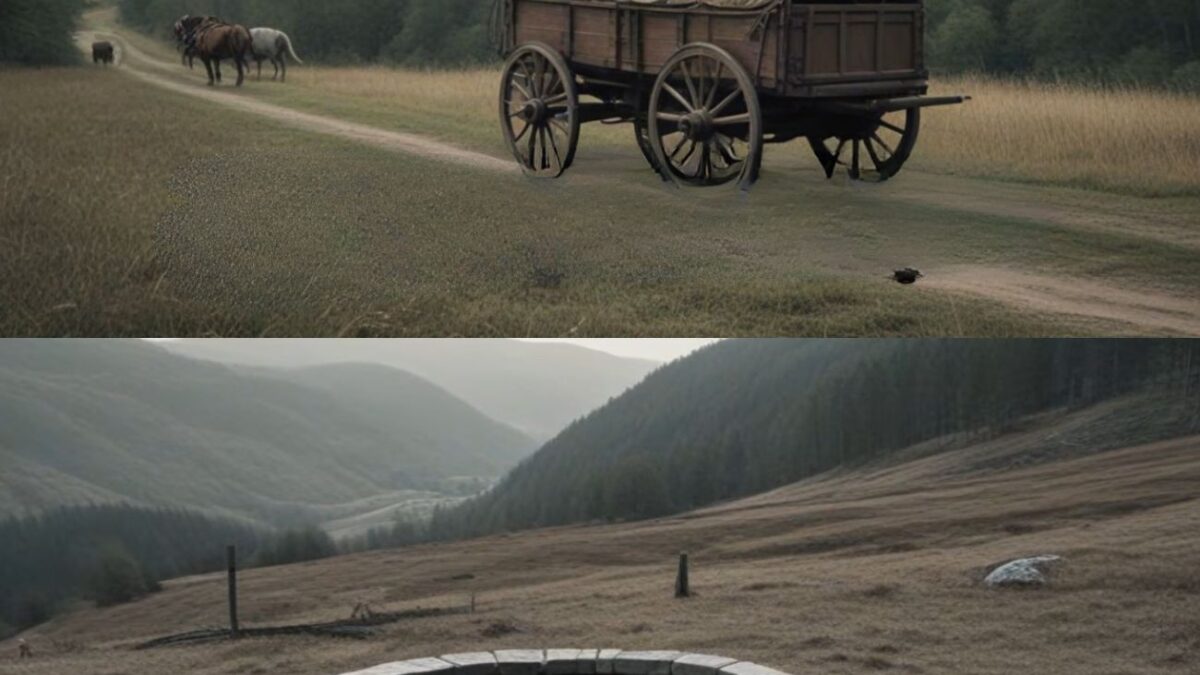
Round and low and made of fieldstone that had been dressed smooth by hands that had known their work. A wooden cover, iron banded, sealed at the edges with pitch that had cracked but not opened. And on the cover, in old whitewash that had gone gray with age, the same mark that had been cut into the mill wall, the circle with a line through it, and beneath the circle, three shallow notches.
Ambrose stood and looked at the well for a long time. Then he took out his compass and shot a bearing back to his last stake, and he shot a bearing forward to the ridge, and he confirmed by the readings that he was, in fact, some 400 yards from where the well was supposed to be. But it was here, and he was here, and there was no other explanation unless the country itself had moved. He wrote down what he saw. He drew the well. He noted the mark. And then he stood up and turned back the way he had come, and he did not run because he was a man who did not run. But he walked at the pace of a man who very badly wanted to run and who was refusing himself the courtesy.
About half a mile from the fork, he stopped. He needed to breathe. He sat down on a fallen log and he opened his canteen and he drank. And while he was drinking, he heard the wagon again. It was closer this time. Not on the trail behind him, not on the trail ahead, on the ridge above. Wheels on hard ground and the creak of an axle and a woman’s voice very low saying something he could almost this time make out. He held very still. He did not look up. He remembered what Zebulon had said, “Do not answer if it speaks to you.”
The wagon passed. When it was gone, he stood and he walked. And he did not stop until he had reached the fork where Sheriff Crowder was waiting for him with a look on his face that said more than any words could have said, that the Sheriff had known all along how this would go.
Ambrose said, “I saw the well.” Sheriff Crowder said, “I know.” Ambrose said it was not where it was supposed to be. Sheriff Crowther said, “It never is.”
Ambrose Renner did not sleep that night either. He sat up in his room at the boarding house with the lamp burning low and Sheriff Crowder across from him in the chair by the window. And neither of them said very much. Around midnight, the Sheriff spoke. He said, “The well was not always sealed.” Ambrose said, “I know. I read the papers.” The Sheriff said, “No. I mean, it has been unsealed twice since Bramwell put the cover on it. Once in 1871 by a man named Corliss Vane who was a photographer out of Asheville. He had heard the story and he wanted to make a picture of the inside. He went down with a lantern and a coil of rope and three men from the town waiting at the fork to pull him up. They waited four hours. When they hauled the rope back, the rope came up empty, and the lantern was tied to the end of it with the glass unbroken and the wick still damp with oil, but the man was gone. And the second time was in 1914 by someone who thought the first time was a trick.”
Sheriff Crowder paused, looking down at his large, steady hands resting on his knees. “And what happened in 1914?” Ambrose asked, his voice steady despite the chill in the room. “The cover was found twenty yards away in the brush,” the sheriff answered quietly, “and the well was empty down to the black rock at the bottom. No bones, no clothing, no sign anyone had ever been inside. But the next morning, when my uncle went to look, the cover was back on, sealed tight with fresh pitch, and the count on the stones had changed from three notches to four.”
Ambrose stared at him, the weight of the mountain pressing against the walls of the small room. He looked down at his own field notes scattered across the desk—the precise measurements, the impossible bearings, the crude drawing of the circle and the line. He understood then that the railroad would never lay its tracks through the Sallow Down, and that the map he had drawn was already as useless as the ones left behind by the men of 1843.
The next morning, Ambrose packed his instruments, closed his leather trunk, and walked down the single street of Caldwell Notch without looking back at the ridges. He caught the midday wagon out to Roanoke and sent a final telegram to Baltimore stating simply that the valley was impassable and the route abandoned. He never surveyed another mountain line, and by the winter of 1894, he had moved to the flat coastal plains of South Carolina, far from any shadow of the Blue Ridge. But until the day he died fifty years later, whenever the wind howled outside his window on an autumn evening, he would sit entirely still in his chair, listening past the sound of the Atlantic tide for the faint, impossible creak of an axle and a woman’s voice calling out from the dark.

