(1953) The Ledlow Twins — What the Rescuers Found in Their Home Still Haunts North Carolina
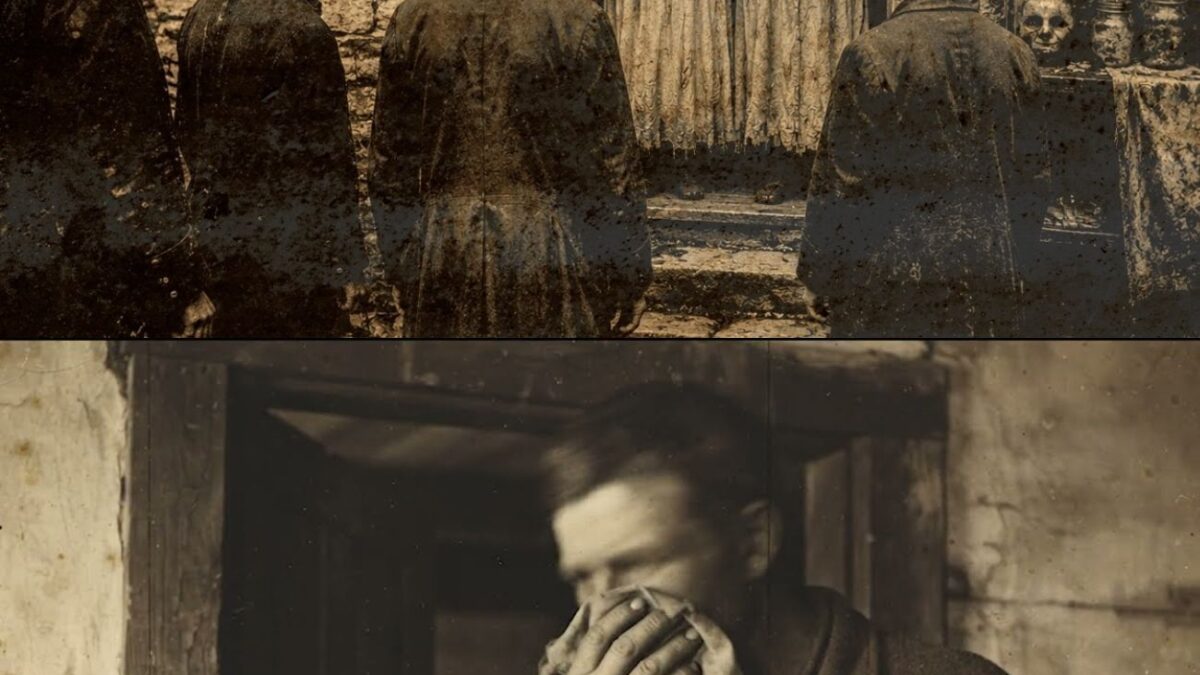
(1953) The Ledlow Twins — What the Rescuers Found in Their Home Still Haunts North Carolina
In the winter of 1953, a fire truck and two county vehicles rolled down a rutted dirt road outside Henderson, North Carolina, answering a call that nobody wanted to make and nobody wanted to receive. The caller was a rural mail carrier named Floyd Burwell, who had been stuffing letters and catalogs into the same dented tin mailbox for going on nine years without once seeing the front door of the house open. He had watched the weeds grow up around the porch. He had watched the windows go dark behind layers of newspaper and cloth. He had smelled, on certain summer afternoons, something drifting from behind the property that he could not identify and did not care to investigate.
But it was February now, and the temperature had fallen below twenty degrees for the sixth straight night, and when Burwell pressed his hand against the mailbox that morning, he noticed the small curl of breath that should have been rising from the chimney was absent. No smoke, no light, no sign of life. He drove to the nearest telephone and called the Vance County Sheriff. What the men found when they finally pried open the front door of that house became the kind of story that people in Henderson told only in whispers. It was not a crime scene, not exactly. It was not a haunting, not in any way the churches would have recognized. It was something else entirely, something that sat in the space between neglect and intention, between madness and ritual, between decay and preservation.
The house belonged to two women, twin sisters, born in the same bed, in the same room thirty-two years before the rescuers arrived. And what those men saw when they crossed the threshold that morning did not leave them. Some of them never spoke about it publicly again. One of them quit his job within the month. The county filed a report that was six pages long, and within a year, four of those pages had gone missing from the courthouse records.
Vance County sits in the northern Piedmont of North Carolina, pressed against the Virginia border like a bruise along a jawline. In 1953, it was tobacco country. Bright leaf tobacco, the kind that dries to a color somewhere between gold and rust, was the economic engine that drove every family in the county. And the rhythm of the year was dictated entirely by the planting season, the topping season, the curing season, and the selling season. Farmers who grew tobacco did not take vacations. They did not leave the county unless someone died or someone married or someone needed to stand before a judge in Raleigh. The land held them, the work held them, and the silence, that deep Piedmont silence that settles over the fields after sundown, held them most of all.
Henderson was the county seat, a town of perhaps 12,000 people in those years, with a main street that ran four blocks and a courthouse built from brick the color of dried blood. There were two churches for every bar and three opinions for every question, and the people who lived there understood without being told that certain families were not to be discussed, not because discussing them was dangerous, but because discussing them was unnecessary. Everyone already knew, and knowing was enough.
The Ledllo family had been in Vance County since before anyone alive could remember. The name appeared in deed records going back to the 1840s, always attached to the same parcel of land southeast of town, 140 acres of mixed timber and bottomland that bordered Tabs Creek on its eastern edge. The Ledllo were never wealthy. They were never prominent. They held no offices and attended no socials and contributed to no subscription drives. But they endured. That was the word people used when they spoke of the family, which was rarely: they endured.
Hosea Ledllo, the father of the twins, was born in 1889 on that same piece of land in a house that his grandfather had built from hand-hewn pine logs chinked with red clay. Hosea was a lean man with deep-set eyes and hands that looked as though they had been carved from the same wood as the house. He did not smile often. He did not speak often. He worked the tobacco and he worked the timber and he kept a kitchen garden that produced enough to feed his household through the winter months, and beyond that, he required nothing from the world and offered nothing in return.
He married Alma Creedmore in 1918, a woman from the next county over who was nineteen years old on her wedding day and who by all accounts never looked nineteen again after that. Alma was small, sharp-featured, with a voice that carried further than it should have for a woman of her size. She had been raised in a household that kept to itself, and she married into a household that kept to itself, and the transition was seamless. Neighbors who lived within a mile of the Ledllo property reported seeing Alma outside the house no more than a dozen times in the first five years of her marriage. She hung laundry. She fed the chickens. She walked to the well. And then she went back inside.
The twins were born on a night in October of 1921. The attending physician was a man named Doctor Harlan Suggs, who practiced out of a two-room office above the hardware store in Henderson, and who made house calls on horseback when the roads were too muddy for his automobile. Doctor Suggs delivered both girls within forty minutes of each other, the first arriving just before midnight and the second arriving just after. He recorded their names as Cora Ledllo and Dora Ledllo. He recorded their weight as five pounds each, which was small but not alarming for twins. He noted that the mother was in fair condition and that the father had remained outside the bedroom for the duration of the delivery, standing on the porch in the dark, smoking hand-rolled cigarettes and saying nothing.
Dr. Suggs would later tell a colleague that the house had struck him as unusually quiet for a home about to receive two new lives. No relatives waiting, no neighbor women helping, just Hosea on the porch and Alma in the bed, and the two babies arriving into a silence so complete that he could hear the creek running a quarter mile away through the open window. He also mentioned something that he did not include in his official record, something he only shared over whiskey at a lodge meeting four years later. The house, he said, smelled wrong. Not dirty, not neglected, wrong. He described it as the smell of a church basement after a flood, damp stone and old paper, and something underneath that was organic, but not identifiable. The house was clean, the floors were swept, the bed linens were white and pressed, but the smell hung over everything like a second ceiling, low and persistent and impossible to ignore. He delivered the babies, collected his fee, and rode back to Henderson in the dark. He never returned to the Ledllo property. He was never asked to.
In the months following the birth, the county nurse made one attempt to visit the household. Her name was Opel Satawite, and she had been assigned to check on newborns in the rural districts as part of a public health initiative funded by the state. Opel drove to the Ledllo property on a Tuesday morning in December of 1921, parked her car at the end of the track, and walked to the house. She knocked three times. Alma Ledllo opened the door, but only wide enough to show her face. Opel introduced herself, explained her purpose, and asked to see the babies. Alma told her the babies were sleeping. Opel asked if she could come inside and wait. Alma said no. Opel asked if the babies were feeding well. Alma said yes. Opel asked if there was anything the family needed. Alma looked at her for a long moment, recalling an expression that was not hostile but was deeply strange, as though Opel had asked a question in a language Alma did not speak. And then she closed the door. Opel stood on the porch for another minute listening. She heard nothing. She walked back to her car and drove to her next appointment. She filed a report noting that she had been unable to examine the Ledllo infants and that the mother appeared unwilling to engage with county services. No follow-up visit was scheduled. No follow-up visit was ever conducted.
The first years of the twins’ lives were invisible to the outside world in nearly every meaningful way. Vance County did not require school attendance until the age of seven, and even then, enforcement in the rural districts was more suggestion than mandate. The Ledllo property was four miles from the nearest schoolhouse by road, farther if you cut through the woods, and Hosea Ledllo made it known through the few interactions he had with county officials that his daughters would be educated at home by their mother, from the Bible, and from a set of encyclopedias that he had purchased from a traveling salesman in 1919. Whether Alma was equipped to provide this education was a question that no one asked because asking would have required visiting the property, and visiting the property would have required a reason, and having a reason would have required someone to care enough to generate one. Nobody did.
What is known about Cora and Dora Ledllo during this period comes almost entirely from the recollections of people who saw them at a distance. A woman named Bertie Fork, who lived on the adjacent property to the north, recalled seeing the two girls playing near the tree line behind the house in the summer of 1926 or 1927. She could not tell them apart. They were both thin, both pale, both wearing dresses made from the same bolt of cloth. They did not call to each other by name, at least not within earshot. They moved in tandem, Bertie said, like two halves of the same thought. When one stopped, the other stopped. When one turned, the other turned. Bertie watched them for perhaps ten minutes from her kitchen window before they disappeared back into the house, and she did not see them again for what she estimated was two full years.
A man named Grady Pucket, who ran a feed supply operation out of a barn on the Lewisburg Road, recalled Hosea Ledllo coming in once or twice a year to buy seed corn and chicken feed, and salt blocks for a cow he apparently kept behind the house. Grady asked about the family on one occasion, a casual question, the kind of thing men said to each other at the feed store: “How are the girls? How is Alma doing?” Hosea had looked at him, Grady said, with an expression that was not hostile, but was not welcoming either. It was the expression of a man who had been asked a question in a language he did not speak. He paid for his supplies and left without answering.
The Depression hit Vance County the way a stone hits still water. The ripples moved outward slowly, touching every household, every farm, every business. Tobacco prices dropped by more than half between 1929 and 1933. Families that had been getting by found themselves no longer getting by. Families that had been struggling found themselves in ruin. The Ledllos, having never participated in the local economy beyond the bare minimum, were insulated from the worst of it. They grew what they ate. They burned what they cut. They needed almost nothing from the outside, and the outside, in its new desperation, had even less reason to think about them.
It was during the Depression years that Alma Ledllo stopped appearing in public altogether. Whether this was a decision she made or a decision that was made for her is something that no one was ever able to determine. The last confirmed sighting of Alma outside the Ledllo property was in the fall of 1932, when she was seen by a passing motorist walking along the edge of the road about half a mile from the house, carrying a basket covered with a cloth. She was walking toward the house, not away from it. She did not look up when the car passed. The motorist, a man named Coleman Thorp, remembered the moment only because Alma was walking in the dead center of the road and he had to swerve to avoid her, and when he honked his horn, she gave no indication that she heard it.
Hosea Ledllo continued to make his infrequent trips to town throughout the 1930s, always alone, always brief, always conducted with the minimum number of words required to complete his transactions. Storekeepers in Henderson knew him by sight, but not by conversation. He bought flour, salt, kerosene, nails, and tobacco seed. He did not buy clothing. He did not buy medicine. He did not buy anything that suggested the presence of children in his home, and no one thought to ask.
In the spring of 1941, Hosea Ledllo collapsed in the yard of the feed store on Lewisburg Road. Grady Pucket found him lying face down beside his truck, still breathing, but unable to speak. Grady called for help, and two men carried Hosea into the back of the store and laid him on a pile of feed sacks. By the time the doctor arrived, Hosea was dead. The cause was recorded as a stroke. He was fifty-two years old.
What happened at the Ledllo property after Hosea’s death is the part of the story where the light begins to dim, because up to this point, the Ledllo family had been merely private, merely eccentric, merely one of those households that every rural community contains: the family that stays to itself, the family that does not wave when you drive past, the family that generates rumors precisely because it generates nothing else. But Hosea’s death removed the last thin thread connecting that household to the world beyond its tree line. And once that thread was cut, everything changed.
The funeral, if there was one, was not conducted by any church in Vance County. No obituary appeared in the Henderson Daily Dispatch. No death notice was posted at the courthouse beyond the required filing. Hosea Ledllo was buried somewhere on the property, presumably by his wife and daughters, though no one witnessed the burial and no grave marker was ever found by anyone outside the family. The county registrar recorded the death based on the doctor’s report and closed the file.
Alma Ledllo was now fifty-two years old, alone with her twin daughters, who were nineteen. The twins had not attended school. They had not attended church. They had not, as far as anyone in the county could determine, ever been to town. They existed only as an assumption, a pair of names on a birth certificate filed twenty years earlier. Two girls who might have grown up or might have disappeared or might have become something entirely different from what anyone would have expected. Nobody checked. Nobody had reason to check. And the county, already stretched thin by the war effort that was consuming every available man and dollar, had no interest in investigating a family that asked for nothing and bothered no one.
The war years passed. The tobacco grew and cured and sold. Young men from Henderson went to Europe and the Pacific, and some of them came back, and some of them did not. Vance County carried on the way it always had, with the quiet stubbornness of a place that believes survival is the highest virtue and privacy is the highest courtesy, and the Ledllo house, set back from the road behind a screen of loblolly pines that grew thicker every year, became a kind of blind spot in the community’s field of vision. People knew it was there. People knew someone lived there. But the knowing was abstract, the way you know there are fish in a lake you never visit: theoretical, distant, not your concern.
It was Floyd Burwell, the mail carrier, who maintained the only consistent point of contact with the Ledllo property throughout the 1940s. Floyd had taken over the route in 1944, replacing a man who had enlisted, and from his first day, the Ledllo mailbox was the strangest stop on his circuit. The mailbox itself was a standard rural delivery box, dented and rusted, mounted on a post that leaned fifteen degrees to the left. It sat at the end of the dirt track that led back to the house, a track so overgrown that by 1946, you could no longer see the house from the road. Floyd delivered mail there twice a week, usually a property tax notice, occasionally a seed catalog, once a year a census form that was never returned. He never saw anyone collect the mail. He never saw anyone on the property. But the mail disappeared from the box between deliveries, so someone was coming to get it. Someone was still alive in there.
Floyd told his wife about the Ledllo place more than once. He described the smell that hung over the property in summer: a sweet, cloying smell that he associated with rotting fruit, but that carried undertones of something else, something organic and unsettling that he could not name. He described the sounds he sometimes heard when he stopped at the mailbox, not voices exactly, but a kind of low murmuring that might have been prayer or might have been humming or might have been two people speaking in a register so low it barely qualified as speech. He described the windows of the house—what he could see of them through the trees—covered with what appeared to be newspaper from the inside, layered so thickly that no light could pass through in either direction. And he described the feeling that came over him every time he stopped at that mailbox, a feeling he could only characterize as being watched by someone who did not want to be seen watching.
Floyd Burwell was not a nervous man. He had served in the First World War and had seen things that most men in Henderson could not imagine, but the Ledllo property made him uneasy in a way that he could not explain and could not shake. He began delivering the mail to that box as quickly as possible, never lingering, never looking toward the house longer than necessary, and he developed a habit of holding his breath for the thirty seconds it took to open the box, deposit the mail, close the box, and drive away. He was not afraid, he insisted. He was just cautious. There was a difference.
The years between 1944 and 1953 produced exactly four documented interactions between the Ledllo property and the outside world. The first was in 1945, when a property tax assessment was conducted by the county and a clerk named Elden Parish was dispatched to the Ledllo land to verify the acreage and condition of the structures. Elden drove his truck down the overgrown track, parked in front of the house, and knocked on the door. No one answered. He knocked again. Nothing. He walked around the house, noting in his report that the structure was in advanced deterioration and that several outbuildings, including what appeared to be a tobacco barn and a chicken house, had partially collapsed. He saw no animals on the property. He saw no cultivated ground. He heard nothing. He left his assessment notice tucked into the doorframe and returned to the courthouse. The notice was gone by his next visit three weeks later, but no one had come to the courthouse to dispute or pay the assessment.
The second interaction was in 1947, when the county health department conducted a routine survey of rural water sources. An inspector named William Tapp drove to the Ledllo property, found the well behind the house, tested the water, and discovered contamination levels that he described in his report as significantly elevated. He attempted to notify the residents. He knocked. He called out. He left a written notice on the door. No response came. He filed his report. No follow-up was conducted.
The third interaction was in 1949, when a hunting dog belonging to a man named Cecil Ray Wright crossed onto the Ledllo property and did not return. Cecil walked the tree line calling for the dog for an hour before he heard it barking somewhere behind the house. He debated with himself for a while, then climbed through the fence and walked onto the property. He found the dog at the edge of the tree line barking at the back of the house. The back door was open, Cecil said—not wide open, but cracked, as if someone had opened it to look out and then decided not to close it. Cecil could see nothing inside. The interior was dark, completely dark, the kind of darkness that seems thicker than the absence of light, the kind you see in caves and cellars and places where light is not just absent, but unwelcome. He grabbed his dog by the collar and left. He told his wife that night that something was wrong at the Ledllo place. He said the dog had whimpered the entire walk back to the fence line and would not eat its dinner that evening. He said the open door had bothered him more than anything else because it had not been open in the way a door opens when someone is going in or coming out. It was open the way a mouth opens when someone is listening. His wife told him it was none of their business. Cecil said he supposed she was right, but he kept his dog fenced after that, and he never hunted the timber on that side of the creek again.
The fourth interaction was the one that ended everything. On the morning of the 11th of February, 1953, Floyd Burwell pulled his mail truck up to the Ledllo mailbox at approximately 9:15 in the morning. The temperature was eighteen degrees. The sky was a flat iron gray that promised snow, but had not yet delivered it. Floyd noticed immediately that the mailbox was full—not just full, but overflowing. Letters and catalogs were jammed so tightly into the box that the door would not close. This meant that no one had collected the mail in at least two weeks. Floyd had never seen the box this full. In nine years of delivering to this stop, the box had always been emptied between visits. Always.
He sat in his truck for a moment, looking down the overgrown track toward where the house sat, hidden behind the pines. He could not see the house. He could not hear anything, and he noticed what he had mentioned to his wife earlier: the absence of chimney smoke. In February, in eighteen-degree weather, there should have been smoke. Every house in the county had a fire going. Every chimney was producing its gray thread of warmth. The Ledllo chimney was cold.
Floyd drove to the general store at the crossroads two miles east and used the telephone to call the sheriff’s office. He told the dispatcher that he believed someone at the Ledllo property might be in distress. He used that word specifically—distress, not dead, not gone, distress—because he did not know what had happened. And in Vance County in 1953, you did not make accusations. You expressed concern. You left the conclusions to the men with badges.
Sheriff Vernon Callaway dispatched two deputies to the property within the hour. They were joined by a volunteer firefighter named Earl Pool, who brought a pry bar in case the door needed to be forced, and by Floyd Burwell himself, who felt an obligation to be present that he could not articulate. The four men drove down the track in two vehicles. The trees pressed close on both sides. Dead vines hung from the branches like cords of frayed rope. The track was barely passable, and at one point Earl Pool had to get out and drag a fallen limb off the path.
When they reached the clearing where the house stood, all four men stopped. The house was smaller than any of them expected: a single-story frame structure, originally painted white, now faded to a gray that matched the sky above it. The porch sagged on the left side, pulling away from the house as if it had tried to leave and been caught. Every window was covered—not with curtains, but with paper, cloth, cardboard, and what appeared to be pieces of old feed sacking, all layered and pasted over the glass so completely that the windows looked like sealed wounds. The yard around the house was bare dirt, no grass, no weeds, nothing growing within thirty feet of the structure in any direction. This struck the men as strange. Even in winter, dormant weeds should have been visible. It was as though the ground itself had pulled back from the building.
Deputy Alton Hayes approached the front door and knocked. Three hard knocks with the flat of his hand. The sound seemed to die the moment it left his knuckles, absorbed by something inside the house that muffled it. No answer. He knocked again, calling out, identifying himself as the county sheriff’s department, asking if anyone was inside, asking if anyone needed help.
Silence. Not the ordinary silence of an empty house, but a dense, layered silence, the silence of a place that had been quiet for so long that the quiet had become structural, load-bearing, a feature of the architecture itself. Deputy Hayes looked at Deputy Marcus Cain. Marcus looked at Floyd. Floyd looked at Earl Pool, who was holding the pry bar. Earl stepped forward and fitted the flat end of the bar between the door and the frame. The wood was soft, damp despite the cold, and the door gave way with a sound that Earl would later describe as a sigh—not a crack, not a snap, a sigh, as if the house had been holding its breath and had finally exhaled.
The smell hit them before the sight did. It was not the smell of death. All four men had encountered death before in various forms, and this was not that. It was something older, stranger, more complex. Earl Pool called it the smell of time. Deputy Hayes called it the smell of a root cellar that had been sealed for decades. Floyd Burwell did not call it anything. He simply pressed his handkerchief over his nose and mouth and breathed through the cloth. The smell was sweet and sour simultaneously, carrying notes of mold, of animal musk, of something fermented, of wood smoke so old it had become part of the walls, and beneath all of it, something else, something that none of them could identify, and that none of them would ever forget.
They entered the front room. The first thing they noticed was that there was no furniture, not in the conventional sense. There were no chairs, no tables, no sofa, no sideboard, nothing that a visitor would recognize as the furnishings of a living space. Instead, the room was filled from floor to a height of roughly four feet with newspapers—stacked newspapers, bundled newspapers, loose newspapers, newspapers folded into shapes that were neither useful nor decorative, geometric forms, triangles and cylinders, and flat-sided constructions that covered every surface and lined every wall. The stacks were precise. They were not piled haphazardly, not thrown into corners, not accumulated the way a hoarder accumulates. They were arranged deliberately with what appeared to be great care and considerable time invested.
Deputy Hayes moved his flashlight across the room and noticed that many of the newspapers had been written on. In the margins, in the spaces between columns, across the headlines and photographs, someone had written in a small, dense hand using what appeared to be a mixture of ink and pencil. The writing was everywhere, on every visible surface of every newspaper. Hayes leaned closer and tried to read a passage. The handwriting was legible, but the content was not. It appeared to be a combination of Bible verses, personal observations, and something else entirely—strings of words that followed no grammar and obeyed no syntax, words that might have been invented or might have been remembered from somewhere so deep in the writer’s mind that they had come back changed, reshaped, broken apart, and reconstructed into something private and impenetrable.
The men moved through the front room into what had been the kitchen. The stove was cold and had been cold for some time. A layer of ash sat in the firebox undisturbed. Pots and pans hung from nails driven into the wall, but they were not ordinary pots. Each one had been wrapped in cloth tightly, methodically secured with twine so that the metal was entirely concealed. Jars lined the counter and the window sill, dozens of them, mason jars with wire bale lids, and inside each jar was something preserved. Some contained what appeared to be vegetables—tomatoes, okra, and beans—suspended in cloudy liquid. Others contained things the men did not recognize: small objects wrapped in fabric, bundles of dried plant material tied with thread, stones, smooth river stones arranged in patterns inside the glass. One jar, sitting alone on the far end of the counter, contained a quantity of human hair. It was gray, long, carefully coiled inside the jar like a sleeping animal.
Between the kitchen and the back room was a narrow hallway, no more than four feet wide, that had been transformed into something the men struggled to describe afterward. The walls of the hallway were covered not in writing, but in pressed flowers and leaves—hundreds of them, possibly thousands. Each specimen was flattened and affixed to the wall with what appeared to be a paste made from flour and water. The specimens were arranged in rows, organized by type, and each was accompanied by a small label written in the same hand that covered the newspapers: clover, goldenrod, sweet gum leaf, white oak leaf, sassafras, pine needle, dogwood blossom. The labels were meticulous, and beside each name was a symbol, a small drawn figure that did not correspond to any botanical notation the men had ever seen. Some of the specimens were recent, still holding a faint trace of color. Others were so old they had turned the brown-black of objects that have passed beyond drying into a kind of mineral permanence. Deputy Hayes estimated there were specimens dating back at least fifteen years, meaning the twins had been collecting, pressing, labeling, and mounting plant material on these walls since they were teenagers, building a catalog of every growing thing within walking distance of their house and annotating it in their private language.
The floor of the hallway was different from the other rooms. It had been scrubbed—not just swept, scrubbed. The wood was raw, nearly white, as though the top layer of grain had been worn away by repeated cleaning. And in the center of the hallway, visible only because of how clean the surrounding wood was, there were marks, circular marks like the rings left by a wet glass on a table, but larger, perhaps eight inches in diameter. They formed a line down the center of the hallway, spaced evenly, one every three feet, leading from the kitchen doorway to the door of the back room. Deputy Cain counted seven of them. They looked, he said, like footprints left by someone walking on stilts, or like the impressions of cups pressed into soft wood and left there long enough to leave a permanent stain.
Earl Pool opened the door to the back of the house and stopped in the threshold, his breath catching in his throat as the beam of his flashlight cut through the heavy air. There, resting side by side upon a mattressless iron bed frame draped in old quilts, lay Cora and Dora Ledllo, wrapped in layers of white cotton cloth, perfectly preserved by the dry, stagnant cold of the room, looking less like the dead and more like twin effigies carved from bone and ash. They had passed away weeks before, untouched by the world, clinging to each other in the absolute silence they had cultivated their entire lives. The deputies stepped back into the hallway in stunned silence, realizing that the house had not merely been lived in, but had served as an impenetrable monument to a time that stopped moving long before anyone came looking.

