(1905, Mississippi) The Most Deranged Bayou Family History Ever Covered Up
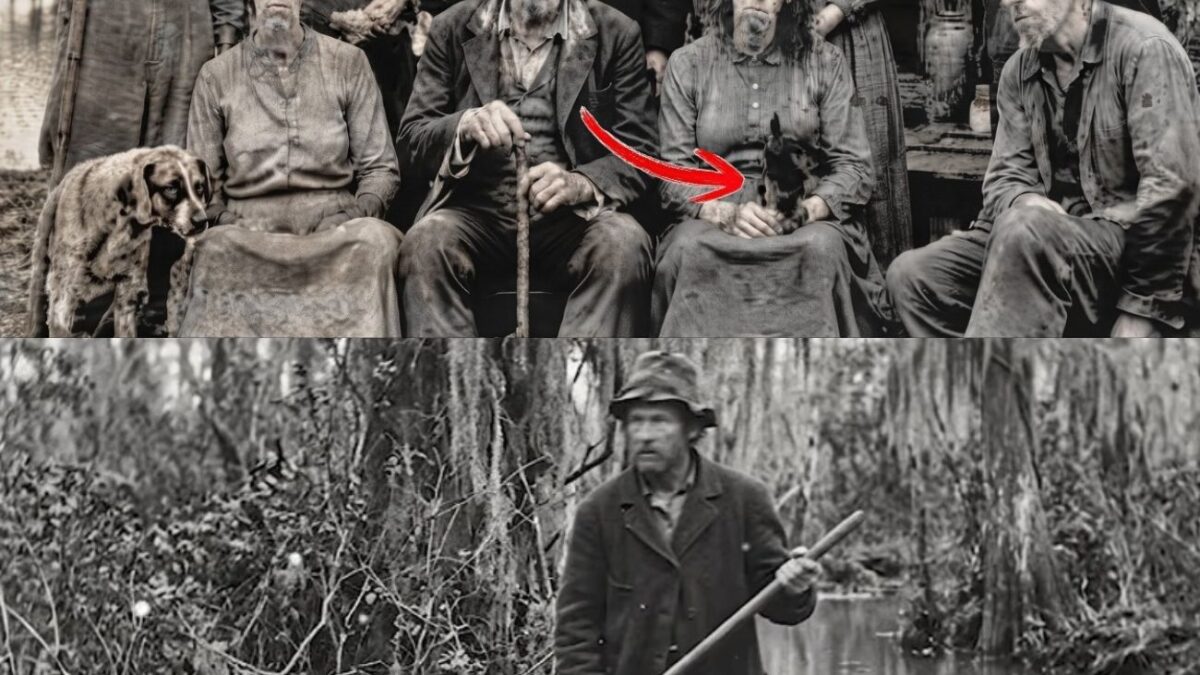
(1905, Mississippi) The Most Deranged Bayou Family History Ever Covered Up
There is a filing cabinet in the basement of the Hancock County Courthouse in Bay St. Louis, Mississippi. It sits behind a locked door that has not been officially opened since 1912. The cabinet holds seven folders. Each folder is labeled with a single surname, and that surname, the one written on every tab in faded black ink, belongs to a family that the entire county agreed to forget. In 1905, a land surveyor named Thomas Callaway was dispatched by the Gulf and Ship Island Railroad to chart a proposed spur line through the lower Pearl River basin. His assignment was simple: walk the route, measure elevations, mark the timber stands and waterways, file the report, and move on to the next job. Callaway was 31 years old, a veteran of six previous rail surveys across the Gulf States, and by every account a careful, sober, meticulous man. He kept a daily field journal. He sketched maps by hand. He noted the species of every bird he heard and the depth of every creek he forded. He was not the kind of man who invented stories, exaggerated details, or let his imagination run ahead of his compass needle.
On the 14th of September 1905, Callaway entered a stretch of bottomland bayou, roughly 11 miles southeast of the town of Kiln. The trees closed in. The ground turned soft. The water rose to his ankles, then his knees, then his waist. His notes from that afternoon described the canopy as so thick that the sun disappeared entirely by 2 in the afternoon. He wrote that the air smelled of sulfur and rotting vegetation. He wrote that the birds stopped singing, and then at approximately 4:30 in the afternoon, Callaway walked into a clearing he had no reason to expect, and he found something that no railroad survey had ever prepared him for. He found the Pardio compound.
What Thomas Callaway documented over the next 72 hours in the clearing would fill 46 pages of his field journal. Those 46 pages would later be removed from the journal by the Hancock County Sheriff, placed in a sealed envelope, and locked in the cabinet that still sits in that courthouse basement today. A note was attached to the envelope in the sheriff’s own handwriting. The note read, “In full, not for the public record. God help whoever reads this next.” For over a century, nobody did. Then in 2019, a graduate student from the University of Southern Mississippi named Katherine Morell was conducting archival research on timber rights disputes in the Pearl River corridor. She requested a set of land survey documents from the Hancock County Clerk’s Office. What she received through what appears to have been a clerical error was not a set of timber maps. It was the contents of that locked filing cabinet. It was the sealed envelope. It was all 46 pages of Callaway’s journal. And it was the full unredacted record of the Pardio family dating back to 1841.
What those records describe is a family history so profoundly disturbing, so meticulously hidden, and so completely erased from every public account of Hancock County that even the neighboring families who lived within 5 miles of the compound claimed under oath that no such family had ever existed. They were lying. They all knew. And the reason they all knew is the reason the records were sealed in the first place. The Pardios were not simply a reclusive bayou family. They were not eccentric homesteaders or misunderstood backwards folk. What the documents reveal page after page, entry after entry, is something far worse. The Pardio family operated for over 60 years as a self-contained world with its own laws, its own courts, its own punishments, and its own definitions of who counted as a human being and who did not. And every person who lived inside that compound, whether they were born there or whether they wandered in by accident, was subject to those definitions.
This is the story that Hancock County buried. This is the family they erased, and this is the history that was never supposed to leave that filing cabinet. If you have ever heard a story and thought, “This cannot be real. This cannot have happened in a place with roads and churches and elected officials,” then what you are about to read will change the way you understand what was possible in the deep American South at the turn of the last century.
To understand how the Pardio compound came to exist, you have to understand the land itself. The lower Pearl River Basin in 1841 was not a place where people settled by choice. It was a place where people disappeared. The river splits into dozens of channels as it approaches the Gulf, braiding through cypress swamps and tidal marshes that shift with the seasons. In dry months, a man could walk for miles on solid ground and believe he knew the terrain. In wet months, that same ground would be under 4 feet of black water, and every landmark would vanish overnight. The bayou had no names on any official map. The trees grew so close together that sunlight only reached the forest floor in narrow shafts that moved with the wind. Hunters who went in rarely came back on the same path. Some of them did not come back at all.
This was not frontier wilderness in the romantic sense. This was not the open prairie or the forested mountains where a capable man could carve out a living with an axe and a strong back. This was hostile ground, where water bred disease. The mosquitoes carried fevers that killed more settlers in southern Mississippi between 1830 and 1860 than any war or famine. The soil, where it existed above the waterline, was acidic and thin. Growing crops required constant labor just to keep the swamp from reclaiming the cleared land. And the creatures that lived in the water—the alligators, the cottonmouths, the snapping turtles the size of wagon wheels—treated every human intrusion as an invasion of their territory.
Into this landscape, sometime in the autumn of 1841, came a man named Augustin Pardio. The earliest record of Augustin Pardio in Mississippi appears in a receipt for dry goods purchased at a trading post near Gainesville in what was then Hancock County. The receipt is dated October the 11th, 1841. It lists salt, gunpowder, lead shot, three bolts of rough cloth, an iron cookpot, and 40 pounds of cornmeal. The receipt is signed with an X, and the trading post clerk noted in the margin that the buyer was a Frenchman of middle age traveling with a wagon, several women, and numerous children. Destination unknown.
That is the last voluntary contact Augustin Pardio had with the outside world for nearly 14 years. What happened between 1841 and 1855 is reconstructed almost entirely from the testimony of a trapper named Solomon Greer, who gave a deposition to the Hancock County Justice of the Peace in 1856. Greer had been running trap lines in the lower Pearl River Basin for over a decade and was one of the few men alive who knew the interior bayou well enough to navigate it in any season. His deposition, which runs to 11 handwritten pages, describes his first encounter with the Pardio compound in the winter of 1855.
Greer stated that he had been following a line of muskrat sets along a channel he called Bayou Malheur, a name that does not appear on any official map, but which Greer said was used by the Choctaw people who had lived in the area before removal. The name translates roughly as bad luck water or water of misfortune. Greer said that the Choctaw avoided Bayou Malheur entirely and that he had been warned by an elderly Choctaw woman years earlier to stay away from the upper reaches of that channel. He had ignored the warning because the trapping was good.
On this particular morning, Greer followed Bayou Malheur farther upstream than he had ever gone before, pushing through a narrow channel choked with fallen cypress. He said the water was shallow enough to pole his pirogue, but too deep to walk. After approximately two hours of poling, the channel opened suddenly into a wide, still pool, and on the far side of that pool, on a low ridge of dry ground that rose perhaps three feet above the waterline, Greer saw what he initially took to be a small settlement.
He counted seven structures. The largest was a log building roughly 40 feet long and 15 feet wide with no windows and a single door. Around it stood six smaller cabins arranged in a rough semicircle, all facing inward toward the main structure. Behind the cabins, Greer could see a cleared field of perhaps two acres planted with what he recognized as corn and sweet potatoes. There were hogs penned along the tree line. There were chickens scratching in the dirt. And there were people.
Greer estimated he saw between 15 and 20 individuals, including several children. He said they were dressed in rough handsewn clothing and that the women wore their hair loose and uncombed. He said the children were barefoot. He said no one spoke above a whisper. And he said that every person he could see, without exception, stopped what they were doing and turned to face him the moment his pirogue came into view.
What happened next is where Greer’s testimony becomes difficult to read. He said a man came out of the main building. The man was tall, heavily built, with a full gray beard and hands that Greer described as the largest I have ever seen on a living person. The man walked to the edge of the water and stood there looking at Greer. He did not speak. He did not wave. He did not raise a weapon. He simply stood and looked.
Greer called out a greeting. He identified himself as a trapper. He said he meant no harm and was simply passing through. The man said nothing. Greer said that while the man stood at the water’s edge, every other person in the compound moved slowly and silently behind the main building and out of sight. Within 30 seconds, the only person visible was the tall man. The clearing, which moments earlier had held nearly 20 people, appeared empty.
Greer said he felt at that moment a kind of fear he had never experienced before—not the fear of violence or ambush, but something else. He said it was the fear of having seen something he was not supposed to see, of having accidentally opened a door into a room that was meant to stay locked. He said the tall man’s face showed no anger, no surprise, no curiosity. It showed nothing at all, and that blankness, that absolute absence of reaction, was what frightened him most.
Greer turned his pirogue around and pulled back downstream without another word. He did not return to Bayou Malheur for three months, but he did return. And what he found on that second visit is what eventually made its way into the official record, because what Greer saw on his second visit was something he could not keep to himself, no matter how much the tall man’s empty face haunted his sleep.
Greer returned to Bayou Malheur in March of 1856. He later told the justice of the peace that he could not explain why he went back, only that he felt compelled. He said the compound had stayed in his mind like a splinter, and he needed to see it again to convince himself it was real. This time he approached from a different direction, coming in from the east through a shallow swale that ran parallel to the main channel. He left his pirogue tied to a cypress knee about a quarter mile from the clearing and approached on foot, staying low in the underbrush.
He said he could smell the compound before he could see it: wood smoke, animal waste, and something else—something sharper, something he compared to the smell of a tannery, but worse. When he reached the tree line and looked into the clearing, the compound had changed. The seven structures he had seen three months earlier had grown to nine. Two new buildings had been constructed, both smaller than the original cabins, but built with the same rough-hewn logs and mud chinking. One of these new structures had no door. Its only opening was a narrow slot cut into the wall at about head height, roughly six inches wide and two feet tall.
Greer watched the compound for what he estimated to be three hours. During that time, he observed the following: The tall man, whom Greer now understood to be the patriarch of the family, emerged from the main building several times. Each time he emerged, every person in the clearing stopped moving. Not slowed down—stopped. Whatever they were carrying, they held still. Whatever they were doing, they froze. They did not resume until the tall man either returned inside or gave a signal that Greer described as a single sharp nod of his head.
Greer counted 23 people in the compound on that second visit. He noted that several of the women appeared to be pregnant. He noted that the children ranged in age from what he guessed was about two years old to perhaps 14 or 15. He noted that none of the children played. None of them ran. None of them made any sound that he could hear from his position in the tree line.
He also noted something that disturbed him more than anything else: Along the western edge of the clearing, behind the row of cabins, there was a row of wooden posts driven into the ground. There were eight posts. Each post was about four feet tall, and each one had a length of iron chain attached to it. The chains were short, perhaps three feet long, and each one ended in what Greer recognized as a leg shackle, the kind used to restrain enslaved people on plantations.
The shackles were not empty. Two of the eight posts held a person. Greer could not determine from his position whether the chained individuals were men or women, but he could see that they were alive because they moved periodically, shifting their weight or adjusting their position on the ground. He said they appeared to be sitting in the dirt at the base of the posts. He said neither of them called out or made any attempt to attract attention. He said they sat in the dirt the way that animals sit in cages, with a kind of resignation so complete that it no longer looked like suffering. It looked like something beyond suffering. It looked like the total surrender of the idea that any other state of existence was possible.
Greer left the tree line before dark and pulled back to the main channel. He said he did not sleep that night. He said he sat in his pirogue in the middle of the bayou wrapped in a blanket and stared at the water until dawn. Three days later, he walked into the office of the justice of the peace in Gainesville and gave his deposition.
What happened next is where the story of the Pardio family begins to intersect with the story of Hancock County itself, and where the question of who knew what and when and why nothing was done becomes a question that implicates not just a single family living deep in the swamp, but an entire community of people who chose deliberately and repeatedly to look the other direction.
The justice of the peace who took Greer’s deposition was a man named Bartholomew Keane. Keane had held the position for 11 years and was, by the standards of the antebellum Gulf Coast, a respected figure. He had presided over land disputes, minor criminal matters, and the occasional probate case. He was not a wealthy man, but he owned a small farm on the Jordan River and was known as fair-minded, if somewhat cautious.
Keane read Greer’s deposition twice. He then asked Greer a series of questions that Greer dutifully answered. The questions focused almost entirely on the location of the compound, how difficult it would be to reach, whether the Pardios appeared to have firearms, and how many adult men Greer had observed. Then Keane did something that would define the county’s relationship with the Pardio family for the next half century: He wrote at the bottom of the deposition the following notation: “Received and read. No action to be taken at this time. The situation described, while irregular, falls outside the jurisdiction of this office, as the parties involved are not known to be in violation of any statute currently enforced in this county.”
And that was it. Greer’s testimony about chained human beings in a clearing in the swamp was received, noted, and filed with no follow-up, no investigation, no dispatch of a constable or deputy, no letter to the sheriff’s office, nothing. One researcher who later examined this document, a legal historian affiliated with the Mississippi Department of Archives, noted that Keane’s jurisdictional claim was entirely fabricated. There was no legal basis for his refusal to act. The restraint of persons in chains, even in 1856 Mississippi, was governed by specific statutes that required either proof of ownership in the case of enslaved persons or evidence of lawful detention in the case of criminal suspects. An unknown family chaining unidentified individuals to posts in an uncharted swamp did not fall into any recognized legal category. Keane’s notation was not a legal opinion. It was an excuse.
But why did Keane refuse to act? The answer to that question remained buried for nearly 50 years until Thomas Callaway, the railroad surveyor, pulled it into the light quite by accident.
Let us return to Callaway, because what he found when he entered the Pardio compound in September of 1905 was not merely an updated version of what Greer had described half a century earlier. The compound had not simply persisted; it had evolved, and the evolution was in every meaningful sense a descent. Between 1856 and 1905, the Pardio family had grown from the roughly 23 people Greer counted to what Callaway estimated after careful observation was between 60 and 70 individuals. The compound had expanded from nine structures to more than 20, spreading outward from the original clearing into the surrounding tree line. Some of the newer structures were built on stilts above the waterline. Others were half-buried in the ground with earthen walls and roofs of woven palmetto. One of the structures, which Callaway described in meticulous detail, was built entirely underground, accessible only through a trapdoor covered with moss and leaf litter.
But the physical growth of the compound was not what Callaway wrote about most extensively. What consumed the majority of his 46 pages was the social structure he observed—the system of control, hierarchy, and punishment that governed every aspect of life inside the Pardio world.
Callaway arrived at the compound’s perimeter on the afternoon of September the 14th. Unlike Greer, he was not immediately noticed. The approach from the south, which the railroad survey route followed, led through a dense stand of tupelo gum that provided heavy cover almost to the edge of the clearing. Callaway heard the compound before he saw it. He heard hammering. He heard the sound of a hand grinding corn. He heard a child crying, followed by a sharp sound he later identified as a slap, followed by silence.
He moved to the edge of the tree line and looked into the clearing. What he saw first was the main building. It had been expanded from the original 40-foot structure Greer described into a long, low hall that Callaway estimated at nearly 80 feet in length. The walls had been reinforced with additional layers of logs, and the roof had been replaced with hand-split cypress shingles. The building had no windows. The single door that Greer had noted 50 years earlier had been replaced by a set of heavy double doors, and those doors were flanked on either side by what Callaway recognized, with considerable alarm, as gunports—narrow horizontal slits cut through the log walls just wide enough to accommodate the barrel of a rifle. This was not a home. It was a fortification.
Around the main hall, the cabins and outbuildings spread in concentric rings, each ring slightly farther from the center and slightly smaller in construction. Callaway noticed that the quality of the buildings decreased as the distance from the main hall increased. The innermost ring of cabins had solid walls, shingled roofs, and raised floors. The middle ring had crude construction with gaps in the walls filled with mud and moss. The outermost ring was barely shelters at all—lean-tos made of stacked branches, dugouts carved into the slope of the ridge, structures that an experienced outdoorsman like Callaway would have been reluctant to call habitable. He understood immediately what this architecture meant: The distance from the main hall corresponded to status within the family. Those closest to the patriarch lived in relative comfort. Those farthest away lived in conditions that Callaway compared in his journal to “the worst quarters I have seen on any plantation in my travels, and I have seen many.”
Callaway spent the remainder of that first afternoon observing from the tree line. He noted the movements of the compound’s inhabitants with the same precision he applied to his survey measurements. He recorded times, directions, activities, and the approximate ages and physical conditions of every person he could see. His notes from that first afternoon include the following observations: At approximately 5:00 in the evening, a bell was rung inside the main hall. The bell had a flat, dull tone, not the clear ring of a church bell, but the heavy clang of iron struck against iron. At the sound of this bell, every person in the compound stopped what they were doing and moved in what Callaway described as an orderly procession, without speaking, toward the main hall. They filed through the double doors single file. The last person to enter was a woman who appeared to be in her 60s, and she pulled the doors shut behind her.
For the next 40 minutes, Callaway heard nothing from inside the main hall—no voices, no movement, nothing but the sounds of the swamp, the frogs, the insects, the occasional splash of something large moving through the water. Then the doors opened, and the people filed out again in the same order they had entered. They returned to their respective buildings without speaking. Within 10 minutes, the clearing was empty. Callaway wrote in his journal that this scene reminded him of something, but he could not immediately identify what. Later that night, sitting in his camp a half mile from the compound, he realized what it was: It reminded him of a prison yard. The way the inmates moved at the sound of the bell, the silence, the orderly compliance, the return to quarters. It was not the behavior of a family. It was the behavior of an institution. And the institution it most closely resembled was a penitentiary.
But this was no penitentiary. There were no guards in uniform. There were no walls or fences. The bayou itself served as the barrier, and the warden was not an appointed official with a badge and a statute book. The warden was a single man, and every person in that compound answered to him with a deference that Callaway found in his own word terrifying.
The man was Augustin Pardio, or rather the man who held the name Augustin Pardio, because Callaway would soon discover that the patriarch he observed in 1905 could not possibly have been the same Augustin Pardio who purchased salt and gunpowder at a trading post in 1841. The dates did not allow it. The man Callaway observed was perhaps 55 or 60 years old. The man who signed the receipt in 1841 would have been well over 100. The name, Callaway eventually realized, was not a name at all. It was a title, a position, and it was passed from one generation to the next through a process that the journal entries describe in terms that make the blood run cold.
The following morning, September the 15th, Callaway made a decision that would determine the course of his life and the fate of the Pardio family secret. He decided not to skirt the compound and continue his survey. He decided to enter it. His reasoning, as recorded in his journal, was practical: The proposed rail line ran directly through the parcel of land on which the compound sat. Any legitimate survey would require him to document the presence of existing structures and inhabitants. He was, in the strictest sense, doing his job. But his journal also reveals a second motivation, one that speaks to something deeper than professional obligation. Callaway wrote, “I cannot walk past this place and file a report that says nothing. A man who sees what I have seen and says nothing is no better than the swamp water which covers everything and reveals nothing.”
Callaway approached the compound from the south in plain view, carrying his surveying equipment and wearing the canvas vest that identified him as a railroad employee. He walked directly toward the main hall. He was met, as Greer had been 50 years earlier, by the patriarch. The man emerged from the double doors and stood on the packed earth in front of the building, watching Callaway approach.
This time, however, the patriarch spoke. According to Callaway’s journal, the man’s first words were, “You are not the first to come. You will not be the last. But you will leave when I tell you, and you will not come back.” The voice, Callaway wrote, was calm. There was no threat in it. There was no anger. There was only certainty—the kind of certainty that comes from absolute authority, exercised without challenge for so long that it has become indistinguishable from natural law.
Callaway identified himself, explained the railroad survey, and asked permission to document the compound’s location and structures for his report. The patriarch studied him for a long moment. Then he nodded once and said, “You may look, you may write, but you will not take anything from this place. Not a stone, not a board, not a person.” That last word—person—is the one Callaway underlined in his journal twice.
What Callaway saw over the next two days as he moved through the compound, measuring, sketching, and recording, forms the core of the sealed document. And the details, taken together, describe a world that operated by rules so alien to the society that existed just 11 miles away in the town of Kiln that it might as well have been located on a different continent.
The first thing Callaway noted was the population. He conducted what amounted to an informal census, counting every individual he could see and estimating ages based on physical appearance. His final count was 67 people. Of those 67, he classified 41 as adults over the age of approximately 16 and 26 as children under that age. Of the 41 adults, he estimated that 28 were women and 13 were men. This ratio disturbed him. In any normal settlement of 67 people, the ratio of men to women would be roughly equal or slightly weighted toward men in a frontier environment. The Pardio compound had more than twice as many adult women as men.
Callaway noted this discrepancy and initially attributed it to the dangers of bayou life, assuming that men might die at higher rates from accidents, snakebites, or disease. He was wrong. The reason for the imbalance was far more deliberate than natural attrition, and he would discover it on his second day inside the compound, when the patriarch’s eldest son—a man Callaway refers to in his journal only as “the second”—took him on a guided tour of the structures that the patriarch had specifically forbidden him to enter on his first day.
The second was a man of about 30, powerfully built, with the same oversized hands as his father and a scar that ran from his left ear to the corner of his mouth. He spoke in short, declarative sentences, rarely using more than five or six words at a time, but he answered Callaway’s questions with a directness that suggested either complete transparency or complete indifference to what Callaway might think.
Callaway asked him about the ratio of men to women. The second’s answer, recorded verbatim in the journal, was this: “Boys that cannot lead are sent away. Girls stay. We need mothers more than we need mouths.”
Callaway asked what “sent away” meant. The second looked at him with what Callaway described as genuine surprise, as though the question were absurd. Then he said, “The bayou takes them.”
Callaway pressed the point. He asked whether “the bayou takes them” meant that the boys were expelled from the compound to fend for themselves in the swamp. The second said nothing. He turned and walked toward the next building, and Callaway understood that the conversation on that subject was over. But the surveyor’s mind was not still. He wrote in his journal that night that he believed “sent away” and “the bayou takes them” carried a meaning darker than exile. He wrote, “A boy of 8 or 10 turned out into this swamp with no provisions and no knowledge of the trails would not survive 3 days. And I believe the family knows this. I believe the family counts on this. The bayou does not take them. The family feeds them to it.”
The second also explained, in his truncated, clipped manner, the compound’s system of marriage. Marriage as the outside world understood it did not exist inside the compound. There were no ceremonies, no vows, no rings, and no celebration of any kind. Instead, the patriarch assigned pairings. When a girl reached what the second described as “readiness”—a term that Callaway estimated corresponded to an age of approximately 13 or 14—the patriarch would designate which man she would live with. The designation was permanent and could not be questioned.
Callaway asked whether the women had any say in their pairings. The second looked at him with what Callaway described as pity, not contempt—pity, as though Callaway were a child asking why the sun moves across the sky. The second said, “The patriarch knows. The women do not need to know.”
Callaway asked what happened if a woman refused a pairing. The second said nothing. He glanced toward the trapdoor that covered the underground hole, and that glance was answer enough.
The birth records inside the compound were maintained by the patriarch alone. There was no midwife from the outside world, no doctor, no assistance of any kind beyond what the women themselves could provide for each other during labor. Callaway observed two women in what appeared to be advanced stages of pregnancy during his visit. Neither of them had been excused from their work assignments. They hauled water. They bent over the grinding stones. They dug in the garden. And when the time came, as Callaway’s notes later confirmed, they went to a designated cabin and delivered their children with the help of the older women, and then they returned to work within days.
The children who were born in the compound belonged in every practical sense to the patriarch, not to their mothers, not to the men they had been paired with. The patriarch named them. The patriarch assigned them to cabins. The patriarch determined as they grew which ones would stay and which would be sent away. And the basis for this determination, as far as Callaway could discern, was entirely at the patriarch’s discretion.
As Callaway’s final hours within the compound drew to a close, he realized the terrifying depth of what he had uncovered. His 46 pages of notes were not merely a record of an isolated clan, but a map of human erasure. On his third morning, he gathered his instruments, walked past the silent inhabitants who stared unblinkingly from the shadows of the eaves, and crossed the threshold back into the swamp. He filed his survey report alongside a sealed addendum detailing the Pardio settlement, intending to hand it directly to federal authorities in New Orleans. However, before he could reach the city, local deputies intercepted him, confiscated his original field book, and warned him that his career—and his life—would end quietly in the bayou if he spoke a single word of what he had seen. Callaway lived out his remaining years in fearful silence, carrying the crushing weight of the secret until his death in 1921. Today, those 46 pages remain locked away in the Hancock County Courthouse basement, a silent testament to a dark chapter that the world chose to forget, leaving behind only the whispered warning: God help whoever reads this next.

